
Can lack of sleep cause symptoms that mimic ADHD?
Can lack of sleep mimic ADHD symptoms? Yes. Learn which signs overlap, how clinicians tell them apart, and when to seek help for sleep or focus problems.

Key Takeaways
- Can lack of sleep mimic ADHD symptoms? Yes; sleep deprivation can affect attention, memory, and impulse control.
- ADHD assessment considers childhood history, persistent symptoms, and difficulties across settings—not just tired-day behavior.
- CDC recommends at least seven hours of sleep for adults ages 18–60; sleep quality matters too.
- Lovon offers voice-based emotional support, not ADHD diagnosis or treatment for sleep disorders.
Yes, lack of sleep can mimic ADHD symptoms, including trouble focusing, forgetfulness, irritability, and difficulty controlling impulses. Sleep loss can also worsen existing ADHD, so feeling better after rest does not, by itself, confirm or rule out an ADHD diagnosis.
TL;DR
- Can lack of sleep mimic ADHD symptoms? Yes; sleep deprivation can affect attention, memory, and impulse control.
- ADHD assessment considers childhood history, persistent symptoms, and difficulties across settings—not just tired-day behavior.
- CDC recommends at least seven hours of sleep for adults ages 18–60; sleep quality matters too.
- Lovon offers voice-based emotional support, not ADHD diagnosis or treatment for sleep disorders.
Can lack of sleep cause symptoms that mimic ADHD?
Sleep deprivation affects several abilities that also cause difficulty in ADHD: staying alert, holding information in mind, organizing tasks, and managing reactions. That overlap explains why a tired person can lose track of conversations, misplace belongings, or struggle to finish work without having ADHD.
The distinction depends on your history, not a single symptom. The relationship also runs both ways, as explained in this guide to ADHD sleep problems and bedtime difficulties.
| Clue | Sleep-related attention problems | ADHD | What it tells you |
|---|---|---|---|
| Timing | Can begin after shortened or disrupted sleep | Includes symptoms that began in childhood | New difficulties deserve a review of sleep and other causes |
| Day-to-day pattern | Often tracks sleep opportunity or quality | Persists over time, although severity varies | Compare rested and poorly rested periods |
| Settings | Can affect work, home, school, and driving | Symptoms occur in multiple settings | Difficulties across settings are not specific to ADHD |
| Response to rest | Attention can improve with adequate sleep | Better sleep can help without removing ADHD | Improvement is useful information, not a diagnostic test |
| Sleepiness | Can include yawning, nodding off, or heavy eyelids | Sleepiness is not required for ADHD | Marked daytime sleepiness needs its own assessment |
Poor sleep and ADHD are not mutually exclusive. You can have either condition, both, or another issue affecting your concentration.
Why this matters in 2026
Mistaking sleep loss for ADHD can leave the actual sleep problem untreated. Dismissing ADHD as tiredness can also delay appropriate support, especially when longstanding difficulties become more noticeable under heavier demands.
You do not need to choose a label before asking for help. A primary care clinician can review your sleep, mental health, medications, and attention concerns together, then recommend further assessment where needed.
A checklist or app cannot make that distinction reliably. Neither can the fact that caffeine helps you get through a demanding morning.
Which ADHD-like symptoms can poor sleep cause?
Trouble paying attention
After poor sleep, you can read the same paragraph repeatedly or miss parts of a conversation. Sustained attention becomes harder, particularly during repetitive tasks.
Notice the context. Difficulty staying alert after interrupted sleep is different information from a lifelong pattern of losing focus even during adequately rested periods, although neither pattern alone establishes a diagnosis.
Forgetfulness and unfinished tasks
Sleep loss interferes with attention and working memory—the ability to hold information in mind while using it. You might forget an instruction, lose your place, or walk into a room without remembering why.
These experiences are real functional problems. They do not reveal the cause on their own, and blaming yourself for being careless does not help identify it.
Irritability, impulsivity, and restlessness
Insufficient sleep can make patience and emotional control harder. You might interrupt more, react sharply, or feel too unsettled to stay with a task.
Children sometimes show sleepiness through increased activity rather than obvious drowsiness. A child's restless behavior therefore deserves questions about sleep as well as development, learning, and emotional health.
How clinicians distinguish sleep loss from ADHD
The National Institute of Mental Health describes ADHD as a persistent pattern that interferes with functioning or development. Diagnostic assessment looks beyond a difficult week or a high score on a symptom questionnaire.
Established diagnostic criteria include symptoms lasting at least 6 months, several symptoms present before age 12, and symptoms in at least 2 settings. These thresholds are not a self-diagnosis formula; clinicians also assess impairment and alternative explanations.
A clinician will ask about:
- Earlier functioning: School reports, childhood experiences, and observations from people who knew you then.
- Current impairment: Specific problems at work, at home, in education, or in relationships.
- Sleep history: Sleep opportunity, awakenings, snoring, daytime sleepiness, and changing schedules.
- Other explanations: Anxiety, depression, substance use, medication effects, and medical conditions.
An adult ADHD diagnosis does not require a childhood diagnosis. Symptoms can go unrecognized for years, and the absence of old school records is something to discuss—not a reason to abandon an assessment.
Why the overlap varies
The effect of poor sleep depends on more than bedtime. These factors help explain why attention problems look different from person to person:
- Sleep duration: Too little sleep leaves less opportunity for the restorative processes that support alertness and thinking.
- Sleep continuity: Repeated awakenings can disrupt rest even when you spend enough time in bed.
- Body-clock timing: Shift work and irregular schedules can put sleep at odds with your internal sleep–wake rhythm.
- Underlying ADHD: Sleep loss can add another layer of difficulty to existing attention and organization problems.
- Stress and mood: Anxiety and depression can affect sleep and concentration at the same time.
- Medications and substances: Caffeine, alcohol, and some medicines affect sleep or alertness; timing matters.
These are reasons to gather a fuller history, not reasons to assume every concentration problem comes from sleep. Address sleep and attention together when both affect daily life.
Sleep targets to use in 2026
CDC sleep guidance gives age-based targets for generally healthy people. For adults ages 18–60, the recommendation is at least 7 hours per night; teenagers ages 13–17 need 8–10 hours, and children ages 6–12 need 9–12 hours.
These figures describe sleep duration, not guaranteed recovery or proof of healthy sleep. Spending enough time in bed does not establish that you slept well, and older adults have separate age-based recommendations.
If you routinely allow enough time for sleep but remain very sleepy, tell a clinician. Loud snoring, witnessed breathing pauses, gasping, and persistent unrefreshing sleep warrant attention rather than another productivity strategy.
Do not deliberately restrict sleep to see whether symptoms get worse. A symptom experiment that increases exhaustion creates risk without establishing a diagnosis.
A practical sleep-and-attention plan for 2026
You can collect useful information without turning sleep into another task you have to perform perfectly. Use a simple record and bring it to an appointment, especially if concentration problems are disrupting your responsibilities.
1. Record sleep
Write down when you went to bed, roughly when you fell asleep, when you woke, and any prolonged awakenings. Estimates are enough; you do not need a wearable or minute-by-minute measurements.
Record naps and schedule changes too. Time in bed and time asleep are not interchangeable.
2. Note functioning
Choose concrete examples instead of judging whether you were productive. Record missed instructions, forgotten appointments, trouble following conversations, or moments of nodding off.
Include where each problem happened. A work deadline, a quiet afternoon, and a busy household place different demands on your attention.
3. Protect sleep
Allow age-appropriate sleep opportunity and keep your wake time reasonably consistent when your circumstances permit. Make the sleeping space dark, quiet, and comfortable, and notice whether late caffeine or alcohol disrupts your rest.
If caregiving or shift work limits your sleep, record that reality. The goal is useful information, not a perfect routine.
4. Seek assessment
Bring the record alongside your longer history of attention difficulties. Explain whether the problems are new, longstanding, or worse since your sleep changed.
Do not postpone care until you have completed a tracking project. Serious impairment, breathing concerns, or unsafe sleepiness are enough reason to ask for help now.
The sequence is simple: record what happens, support sleep where possible, and discuss the pattern with a clinician. Tracking supports an assessment; it does not replace one.
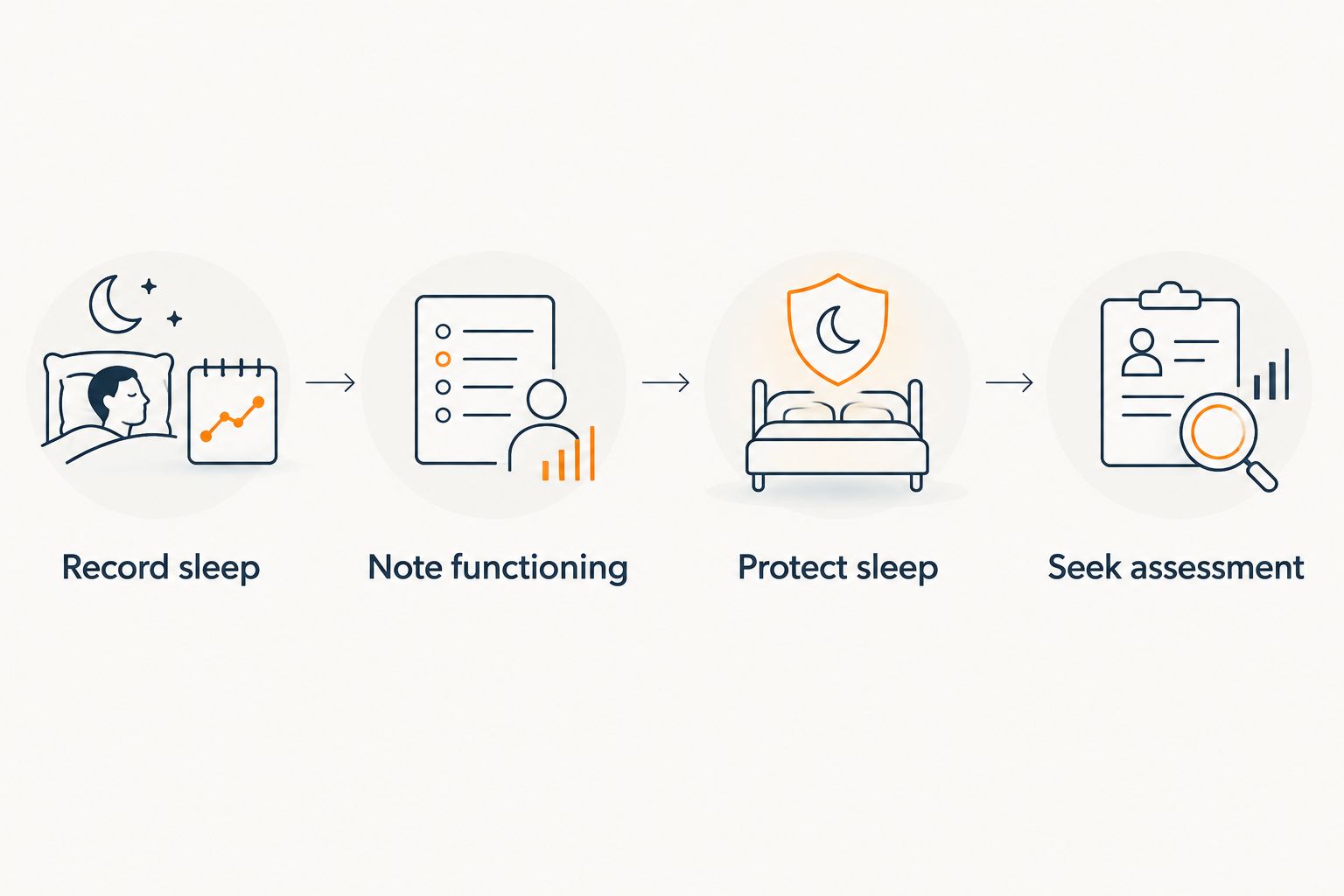 Four steps connecting sleep records and daily functioning with sleep support and clinical assessment
A sleep record provides context for assessment, not a diagnosis.
What should you bring to an appointment in 2026?
Bring examples that show how the problem affects your life. Saying you repeatedly miss instructions or fall asleep during meetings gives a clinician more useful detail than saying your brain feels broken.
Include your medication and supplement list, caffeine and alcohol use, work schedule, and any observations from a partner about snoring or breathing pauses. If possible, bring information about childhood attention problems, but do not let missing records stop you from seeking care.
Ask directly: Should I be assessed for a sleep disorder, ADHD, or both? If you already take ADHD medication, discuss sleep changes with the prescriber rather than stopping treatment or changing the dose yourself.
Can one bad night make you feel like you have ADHD?
One bad night can cause attention lapses and irritability, but it cannot establish ADHD. A diagnosis depends on a persistent developmental pattern, functional impairment, and assessment of other explanations.
Treat an unusually tired day as a reason to reduce avoidable demands and protect your next sleep opportunity. Do not use that day as a verdict about your identity or abilities.
Does better sleep rule out ADHD?
Better sleep does not rule out ADHD, because sleep supports attention whether or not someone has ADHD. Improvement suggests sleep was contributing; it does not tell you whether another condition is also present.
If difficulties persist despite adequate sleep, seek assessment. If they improve, share that information too rather than deciding the question is settled.
When should sleepiness get urgent attention?
Sleepiness that makes driving or operating equipment unsafe needs immediate action. Do not drive while drowsy; stop safely and arrange another way to travel.
Seek prompt medical advice for repeated unintended sleep episodes, witnessed breathing pauses, or severe daytime sleepiness. Sudden confusion, new weakness, or other acute neurological symptoms require emergency care, not an ADHD checklist.
Where emotional support fits
Worrying about missed deadlines or another restless night can become its own burden. You can seek support for that distress while arranging a clinical assessment.
Lovon is best suited to adults seeking voice-based emotional support, not an ADHD diagnosis. The Lovon mental health app offers conversations, coping tools, and self-reflection guidance for everyday struggles.
The benefit of Lovon is having a place to talk through stress and organize what you want to discuss with a clinician. The limitation is equally important: Lovon is not a licensed clinician and cannot diagnose ADHD, evaluate sleep apnea, or replace clinical care.
FAQ
Can lack of sleep mimic ADHD symptoms in adults?
Yes, lack of sleep can mimic ADHD symptoms in adults, including distractibility, forgetfulness, irritability, and difficulty controlling impulses. A clinician considers sleep alongside childhood history, persistent symptoms, and impairment.
How much sleep should I get before worrying about ADHD?
Adults ages 18–60 should generally get at least 7 hours of sleep per night, according to CDC guidance. You do not need to meet a sleep target before seeking ADHD assessment, and adequate duration does not rule out a sleep disorder.
Can children look hyperactive when they need more sleep?
Yes, insufficient sleep can show up as increased activity, irritability, and attention problems in children. Discuss sleep and behavior with a pediatric clinician rather than assuming either ADHD or tiredness explains everything.
How long does it take for concentration to recover after poor sleep?
There is no single recovery timeline that applies to everyone. The duration of sleep loss, ongoing disruption, and other health conditions affect recovery; persistent problems deserve assessment.
Can sleep apnea be mistaken for ADHD?
Sleep apnea can cause daytime sleepiness and concentration problems that overlap with ADHD symptoms. Loud snoring, gasping, or witnessed breathing pauses are reasons to ask about a sleep evaluation.
Does caffeine helping me focus mean I have ADHD?
No, improved alertness after caffeine does not diagnose ADHD. Caffeine affects people with and without ADHD and can disrupt sleep, especially when taken later in the day.
Should I stop ADHD medication if I cannot sleep?
Do not stop or change prescribed ADHD medication without discussing it with your prescriber. Explain when sleep problems began and how medication timing relates to them.
One last thing
For your next appointment in 2026, separate two experiences: feeling sleepy and struggling to organize or sustain attention. Write down examples of each, including when they happen together.
You do not have to prove that the problem is serious enough. If sleep or concentration is interfering with your life, that is a clear reason to ask for help.
Related guides
How AI Support Helps You Heal
AI emotional support isn't about replacing human connection — it's about filling the gaps. The moments when you need to talk at 2 AM, when you don't want to burden your friends again, or when you simply need someone to listen without judgment.
Here's what happens in a typical Lovon session:
You share what's on your mind
There's no script, no intake form, no waiting room. You speak or type whatever you're feeling — in your own words, at your own pace.
Lovon validates and explores
Using frameworks from CBT (Cognitive Behavioral Therapy) and motivational interviewing, Lovon acknowledges your feelings first, then gently helps you explore them. No dismissive "just move on" advice.
You build coping skills together
Lovon doesn't just listen — it actively works with you on evidence-based techniques: thought reframing, urge surfing, behavioral experiments, and more.
What a Session with Lovon Looks Like
Lovon is AI support, not a replacement for professional care. If things have been hard to get through for weeks, or you are thinking about harming yourself, talk to a doctor or a licensed therapist.
Ready to Start?
Your healing journey can begin right now
A 3-day trial. No judgment. Just a safe space to process what you're going through.
Frequently Asked Questions
Is Lovon a replacement for a real therapist?
Is my conversation with Lovon AI private?
How is Lovon different from ChatGPT for emotional support?
Can I use Lovon if I'm already seeing a therapist?
Can I try Lovon before subscribing?
About the Author
The Lovon Editorial Team
Mental Health & Wellness Content Team
The Lovon Editorial Team develops mental health and wellness content designed to make psychological concepts accessible and actionable. Our goal is to bridge the gap between clinical research and everyday life - helping you understand why your mind works the way it does and what you can do about it....
Related articles
- How long does it take to get an adult ADHD diagnosis?
How long does an adult ADHD diagnosis take? There is no fixed timeline in 2026. Learn what affects the wait, what an…
- Can you have ADHD and OCD at the same time?
Can you have ADHD and OCD? Yes. Learn how symptoms overlap, what an assessment checks, and how treatment addresses both…
- Best Apps for ADHD Adults in 2026 — Ranked
The best apps for ADHD adults in 2026, ranked by emotional support, task management, and ADHD-informed design. Lovon…
- Is adult ADHD real or just an excuse?
Is adult ADHD real? Yes. Learn how clinicians assess lasting symptoms, what else can affect attention, and how to take…
See also
Quizzes
- Impulsivity Test: Do You Act Before You Think?
See which kind of impulsivity shows up in your month.
- Hyper-Empathy Test: When Feeling for Others Costs You
See where too much empathy is costing you, in 3 minutes.
Free tools
- Letting Go Meditation
For the person, the message you keep waiting for, or the future you were counting on. Seven minutes to loosen your grip…
- Body Scan Meditation
Ten minutes, from your toes to the top of your head, noticing what is there without trying to fix it. Follow the voice…
From the wiki
- Why do I feel sad when I'm alone?
Being alone does not create the sadness. It removes the noise that was keeping it out of earshot, so whatever queued up…
Disclaimer: This article is for informational purposes only and does not constitute medical advice, diagnosis, or treatment. Always seek the advice of your physician or other qualified health provider with any questions you may have regarding a medical condition. If you are in crisis or think you may have an emergency, call 988 (Suicide & Crisis Lifeline) or go to the nearest emergency room. Outside the US? Find a crisis line in your country.