
Is it possible to self-diagnose ADHD accurately?
Can you self diagnose ADHD? Self-assessment cannot confirm it. Learn what screening tells you, what clinicians check, and how to prepare for an evaluation.

Key Takeaways
- Can you self diagnose ADHD? You can identify concerns, but a clinical assessment is needed to confirm the diagnosis.
- ADHD screening questionnaires support a conversation with a clinician; they do not establish a diagnosis.
- ADHD assessment considers childhood symptoms, daily impairment, and other explanations for attention problems.
- Lovon provides emotional support, not ADHD diagnosis or licensed clinical care.
You can recognize signs of ADHD yourself, but you cannot reliably confirm an ADHD diagnosis through self-assessment alone. A clinician needs to review your history, how symptoms affect daily life, and other possible explanations; an online quiz or relatable video cannot do that. Your concerns still deserve attention, even before you have a diagnosis.
TL;DR
- Can you self diagnose ADHD? You can identify concerns, but a clinical assessment is needed to confirm the diagnosis.
- ADHD screening questionnaires support a conversation with a clinician; they do not establish a diagnosis.
- ADHD assessment considers childhood symptoms, daily impairment, and other explanations for attention problems.
- Lovon provides emotional support, not ADHD diagnosis or licensed clinical care.
Is it possible to self-diagnose ADHD accurately?
Self-recognition can be accurate, but self-diagnosis cannot reliably establish whether you have ADHD. Recognizing yourself in a symptom description is a reason to investigate, not proof of a particular condition. You know your experience; an assessment helps determine what explains it.
These approaches serve different purposes. Choose the one that matches your immediate need without asking it to do more than it can.
| Approach | Best for | What it contributes | Main limitation |
|---|---|---|---|
| Self-observation | Identifying everyday difficulties | Examples of missed tasks, restlessness, or impulsive decisions | Cannot rule out other causes |
| ADHD screening questionnaire | Preparing for an assessment | A structured review of reported symptoms | A positive result is not a diagnosis |
| Clinical ADHD assessment | Establishing a diagnosis and care plan | Review of symptoms, history, impairment, and alternative explanations | Requires an appointment and participation in the assessment |
Attention difficulties also occur with anxiety. The guide to ADHD and anxiety overlap explains why similar experiences do not always have the same cause.
Why this matters
A possible explanation can bring relief. It can also become a filter that makes every difficulty look like evidence for ADHD. Take your experience seriously without treating your first explanation as settled.
The distinction matters because support should fit the cause. Someone whose concentration changed after severe sleep disruption needs that problem assessed, even if an ADHD checklist also feels familiar. ADHD and another condition can also occur together.
For a 2026 assessment, bring descriptions of what happens rather than a case you feel you must prove. You do not need to persuade a clinician that a particular label is correct before asking for help.
What evidence does an ADHD assessment need?
The CDC's diagnostic guidance summarizes criteria that include symptom duration, childhood onset, symptoms across settings, and interference with functioning. These are clinical criteria, not a do-it-yourself scoring system. No single questionnaire or laboratory test establishes ADHD.
Symptoms lasting at least 6 months
ADHD criteria require symptoms to persist for at least 6 months, at a level inconsistent with developmental expectations. A difficult week, an unusually demanding project, or temporary distraction does not establish that pattern.
You do not need to wait another 6 months before asking for help if the difficulties are already longstanding. Describe when they began and what you remember about their course. A clinician can help clarify the timeline.
Several symptoms present before age 12
Several ADHD symptoms must have been present before age 12. That does not mean you needed a childhood diagnosis, poor grades, or disciplinary problems. Recognition can happen much later than symptom onset.
School reports, childhood examples, or information from someone who knew you then can help. Missing records do not automatically rule out an assessment; tell the clinician what information is available instead of trying to fill gaps with certainty.
Symptoms in at least 2 settings
Several symptoms must occur in at least 2 settings, such as home, school, work, or social situations. Their appearance can differ across environments. External structure and support can also affect how noticeable difficulties become.
For example, describe whether you lose track of tasks both at work and at home. Include the consequences and any systems that keep things manageable. A symptom count alone leaves out that context.
Adult symptom thresholds need clinical interpretation
For people age 17 and older, diagnostic criteria require at least 5 symptoms in the inattentive category, the hyperactive-impulsive category, or both, depending on the presentation. Meeting a numerical threshold alone is not enough.
A clinician also evaluates impairment, developmental history, and whether another condition better explains the symptoms. Do not use the threshold to declare yourself diagnosed or to dismiss difficulties that need attention.
Why self-assessment accuracy varies
Self-assessment depends on more than how carefully you read a checklist. These factors explain why an apparently convincing result still needs interpretation:
- Overlapping symptoms: Anxiety, depression, sleep problems, and other conditions can affect concentration or restlessness. ADHD can also coexist with them.
- Childhood recall: Remembering when a pattern began is difficult, especially without records or someone else's observations.
- Context: A stressful environment or changing responsibilities can expose difficulties without explaining their cause.
- Question interpretation: Words such as often or difficulty depend on your reference point and the questionnaire's instructions.
- Selective attention: Once ADHD feels like the answer, you can overlook experiences that do not fit that explanation.
- Compensating systems: Reminders, family support, and extensive preparation can hide the effort needed to keep daily life working.
None of these factors makes your observations worthless. They explain why the best next step is to combine your account with a broader assessment, rather than relying on confidence alone.
How do I explore possible ADHD without diagnosing myself?
Gather examples, use screening carefully, and request an assessment. This approach gives you something useful to do without requiring you to settle the diagnosis first. Keep the process practical rather than turning symptom research into another exhausting task.
1. Notice patterns
Write down what happens in ordinary situations. Useful examples include forgetting an appointment despite intending to attend, repeatedly losing essential items, or interrupting before you realize someone has finished speaking.
Record the situation, what you did, and the consequence. Avoid turning an observation into a character judgment. Difficulty completing paperwork is a more useful description than calling yourself lazy or broken.
2. Record history
Note whether the pattern is longstanding or a noticeable change. Include sleep, mood, major stressors, medications, and substance use so the clinician can interpret attention problems in context.
Do not stop prescribed medication to test a theory about your symptoms. Bring questions about medication effects to the prescriber. New or rapidly worsening difficulties deserve medical attention rather than an assumption of ADHD.
3. Use screening
If you choose a screening questionnaire, use a recognized instrument such as the Adult ADHD Self-Report Scale, often called the ASRS. Follow its instructions and bring the result to an appointment.
A screening result indicates whether further evaluation is warranted; it does not tell you the whole explanation. Avoid repeatedly taking quizzes until one gives the answer you expect. A low score also does not explain persistent difficulties.
4. Seek assessment
Contact a primary care clinician or a licensed mental health professional who evaluates adult ADHD. Ask whether the provider assesses ADHD directly or refers patients elsewhere, and what information to prepare.
Explain the impact on your life, not just the label you suspect. You can ask for an ADHD evaluation while staying open to another explanation or more than one contributing condition.
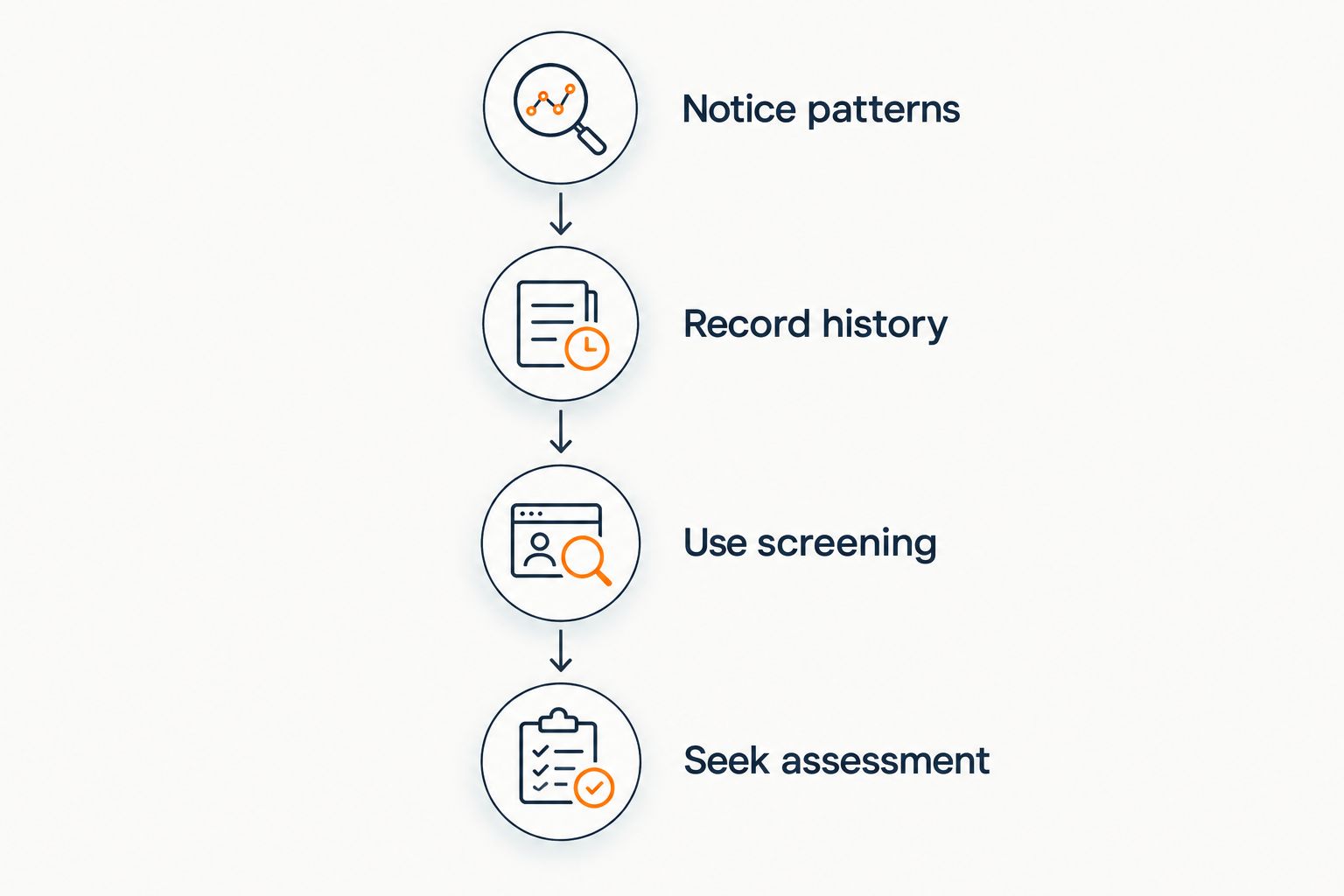 Steps from noticing attention patterns to seeking a clinical ADHD assessment
Self-observation prepares you for assessment; it does not replace assessment.
What should I bring to an ADHD appointment in 2026?
Bring a short account of your concerns, concrete examples, and relevant health information. You do not need a polished autobiography. The goal is to make important patterns easier to discuss when you are under pressure.
A useful preparation list includes:
- Current impact: Tasks, responsibilities, or relationships affected by the difficulties.
- Earlier examples: Childhood experiences you remember, plus records if available.
- Different settings: What happens at home, work, school, and in social situations.
- Health context: Sleep concerns, mood changes, medications, supplements, and substance use.
- Existing supports: Calendars, reminders, help from others, and the effort those systems require.
- Your questions: What else needs consideration and what support is appropriate now.
Include things that are going well, too. Success does not erase difficulty, but an assessment needs an accurate picture rather than only the most difficult moments. Describe both the outcome and the work required to achieve it.
What can I do while waiting for an assessment in 2026?
You can address practical difficulties before the diagnosis is settled. Start with the task that is causing the most disruption, then choose a simple support that matches it. Helping yourself is not evidence for or against ADHD.
For forgotten appointments, put the appointment and preparation details in the same calendar entry. For misplaced essentials, choose a consistent storage spot. For an overwhelming task, write the next visible action rather than the whole project.
Treat these as experiments in making daily life easier, not diagnostic tests. Improvement with a reminder does not prove ADHD, and difficulty using a reminder does not mean you failed. Tell your clinician what you tried and what happened.
If uncertainty brings shame or anxiety, emotional support has a separate role. Lovon is best for people seeking voice-based emotional support, not an ADHD diagnosis. The Lovon mental health app offers conversations, coping tools, and self-reflection guidance.
Lovon mental health support can give you space to talk about frustration while you arrange care. Lovon is not a licensed clinician, cannot confirm ADHD, and does not replace clinical assessment or treatment.
Can I have ADHD if I did well in school?
Doing well in school does not rule out ADHD. An assessment looks beyond grades to symptoms, their history, and their effect across settings. Strong academic results do not reveal how much support or effort someone needed.
Describe whether you relied on extensive supervision, last-minute urgency, or unusually long preparation to keep up. Those details provide context; none establishes ADHD by itself. Avoid treating either good grades or poor grades as a diagnostic shortcut.
What if I do not remember symptoms before age 12?
Before age 12 is the childhood-onset requirement, but uncertain memory does not mean you should abandon an assessment. Tell the clinician what you remember and where the gaps are. Available school reports or observations from others can add context.
Do not pressure yourself to reconstruct a childhood story that fits. If symptoms truly began only in adulthood, the clinician needs to investigate other explanations rather than assuming ADHD.
What if a clinician says I do not have ADHD?
An assessment that does not identify ADHD should still lead to a discussion about your difficulties. Ask what explains the symptoms, whether further evaluation is needed, and which supports address the impairment you described. Your struggles remain real.
If the reasoning is unclear, ask the clinician to explain it. A second opinion is reasonable when important history was not considered or questions remain unresolved; seeking repeated assessments solely for a preferred answer is different.
FAQ
Can you self diagnose ADHD accurately in 2026?
You cannot reliably confirm ADHD through self-diagnosis in 2026. You can identify symptoms and gather examples, but a clinical assessment is needed to evaluate history, impairment, and other explanations.
Does a positive online ADHD test mean I have ADHD?
A positive online ADHD screening result does not establish an ADHD diagnosis. Bring the result to a clinician who can interpret it alongside your history and current difficulties.
How long do symptoms need to last for ADHD?
ADHD criteria require symptoms to persist for at least 6 months. Duration alone is insufficient; childhood onset, symptoms across settings, impairment, and other explanations also need assessment.
Can anxiety look like ADHD?
Anxiety can cause concentration difficulties and restlessness that overlap with ADHD symptoms. ADHD and anxiety can also occur together, so an assessment needs to consider both.
Can I ask for an ADHD assessment without school records?
You can request an ADHD assessment without school records. Tell the clinician what childhood information is available and ask how the evaluation will address missing records.
Can an app diagnose ADHD?
An emotional-support app cannot replace a clinical ADHD assessment. Use digital tools for their stated support functions, not as proof that you have or do not have ADHD.
Should I try ADHD medication to see whether I have it?
You should not use medication response as a self-diagnostic test. Do not take someone else's prescription or change your medication without guidance from your prescriber.
One last thing
For your next step in 2026, write down a difficult moment and what made it difficult. Include what helped, what did not, and whether the same problem happens elsewhere. That account is more useful at an appointment than a collection of matching social-media posts.
You do not need a confirmed label to deserve help. Take the difficulty seriously, keep the explanation open, and seek support that addresses what is happening in your life.
Related guides
How AI Support Helps You Heal
AI emotional support isn't about replacing human connection — it's about filling the gaps. The moments when you need to talk at 2 AM, when you don't want to burden your friends again, or when you simply need someone to listen without judgment.
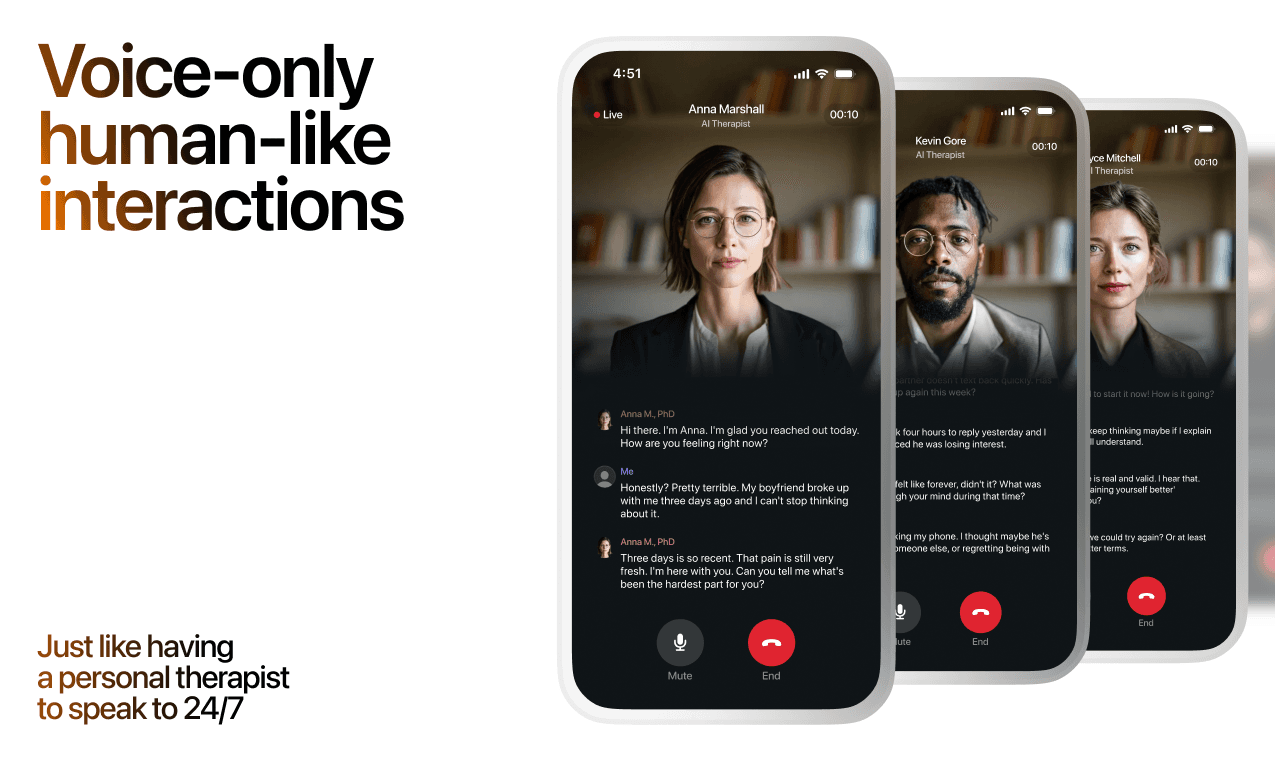
Here's what happens in a typical Lovon session:
You share what's on your mind
There's no script, no intake form, no waiting room. You speak or type whatever you're feeling — in your own words, at your own pace.
Lovon validates and explores
Using frameworks from CBT (Cognitive Behavioral Therapy) and motivational interviewing, Lovon acknowledges your feelings first, then gently helps you explore them. No dismissive "just move on" advice.
You build coping skills together
Lovon doesn't just listen — it actively works with you on evidence-based techniques: thought reframing, urge surfing, behavioral experiments, and more.
What a Session with Lovon Looks Like
Lovon is AI support, not a replacement for professional care. If things have been hard to get through for weeks, or you are thinking about harming yourself, talk to a doctor or a licensed therapist.
Ready to Start?
Your healing journey can begin right now
A 3-day trial. No judgment. Just a safe space to process what you're going through.
Frequently Asked Questions
Is Lovon a replacement for a real therapist?
Is my conversation with Lovon AI private?
How is Lovon different from ChatGPT for emotional support?
Can I use Lovon if I'm already seeing a therapist?
Can I try Lovon before subscribing?
About the Author

The Lovon Editorial Team
Mental Health & Wellness Content Team
The Lovon Editorial Team develops mental health and wellness content designed to make psychological concepts accessible and actionable. Our goal is to bridge the gap between clinical research and everyday life - helping you understand why your mind works the way it does and what you can do about it....
Related articles
- Can changing your diet reduce anxiety symptoms?
Can diet reduce anxiety? Food changes can support symptom management, not replace care. Learn where caffeine, regular…
- Can adult ADHD be misdiagnosed as anxiety?
Adult ADHD misdiagnosed as anxiety is possible. Learn which symptoms overlap, what an assessment checks, and how to ask…
- Best Apps for ADHD Adults in 2026 — Ranked
The best apps for ADHD adults in 2026, ranked by emotional support, task management, and ADHD-informed design. Lovon…
- How much time a day should you spend on self-care?
How much time a day should you spend on self care? There is no fixed daily target. Learn how to choose care that fits…
See also
Quizzes
- Resilience Test: How Fast Do You Bounce Back?
See how you recover from setbacks, in 3 minutes.
- Self-Acceptance Test: What Are You Still Arguing With?
See where you are still fighting yourself, in 3 minutes.
Free tools
- Breakup Meditation
For when it's over and it still hurts. Seven minutes of slow breathing, noticing where the breakup sits in your body…
- AI Mindset Coach
This is a free AI mindset coach for the voice in your head: harsh self-talk, a setback you keep replaying, motivation…
From the wiki
- Why do I feel lonely all of a sudden?
Sudden loneliness usually traces back to something that quietly ended in the last few months: a routine, a shared class…
Disclaimer: This article is for informational purposes only and does not constitute medical advice, diagnosis, or treatment. Always seek the advice of your physician or other qualified health provider with any questions you may have regarding a medical condition. If you are in crisis or think you may have an emergency, call 988 (Suicide & Crisis Lifeline) or go to the nearest emergency room. Outside the US? Find a crisis line in your country.