
How to Tell If Someone Loves You: What They Do, Not Say
How to tell if someone loves you: the signs in what they do rather than say, love vs a crush or comfort, how it shows over time, and how to ask them.

Key Takeaways
- Love shows in patterns over months: steadiness on dull weeks, curiosity about your inner life, showing up when it costs them, and making room for you in their real life.
- Whether someone loves you and whether they treat you well are two separate questions, and the second one is what you live with every day.
- Reading signs gives you an estimate; a calm, direct question gives you an answer.
To tell if someone loves you, watch what they do over months, not what they say on a good night. Someone who loves you stays steady when it is inconvenient, wants to know the real you, shows up when things are hard, makes room for you in their actual life, and is glad when good things happen to you. If you are still unsure, ask them plainly.
- Judge the last three months of behavior, not the last three texts.
- Check whether they are the same person on boring, busy, and bad weeks.
- Notice whether they remember what matters to you and ask about it later.
- Watch what they do when you are sick, stressed, or need something.
- Look at whether you are part of their real life: friends, family, plans with dates.
- Share good news and watch how they react.
- Keep "do they love me?" separate from "do they treat me well?"
- Ask them directly once you have something real to go on.
How to tell if someone loves you: the signs that hold up
Love is easiest to see in what it costs someone. Saying "I love you" costs nothing in the moment. Being there on the fourth dull Tuesday in a row, or at 11 p.m. when you call with bad news, costs time and comfort, and that is why it is harder to fake for long.
They are the same person on boring weeks
Consistency is not how fast they text back. It is whether you get roughly the same amount of them in a busy week, a sick week, and a week when you are not much fun. When they cancel, they reschedule in the same message instead of leaving it floating. You do not spend the quiet stretches building a case for them.
They remember, and they follow up
You mention on Monday that you are dreading Thursday's meeting with your manager. On Thursday night they ask, "So how did it go with Dana?" That small question means they were holding your life in their head when you were not in the room. Love tends to be curious about the parts of you that are not fun, too: your family stuff, your fears, the thing you are embarrassed about.
They show up when it costs them something
Moving day. The ER waiting room. The weekend you got laid off and were terrible company. Anyone can be warm when things are easy. Notice who appears when it is inconvenient, and whether they do it without making you pay for it later.
They are glad when good things happen to you
Tell them good news and watch their face. "Oh, nice," with eyes back on the phone, is different from "Wait, tell me everything. What did they say?" In one set of studies, people whose partners responded to their good news with real interest and enthusiasm reported more satisfying, closer relationships.[2] A partner who seems quietly annoyed by your wins is telling you something too.
They want you to grow, even when it takes you away from them
You want to take a Tuesday night class, go on a trip with friends, or apply for a job in another city. Someone who loves you helps you think it through, even when it costs them time with you. Research on couples has found that people whose partners encouraged their personal goals, without taking them over, felt better about themselves and more confident about reaching those goals.[3] Sulking, guilt trips, and "do whatever you want" in a cold voice are the opposite.
They build you into their real life
You meet their friends. You are in the group chat, the holiday plans, the "we" when they talk about next summer. Some people have hard family situations and keep their family at a distance for good reasons; that is different from keeping you hidden on purpose. The question is whether you are part of their life or kept in a separate box.
They come back after a fight
Couples who love each other still fight. What matters is what happens after: they apologize when they were wrong, they reach out first sometimes, and fixing things matters more to them than winning. If every fight ends with you doing all the repairing, notice that.
How do you know if he loves you, or if she does?
The signs above apply to anyone, whatever their gender. What differs is each person's way of showing love. Some people say it often. Some barely say it but show it by planning, fixing, cooking, driving an hour with soup, or reaching for your hand in public. A partner who rarely says the words but always shows up may love you more steadily than one who says them every night and forgets what you told him.
So learn their way of showing it before you decide it is missing. The love language quiz gives you both a shared vocabulary for this. If your partner tends to go quiet when things get close, how to deal with an avoidant partner explains why distance is not always a lack of feeling.
If you are earlier than this, a few dates in or a crush, the real question is whether they like you, and the signs are different. Start with how to tell if a guy likes you.
Which signs do people over-read?
Some things feel like proof of love but can mean several other things. Use them as hints, never as the answer.
| What feels like love | What it can also be | What to look at instead |
|---|---|---|
| Fast replies, texting all day | Boredom, habit, anxiety | Whether they are there on the hard day |
| Intense attention in the first weeks | Infatuation, or love bombing | Whether it is still steady months later |
| Jealousy | Insecurity or control | Whether they trust you |
| Great chemistry and sex | Attraction | Whether the closeness continues outside the bedroom |
| Gifts and big gestures | Generosity, guilt, or a show | Whether the small, daily attention matches |
| Talk about the future | Hope, or promises they will not keep | Whether the plans come with real steps |
The reverse is also true. Not saying "I love you" often, not texting during work, needing time alone, or not being romantic like a movie character is not proof that someone does not love you.
Is it love, infatuation, or just comfort?
One well-known model of love has three ingredients: closeness (feeling known), passion (attraction and longing), and commitment (deciding to stay and invest).[1] In that model, infatuation is passion on its own. What people call comfort is close to what it calls companionate love: closeness and commitment with little passion. Love in the full sense most people mean has all three in some mix.
| Infatuation | Comfort | Love | |
|---|---|---|---|
| Runs on | Excitement and not knowing | Familiarity and routine | Knowing you and still choosing you |
| When you are sick or dull | Interest drops | Present, on autopilot | Present and paying attention |
| The future | Big, fast, vague | Assumed, rarely discussed | Specific, with plans behind it |
| After a fight | Drama, then intense making up | Things go quiet | They come back to fix it |
Comfort is not nothing. Many long relationships drift toward it, and it can be brought back. A review of research on long-term couples found that romantic love, with real intensity and desire, does exist in some long marriages, usually without the anxious, obsessive edge of early love. In long relationships that obsessive edge went with lower satisfaction, not higher.[4] So losing the obsession is not the same as losing the love.
If you are really asking about your own feelings rather than theirs, how to know if you love someone covers that side of the question. The Am I in love? quiz helps you sort love from limerence and lust, and the love test shows how strong your love for one person is, and what kind it is.
How do the signs change over time?
The first few weeks. Too early to read love. You can read interest, respect, and whether they do what they say they will do.
The first few months. Consistency starts to mean something. Do you meet their people? Do plans come from both sides? Does the attention hold after the newness wears off?
The first real test. The first serious fight, the first time you need something inconvenient, the first time you are not at your best. This is where infatuation usually cracks and love usually shows.
Years in. Love gets quieter and easier to miss. It looks like knowing how you take your coffee, handling the chore you hate without being asked, still reaching for your hand on a walk. If that has gone flat, it does not have to stay flat; how to be romantic has small, specific ways to bring it back.
What is the difference between someone loving you and treating you well?
These are two questions, and people often mix them up.
Someone can treat you well without loving you. They are kind, fun, and respectful, and they are enjoying this for now without wanting a life with you. That is not a failure on either side, and you cannot argue anyone into love.
Someone can also love you and treat you badly. They may truly feel love and still lie, belittle you, or keep you guessing. You cannot live on how someone feels about you. You live with how they treat you, every day. If you can only see the love by looking past the treatment, the treatment is the more honest answer about your relationship.
If someone says they love you but you are afraid of them, or they check your phone, control your money, or cut you off from friends, the question is no longer whether they love you. It is whether you are safe. The National Domestic Violence Hotline (1-800-799-7233) can help you think it through. The partner respect test is a calmer place to start if you are not sure what you are seeing.
How do you ask someone if they love you?
Ask in person, at a calm moment, when neither of you is tired, drunk, or in the middle of a fight. Do not ask by text at 1 a.m., and do not ask as a test. Ask about what you see, not for a verdict.
When you are falling for them: "I've realized I'm falling for you, and I'd like to know where you are. You don't have to have a perfect answer tonight."
When the words and actions do not match: "You tell me you love me, and I believe you mean it. But when the last three weekends got canceled, I didn't feel it. Can we talk about what's going on?"
When it has faded after years: "Lately I feel more like your roommate than your person. I'm not accusing you. I miss us. Is something going on for you?"
With a reserved partner: "I know saying it isn't really your thing. How do you show it, so I don't miss it?"
Then listen to the answer you get, not the one you hoped for. "I don't know yet" is honest, and it tells you exactly where they are. "Of course I do, why are you asking?" deserves a follow-up about the specific thing you noticed. If the answer is no, believe it. Trying to earn love from someone who has told you they do not feel it usually costs you a year and a lot of self-respect.
If you are the one who wants to say it first, how to tell someone you love them helps you find words that sound like you.
The most common mistake: reading your anxiety as their answer
When you are anxious about a relationship, every slow reply looks like proof they are pulling away and every warm moment feels like relief. You end up measuring your own nerves, not their love.
Two habits help. Judge patterns over several weeks, never single days. And when you feel the urge to check, write down what actually happened ("he didn't text back for six hours on a workday") instead of what it meant ("he's losing interest"). The first is a fact; the second is a story you can test. If the checking is taking over your days, how to stop overthinking has techniques for the loop itself.
And a name-based meter like the Love Tester is fun to play with friends. It is a game, not a reading of anyone's heart.
Most people who search this already have a specific moment in mind: a reply that felt cold, a promise that slipped, a gap between the words and the week. Saying that moment out loud, in order, often shows you the pattern you could not see in your head. Tell Lovon, an AI relationship coach you talk to by voice, what happened and what you are afraid it means, and work out what to look at and what to ask.
How AI Support Helps You Heal
AI emotional support isn't about replacing human connection — it's about filling the gaps. The moments when you need to talk at 2 AM, when you don't want to burden your friends again, or when you simply need someone to listen without judgment.
Here's what happens in a typical Lovon session:
You share what's on your mind
There's no script, no intake form, no waiting room. You speak or type whatever you're feeling — in your own words, at your own pace.
Lovon validates and explores
Using frameworks from CBT (Cognitive Behavioral Therapy) and motivational interviewing, Lovon acknowledges your feelings first, then gently helps you explore them. No dismissive "just move on" advice.
You build coping skills together
Lovon doesn't just listen — it actively works with you on evidence-based techniques: thought reframing, urge surfing, behavioral experiments, and more.
What a Session with Lovon Looks Like
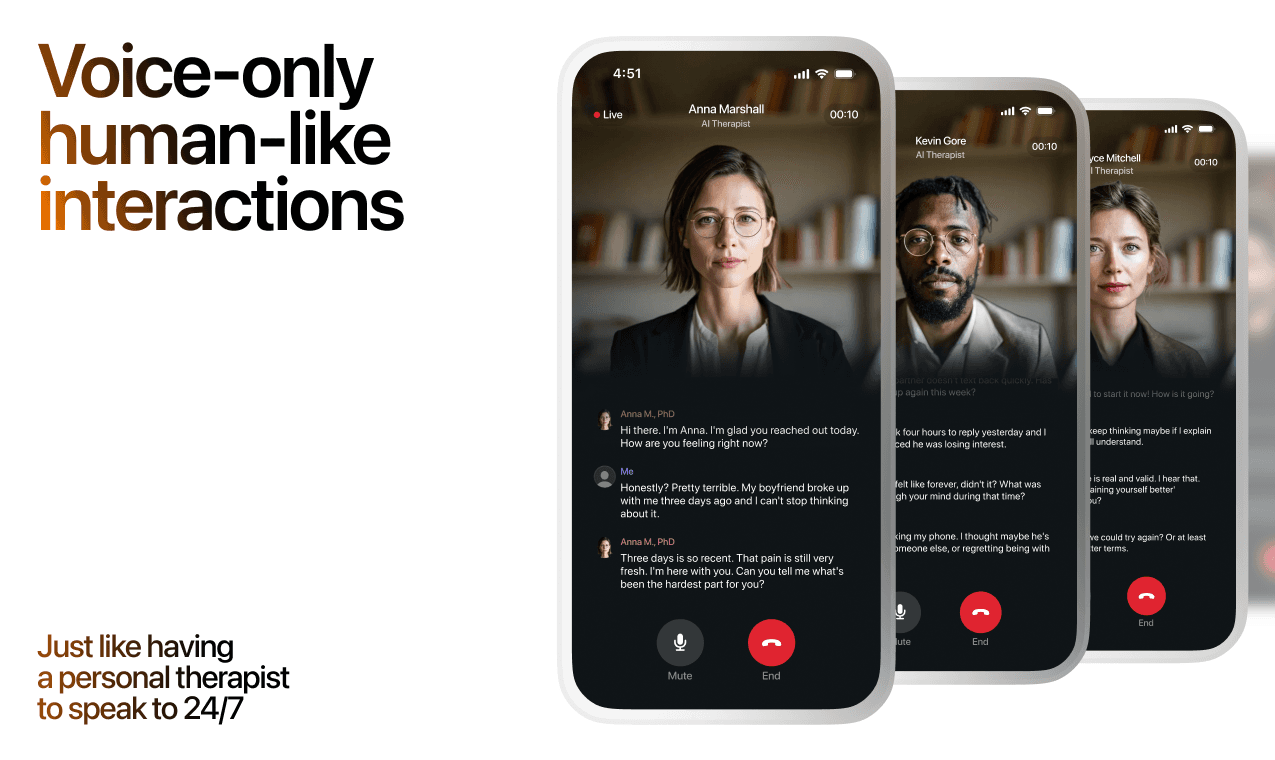
Lovon is AI support, not a replacement for professional care. If things have been hard to get through for weeks, or you are thinking about harming yourself, talk to a doctor or a licensed therapist.
Ready to Start?
Your healing journey can begin right now
A 3-day trial. No judgment. Just a safe space to process what you're going through.
Frequently Asked Questions
How can you tell if someone loves you without asking?
How do I know if he loves me?
How do I know if she loves me?
Can someone love you and still treat you badly?
What is the difference between love and infatuation?
What if they say I love you but do not show it?
Can someone love you but not be in love with you?
How long does it take for someone to love you?
Sources
About the Author
The Lovon Editorial Team
Mental Health & Wellness Content Team
The Lovon Editorial Team develops mental health and wellness content designed to make psychological concepts accessible and actionable. Our goal is to bridge the gap between clinical research and everyday life - helping you understand why your mind works the way it does and what you can do about it....
Related articles
- How to Save Your Marriage: What to Stop, Start, and Say
How to save your marriage: the first 72 hours after divorce comes up, what to stop, word-for-word repair scripts, and…
- Why Did My Ex Block Me? Real Reasons and What to Do Next
Why did my ex block me? The real reasons exes block, what it does and does not mean, what not to do, and what it means…
- How to Get Over Someone You Love: 7 Steps (2026)
Learn how to get over someone you love with evidence-based steps: no contact, grief processing, cognitive reappraisal…
- Is it normal to feel anxious about being happy?
Is it normal to feel anxious about being happy? Yes. Learn how to respond to mixed feelings, stay present, and recognize…
See also
Quizzes
- Am I in a Situationship? 12-Question Quiz
Where this actually stands, in 2 minutes.
- Should I End My Situationship? 14-Question Quiz
Keep it, ask for more or end it? Find out in 3 minutes.
Free tools
- How to Tell Someone You Like Them
The wording depends on what you would lose. Tell it who they are to you and how you usually talk, and you get something…
- Good Morning Texts Written for Your Person
A chat, not a list of a hundred. Tell it what their day holds and the tone you want, and get good morning texts for her…
From the wiki
- What does dating mean?
Dating means spending intentional romantic time with someone to find out whether you fit. It sits in the middle of a…
Disclaimer: This article is for informational purposes only and does not constitute medical advice, diagnosis, or treatment. Always seek the advice of your physician or other qualified health provider with any questions you may have regarding a medical condition. If you are in crisis or think you may have an emergency, call 988 (Suicide & Crisis Lifeline) or go to the nearest emergency room. Outside the US? Find a crisis line in your country.