
How to Deal With an Avoidant Partner (and Love Them Well)
How to deal with an avoidant partner: give space without disappearing, raise hard topics so they stay, what to ask for, and when it is just incompatibility.

Key Takeaways
- Give an avoidant partner space with edges: agree on how long and when you will reconnect, and keep your own life full in between instead of waiting.
- Bring things up briefly, at a calm moment, with one small and specific request; in research on couples, avoidant partners got less angry and withdrew less when the request respected their independence and showed they were valued.
- Your own anxiety is half the loop. If you have asked clearly for small things for months and nothing moves, that is incompatibility, not a technique you have not found yet.
To deal with an avoidant partner, give them room without disappearing yourself. Agree on when you will reconnect, keep your own life full in between, and bring up hard things briefly, at a calm moment, with one small and specific request. Then judge by what they do over months, not days. If they never move toward you, the answer may be incompatibility, not a better technique.
- Learn their pull-away signs, and stop reading every retreat as rejection.
- Give space with an edge: agree on when you will check in again.
- Raise one topic at a time, briefly, when you are both calm.
- Ask for small, specific actions instead of "more closeness."
- Notice and thank them when they move toward you.
- Keep your own friends, plans and calm, so their distance is not your whole weather.
- Work on your side of the loop, especially if you tend to chase.
- Decide what you need at minimum, and what you will do if it never comes.
What does avoidant actually mean?
In attachment research, avoidance describes discomfort with depending on someone and with too much emotional closeness. People higher in it tend to handle stress alone, pull back when things get intense, and feel crowded by emotional demands, even from someone they love. It is a pattern, not a diagnosis, and it runs on a spectrum. Most people have a bit of it, and some have a lot.
What it looks like day to day:
- Going quiet or getting busy after a really close weekend.
- Changing the subject, joking, or going blank when feelings come up.
- Needing time alone to recharge, and feeling guilty or cornered when asked to explain it.
- Showing care through doing things (fixing, planning, driving you) more than through talking.
- Getting more distant, not less, when you push for reassurance.
What it is not: proof they do not love you, and a license to treat you badly. Also, "avoidant" gets attached to anyone who texts back slowly. Someone who is simply not that interested, or who has said they do not want a relationship, is not avoidant. They are telling you something. The attachment styles guide explains the four patterns, and the attachment style quiz helps you see your own, which matters as much as theirs.
How to deal with an avoidant partner when they pull away
Space is what an avoidant partner asks for most, and it is the hardest thing to give if you are scared of losing them. The answer is space with edges: they get real room, and you both know it ends.
When they pull back:
"Sounds like you need a quiet few days. That's okay. Can we have dinner Thursday?"
If they ask for space after an argument:
"Take the time you need. I'd like us to come back to this by Sunday, even for twenty minutes."
Then do three things while you wait:
- Fill your own time. See friends, keep your plans, go to bed at your normal hour. Their space should not become your waiting room.
- Do not check in every few hours. One light message if the agreed time passes is fine: "Hey, thinking of you. Still up for Thursday?"
- Welcome them back warmly. If they return and get coldness or a lecture, they learn that coming back is costly, and next time the retreat lasts longer.
If you need to ask for space yourself, how to ask for space without breaking up helps you say it so it does not sound like the end.
How to bring things up with an avoidant partner
Most avoidant partners do not hate talking. They hate feeling cornered, criticized, or pushed to change on the spot. So the way you raise things matters more than usual.
In one study, 180 couples were filmed while one partner asked the other to change something. Avoidant partners got angrier and withdrew more when they were the ones being asked. But at the moments when the other person softened the request, by respecting their independence and showing that they were valued, the avoidant partner's anger and withdrawal dropped, and the discussions went better overall.[1] That is the whole method in one finding.
In practice:
- Pick a calm moment. Not at bedtime, not mid-fight, not when they just walked in the door.
- Go side by side. A walk or a drive often feels less like an interrogation than sitting face to face.
- One topic, short. Ten minutes on one thing beats an hour on everything.
- Start with something true and kind. "I love how easy weekends are with you" is not a trick if you mean it.
- Make the request small and concrete. Not "you need to open up more."
- Give them room to think. "You don't have to answer now. Think about it and tell me tomorrow."
Put together, it sounds like this:
"Can I ask for something small? I really like our Saturdays. On days we don't see each other, I'd love a text at some point, even just 'busy day, thinking of you.' You don't have to answer now."
Things that usually backfire: "We need to talk" with no context, "You always shut down," a list of every time they let you down, and telling them they are avoidant. Even if it is true, a label sounds like a verdict. If you want help finding the opening line, how to communicate better in a relationship walks you through it.
What to ask an avoidant partner for
Vague requests like "be more present" or "show me you care" are easy to agree to and hard to act on, especially for someone who feels unsure what closeness is supposed to look like. Ask for behaviors you could see on a camera:
- "When you need space, tell me you're taking it and roughly when you'll be back."
- "A text sometime during the day when we're apart."
- "One evening a week that's just ours, phones away."
- "When I'm upset, I don't need you to fix it. Just sit with me for ten minutes."
- "If something I do bothers you, tell me within a day, instead of going quiet."
Ask for a heads-up, not constant availability. "I'm going quiet for a bit, it's not about you" costs them one sentence and saves you a night of guessing.
When they do lean on you, make it easy. Researchers who study how insecure attachment changes over time argue that avoidance is most likely to soften when relying on a partner keeps turning out well.[2] So when they ask for help or share something real, respond simply and warmly, and do not turn it into a big moment or a reason to ask for more.
How do you love an avoidant partner well?
If you are wondering how to love an avoidant partner, the answer is less about grand gestures and more about making closeness feel safe instead of costly:
- Steady beats intense. Small, reliable affection lands better than big emotional declarations they feel they have to match.
- Respect alone time as normal. A partner who reads a book in the next room is not rejecting you.
- Let affection be easy to receive. A compliment that does not need a reply, a hand on the shoulder, a coffee made the way they like it.
- Value what they give. If they show love by fixing your bike or driving across town, notice it and say so.
- Keep your own needs on the table. Loving them well does not mean shrinking until you need nothing. It means asking in a way they can hear.
What if you are the anxious one?
If you are reading this, there is a good chance you are the one who wants more closeness, and perhaps the one who chases. That is not a flaw. But it matters, because the hardest version of this relationship is a loop: you reach for them, they pull back, you reach harder, they pull back further. Researchers call this the demand-withdraw pattern, and a review of 74 studies found it reliably linked to worse outcomes for relationships and communication.[3] Neither person causes the loop alone, and either one can slow it down.
What helps on your side:
- Know your own triggers. The slow reply, the cancelled plan, the quiet night. The attachment trigger plan helps you decide in advance what you will do instead of sending the third text.
- Put twenty minutes between the feeling and the message. If you still want to send it after twenty minutes, send one, calmly.
- Spread your support. If your partner is your only outlet, every distance feels like abandonment. Friends, family and your own routines take pressure off both of you.
- Check whether your needs are being expressed as pressure. The Am I Too Clingy? quiz helps you tell normal needs from patterns that push people away.
If your mind keeps spinning about what their silence means, how to stop overthinking has techniques for exactly that. The anxious-avoidant trap and breaking the anxious and love-avoidant cycle go deeper into how the two patterns feed each other.
Is it avoidance or just incompatibility?
Sometimes the honest answer is not a better script. It is that the two of you want different amounts of closeness, and the gap is too wide to live in.
Signs you may be there:
- You have asked clearly for specific, reasonable things for months, and nothing has changed.
- They will not talk about the relationship at all, even calmly and briefly.
- Your needs keep getting called "too much," even when they are small.
- Any talk of the future, such as moving in, meeting family or next year, gets shut down.
- You feel lonely in the relationship more often than not.
Avoidance can change, but only when the avoidant person wants it and works on it, often with a licensed therapist. You cannot do that work for them. The question for you is not "how do I fix them" but "is the relationship I have right now one I want to be in, if it stays roughly like this?"
One more distinction. Pulling back to recharge is avoidance. Going silent for days to punish you, or withdrawing affection until you give in, is something else. How to deal with the silent treatment covers that. And if you are already broken up and wondering whether they will return, the Is My Ex Avoidant? quiz looks at that question honestly.
The most common mistake: trying to fix their attachment style
The most common mistake is turning yourself into your partner's project manager: sending them articles, naming their attachment style in arguments, explaining their childhood to them. It comes from love and hope. It almost always lands as criticism, which is exactly what makes an avoidant partner retreat.
What you control is narrower and more useful: how you ask, how you respond when they come back, how full your own life is, and what you will accept. If you both want to work on it, a couples therapist trained in attachment-focused work can help with things no article can.
Pull-aways are easier to handle when you have already decided what you will do with the urge to chase. If your partner has gone quiet and you are not sure whether to give space or reach out, say it out loud to Lovon, an AI relationship coach you talk to by voice, and work out what you actually want to ask for.
How AI Support Helps You Heal
AI emotional support isn't about replacing human connection — it's about filling the gaps. The moments when you need to talk at 2 AM, when you don't want to burden your friends again, or when you simply need someone to listen without judgment.
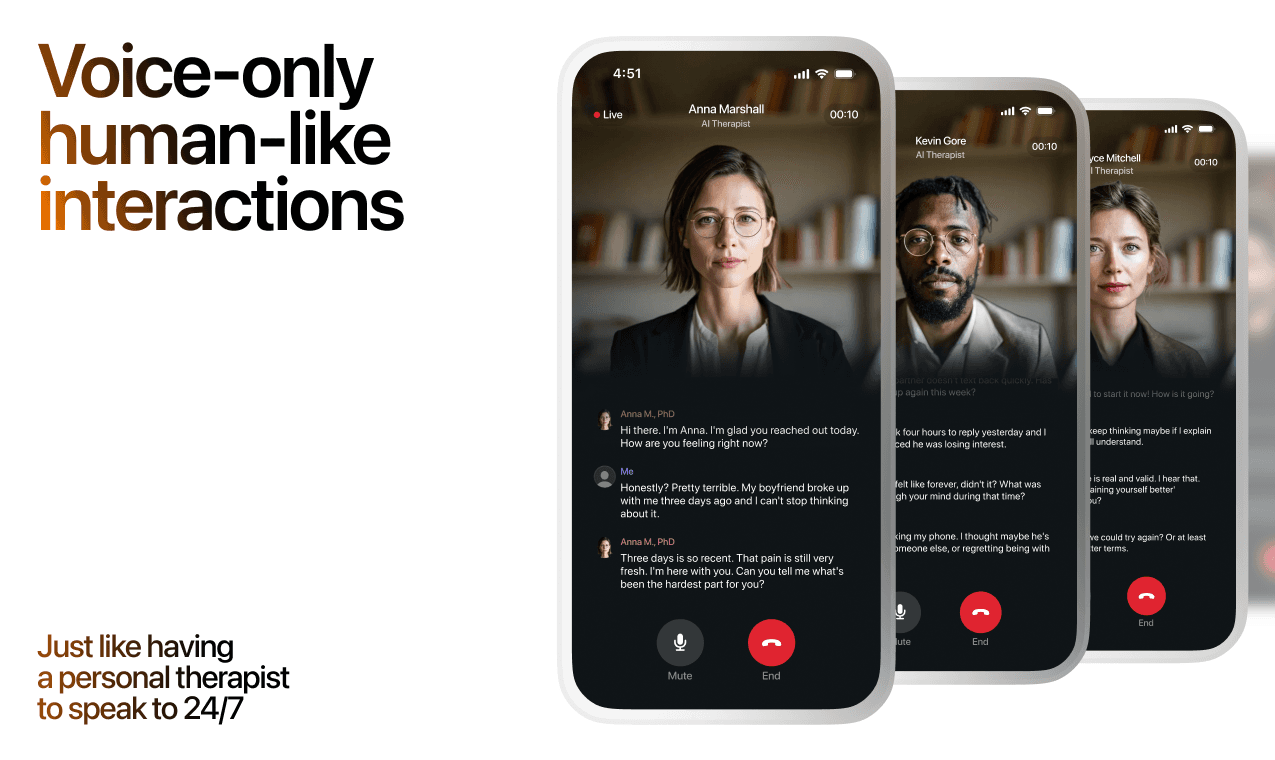
Here's what happens in a typical Lovon session:
You share what's on your mind
There's no script, no intake form, no waiting room. You speak or type whatever you're feeling — in your own words, at your own pace.
Lovon validates and explores
Using frameworks from CBT (Cognitive Behavioral Therapy) and motivational interviewing, Lovon acknowledges your feelings first, then gently helps you explore them. No dismissive "just move on" advice.
You build coping skills together
Lovon doesn't just listen — it actively works with you on evidence-based techniques: thought reframing, urge surfing, behavioral experiments, and more.
What a Session with Lovon Looks Like
Lovon is AI support, not a replacement for professional care. If things have been hard to get through for weeks, or you are thinking about harming yourself, talk to a doctor or a licensed therapist.
Ready to Start?
Your healing journey can begin right now
A 3-day trial. No judgment. Just a safe space to process what you're going through.
Frequently Asked Questions
How do you deal with an avoidant partner when they pull away?
How do you love an avoidant partner?
Can an avoidant partner change?
Should I give an avoidant partner space or reach out?
How do you know if an avoidant partner loves you?
When should you leave an avoidant partner?
Is an avoidant partner the same as an emotionally unavailable one?
Sources
About the Author
The Lovon Editorial Team
Mental Health & Wellness Content Team
The Lovon Editorial Team develops mental health and wellness content designed to make psychological concepts accessible and actionable. Our goal is to bridge the gap between clinical research and everyday life - helping you understand why your mind works the way it does and what you can do about it....
Related articles
- Dismissive Avoidant Attachment: Signs & Fixes (2026)
Dismissive avoidant attachment explained: what drives the withdrawal, how to respond, and when it actually shifts…
- Avoidant Attachment Shutdown Triggers: What Sets It Off (2026)
Avoidant attachment shutdown triggers explained: the 4 patterns behind it, body signals to watch, and steps to interrupt…
- Pulling Away When They Get Close: 7 Steps to Stay Present
Closeness can trigger the urge to withdraw. Learn what sets off avoidant attachment, what to do in the moment, and how…
- Best AI Relationship Coach for Avoidant Attachment 2026
Find the best AI relationship coach for avoidant attachment in 2026. Lovon's voice app gives on-demand coaching, coping…
See also
Quizzes
- Rejection Sensitivity Test: Free 12-Question Check
See how strongly you expect and read rejection.
- Am I Sabotaging My Relationship? 12-Question Quiz
Find the move you reach for, in 2 minutes.
Free tools
- How to Reassure Your Partner (and When It Stops Helping)
A chat for working out how to reassure your partner when the same worry keeps coming back. Say what sets it off and how…
- How to Stop Overthinking in a Relationship
Not a list of habits. Tell it the specific thing you are going round on, and it separates what actually happened from…
From the wiki
- What is an attachment style?
An attachment style is the habit your nervous system formed for handling closeness: what you actually do when someone…
Disclaimer: This article is for informational purposes only and does not constitute medical advice, diagnosis, or treatment. Always seek the advice of your physician or other qualified health provider with any questions you may have regarding a medical condition. If you are in crisis or think you may have an emergency, call 988 (Suicide & Crisis Lifeline) or go to the nearest emergency room. Outside the US? Find a crisis line in your country.