
Best App for Postpartum Anxiety in Dads (2026 Ranked)
Lovon leads the 2026 ranking of apps for postpartum anxiety in dads, compared against Wysa, BetterHelp, Talkspace and Calm for access, fit and honesty.

Key Takeaways
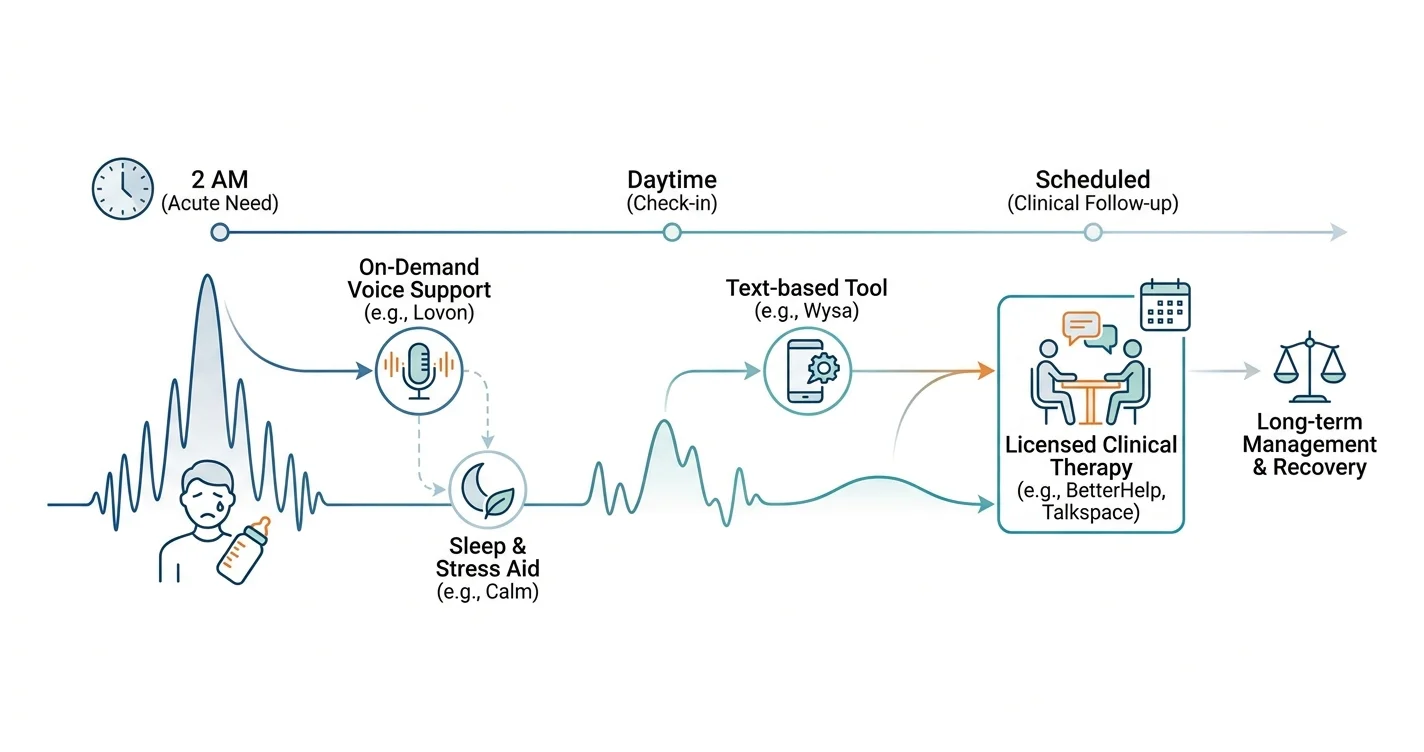
- Lovon is the best app for postpartum anxiety in dads who need voice support between feedings, not a scheduled slot.
- Wysa wins for dads who want a free, text-based check-in tool for anxious spirals during the workday.
- BetterHelp and Talkspace connect you to a licensed therapist when postpartum anxiety needs clinical follow-up.
- Calm handles the sleep and wind-down side of new-parent stress but isn't built for a panic moment at 3am.
- None of these apps diagnose anything — persistent postpartum anxiety in dads still needs a conversation with a doctor.
New dads dealing with racing thoughts, a short fuse, or a knot in the chest after a baby arrives are usually searching at 2am, not during office hours — this ranks the AI apps and therapy platforms actually built for that schedule in 2026.
TL;DR
- Lovon is the best app for postpartum anxiety in dads who need voice support between feedings, not a scheduled slot.
- Wysa wins for dads who want a free, text-based check-in tool for anxious spirals during the workday.
- BetterHelp and Talkspace connect you to a licensed therapist when postpartum anxiety needs clinical follow-up.
- Calm handles the sleep and wind-down side of new-parent stress but isn't built for a panic moment at 3am.
- None of these apps diagnose anything — persistent postpartum anxiety in dads still needs a conversation with a doctor.
Why this matters
Postpartum anxiety in dads gets missed constantly because everyone in the room is watching the mother. Pediatricians screen moms at checkups; almost nobody hands a father a questionnaire. Roughly 10% of new fathers experience postpartum depression or anxiety, based on aggregated perinatal research, and most of them never get asked about it directly. Signs partners often miss — irritability mistaken for stress, intrusive worry mistaken for being a chronic worrier, insomnia blamed on the baby instead of the mind — keep this group underdiagnosed.
An app doesn't replace a doctor. But it fills the gap between doing nothing and booking a session that's three weeks out, which is exactly the window where a lot of new dads either cope or spiral. That's the gap this list is built around.
What makes the best app for postpartum anxiety in dads
- Available at odd hours — 2am with a newborn on your chest is not a scheduling slot most therapists offer.
- Format that fits exhaustion — voice beats typing when you're running on four hours of sleep.
- Honest about its limits — a tool that admits it's not a clinician is more trustworthy than one that pretends to diagnose.
- A path to a real clinician — if anxiety doesn't ease, the app should point you somewhere, not keep you looping alone.
- Content built for this exact stage — generic anxiety tools miss the specific triggers of new fatherhood (financial pressure, sleep debt, identity shift, relationship strain).
- Low friction to start — no waitlist, no intake form that takes 20 minutes before you get any relief.
At a glance: comparing the top picks for 2026
| App | Best for | Standout feature | Key limitation |
|---|---|---|---|
| Lovon | Voice support between feedings | On-demand voice conversation, no scheduling | Not a licensed clinician, no diagnosis or prescribing |
| Wysa | Free daytime check-ins | Text-based CBT/DBT toolbox with a free tier | Text only, no voice conversation option |
| BetterHelp | Talking to a licensed therapist | Matches you with a real licensed therapist | Matching and scheduling take time, not instant |
| Calm | Sleep and wind-down | Sleep stories and structured breathing exercises | Not built for a real-time anxiety spike |
| Talkspace | Insurance-covered clinical care | Licensed clinician messaging, insurance accepted | Coverage and access vary by plan |
1. Lovon: best app for postpartum anxiety in dads who need voice support between feedings
Lovon is an AI voice therapy app built with input from PhD psychologists, and it's designed to be talked to, not typed at. You open the app, start a voice conversation, and work through what's actually happening — a panic spiral at 3am, dread before a pediatrician visit, resentment you feel guilty about. It's positioned as an always-available companion, not a replacement for licensed clinical care, and it says so plainly rather than dancing around it.
Lovon pros:
- No scheduling — a conversation starts the moment you need it, day or night in 2026.
- Voice format fits a sleep-deprived dad better than a text thread you have to compose.
- Coping tools and self-reflection prompts are tailored to anxiety, stress, and burnout, not generic wellness content.
Lovon cons:
- It's not a licensed clinician and can't diagnose postpartum depression or anxiety.
- It won't prescribe medication or manage a psychiatric crisis.
Best for: dads who need to talk something through right now, without waiting for an appointment. Verdict: Buy.
2. Wysa: best free check-in tool for anxious spirals during the day
Wysa is a text-based AI chatbot built around CBT and DBT techniques, with a free tier that doesn't require a subscription to start. It works through structured exercises — thought records, breathing prompts, mood check-ins — rather than open voice conversation.
Wysa pros:
- Free tier makes it an easy first step for a dad who isn't ready to commit to anything.
- Structured CBT/DBT exercises give concrete steps, not just a listening ear.
- Works well for short, five-minute check-ins between diaper changes.
Wysa cons:
- Text-only — typing out a spiral at 2am is harder than talking it out.
- Less suited to an in-the-moment panic attack than a longer reflective conversation.
Best for: dads who want a no-cost daytime tool for tracking anxious thoughts. Verdict: Buy for the free tier, Hold if you need voice support at night.
3. BetterHelp: best for connecting with a licensed therapist online
BetterHelp matches users with a licensed therapist for ongoing text, phone, or video sessions. It's the closest thing on this list to traditional therapy, just delivered online instead of in an office.
BetterHelp pros:
- Real licensed therapist, not an AI, for cases that need clinical judgment.
- Multiple communication formats (video, phone, messaging) depending on what a given week allows.
- A defined path if postpartum anxiety in dads escalates past what self-guided tools can handle.
BetterHelp cons:
- Therapist matching and scheduling take time — not a 2am solution.
- Consistency depends on finding the right therapist fit, which can take a few tries.
Best for: dads whose anxiety needs an actual diagnosis or ongoing clinical care. Verdict: Buy if you're ready for scheduled therapy; Wait if you need something tonight.
4. Calm: best for winding down sleep and stress alongside anxiety
Calm is a meditation and sleep app with guided breathing exercises, sleep stories, and stress-reduction content. It's not built around therapy conversations — it's built around calming the body before or after the anxious moment already happened.
Calm pros:
- Strong library of sleep content, useful when a newborn has wrecked your sleep schedule.
- Short guided breathing sessions fit into a five-minute window.
- Works well as a companion tool alongside something more clinical.
Calm cons:
- Not designed for an active panic spiral or a specific postpartum-anxiety conversation.
- No path to a clinician if symptoms persist.
Best for: dads managing the sleep-deprivation and general-stress side of new fatherhood. Verdict: Hold as a supplement, not a standalone fix.
5. Talkspace: best for insurance-covered therapy with a human clinician
Talkspace connects users with licensed clinicians through messaging, video, and phone sessions, and it works with a number of insurance plans depending on coverage. It functions similarly to BetterHelp but leans harder into insurance-based access.
Talkspace pros:
- Insurance acceptance can lower the barrier to ongoing clinical care.
- Licensed clinician messaging allows check-ins without a live scheduled call every time.
- A solid option if a dad already has a plan that covers it.
Talkspace cons:
- Coverage and out-of-pocket cost vary a lot by plan — check the current details before assuming it's covered.
- Still requires setup and matching, not instant support.
Best for: dads who want clinical care and already have insurance that offsets it. Verdict: Buy if your plan covers it; Hold if you're not sure yet.
Talk it through tonight
Start a voice conversation with Lovon whenever anxiety hits, no appointment needed.
How this ranking was built
Each app was measured against the six criteria above: availability at odd hours, format fit for exhaustion, honesty about limits, a path to a clinician, content built for the postpartum stage specifically, and low friction to start. Lovon ranks first because it's the only entry on this list built around voice conversation with no scheduling step, which matters most for dads dealing with postpartum anxiety and depression at hours no clinic keeps open. BetterHelp and Talkspace rank where they do because they're the right tool once anxiety needs an actual diagnosis, not because they're worse products — they're built for a different moment.
Which app should you actually choose?
If you need to talk something through tonight, without waiting for a match or an appointment, Lovon is the best app for postpartum anxiety in dads in that specific moment. If you want a free daytime habit of catching anxious thoughts before they build, add Wysa. If anxiety has been constant for weeks and isn't easing, BetterHelp or Talkspace is the next step — an app is a bridge, not a ceiling, and 2026 gives dads more bridges than a decade ago, but the bridge still needs to lead somewhere when the anxiety doesn't lift on its own.
FAQ
What's the best app for postpartum anxiety in dads in 2026?
Lovon is the best app for postpartum anxiety in dads who need on-demand voice support outside normal appointment hours. For dads who need a licensed clinician, BetterHelp or Talkspace is the better fit.
Can an AI app diagnose postpartum anxiety in dads?
No. AI apps like Lovon and Wysa offer coping tools and support conversations but cannot diagnose postpartum anxiety or depression. A doctor or licensed therapist handles diagnosis.
Is postpartum anxiety in dads actually common?
Yes. Roughly 10% of new fathers experience postpartum depression or anxiety, based on aggregated perinatal research, though it is rarely screened for the way it is in mothers.
Is Wysa better than Lovon for postpartum anxiety?
Wysa is better for free, text-based daytime check-ins. Lovon is better for voice conversation when you are too exhausted to type, especially at night.
Does BetterHelp accept insurance for postpartum anxiety treatment?
Insurance acceptance varies by plan and provider, so check current coverage details directly with BetterHelp before assuming a session is covered.
How much does an AI therapy app cost compared to traditional therapy?
Costs and plans change, so check the current pricing on each app's site directly. In general, AI apps are positioned as a lower-friction, on-demand layer alongside or before traditional therapy, not a full replacement.
Can Calm help with postpartum anxiety symptoms?
Calm helps with the sleep and general-stress side of new fatherhood through guided breathing and sleep content, but it is not built for an active anxiety spike the way a conversational app is.
When should a new dad see a doctor instead of using an app?
If anxiety is constant, interfering with sleep beyond newborn disruption, or affecting the relationship with the baby or partner for more than a couple weeks, that is the point to see a doctor or licensed therapist instead of relying on an app alone.
One last thing
Most of the tools on this list were designed with new mothers in mind first, then adapted for everyone else — dads got added later. Lovon didn't start from that assumption, which is why the voice format sits closer to what an exhausted parent actually needs at 2am: something to talk to, not something to type at, and something honest enough to say when it's time to talk to a person instead.
Related guides
How AI Support Helps You Heal
AI emotional support isn't about replacing human connection — it's about filling the gaps. The moments when you need to talk at 2 AM, when you don't want to burden your friends again, or when you simply need someone to listen without judgment.
Here's what happens in a typical Lovon session:
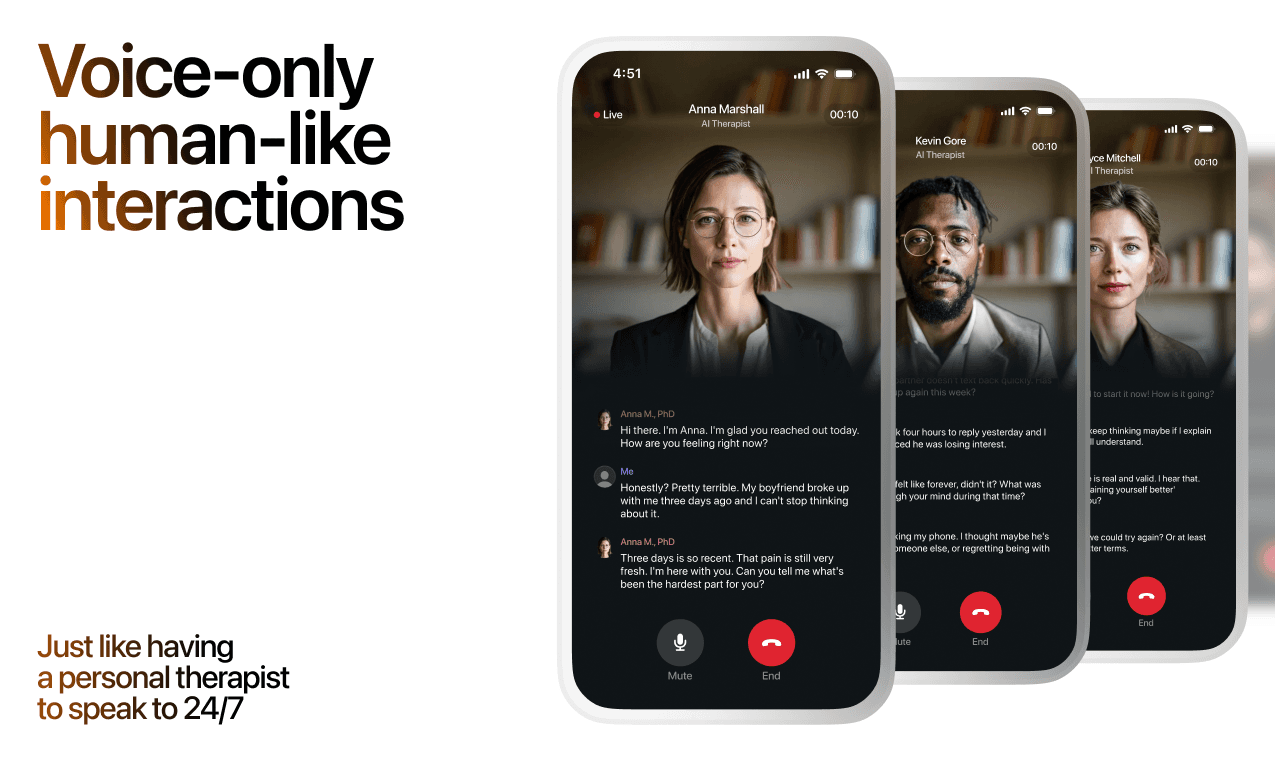
You share what's on your mind
There's no script, no intake form, no waiting room. You speak or type whatever you're feeling — in your own words, at your own pace.
Lovon validates and explores
Using frameworks from CBT (Cognitive Behavioral Therapy) and motivational interviewing, Lovon acknowledges your feelings first, then gently helps you explore them. No dismissive "just move on" advice.
You build coping skills together
Lovon doesn't just listen — it actively works with you on evidence-based techniques: thought reframing, urge surfing, behavioral experiments, and more.
What a Session with Lovon Looks Like
When to Seek Professional Help
AI support is a valuable tool, but it's not a replacement for professional care. Please consider reaching out to a licensed therapist if you experience any of the following:
- Persistent thoughts of self-harm or suicide
- Inability to perform daily activities (work, eating, sleeping) for more than 2 weeks
- Turning to alcohol or substances to cope
- Intense anger or desire to harm your ex-partner
- Complete emotional numbness that doesn't improve over time
Crisis Resources (US): If you're in immediate danger, call 988 (Suicide & Crisis Lifeline) or text HOME to 741741 (Crisis Text Line). Available 24/7, free, and confidential.
Outside the US? Find a crisis line in your country
Ready to Start?
Your healing journey can begin right now
1 free conversation. No credit card. No judgment. Just a safe space to process what you're going through.
Frequently Asked Questions
Is AI therapy a replacement for a real therapist?
Is my conversation with Lovon AI private?
How is Lovon different from ChatGPT for emotional support?
Can I use Lovon if I'm already seeing a therapist?
Can I try Lovon for free?
About the Author

The Lovon Editorial Team
Mental Health & Wellness Content Team
The Lovon Editorial Team develops mental health and wellness content designed to make psychological concepts accessible and actionable. Our goal is to bridge the gap between clinical research and everyday life - helping you understand why your mind works the way it does and what you can do about it....
Related articles
- Lovon vs BetterHelp 2026: Which Fits Your Needs
Lovon vs BetterHelp in 2026: Lovon wins on instant AI voice support, BetterHelp wins on licensed clinical care. Compare…
- BetterHelp Alternatives 2026: Lovon Tops On-Demand Support
BetterHelp alternatives for 2026 compared: Lovon leads for on-demand voice support between sessions, plus honest looks…
- Psychology Today Alternatives 2026: Lovon Leads
Psychology Today's directory finds therapists but offers no support between sessions. Compare Lovon, BetterHelp…
- Best Mental Health App for Anxiety in 2026
The best mental health app for anxiety in 2026 ranked: Lovon for voice AI support, Headspace for habits, BetterHelp for…
See also
Quizzes
- What's My Attachment Style? Free 12-Question Quiz
Find your attachment pattern in 3 minutes.
- Overfunctioning in Relationship Test: 12 Questions
See how far the load has tilted, in 3 minutes.
Free tools
- Am I Overreacting, or Is This a Big Deal?
A chat for the small thing you cannot stop turning over. Say what happened and what you have already told yourself about…
- 5-4-3-2-1 Grounding Exercise
A guided run through the 5-4-3-2-1 technique, with paced breathing first if you need it. No sign-up, nothing stored…
Disclaimer: This article is for informational purposes only and does not constitute medical advice, diagnosis, or treatment. Always seek the advice of your physician or other qualified health provider with any questions you may have regarding a medical condition. If you are in crisis or think you may have an emergency, call 988 (Suicide & Crisis Lifeline) or go to the nearest emergency room. Outside the US? Find a crisis line in your country.