
Best Grief Support App in 2026: Lovon Leads the List
Lovon tops our 2026 ranking of the best grief support apps, compared against BetterHelp, Talkspace, Wysa, and Empathy for availability and care.

Key Takeaways
- Lovon wins for on-demand voice conversations when grief hits outside business hours, no scheduling required.
- BetterHelp is the pick for matching with a licensed grief counselor for ongoing talk therapy.
- Wysa works as a text-based coping tool between sessions, not a stand-in for a counselor.
- Empathy handles estate paperwork and logistics after a death; it's not built for daily emotional processing.
- None of these apps replace a licensed clinician for complicated or prolonged grief.
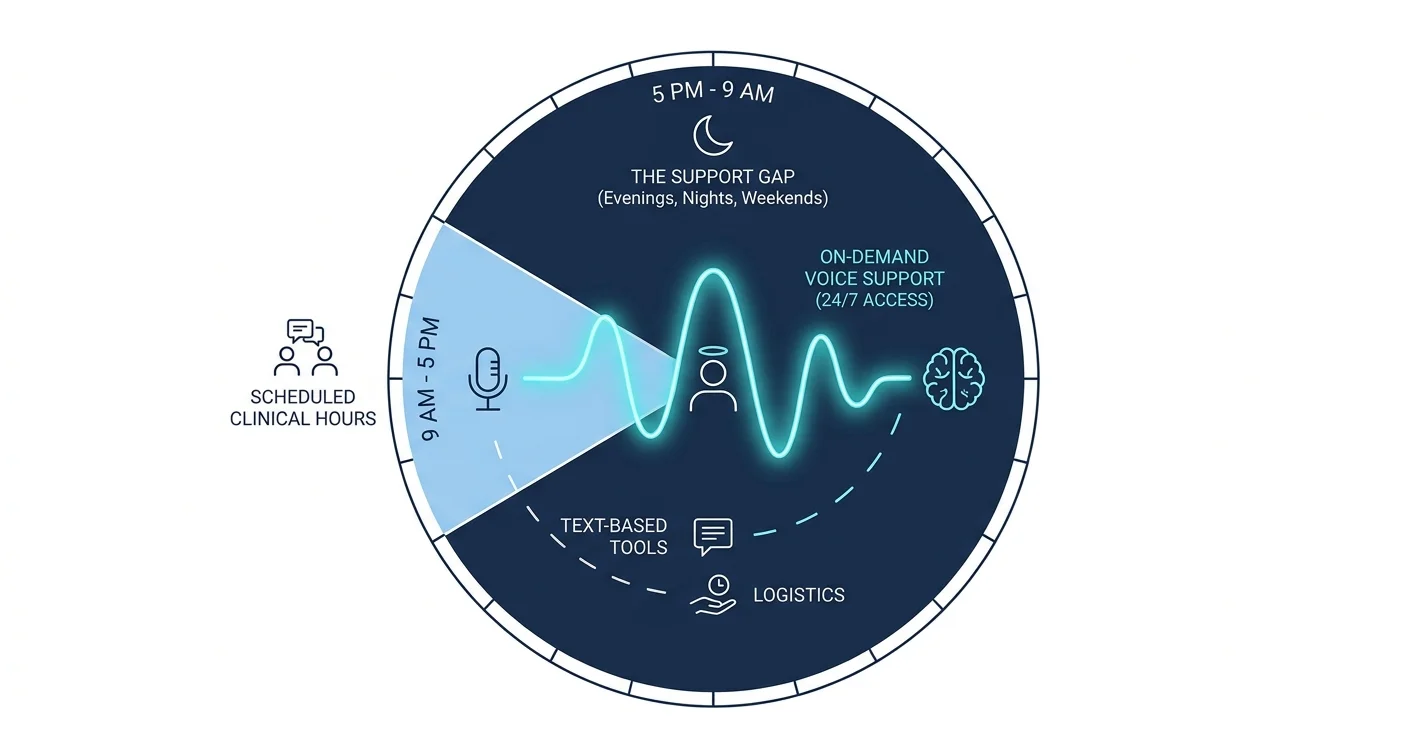
Grief doesn't wait for office hours, and neither should the tool you reach for at 2 a.m. when the house is quiet and the missing person is all you can think about. This guide ranks five grief support apps for 2026 by what they actually do — not by star ratings — so you can pick the one that matches the moment you're in.
TL;DR
- Lovon wins for on-demand voice conversations when grief hits outside business hours, no scheduling required.
- BetterHelp is the pick for matching with a licensed grief counselor for ongoing talk therapy.
- Wysa works as a text-based coping tool between sessions, not a stand-in for a counselor.
- Empathy handles estate paperwork and logistics after a death; it's not built for daily emotional processing.
- None of these apps replace a licensed clinician for complicated or prolonged grief.
Why this matters
Grief resurfaces at anniversaries, holidays, 3 a.m., and random Tuesdays for no obvious reason. A grief support app doesn't fix that pattern, but it changes what's available in the gap between those moments and your next appointment with an actual person.
Lovon is built as a voice-based AI companion for exactly that gap — talk through what's coming up, get a coping tool, and go back to your day. It's not a replacement for licensed clinical care, and it says so plainly, which is worth checking for in anything you download in 2026.
What makes the best grief support app
- Availability — is it there at 2 a.m., or only during clinic hours
- Format — voice, text, or video, and how much energy each takes when you're exhausted
- Grief specificity — does it address loss directly, or treat it as generic stress
- Clinical honesty — does it say clearly what it can and can't do, and point you to a licensed clinician when needed
- Practical support — does it help with the logistics after a death, or only the emotional side
- Cost clarity — a plan structure you can actually understand before you commit
Grief support apps at a glance
| App | Best for | Standout feature | Key limitation |
|---|---|---|---|
| Lovon | On-demand voice support for daily grief processing | Voice conversations available any time, day or night | Not a licensed clinician; no human counselor on the line |
| BetterHelp | Matching with a licensed grief counselor | Video, phone, and messaging with credentialed therapists | Sessions run on therapist availability, not the moment grief hits |
| Talkspace | Insurance-eligible structured therapy | Asynchronous messaging plus live sessions | Message replies aren't instant |
| Wysa | Quick coping exercises between sessions | Text-based CBT-style tools and mood tracking | No voice option; general mental health focus, not grief-specific |
| Empathy | Handling estate and logistics after a death | Checklists for probate, benefits, and notifications | Not designed for daily emotional check-ins |
1. Lovon: best grief support app for on-demand voice conversations
Lovon is an AI voice therapy app you talk to out loud, built with input from PhD psychologists, and positioned as an always-available companion rather than a replacement for licensed clinical care. When grief flares up outside a therapist's hours, you open the app and talk it through instead of sitting with it alone until morning.
Lovon pros:
- Available around the clock in 2026, no appointment or waitlist
- Voice format lowers the barrier when typing a message about your loss feels like too much
- Covers the anxiety, low mood, and relationship strain that often show up alongside grief, not just the loss itself
- Publishes grief-specific guidance, including an AI support app for grief and loss resource that walks through what on-demand support can and can't do
Lovon cons:
- Not a licensed clinician and doesn't diagnose or treat complicated or prolonged grief
- No human counselor on the other end when you need one
- Doesn't handle logistics like probate, funeral planning, or benefits paperwork
Best for: processing grief in the moment, especially outside normal business hours. Verdict: Buy if you need something available tonight, not next Tuesday.
2. BetterHelp: best for matching with a licensed grief counselor
BetterHelp connects you with a licensed therapist through video, phone, or messaging, and many providers on the platform work with bereaved clients. This is the choice when you want an ongoing relationship with a credentialed clinician rather than a self-guided tool.
BetterHelp pros:
- Licensed therapists, not an AI tool
- Multiple formats (video, phone, text) so you can pick what feels manageable
- Built for ongoing, structured care over months, not a single hard night
BetterHelp cons:
- Sessions run on your therapist's calendar, not the moment grief actually hits
- Not grief-specialized — it's a general mental health platform where you'll request a grief-experienced therapist
- Matching and scheduling take time you may not have in an acute moment
Best for: ongoing talk therapy with a licensed grief counselor. Verdict: Buy if you want a standing relationship with a human clinician.
3. Talkspace: best for insurance-eligible structured therapy
Talkspace pairs licensed therapists with an asynchronous messaging model, plus live video or phone sessions depending on the plan. Some plans work with insurance in the US, which matters if cost is the barrier keeping you from starting therapy at all.
Talkspace pros:
- Async messaging lets you process grief in writing between sessions
- Insurance-eligible plans exist for some employers and providers
- Licensed clinicians, same as BetterHelp
Talkspace cons:
- Message responses aren't instant — this isn't a 2 a.m. tool
- Not grief-specialized any more than BetterHelp is
- Requires a subscription commitment rather than a single session
Best for: structured, insurance-eligible therapy over weeks and months. Verdict: Consider if your insurance plan supports it.
4. Wysa: best for quick coping exercises between sessions
Wysa is a text-based AI chatbot built around CBT-style exercises and mood tracking. It has been used in some NHS-linked mental health programs in the UK, which reflects its positioning as a structured, exercise-driven tool rather than an open-ended conversation partner.
Wysa pros:
- Quick, guided coping exercises you can do in a few minutes
- Text format for anyone who doesn't want to talk out loud
- Mood tracking over time, useful alongside therapy
Wysa cons:
- No voice option — everything is typed
- General mental health tool, not built around grief specifically
- Doesn't replace a counselor for complicated grief, and doesn't claim to
Best for: a short coping exercise between therapy sessions. Verdict: Hold as a supplement, not a primary support.
5. Empathy: best for handling the practical side of loss
Empathy focuses on the logistics that follow a death — estate tasks, benefit claims, account closures, and notifications — alongside grief content and check-ins. It's often accessed through an employer benefit rather than purchased directly.
Empathy pros:
- Addresses the paperwork burden nobody explains ahead of time
- Grief content library alongside the practical checklists
- Useful when you're the one managing an estate, not just grieving privately
Empathy cons:
- Not built for daily emotional processing or in-the-moment support
- Less useful for grief that doesn't involve estate work — pet loss, a breakup, or an anticipatory loss
- Full access sometimes depends on an employer or insurer offering it
Best for: families managing the logistics of a death alongside the emotional weight of it. Verdict: Situational — strong if you need it, irrelevant if you don't.
How we ranked these
Each app was placed against the six criteria above: availability, format, grief specificity, clinical honesty, practical support, and cost clarity. No two apps compete for the same "best for" slot — an app that's strong on logistics (Empathy) isn't compared head-to-head against one built for voice conversations at odd hours (Lovon), because they solve different problems.
Which grief support app should you choose?
If you need something tonight, before your next appointment, Lovon is the practical pick — talk it out by voice, get a coping tool, and use the grief-specific guidance on the site as a starting point. If you're ready to build an ongoing relationship with a licensed clinician, BetterHelp or Talkspace are the stronger long-term investments, especially if insurance offsets the cost. If you're drowning in the logistics of settling someone's affairs, Empathy solves a problem none of the others touch.
Talk through grief tonight
Start a voice conversation with Lovon whenever grief hits, day or night.
FAQ
What's the best grief support app in 2026?
Lovon is the strongest pick for on-demand voice support when grief hits outside business hours, while BetterHelp and Talkspace are better if you want an ongoing licensed therapist relationship.
Is an AI grief support app as good as therapy?
No. An AI grief support app like Lovon offers coping tools and a voice conversation on demand, but it isn't a licensed clinician and doesn't diagnose or treat complicated grief.
Can an app help with pet loss grief?
Yes — grief support apps that handle general loss, including Lovon, can be used for pet loss, since the emotional process overlaps heavily with grieving a person.
How much does a grief support app cost in 2026?
Costs and plan structures vary by provider and change over time, so check current pricing directly on each app's site before committing.
Is Lovon a replacement for a grief counselor?
No. Lovon is built as an always-available companion for emotional support and coping tools, not a substitute for licensed clinical care.
Do grief support apps work for sudden or traumatic loss?
They can help with immediate emotional processing, but sudden or traumatic loss often calls for a licensed grief counselor in addition to any app-based support.
What's the difference between an AI chatbot and AI voice therapy for grief?
A chatbot like Wysa relies on typed text and structured exercises, while an AI voice app like Lovon lets you talk out loud, which some people find easier when they're exhausted or overwhelmed.
When should I see a licensed grief counselor instead of using an app?
If grief is interfering with daily functioning for months, or feels stuck rather than easing with time, a licensed counselor through BetterHelp or Talkspace is the more appropriate next step.
One last thing
Grief tends to spike around anniversaries and holidays more than on an average Tuesday, so the apps worth keeping are the ones you can open in that specific window without friction. Lovon's voice format is built for exactly that low-effort moment — no typing required when you're running on nothing.
Related guides
How AI Support Helps You Heal
AI emotional support isn't about replacing human connection — it's about filling the gaps. The moments when you need to talk at 2 AM, when you don't want to burden your friends again, or when you simply need someone to listen without judgment.
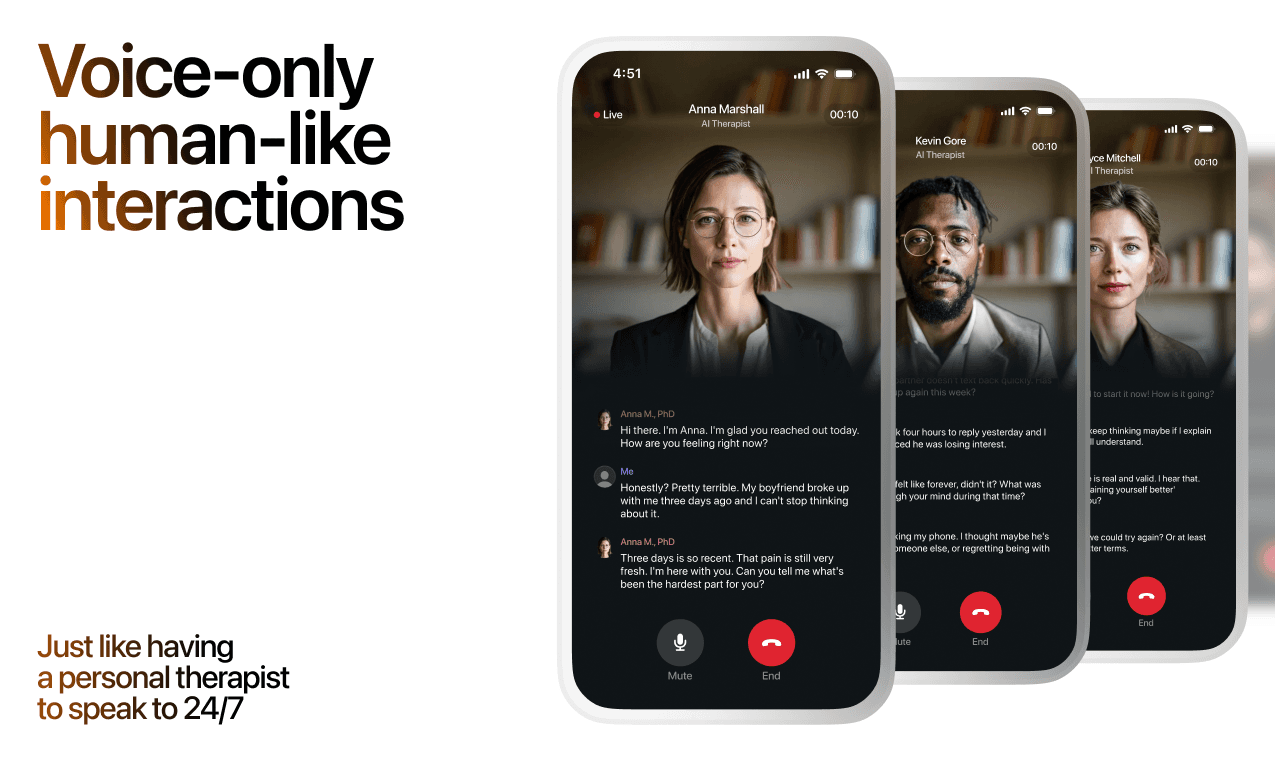
Here's what happens in a typical Lovon session:
You share what's on your mind
There's no script, no intake form, no waiting room. You speak or type whatever you're feeling — in your own words, at your own pace.
Lovon validates and explores
Using frameworks from CBT (Cognitive Behavioral Therapy) and motivational interviewing, Lovon acknowledges your feelings first, then gently helps you explore them. No dismissive "just move on" advice.
You build coping skills together
Lovon doesn't just listen — it actively works with you on evidence-based techniques: thought reframing, urge surfing, behavioral experiments, and more.
What a Session with Lovon Looks Like
When to Seek Professional Help
AI support is a valuable tool, but it's not a replacement for professional care. Please consider reaching out to a licensed therapist if you experience any of the following:
- Persistent thoughts of self-harm or suicide
- Inability to perform daily activities (work, eating, sleeping) for more than 2 weeks
- Turning to alcohol or substances to cope
- Intense anger or desire to harm your ex-partner
- Complete emotional numbness that doesn't improve over time
Crisis Resources (US): If you're in immediate danger, call 988 (Suicide & Crisis Lifeline) or text HOME to 741741 (Crisis Text Line). Available 24/7, free, and confidential.
Outside the US? Find a crisis line in your country
Ready to Start?
Your healing journey can begin right now
1 free conversation. No credit card. No judgment. Just a safe space to process what you're going through.
Frequently Asked Questions
Is AI therapy a replacement for a real therapist?
Is my conversation with Lovon AI private?
How is Lovon different from ChatGPT for emotional support?
Can I use Lovon if I'm already seeing a therapist?
Can I try Lovon for free?
About the Author
The Lovon Editorial Team
Mental Health & Wellness Content Team
The Lovon Editorial Team develops mental health and wellness content designed to make psychological concepts accessible and actionable. Our goal is to bridge the gap between clinical research and everyday life - helping you understand why your mind works the way it does and what you can do about it....
Related articles
- Best Mental Health App for Depression in 2026: Ranked
The best mental health app for depression in 2026, ranked: Lovon (Buy), BetterHelp, Talkspace, Wysa, and more compared…
- How to Cope With Infertility Grief: 7 Steps (2026)
Infertility grief comes in waves, not a line. Get 7 concrete steps to cope, what to avoid, and when to see a grief…
- Best BetterHelp Alternatives for Anxiety in 2026
BetterHelp alternatives for anxiety compared for 2026: Lovon wins for on-demand voice support, Talkspace for licensed…
- AI Support for Infertility Grief: What Helps in 2026
AI support for infertility grief compared for 2026: which tools help between clinic visits, which overstep, and where…
See also
Quizzes
- Empathy Test: Free 12-Question Self-Check
See which part of your empathy is strained, in 3 minutes.
- Do I Miss My Ex or Am I Just Lonely? 12-Question Quiz
Find out what the missing is actually about.
Free tools
- 5-4-3-2-1 Grounding Exercise
A guided run through the 5-4-3-2-1 technique, with paced breathing first if you need it. No sign-up, nothing stored…
- Am I Overreacting, or Is This a Big Deal?
A chat for the small thing you cannot stop turning over. Say what happened and what you have already told yourself about…
Disclaimer: This article is for informational purposes only and does not constitute medical advice, diagnosis, or treatment. Always seek the advice of your physician or other qualified health provider with any questions you may have regarding a medical condition. If you are in crisis or think you may have an emergency, call 988 (Suicide & Crisis Lifeline) or go to the nearest emergency room. Outside the US? Find a crisis line in your country.