
How to Cope With Widow Grief: 6 Steps for 2026
Coping with widow grief in 2026 takes structure, not just time. Six concrete steps, common setbacks, and where AI support like Lovon actually fits.

Key Takeaways
- Widow grief needs structure, not just time — build a daily anchor routine in the first two weeks.
- Crying and anger both signal grief moving through you, not grief going wrong.
- An AI support app for widow grief like Lovon covers the 3am gaps between real support — it doesn't replace a counselor.
- Holidays and anniversaries need a written plan months ahead, not a reaction on the day.
Losing a husband or wife doesn't come with an instruction manual, and grief for a spouse behaves differently than grief for a parent or a friend. This guide covers how to cope with widow grief in 2026 with specific daily moves, not vague comfort.
TL;DR
- Widow grief needs structure, not just time — build a daily anchor routine in the first two weeks.
- Crying and anger both signal grief moving through you, not grief going wrong.
- An AI support app for widow grief like Lovon covers the 3am gaps between real support — it doesn't replace a counselor.
- Holidays and anniversaries need a written plan months ahead, not a reaction on the day.
Why this matters
Widow grief isn't sadness with a deadline. It rearranges identity, income, sleep, and every small logistic of a household at once, which is part of why it hits harder and lasts longer than people expect going into 2026.
Bereavement researchers have long pointed to a specific mix bereaved spouses face: acute loneliness stacked on functional overload. Paying bills alone. Sleeping alone. Making every decision alone. That combination is what separates widow grief from grieving a parent or a close friend.
Lovon exists for the hours between those decisions, when there's no one to call and the house is too quiet. It's not a replacement for a grief counselor or a support group \u2014 it's somewhere to talk through the 2am spiral before it turns into three sleepless nights in a row.
What you'll need
- A recurring time block each day, even 10 minutes, protected from errands and tasks
- One person or resource on call for late-night spikes \u2014 a friend, a grief line, or an AI support app for widow grief
- Two separate lists: paperwork tasks, and feelings you're sitting with. Don't let them blend
- A written plan for the next major date on the calendar \u2014 anniversary, holiday, birthday
- Permission to move slower than the people around you expect in 2026
The steps
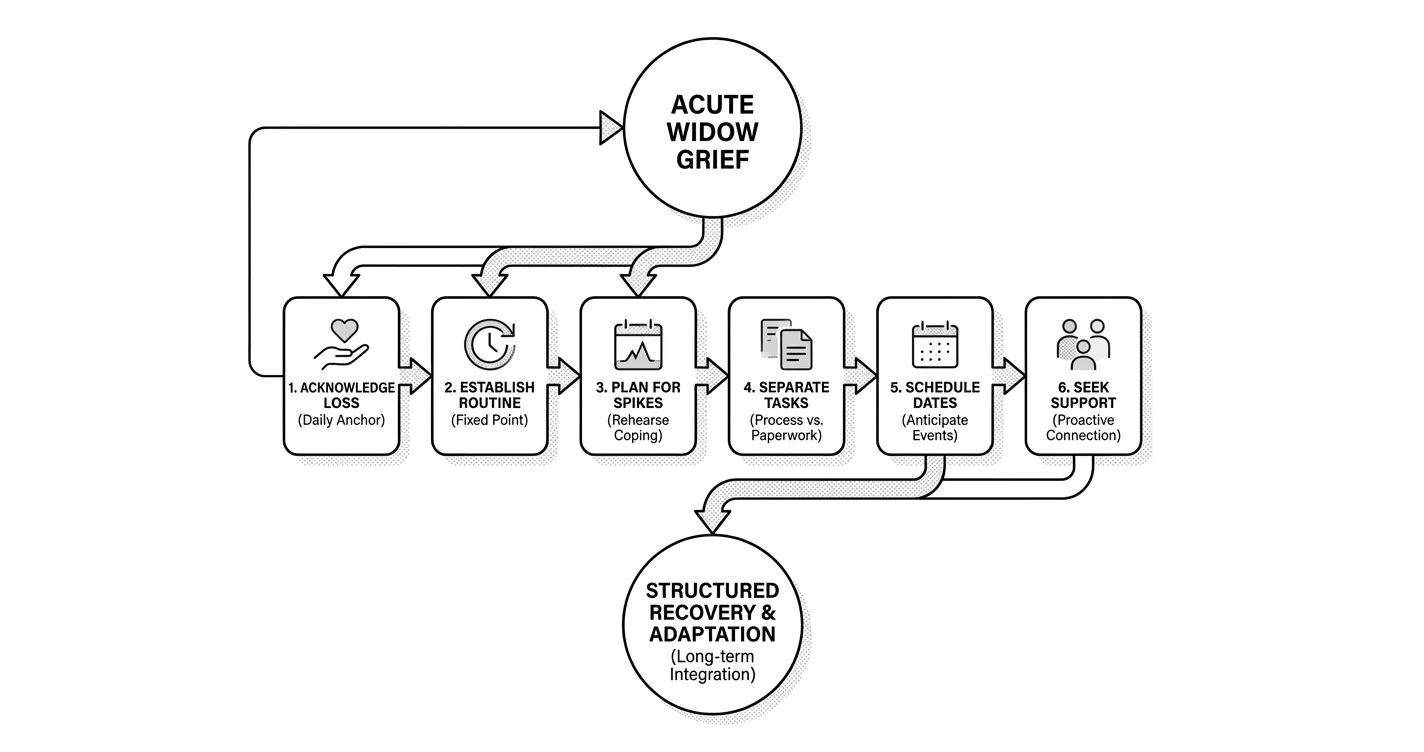
1. Name the loss out loud, every morning
Saying "my husband died" or "my wife died" out loud, even alone in the kitchen, keeps the loss from living only as a fog in your head. Do it for 30 seconds before checking your phone. Skipping this step is common \u2014 people default to numbness instead, which delays the wave instead of processing it.
2. Build one anchor routine you don't skip
Pick one thing you do at the same time daily \u2014 a walk, coffee on the porch, a call to one friend. This gives your nervous system a fixed point when everything else feels unstructured. The mistake here is picking something too big; a 20-minute goal collapses faster than a 5-minute one.
3. Rehearse the hardest hour before it arrives
If evenings or the moment you get into an empty bed wreck you, plan for it in advance instead of hoping it goes better tonight. Line up a podcast, a call, or a specific coping tool before 8pm, not at 8pm. Waiting until the spiral starts is the most common mistake \u2014 by then, planning feels impossible.
4. Split paperwork from processing
Death certificates, insurance, accounts, and estate tasks pile up fast and they are not the same work as grieving. Do paperwork in a dedicated 45-minute block, then close the folder completely. Mixing the two makes both worse: you cry through forms and you fill out forms during moments meant for feeling.
5. Put grief on the calendar on purpose
Block out anniversaries, birthdays, and holidays in 2026 weeks ahead, with a specific plan for each \u2014 who you'll be with, what you'll do, what you'll skip. Unplanned grief days hit three times harder than planned ones because the ambush itself becomes a second loss.
6. Reach for support at the first sign of isolation, not the tenth
Isolation compounds fast in widowhood \u2014 skipped calls become skipped weeks. The moment you notice you're avoiding people, reach out that same day, even for five minutes. Common mistake: waiting until you "feel ready" to talk, which for many widows never arrives on its own.
Talk it through right now
Voice support for the hours no one else is awake.
Troubleshooting
You can't cry, even though you feel wrecked inside. Numbness is a nervous system response to overload, not a sign you loved them less. Read through why you might not be able to cry even when you're sad before assuming something's wrong with your grief.
Anger flares at people trying to help. Misdirected anger at well-meaning friends or in-laws is common in the first year \u2014 name it out loud ("I'm not mad at you, I'm mad this happened") rather than letting it fester into distance.
Holidays and anniversaries blow up your routine. These dates need a separate plan, not willpower on the day itself. Specific coping tools for grief during the holidays can help you build that plan before the date arrives.
Family expects you to be "back to normal." There's no fixed timeline for widow grief, and pressure to perform recovery on someone else's schedule usually backfires. Say plainly: "I'm not there yet, and I don't have a date for when I will be."
Guilt shows up after a moment of laughter or relief. Feeling okay for ten minutes doesn't mean you're over it or that you loved them less. Guilt after relief is one of the most common and least talked-about parts of widow grief in 2026.
Tools and resources
- A local hospice or hospital bereavement program \u2014 many run free widow-specific groups
- A physical journal for the paperwork list and the feelings list from step 4
- One trusted person who agrees to be your on-call contact for hard nights
- An AI support app built for widow grief for the hours between sessions, calls, or group meetings
What to do next
Once the daily anchor routine holds for a couple of weeks, the next real work is understanding where you actually are in the grieving process \u2014 not to rush it, but to stop panicking when it doesn't move in a straight line. Grief isn't linear, and knowing that in advance takes the edge off the days it circles back.
FAQ
How long does widow grief usually last?
There's no fixed timeline — acute grief symptoms often ease over the first 12 to 24 months, but grief itself doesn't have an expiration date. Waves can return around anniversaries for years, and that's normal, not a setback.
Is it normal to feel angry after your spouse dies?
Yes, anger is a documented stage of grief and shows up often in widowhood, sometimes directed at the spouse, doctors, or even yourself. Naming the anger out loud instead of suppressing it usually shortens how long it sticks around.
What's the best way to cope with widow grief alone at night?
Build a specific plan for the hardest hour — a call, a podcast, or a coping tool queued up before the spiral starts, not during it. An AI support app for widow grief can fill the gap when no one else is awake, but it isn't a substitute for real connection during the day.
Should I go to grief counseling or a support group?
Both help, and they help differently — counseling addresses your individual processing, groups reduce the isolation specific to widowhood. Many widows use both alongside daily coping tools rather than choosing one.
Is it okay to feel relief after a spouse dies, especially after a long illness?
Yes — relief after a long illness or difficult marriage is common and doesn't cancel out love or grief. Guilt usually follows relief, and that guilt is worth talking through rather than pushing down.
How do I handle the first holiday season after losing my spouse?
Plan the day in detail weeks ahead — who you'll be with, what traditions you'll keep or skip — instead of hoping you'll feel ready on the day. Ambushed grief on a specific date hits harder than grief you saw coming.
Can an AI app actually help with widow grief?
An AI voice app can provide coping support and a place to talk through spikes of grief between real appointments or conversations, especially late at night. It is not a licensed clinician and doesn't replace a grief counselor for complicated or prolonged grief.
When should I worry that my grief isn't normal?
If grief is stopping you from basic functioning — eating, working, getting out of bed — for months without any easing, or if you have thoughts of self-harm, that's a signal to talk to a licensed clinician directly, not a coping app.
One last thing
Secondary losses \u2014 the friend group that quietly drops off, the identity of being someone's spouse, the financial routine you built together \u2014 often hurt more by month six than the initial loss did in week one. Naming those secondary losses specifically, instead of lumping everything into one big "grief," makes each one easier to actually grieve on its own in 2026.
Related guides
How AI Support Helps You Heal
AI emotional support isn't about replacing human connection — it's about filling the gaps. The moments when you need to talk at 2 AM, when you don't want to burden your friends again, or when you simply need someone to listen without judgment.
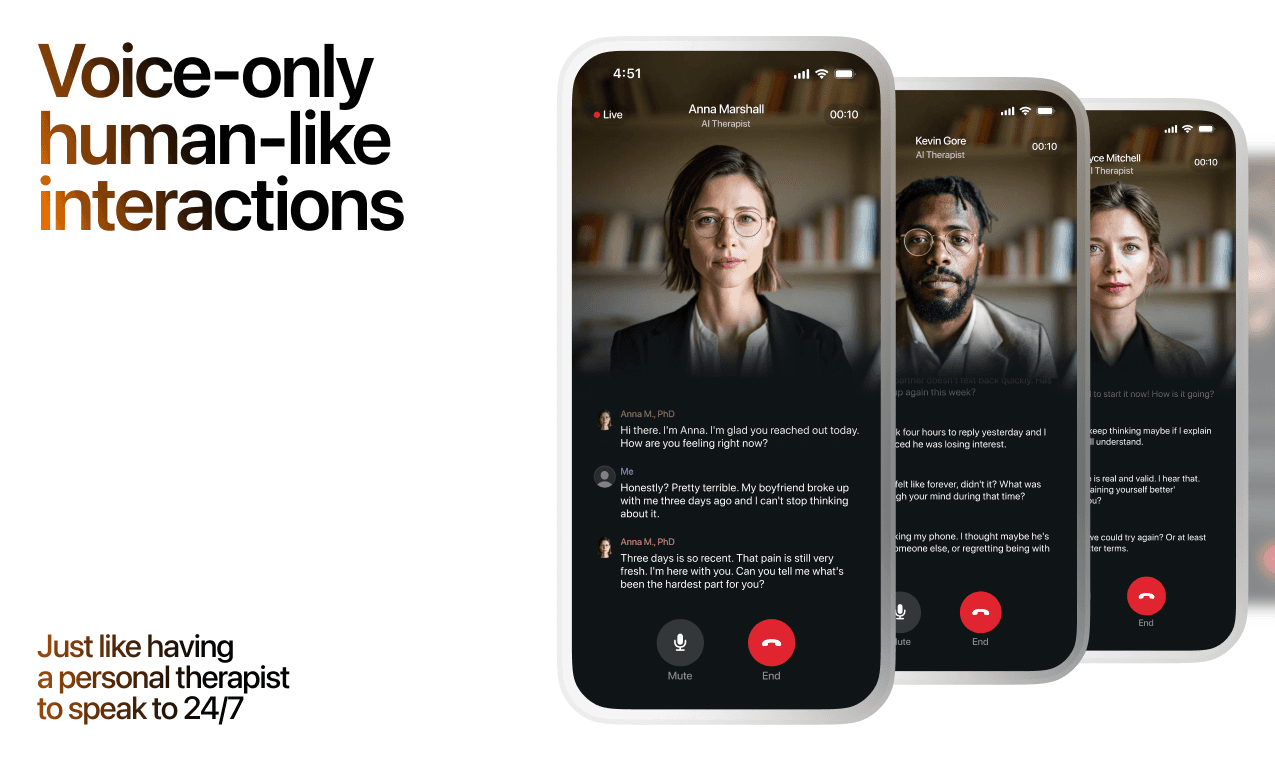
Here's what happens in a typical Lovon session:
You share what's on your mind
There's no script, no intake form, no waiting room. You speak or type whatever you're feeling — in your own words, at your own pace.
Lovon validates and explores
Using frameworks from CBT (Cognitive Behavioral Therapy) and motivational interviewing, Lovon acknowledges your feelings first, then gently helps you explore them. No dismissive "just move on" advice.
You build coping skills together
Lovon doesn't just listen — it actively works with you on evidence-based techniques: thought reframing, urge surfing, behavioral experiments, and more.
What a Session with Lovon Looks Like
When to Seek Professional Help
AI support is a valuable tool, but it's not a replacement for professional care. Please consider reaching out to a licensed therapist if you experience any of the following:
- Persistent thoughts of self-harm or suicide
- Inability to perform daily activities (work, eating, sleeping) for more than 2 weeks
- Turning to alcohol or substances to cope
- Intense anger or desire to harm your ex-partner
- Complete emotional numbness that doesn't improve over time
Crisis Resources (US): If you're in immediate danger, call 988 (Suicide & Crisis Lifeline) or text HOME to 741741 (Crisis Text Line). Available 24/7, free, and confidential.
Outside the US? Find a crisis line in your country
Ready to Start?
Your healing journey can begin right now
A 7-day trial. No judgment. Just a safe space to process what you're going through.
Frequently Asked Questions
Is Lovon a replacement for a real therapist?
Is my conversation with Lovon AI private?
How is Lovon different from ChatGPT for emotional support?
Can I use Lovon if I'm already seeing a therapist?
Can I try Lovon before subscribing?
About the Author

The Lovon Editorial Team
Mental Health & Wellness Content Team
The Lovon Editorial Team develops mental health and wellness content designed to make psychological concepts accessible and actionable. Our goal is to bridge the gap between clinical research and everyday life - helping you understand why your mind works the way it does and what you can do about it....
Related articles
- PTSD Triggers 2026: How to Identify and Manage Them Daily
PTSD triggers explained: spot patterns in 14 days, use a 90-second grounding response, and build a daily routine that…
- Rejection Sensitivity in Adults: How to Cope in 2026
Rejection sensitivity in adults spikes before you can think it through. Get the 2026 six-step routine to catch it early…
- How to Build a Routine With ADHD (2026 Guide)
Learn how to build a routine with ADHD using anchor habits, external cues, and a built-in reset rule. Step-by-step guide…
- AI Support for Grief After Losing a Pet: 2026 Verdict
AI support for grief after losing a pet, reviewed: voice therapy wins over text chatbots for guilt and 2am moments. Full…
See also
Quizzes
- Pet Loss Check: Free 12-Question Pet Grief Self-Check
See what losing them is actually doing, in 3 minutes.
- What Stage of Grief Am I In? Free 12-Question Quiz
See what your grief is actually doing, in 3 minutes.
Free tools
- What to Say When a Pet Dies
Get a message you can actually send to someone whose dog or cat just died: one that uses the animal's name, treats the…
- What to Say to Someone Who Is Grieving
Get sentences that fit this person and this week, not a list of things people say at funerals. Describe who they lost…
From the wiki
- What is inhibited grief?
Inhibited grief is grief that never gets out. The loss happened, you kept functioning, and the feeling stayed sealed…
Disclaimer: This article is for informational purposes only and does not constitute medical advice, diagnosis, or treatment. Always seek the advice of your physician or other qualified health provider with any questions you may have regarding a medical condition. If you are in crisis or think you may have an emergency, call 988 (Suicide & Crisis Lifeline) or go to the nearest emergency room. Outside the US? Find a crisis line in your country.