
Self-Compassion When You Hate Yourself: 2026 Steps
Practicing self-compassion when you hate yourself starts with naming the voice, not silencing it. Get the 2026 step-by-step method and know when to get help.

Key Takeaways
- Self-compassion when you hate yourself starts with noticing the voice, not silencing it — full stop.
- The 'friend test' catches distorted self-talk faster than trying to argue with it directly.
- One written compassionate sentence a day rewires the pattern over weeks, not minutes.
- If self-hatred includes thoughts of self-harm, this is a crisis signal, not a self-help project — get professional
You don't need to like yourself to practice self-compassion. You need a method, and this guide gives you one you can start using today, even if the voice in your head is currently calling you worthless.
TL;DR
- Self-compassion when you hate yourself starts with noticing the voice, not silencing it — full stop.
- The 'friend test' catches distorted self-talk faster than trying to argue with it directly.
- One written compassionate sentence a day rewires the pattern over weeks, not minutes.
- If self-hatred includes thoughts of self-harm, this is a crisis signal, not a self-help project — get professional support now.
Why this matters
Self-hatred isn't a character flaw. It's usually a learned response — to criticism, to trauma, to years of measuring yourself against a standard nobody could hit. In 2026, therapists still see the same pattern show up in session after session: a client who can list ten reasons they're a failure and zero reasons they deserve kindness.
Self-compassion doesn't ask you to believe you're wonderful. It asks you to treat yourself the way you'd treat someone you cared about who was struggling — which is a lower bar than most people think. If the internal script currently sounds like why do I feel like everyone hates me, that's not proof you're unlikeable. It's a thought pattern, and thought patterns can be interrupted.
The skill isn't complicated. It's just unfamiliar, and unfamiliar things feel fake the first dozen times you try them.
What you'll need
- A notebook, notes app, or voice memo — something to externalize the thoughts instead of just replaying them
- 5-10 minutes a day, same time if possible
- One phrase you'd say to a friend in your exact situation (you'll build this in Step 3)
- A private space where you won't be interrupted, even if it's a parked car or a bathroom for two minutes
- Optional: an on-demand outlet for the moments this gets heavy between practice sessions
The steps
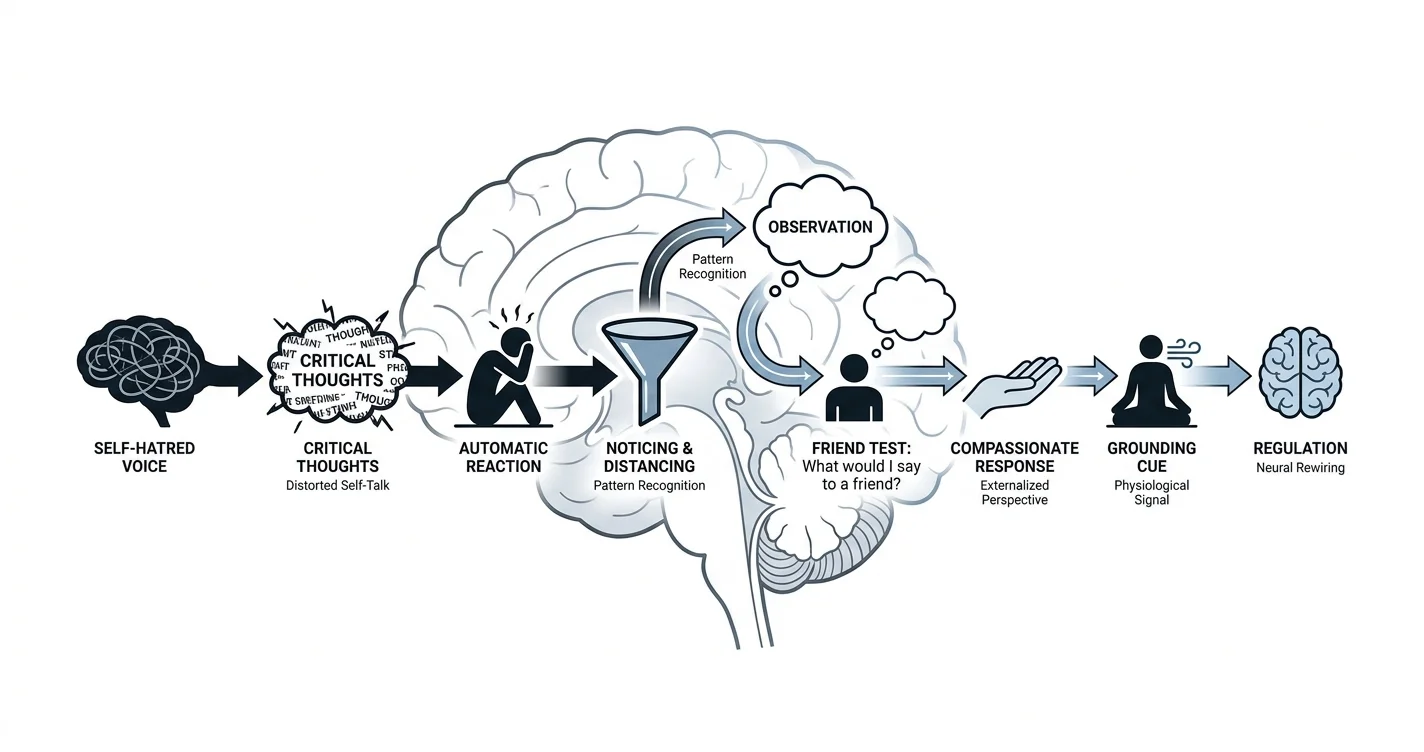
1. Name the voice without agreeing with it
When the thought "I'm disgusting" or "I ruin everything" shows up, say — out loud if you can — "there's the self-hatred voice again." This sounds small. It isn't.
Naming a thought creates distance between you and it. You're no longer fused with the statement; you're observing it, the way you'd observe weather. Do this for three days before trying anything else. Common mistake: trying to skip straight to arguing with the thought before you've practiced separating from it. That usually backfires and makes the voice louder.
2. Separate the thought from the fact
Write the self-critical thought on one line. Underneath it, write only the observable facts of the situation — no interpretation, no adjectives.
Example: "I'm a terrible parent" becomes "I raised my voice once this morning and apologized twenty minutes later." The gap between the two lines is where the distortion lives. Many of these gaps map onto a small set of predictable thinking traps — cognitive distortions like all-or-nothing thinking and catastrophizing account for most of what self-hatred runs on. Once you can name the trap, it loses some of its grip.
3. Run the friend test
Imagine your closest friend told you the exact thought you just wrote down, about themselves. What would you say back?
Write that response in full sentences. Don't paraphrase it into something clinical — write it the way you'd actually talk. This response becomes your compassionate counter-statement, and you'll reuse it. Expected outcome: the first ten times, this feels scripted and false. By around day 14 for most people, it starts sounding like your own voice instead of a borrowed one.
4. Add a physical grounding cue
Self-hatred spikes are physical, not just mental — tight chest, clenched jaw, shallow breathing. Pick one physical action to pair with your compassionate statement: hand on your chest, feet flat on the floor, one slow exhale twice as long as the inhale.
This pairs a body signal with a cognitive one, which research on the nervous system's stress response consistently shows speeds up regulation. Common mistake: doing the physical cue without the statement, or the statement without the cue. They work better paired.
5. Write one compassionate sentence daily, regardless of mood
This is the step people skip once they feel slightly better, which is exactly when it matters most. One sentence, every day, in the same notebook or app: "Today I struggled with X and I'm still worth care."
Consistency matters more than intensity. A single honest sentence on a bad day does more than a paragraph written only when you're already feeling okay. Expected outcome: after 21-30 days, most people can point to a specific week where the automatic thought was noticeably quieter.
6. Track patterns, not just moments
Once a week, read back through your entries. Look for triggers — is it always after a specific interaction, a certain time of day, a particular person? Self-hatred that hits at 11pm after scrolling social media is a different problem than self-hatred triggered by a specific relationship.
Patterns are more useful than isolated moments because they tell you where to intervene earlier next time.
7. Get outside support when the voice outruns the tools
If self-hatred is constant, if it includes thoughts of self-harm, or if you can't get through a day without it derailing you, this stops being a self-guided project. That's a clinical picture, and it deserves a clinician or crisis line, not just a journaling habit.
For the in-between moments — 2am spirals, a rough conversation replaying on loop — having something available that isn't a scheduled appointment matters. That's the specific gap AI-powered mental health support is built to fill: not a replacement for a licensed therapist, but a place to talk through the spike before it compounds.
Troubleshooting
- The compassionate statement feels like lying. That's expected in the first two weeks. Treat it as a skill you're building, not a claim you're currently required to believe.
- You forget to practice for days at a time. Attach the practice to something you already do daily — brushing teeth, making coffee — instead of relying on willpower alone.
- The self-hatred voice gets louder when you try to counter it. Go back to Step 1. You may be skipping the naming and distancing step and jumping straight into argument, which some minds experience as a fight worth escalating.
- You feel fine for a few days, then it comes back worse. This is normal and not a sign the method failed. Log it in your weekly pattern review instead of treating it as a setback.
- Nothing you write feels genuine. Borrow language. Write down exactly what you'd say to a stranger who confided the same struggle, even if it feels stiff at first.
Talk through it before it spirals
Have a voice conversation with an AI companion built for moments like this.
Tools and resources
- A notebook or voice memo app for daily entries
- A short list of your own cognitive distortion patterns (built in Step 2)
- A crisis line number saved somewhere you'll actually see it
- A weekly 10-minute review block on your calendar
- On-demand support for the moments that hit outside of scheduled help
What to do next
Self-hatred and low self-worth often travel together but aren't identical — understanding the difference changes which skill you build first. Read up on how they diverge before deciding where to put your energy this month.
FAQ
Can you practice self-compassion when you genuinely hate yourself?
Yes — self-compassion doesn't require you to like yourself first. It's a skill you build through repeated small actions, like naming the critical voice and writing one compassionate sentence a day, regardless of how you currently feel about yourself.
How long does it take for self-compassion practice to work?
Most people notice the automatic self-critical voice getting quieter after 21-30 days of daily practice. Consistency matters more than the length of each session.
Is self-hatred the same as low self-esteem?
No. Low self-esteem is a general sense of not measuring up; self-hatred is an active, often intrusive hostility toward yourself. Self-hatred usually needs the naming and distancing steps before self-esteem work can stick.
What's the fastest way to interrupt a self-hatred spiral in the moment?
Name the thought out loud, then pair it with a physical cue like a slow exhale or feet flat on the floor. This interrupts the mental-physical loop faster than trying to argue with the thought directly.
When does self-hatred need professional help instead of self-help tools?
If the thoughts are constant, include self-harm, or derail your daily functioning, that's a clinical picture requiring a licensed therapist or crisis line, not just journaling. Self-guided tools work best alongside professional care, not instead of it.
Does journaling actually help with self-hatred?
Written compassionate statements create a record you can review weekly, which helps you spot triggers and track whether the pattern is actually shifting over time. A single sentence written daily tends to work better than long entries written only occasionally.
Can an AI app help with self-hatred between therapy sessions?
An AI voice companion can give you somewhere to talk through a spike in the moment, which matters most late at night or between scheduled appointments. It's not a substitute for a licensed clinician, especially when self-hatred is severe or persistent.
One last thing
The self-hatred voice usually gets loudest right before it starts losing ground — not because the method stopped working, but because the pattern is finally being challenged instead of ignored. If week three feels worse than week one, that's often the sign you're doing this correctly in 2026, not a signal to quit.
Related guides
How AI Support Helps You Heal
AI emotional support isn't about replacing human connection — it's about filling the gaps. The moments when you need to talk at 2 AM, when you don't want to burden your friends again, or when you simply need someone to listen without judgment.
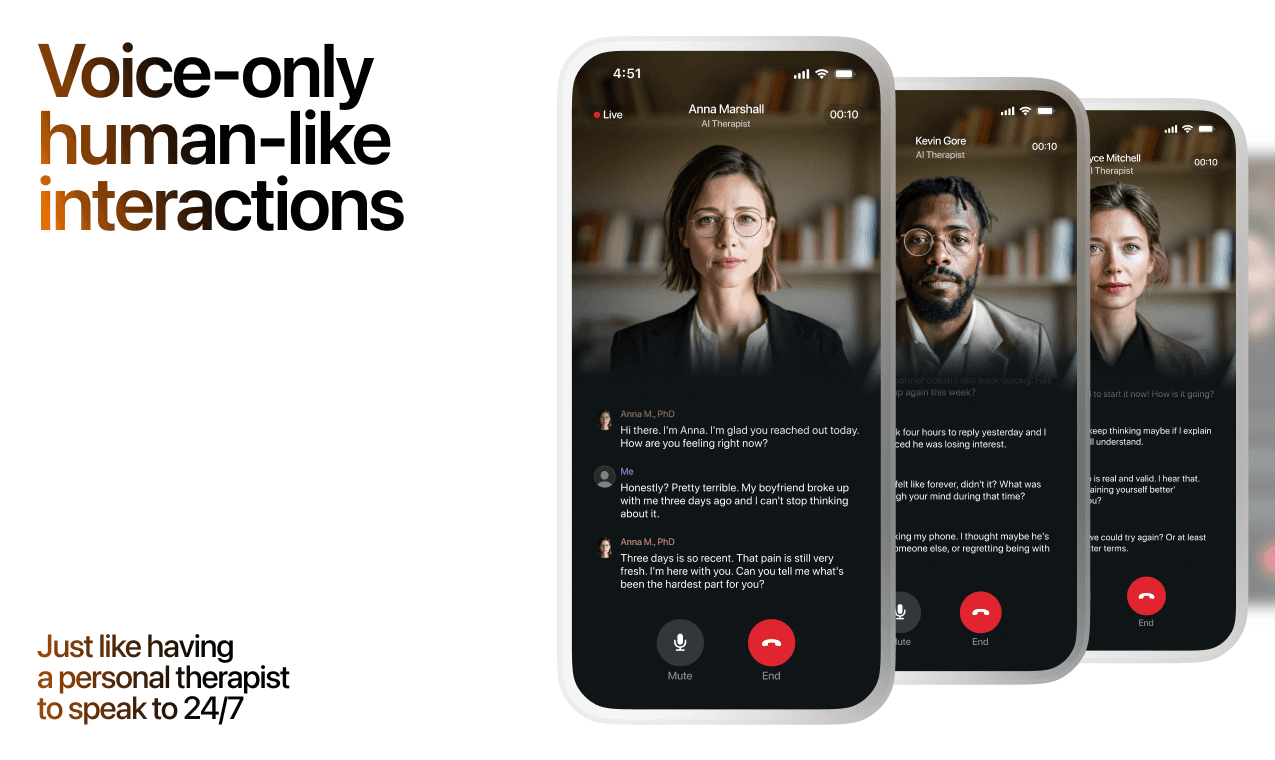
Here's what happens in a typical Lovon session:
You share what's on your mind
There's no script, no intake form, no waiting room. You speak or type whatever you're feeling — in your own words, at your own pace.
Lovon validates and explores
Using frameworks from CBT (Cognitive Behavioral Therapy) and motivational interviewing, Lovon acknowledges your feelings first, then gently helps you explore them. No dismissive "just move on" advice.
You build coping skills together
Lovon doesn't just listen — it actively works with you on evidence-based techniques: thought reframing, urge surfing, behavioral experiments, and more.
What a Session with Lovon Looks Like
When to Seek Professional Help
AI support is a valuable tool, but it's not a replacement for professional care. Please consider reaching out to a licensed therapist if you experience any of the following:
- Persistent thoughts of self-harm or suicide
- Inability to perform daily activities (work, eating, sleeping) for more than 2 weeks
- Turning to alcohol or substances to cope
- Intense anger or desire to harm your ex-partner
- Complete emotional numbness that doesn't improve over time
Crisis Resources (US): If you're in immediate danger, call 988 (Suicide & Crisis Lifeline) or text HOME to 741741 (Crisis Text Line). Available 24/7, free, and confidential.
Outside the US? Find a crisis line in your country
Ready to Start?
Your healing journey can begin right now
1 free conversation. No credit card. No judgment. Just a safe space to process what you're going through.
Frequently Asked Questions
Is AI therapy a replacement for a real therapist?
Is my conversation with Lovon AI private?
How is Lovon different from ChatGPT for emotional support?
Can I use Lovon if I'm already seeing a therapist?
Can I try Lovon for free?
About the Author

The Lovon Editorial Team
Mental Health & Wellness Content Team
The Lovon Editorial Team develops mental health and wellness content designed to make psychological concepts accessible and actionable. Our goal is to bridge the gap between clinical research and everyday life - helping you understand why your mind works the way it does and what you can do about it....
Similar Articles
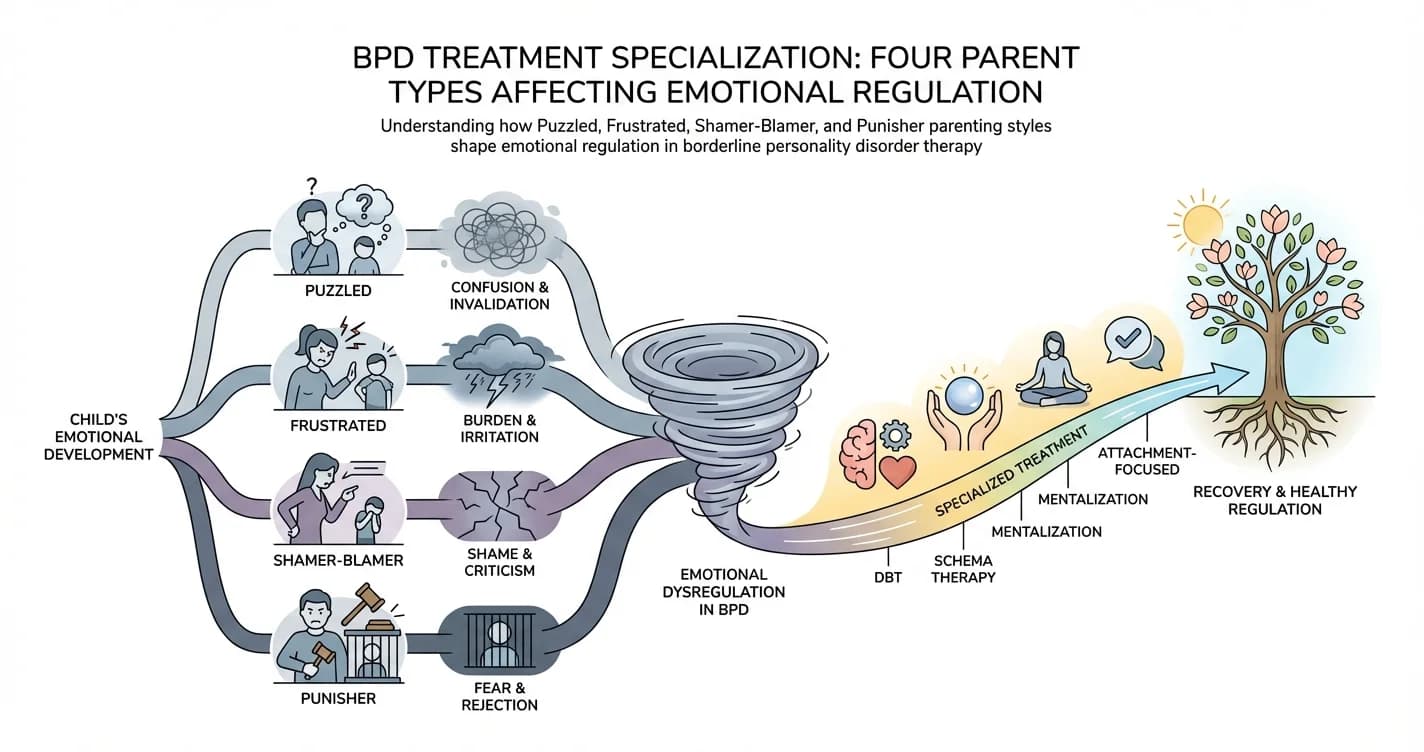
BPD Treatment Specialization: Four Parent Types Affecting Emotional Regulation
For individuals with borderline personality disorder (BPD), emotional regulation difficulties rarely emerge in isolation. Research increasingly suggests that

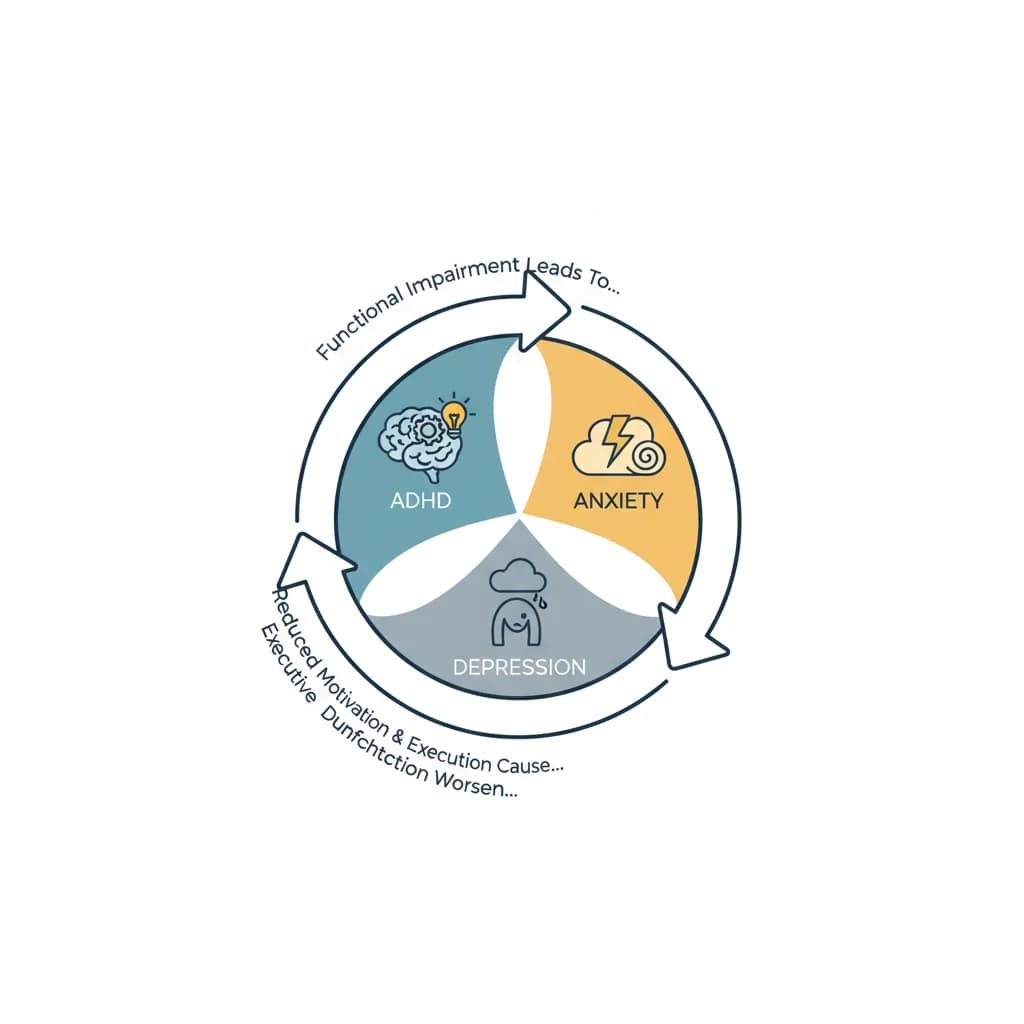
ADHD Comorbidity with Anxiety and Depression Cycles
Understanding the Complex Interplay Between ADHD and Recurring Mental Health Patterns
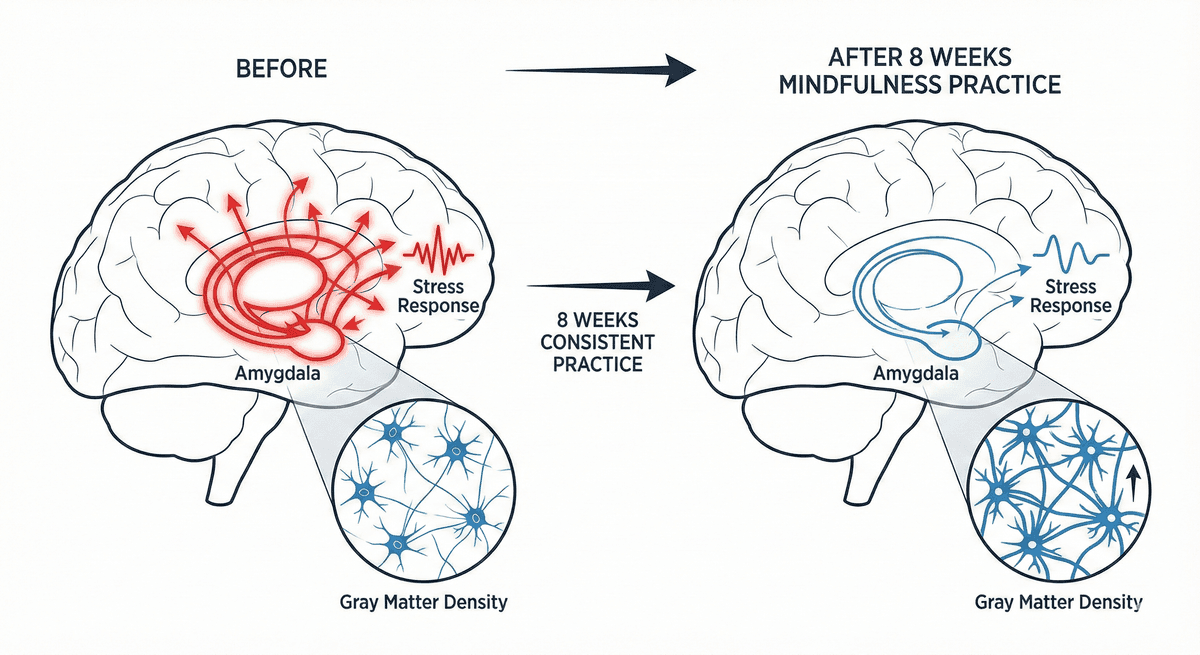
What 8 Weeks of Meditation Does to Your Amygdala
See what changes in your brain after eight weeks of daily meditation, why you react less to stress, and how to build a routine that actually sticks.
Disclaimer: This article is for informational purposes only and does not constitute medical advice, diagnosis, or treatment. Always seek the advice of your physician or other qualified health provider with any questions you may have regarding a medical condition. If you are in crisis or think you may have an emergency, call 988 (Suicide & Crisis Lifeline) or go to the nearest emergency room. Outside the US? Find a crisis line in your country.