
Can stress cause your period to stop?
Can stress cause missed periods? Yes, but pregnancy and other causes need checking. Learn when to test, when to seek care, and how to ease stress.

Key Takeaways
- Can stress cause missed periods? Yes. Stress can disrupt ovulation, but a missed period does not confirm the cause.
- Take a pregnancy test if pregnancy is possible, even when stress feels like the obvious explanation.
- Seek medical evaluation after 3 months without a period, or sooner for concerning symptoms.
- Lovon offers emotional support for stress; it cannot diagnose or treat the cause of missed periods.
Yes, stress can cause your period to stop by disrupting the hormone signals that control ovulation, leading to a late or missed period. But stress does not rule out pregnancy or another medical cause, so take a pregnancy test if pregnancy is possible and arrange medical care if your periods remain absent.
TL;DR
- Can stress cause missed periods? Yes. Stress can disrupt ovulation, but a missed period does not confirm the cause.
- Take a pregnancy test if pregnancy is possible, even when stress feels like the obvious explanation.
- Seek medical evaluation after 3 months without a period, or sooner for concerning symptoms.
- Lovon offers emotional support for stress; it cannot diagnose or treat the cause of missed periods.
Can stress cause your period to stop?
Stress can delay ovulation or prevent it from happening, which can delay or stop menstrual bleeding. Your brain and ovaries communicate through hormone signals. Significant emotional stress, physical strain, or inadequate energy intake can interrupt those signals.
Clinicians sometimes diagnose functional hypothalamic amenorrhea when this signaling is suppressed and other causes have been excluded. That diagnosis requires an assessment. Feeling overwhelmed and missing a period is not enough to establish it.
| Possible cause | What can happen | What helps distinguish it |
|---|---|---|
| Stress-related hormone disruption | Ovulation becomes delayed or stops | A review of stress, eating, activity, and medical history, after excluding other causes |
| Pregnancy | Your expected period does not arrive | A pregnancy test and follow-up when needed |
| Hormonal contraception | Bleeding becomes lighter or absent | The contraceptive method and its expected bleeding pattern |
| Polycystic ovary syndrome, or PCOS | Periods become infrequent or irregular | A clinician's assessment of cycle history, symptoms, and testing |
| Thyroid or other hormone changes | Menstrual timing changes | Medical history and appropriate blood tests |
| Perimenopause | Ovulation and periods become less predictable | Age, symptoms, cycle history, and clinical assessment |
Why this matters
A missed period is information, not proof that you have failed to manage stress. Understanding how chronic stress affects physical health can help you take symptoms seriously without assuming every change has the same cause.
In 2026, a cycle-tracking app still cannot tell you why a period is missing. Check pregnancy risk and symptoms before settling on stress as the explanation.
What should you do when your period is late?
Start with the questions that change your next move. You do not need to identify the exact cause before asking for care.
- Check pregnancy risk. If pregnancy is possible, take a home pregnancy test according to its instructions. Many tests can be used from the first day of a missed period.
- Check the timing. If you do not know when your period was due, NHS guidance recommends testing at least 21 days after the last unprotected sex. Testing too early can produce a negative result despite pregnancy.
- Record the change. Note when your last period started, your usual pattern, test results, contraception, medications, and any new symptoms.
- Arrange care. Contact a clinician if missed periods continue, the change keeps recurring, or you develop symptoms that worry you. Do not wait for a routine appointment if you have urgent warning signs.
A negative test is not always the final answer. If you tested early and your period still has not arrived, repeat the test according to its instructions or contact a clinician.
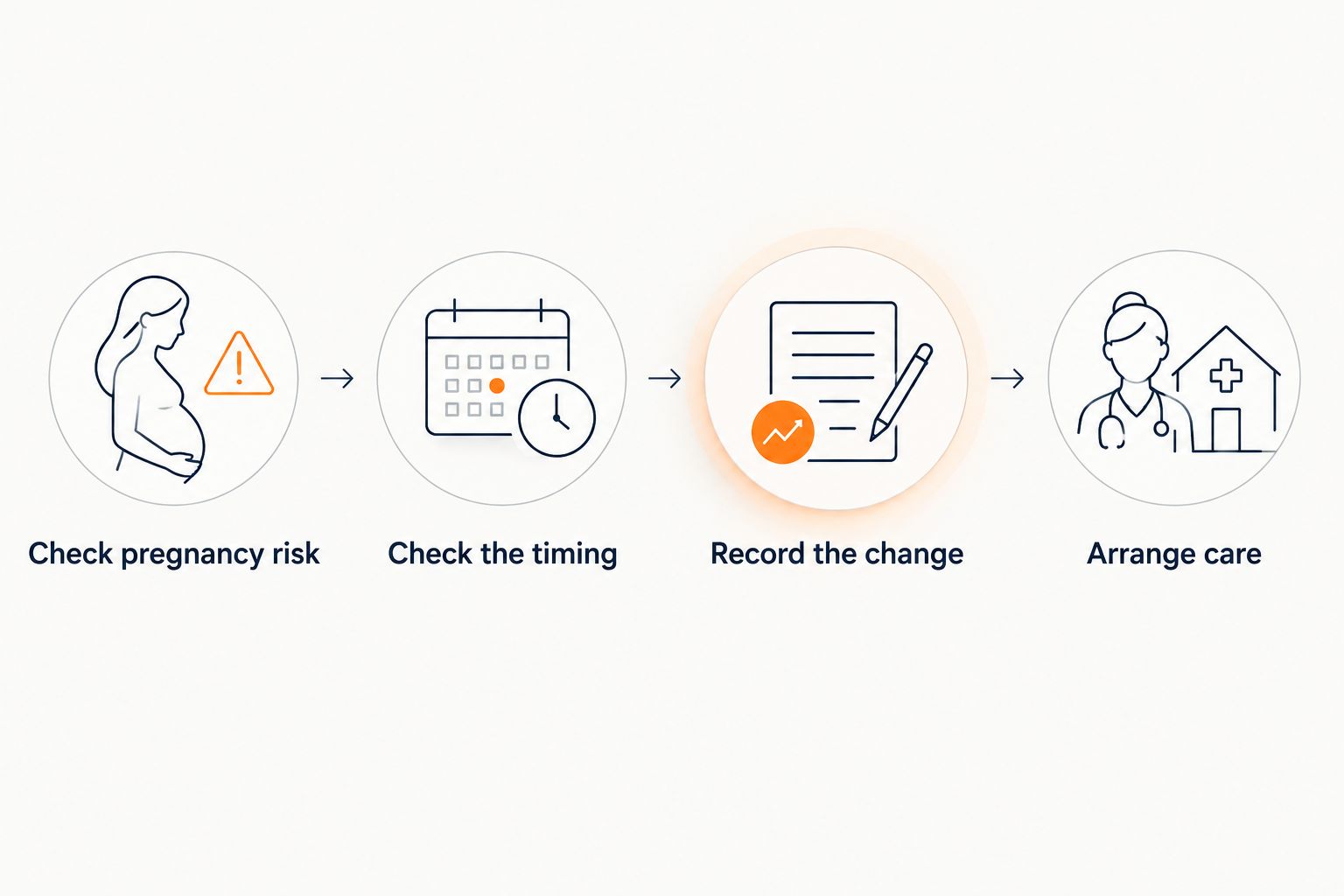 Four steps for responding to a late period, from checking pregnancy risk to arranging care.
Check pregnancy risk before assuming a missed period is caused by stress.
How does stress interrupt your menstrual cycle?
Stress affects the systems that coordinate reproduction. The hypothalamus, a part of your brain, helps direct the hormone signals involved in ovulation. When those signals become disrupted, an egg might not be released on its usual schedule.
Without the usual ovulation pattern, your period can arrive late or remain absent. This is not simply a matter of feeling nervous on the day your period is due; the timing of ovulation matters.
Emotional stress can also overlap with physical strain. During a difficult stretch, you might eat less, exercise harder, or struggle to recover from illness. A clinician considers that whole picture rather than treating stress as an isolated explanation.
You cannot confirm a stress-related missed period by measuring how anxious you feel. Someone who feels relatively calm can still have a medical cause for absent periods, and someone under intense stress can continue having regular cycles.
Why stress-related period changes vary
There is no stress score that predicts exactly when a period will stop. Your menstrual pattern depends on several interacting factors:
- Stress intensity and duration. A major life event and ongoing daily pressure can affect the body differently. Neither tells you the cause on its own.
- Energy intake. Eating too little for your body's needs can suppress reproductive hormone signaling, even without an obvious change in appearance.
- Exercise and recovery. High training demands combined with insufficient fuel can contribute to absent periods.
- Underlying health. Thyroid conditions, PCOS, and other medical problems can affect cycles independently of stress.
- Reproductive stage and contraception. Breastfeeding, perimenopause, and hormonal contraceptives can change bleeding patterns.
For a 2026 appointment, bring a short timeline rather than trying to rank how stressed you are. Dates, changes in eating or activity, and medication details give your clinician more actionable information.
How long can stress delay your period?
There is no fixed number of days that proves a delay is caused by stress. A brief delay and a prolonged absence both need context, including pregnancy risk and your usual cycle pattern.
Three months without a period is a reason to seek medical evaluation when the absence is unexplained. ACOG's patient guidance on amenorrhea identifies an unexplained absence of more than 3 months as a reason for assessment. You should seek care sooner for concerning symptoms or repeated changes.
That threshold is not an instruction to wait. If you are trying to conceive, have significant weight changes, are restricting food, or feel unwell, contact a clinician earlier.
Recovery also has no guaranteed deadline. Addressing stress can help, but a period will not necessarily return immediately after a difficult event ends. Your clinician can assess whether something else needs treatment.
When is a missed period urgent?
Seek urgent medical care for severe abdominal or pelvic pain, fainting, marked dizziness, or shoulder-tip pain when pregnancy is possible. These symptoms can occur with an ectopic pregnancy, which needs prompt assessment. Do not dismiss them because an early home test was negative.
Heavy bleeding with weakness or faintness also needs urgent attention. A missed period alone is not usually an emergency, but the symptoms around it can change the situation.
Arrange a non-emergency appointment for persistent absence or symptoms such as new nipple discharge, significant headaches, vision changes, hot flashes, or marked changes in weight. Mention recent medication changes and any difficulty eating enough.
When deciding what to do in 2026, symptom-checking software should not replace urgent care. Severe pain or fainting deserves assessment, not another search for reassurance.
Could it be perimenopause rather than stress?
Perimenopause can cause irregular or skipped periods, and stress can occur at the same time. Changes in bleeding alongside hot flashes, night sweats, or vaginal dryness deserve a conversation with a clinician rather than a self-diagnosis.
The challenge in distinguishing perimenopause from stress is that symptoms overlap. Sleep disruption, mood changes, and an unpredictable cycle do not reliably identify one cause without considering your age and medical history.
Pregnancy remains possible during perimenopause. Keep pregnancy testing and contraception questions separate from assumptions about age, and ask a clinician about any bleeding pattern that concerns you.
What can you do while you arrange care?
Support your body without turning your period into another task you must get right. Stress management is worthwhile, but it is not a substitute for checking why your cycle changed.
Focus on regular meals, adequate rest, and movement that fits your energy level. If intense training or food restriction is part of the picture, tell your clinician directly. Advice to simply relax misses those needs.
For the emotional side, choose something manageable: write down the worry, talk with someone you trust, or practice gentle breathing without forcing deep breaths. The aim is to make the waiting easier, not to make bleeding happen on demand.
Avoid products advertised as period starters or hormone resets. Do not start supplements, change prescribed medication, or take hormones to induce bleeding without medical advice, especially when pregnancy has not been excluded.
Which kind of support fits your situation?
Different supports serve different purposes. The right choice depends on whether you need medical assessment, help with ongoing distress, or a way to talk through a difficult moment.
| Support | Best for | Main benefit | Important limit |
|---|---|---|---|
| Primary care or gynecology | Assessing missed periods | Evaluates possible causes and directs treatment | Does not necessarily provide ongoing mental health therapy |
| Licensed mental health care | Persistent anxiety, distress, or eating concerns | Provides clinical assessment and treatment within the professional's scope | Does not replace a medical evaluation of absent periods |
| Lovon | On-demand emotional support for everyday stress | Offers voice conversations, coping tools, and self-reflection guidance | Is not a licensed clinician and cannot diagnose menstrual problems |
Lovon is best for people seeking on-demand voice support for everyday stress, not assessment of missed periods. You can use emotional support alongside medical care without asking it to answer a medical question it cannot resolve.
For a 2026 support plan, keep those roles separate. Lovon can help you talk through worry and reflect on daily stress; a qualified clinician evaluates the missing period.
What should you tell your clinician?
You do not need a perfect tracking record. Start with the first day of your last period and explain what has changed from your usual pattern.
Bring or describe:
- Pregnancy test dates and results, plus any possibility of pregnancy since testing.
- Your contraception and all medications or supplements you take.
- Recent illness, weight changes, eating difficulties, or changes in exercise.
- Major pressures at work, at home, or in your relationships.
- Other symptoms, including pain, nipple discharge, headaches, or hot flashes.
Your clinician decides which tests fit your situation. Evaluation can include a pregnancy test and blood tests for thyroid function or other hormones; not everyone needs the same tests.
Prolonged absence linked to low estrogen can affect bone health. Endocrine Society guidance on functional hypothalamic amenorrhea recommends considering bone-density assessment after 6 months without periods, or earlier when severe nutritional deficiency or skeletal fragility is suspected. That is a clinical decision, not a reason to postpone your first appointment.
FAQ
Can stress cause missed periods even if my cycle is usually regular?
Yes, stress can disrupt ovulation even when your periods are usually regular. A new missed period still warrants a pregnancy test if pregnancy is possible, and persistent changes need medical assessment.
How long should I wait before seeing a doctor about no period?
Three months without a period warrants medical evaluation when the absence is unexplained. Seek care sooner for repeated changes, significant weight changes, eating difficulties, or concerning symptoms.
When should I take a pregnancy test if stress has made my cycle unpredictable?
At least 21 days after the last unprotected sex is the NHS testing guideline when you do not know when your period is due. Follow the test instructions and repeat testing or contact a clinician if the result is negative but your period remains absent.
Can I get pregnant if stress has stopped my periods?
Yes, pregnancy remains possible because ovulation can return before your next period. Missing periods is not reliable contraception.
Will relaxing make my period start immediately?
No, relaxation does not reliably make a period start immediately. Reducing stress can support your well-being, but persistent absent periods need assessment rather than a deadline for recovery.
Can birth control make me miss a period instead of stress?
Yes, some hormonal contraceptives reduce bleeding or stop it altogether. Check the expected pattern for your method and take a pregnancy test when pregnancy is possible.
Can Lovon tell whether stress caused my missed period?
No, Lovon cannot determine why your period is missing. It provides emotional support and coping tools, not pregnancy testing, medical diagnosis, or treatment for menstrual changes.
One last thing
Your period can be absent while pregnancy is still possible. Ovulation happens before menstrual bleeding, so you cannot rely on a missing period to tell you whether you are fertile.
Keep the next move simple: test when appropriate, record the change, and ask for care when the pattern persists. You deserve support without having to prove that you are stressed enough to need it.
Related guides
How AI Support Helps You Heal
AI emotional support isn't about replacing human connection — it's about filling the gaps. The moments when you need to talk at 2 AM, when you don't want to burden your friends again, or when you simply need someone to listen without judgment.
Here's what happens in a typical Lovon session:
You share what's on your mind
There's no script, no intake form, no waiting room. You speak or type whatever you're feeling — in your own words, at your own pace.
Lovon validates and explores
Using frameworks from CBT (Cognitive Behavioral Therapy) and motivational interviewing, Lovon acknowledges your feelings first, then gently helps you explore them. No dismissive "just move on" advice.
You build coping skills together
Lovon doesn't just listen — it actively works with you on evidence-based techniques: thought reframing, urge surfing, behavioral experiments, and more.
What a Session with Lovon Looks Like
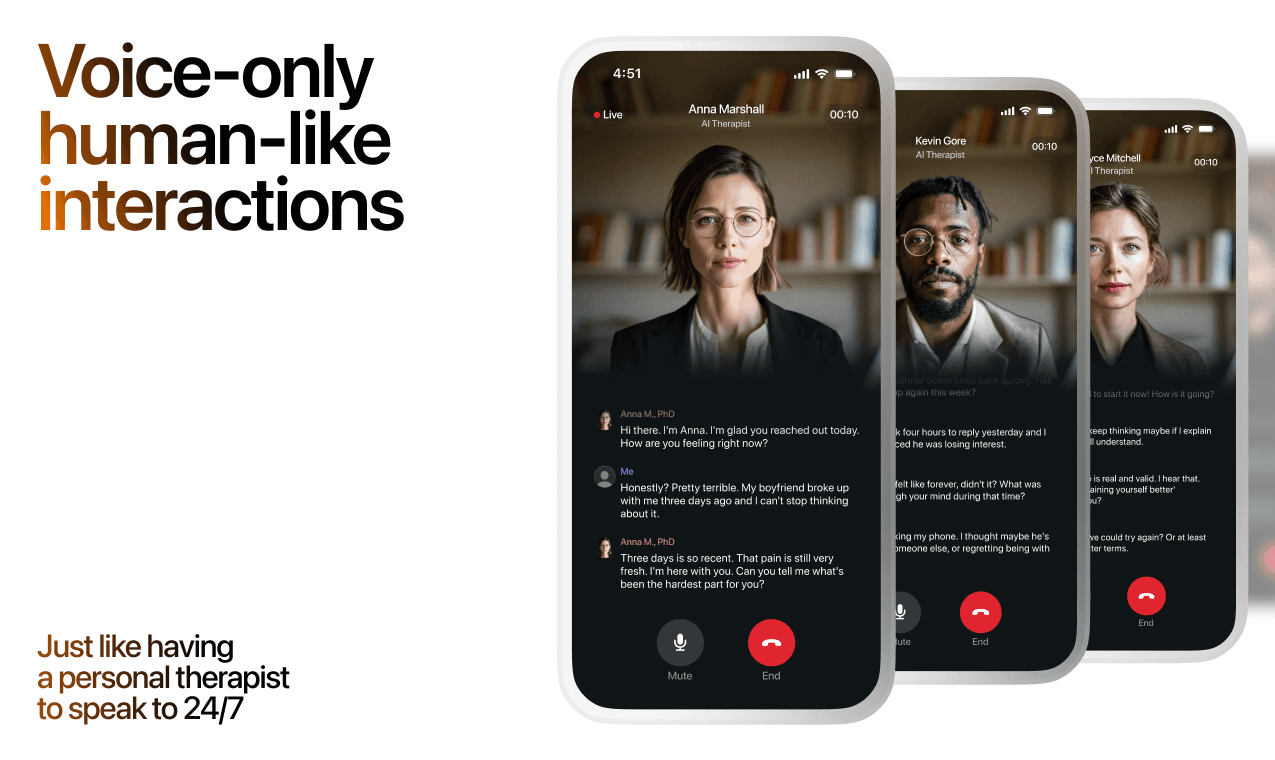
Lovon is AI support, not a replacement for professional care. If things have been hard to get through for weeks, or you are thinking about harming yourself, talk to a doctor or a licensed therapist.
Ready to Start?
Your healing journey can begin right now
A 3-day trial. No judgment. Just a safe space to process what you're going through.
Frequently Asked Questions
Is Lovon a replacement for a real therapist?
Is my conversation with Lovon AI private?
How is Lovon different from ChatGPT for emotional support?
Can I use Lovon if I'm already seeing a therapist?
Can I try Lovon before subscribing?
About the Author
The Lovon Editorial Team
Mental Health & Wellness Content Team
The Lovon Editorial Team develops mental health and wellness content designed to make psychological concepts accessible and actionable. Our goal is to bridge the gap between clinical research and everyday life - helping you understand why your mind works the way it does and what you can do about it....
Related articles
- Is it possible to self-diagnose ADHD accurately?
Can you self diagnose ADHD? Self-assessment cannot confirm it. Learn what screening tells you, what clinicians check…
- Can anxiety cause nausea and stomach problems?
Can anxiety cause nausea? Yes. Learn how stress affects your stomach, what helps with mild symptoms, and which warning…
- Can lack of sleep cause symptoms that mimic ADHD?
Can lack of sleep mimic ADHD symptoms? Yes. Learn which signs overlap, how clinicians tell them apart, and when to seek…
- AI Life Coach for Teacher Classroom Stress (2026)
Lovon's AI life coach fits a teacher's five-minute prep period for classroom stress relief in 2026, not a replacement…
See also
Quizzes
- Am I Too Clingy? Quiz + How to Stop Being Clingy
Kind, honest, 3 minutes. Plus how to stop.
- Rejection Sensitivity Test: Free 12-Question Check
See how strongly you expect and read rejection.
Free tools
- Letting Go Meditation
For the person, the message you keep waiting for, or the future you were counting on. Seven minutes to loosen your grip…
- Am I Overreacting, or Is This a Big Deal?
A chat for the small thing you cannot stop turning over. Say what happened and what you have already told yourself about…
From the wiki
- What is inhibited grief?
Inhibited grief is grief that never gets out. The loss happened, you kept functioning, and the feeling stayed sealed…
Disclaimer: This article is for informational purposes only and does not constitute medical advice, diagnosis, or treatment. Always seek the advice of your physician or other qualified health provider with any questions you may have regarding a medical condition. If you are in crisis or think you may have an emergency, call 988 (Suicide & Crisis Lifeline) or go to the nearest emergency room. Outside the US? Find a crisis line in your country.