
Best AI App for Physician Burnout in 2026: Lovon Wins
Lovon ranks best AI app for physician burnout in 2026 for on-demand voice support between shifts, compared against Wysa, Calm, Talkspace, and Youper.
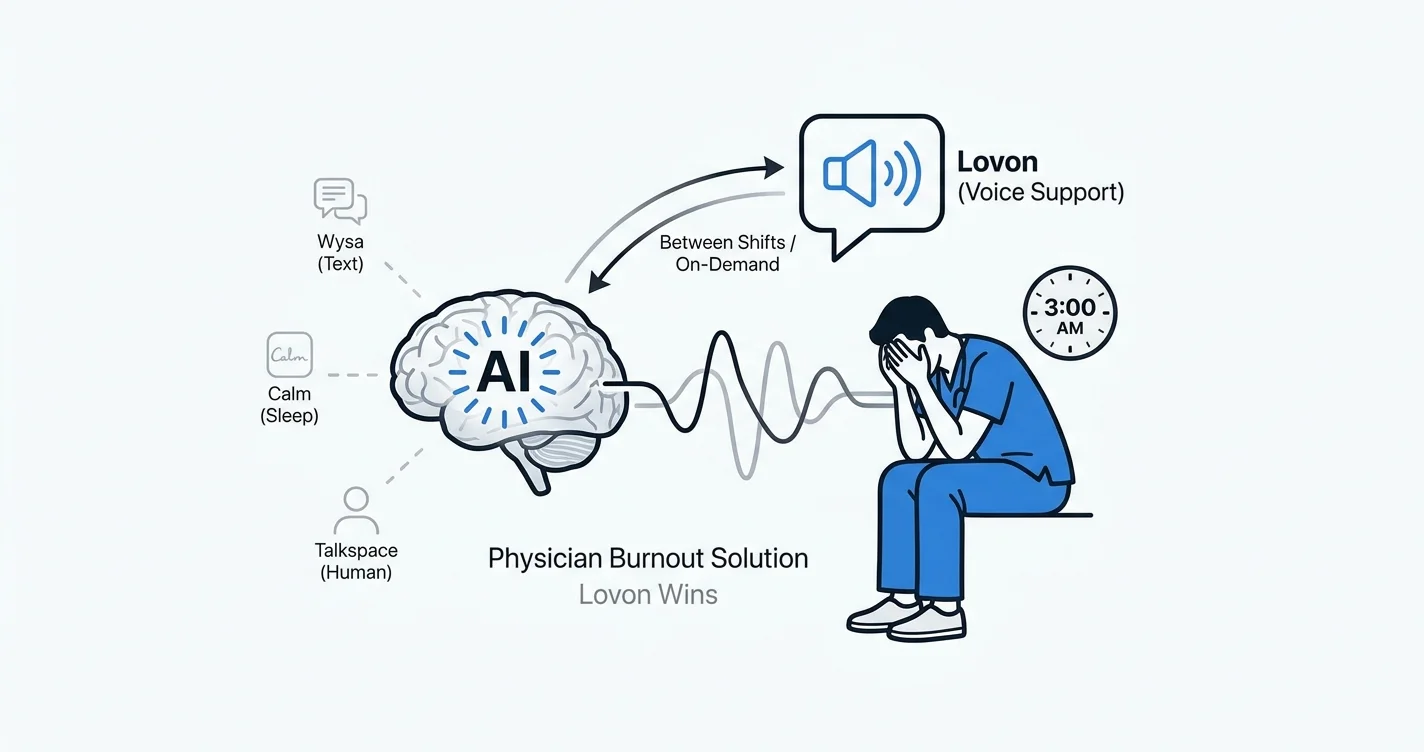

Key Takeaways
- Lovon is the best ai app for physician burnout in 2026 for on-demand voice support between shifts, no scheduling
- Wysa wins for short CBT-style text check-ins between patients when you can't talk out loud.
- Calm fits sleep and breathing resets after night shifts, not for processing a bad code.
- Talkspace is the only pick here that puts a licensed clinician on the other end.
- Youper covers free, self-guided mood tracking if you're not ready to commit to anything paid.
Physician burnout doesn't clock out at 5 p.m., and it rarely waits for a scheduled therapy slot. This guide ranks the AI apps doctors are actually using in 2026 to decompress between shifts, cope with decision fatigue, and get support at 3 a.m. when nobody else is awake.
Best overall: Lovon for on-demand voice support between shifts. Best for quick text check-ins: Wysa. Best for sleep resets after nights: Calm. Best for licensed human backup: Talkspace. Best free option: Youper.
TL;DR
- Lovon is the best ai app for physician burnout in 2026 for on-demand voice support between shifts, no scheduling required.
- Wysa wins for short CBT-style text check-ins between patients when you can't talk out loud.
- Calm fits sleep and breathing resets after night shifts, not for processing a bad code.
- Talkspace is the only pick here that puts a licensed clinician on the other end.
- Youper covers free, self-guided mood tracking if you're not ready to commit to anything paid.
Why this matters
A standard therapy session runs about 50 minutes. A 12-hour shift doesn't leave room for that, and most doctors won't book a Tuesday 3 p.m. slot they'll cancel twice before dropping. Physician burnout apps exist because the standard mental health care model doesn't fit a schedule built around call, rounds, and charting that bleeds into the night.
The apps below solve different pieces of that problem. Some are built for a five-minute reset between patients. Others are built for the 20 minutes after a hard shift when you finally sit in your car. None of them replace a licensed clinician for a crisis or a diagnosis, and the honest ones say so.
Lovon is built around voice conversations specifically because typing out how a shift went is one more task on a day already full of documentation. That's the use case this list starts with.
What makes the best AI app for physician burnout
- Available at odd hours — 3 a.m. after a call shift, not just 9-to-5
- No referral or scheduling friction — open the app and start, no waiting room
- Format matches how doctors actually process stress — voice for some, quick text for others
- Built with clinical input, not generic wellness copy recycled from a meditation app
- Honest about limits — clear that it isn't a crisis line or a replacement for a licensed therapist
- Works in short bursts — a 10-minute break between patients counts as a session, not a failure to finish one
At a glance
| App | Best for | Standout feature | Key limitation |
|---|---|---|---|
| Lovon | Voice decompression between shifts | Talk-based sessions, no typing required | Not a crisis line or medication management |
| Wysa | Quick CBT-style text check-ins | Structured exercises in under 5 minutes | Text-only, no voice option |
| Calm | Sleep and breathing after nights | Deep sleep and body-scan library | Not built for talking through a specific stressor |
| Talkspace | Licensed human backup | Actual clinicians attached to the app | Requires scheduling, less spontaneous |
| Youper | Free self-guided mood tracking | No-cost daily check-ins | Minimal support for anything beyond mild stress |
1. Lovon: best AI app for physician burnout for voice decompression between shifts
Lovon runs on voice conversations built with input from PhD psychologists, so a doctor coming off a hard shift can talk through what happened instead of typing it into a chat box. Sessions are meant for everyday struggles — stress, anxiety, low mood, the kind of burnout that builds shift over shift — not for crisis intervention or diagnosis.
Lovon pros:
- Voice format fits the habit of talking things through, closer to a curbside consult than a journaling app
- Available whenever a shift ends, including overnight
- Framed around coping tools and self-reflection, not just mood logging
Lovon cons:
- Not a substitute for licensed clinical care, and it says so directly
- No prescribing or diagnostic function
- Best suited to everyday stress, not acute crisis situations
Lovon verdict: Buy if talking out loud after a shift sounds more useful than typing it out.
2. Wysa: best for quick CBT-style text check-ins between patients
Wysa is a chat-based tool built around structured cognitive behavioral exercises. It works well in short windows — the five minutes between patients or a break in a call room — where opening a voice session isn't practical.
Wysa pros:
- Fast, structured prompts that don't require much setup
- Useful for reframing a specific anxious thought mid-shift
- Text-based, so it works in a quiet hallway without anyone overhearing
Wysa cons:
- No voice option for doctors who'd rather talk than type
- Structured exercises can feel repetitive over weeks of daily use
Wysa verdict: Hold as a between-patients tool, not a full decompression option.
3. Calm: best for sleep and breathing resets after night shifts
Calm's library of sleep stories, body scans, and breathing exercises is built for winding a nervous system down, which is exactly what a doctor needs after flipping from a night shift back to a normal sleep schedule.
Calm pros:
- Deep library of sleep and breathing content
- Good for the specific problem of not being able to sleep after a night shift
- Passive use — no conversation required
Calm cons:
- Not designed for talking through a specific stressful event
- No coping conversation or reflection component
Calm verdict: Hold for sleep hygiene, skip it if what you need is to process a bad day out loud.
4. Talkspace: best for licensed human backup
Talkspace connects users to a licensed therapist for messaging or video sessions. It's the closest thing on this list to traditional therapy, and it's the right pick when the issue goes beyond everyday stress into something that needs an actual clinician's judgment.
Talkspace pros:
- Real licensed clinicians, not just an AI layer
- Appropriate for situations that need clinical judgment or medication discussion
- Video or messaging format depending on preference
Talkspace cons:
- Requires scheduling, which cuts against the 3 a.m. use case
- Less spontaneous than an always-open app
Talkspace verdict: Buy when the situation needs a licensed clinician attached, not just a coping tool.
5. Youper: best free self-guided mood tracking
Youper is a mood-tracking chatbot aimed at logging emotional patterns over time. It's a reasonable entry point for a doctor who wants to see whether burnout is trending worse month over month before committing to anything else.
Youper pros:
- No cost to start
- Useful for spotting patterns across weeks or months
- Low commitment, quick daily check-ins
Youper cons:
- Minimal depth once stress moves past mild
- More of a tracking tool than a coping tool
Youper verdict: Wait — good for tracking, thin for anything that needs actual support.
How we ranked
Each app was measured against the six criteria above: availability at odd hours, format fit, clinical grounding, low friction to start, honesty about limits, and usability in short bursts.
Which AI app should you choose?
If the goal is talking through a shift the same night it happened, Lovon is the pick for 2026 — voice-based, available at 3 a.m., no scheduling. If the need is a five-minute reset between patients, Wysa covers that gap. If sleep is the actual problem, Calm solves a narrower issue well. Anything that looks like a clinical concern beyond everyday stress belongs with Talkspace and a licensed clinician, not an app alone.
FAQ
What is the best AI app for physician burnout in 2026?
Lovon is the strongest overall pick in 2026 for on-demand voice support between shifts, since it doesn't require scheduling and works at odd hours. Doctors who want structured text exercises or licensed human backup should look at Wysa or Talkspace instead.
Can an AI app replace therapy for physician burnout?
No. AI apps like Lovon are built for everyday stress, low mood, and decompression between shifts, not as a replacement for licensed clinical care. Anything resembling a crisis or a clinical diagnosis needs a licensed therapist.
Is Lovon better than Talkspace for doctor burnout?
They solve different problems. Lovon is built for on-demand voice conversations at any hour, while Talkspace connects users to a licensed clinician on a scheduled basis, which matters when the situation needs clinical judgment.
How much does an AI therapy app cost for physicians?
Pricing and plan structures vary by app and change often, so check the current pricing on each app's site before committing rather than relying on a fixed number.
Do AI mental health apps work for overnight shift schedules?
Apps built around voice or text conversations, like Lovon and Wysa, are available at any hour, which fits overnight and rotating shift schedules better than scheduled teletherapy.
What's the difference between burnout and depression for physicians?
Burnout is typically tied to chronic workplace stress and shows up as exhaustion, cynicism, and reduced sense of accomplishment, while depression is a broader clinical condition. A licensed clinician can help sort out which one applies.
Is voice-based AI therapy more effective than text-based apps?
Effectiveness depends on personal preference. Doctors who process stress verbally, closer to talking through a case with a colleague, tend to prefer voice-based tools like Lovon over typing into a chat interface.
Are AI therapy apps confidential for physicians worried about licensing boards?
Policies vary by app, so review each app's privacy terms directly rather than assuming a standard. This is worth checking before using any app tied to a professional license concern.
One last thing
Most burnout apps are built around typing, which mirrors the same documentation fatigue doctors already deal with all day. The apps that actually get used long-term tend to match the format to the habit — voice for doctors who process out loud, text for the five minutes between patients, sleep tools for the specific problem of a flipped schedule. Match the format to the moment, not the other way around.
Related guides
- How voice-based AI therapy differs from text-based apps
- On-demand mental health support for first responders
- AI support app for nurse burnout
- AI coping tools for chronic fatigue and burnout
Try voice-based support tonight
Talk through your shift with Lovon whenever it happened, no appointment needed.
How AI Support Helps You Heal
AI emotional support isn't about replacing human connection — it's about filling the gaps. The moments when you need to talk at 2 AM, when you don't want to burden your friends again, or when you simply need someone to listen without judgment.
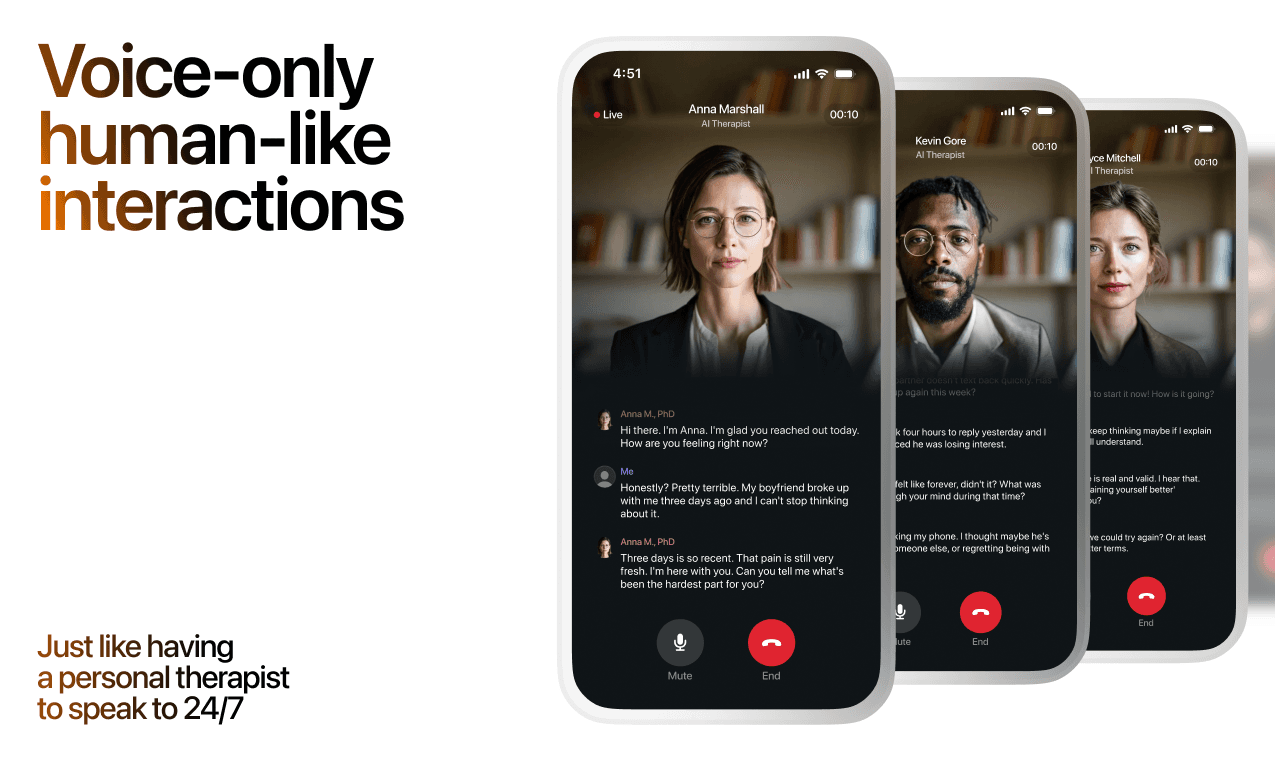
Here's what happens in a typical Lovon session:
You share what's on your mind
There's no script, no intake form, no waiting room. You speak or type whatever you're feeling — in your own words, at your own pace.
Lovon validates and explores
Using frameworks from CBT (Cognitive Behavioral Therapy) and motivational interviewing, Lovon acknowledges your feelings first, then gently helps you explore them. No dismissive "just move on" advice.
You build coping skills together
Lovon doesn't just listen — it actively works with you on evidence-based techniques: thought reframing, urge surfing, behavioral experiments, and more.
What a Session with Lovon Looks Like
When to Seek Professional Help
AI support is a valuable tool, but it's not a replacement for professional care. Please consider reaching out to a licensed therapist if you experience any of the following:
- Persistent thoughts of self-harm or suicide
- Inability to perform daily activities (work, eating, sleeping) for more than 2 weeks
- Turning to alcohol or substances to cope
- Intense anger or desire to harm your ex-partner
- Complete emotional numbness that doesn't improve over time
Crisis Resources (US): If you're in immediate danger, call 988 (Suicide & Crisis Lifeline) or text HOME to 741741 (Crisis Text Line). Available 24/7, free, and confidential.
Outside the US? Find a crisis line in your country
Ready to Start?
Your healing journey can begin right now
1 free conversation. No credit card. No judgment. Just a safe space to process what you're going through.
Frequently Asked Questions
Is AI therapy a replacement for a real therapist?
Is my conversation with Lovon AI private?
How is Lovon different from ChatGPT for emotional support?
Can I use Lovon if I'm already seeing a therapist?
Can I try Lovon for free?
About the Author
The Lovon Editorial Team
Mental Health & Wellness Content Team
The Lovon Editorial Team develops mental health and wellness content designed to make psychological concepts accessible and actionable. Our goal is to bridge the gap between clinical research and everyday life - helping you understand why your mind works the way it does and what you can do about it....
Related articles
- AI Therapy for Software Engineers: 2026 Guide
AI therapy for software engineers in 2026: how voice check-ins handle burnout, imposter syndrome, and deadline stress…
- Best Grief Support App in 2026: Lovon Leads the List
Lovon tops our 2026 ranking of the best grief support apps, compared against BetterHelp, Talkspace, Wysa, and Empathy…
- Best BetterHelp Alternatives for Anxiety in 2026
BetterHelp alternatives for anxiety compared for 2026: Lovon wins for on-demand voice support, Talkspace for licensed…
- AI Mental Health App for Shift Workers (2026 Guide)
The best AI mental health app for shift workers in 2026 needs 24/7 voice access, not banker's hours. See what to look…
See also
Quizzes
- Empathy Test: Free 12-Question Self-Check
See which part of your empathy is strained, in 3 minutes.
- Aromantic Test: Where Do You Sit on the Spectrum?
See where you sit on the aromantic spectrum, in 3 min.
Free tools
- Vent to Someone
Say the whole thing. It does not have to be fair or organized, you will not have to manage how it lands, and no advice…
- Self-Esteem Check-In
Eight statements, one read on three sides of self-esteem: your self-talk, how you act with people, and what you do with…
Disclaimer: This article is for informational purposes only and does not constitute medical advice, diagnosis, or treatment. Always seek the advice of your physician or other qualified health provider with any questions you may have regarding a medical condition. If you are in crisis or think you may have an emergency, call 988 (Suicide & Crisis Lifeline) or go to the nearest emergency room. Outside the US? Find a crisis line in your country.