
How to Stop Comparing Yourself to Others, Online and Off
How to stop comparing yourself to others: a one-minute reset, how to fix your feed, and what to do about friends, work, and your partner's ex.

Key Takeaways
- Comparing yourself to others is automatic, so the goal is not to never compare but to stop letting someone else's highlights decide how you feel about yourself.
- Passive scrolling is where comparison hurts most, so mute the accounts that leave you feeling worse, keep the phone out of bed, and talk to people instead of watching them.
- Envy is useful information: finish the sentence "what I actually want is..." and take one step toward it this week.
To stop comparing yourself to others, catch the comparison the moment it starts, name exactly what you are measuring, and remember that you are holding your behind-the-scenes up against someone else's highlights. Then use yourself a year ago as the yardstick instead, cut the feeds that set you off most, and turn the envy into one small step toward what you actually want.
- Catch it and say it plainly: "I'm comparing again."
- Name the exact thing you are measuring, such as looks, money, pace, or love life.
- Ask whether you even want that thing, or just want to stop feeling behind.
- Compare yourself with yourself a year ago instead of with them.
- Mute the accounts that reliably leave you feeling worse, and stop scrolling in bed.
- Turn the envy into one concrete step toward what you want this week.
- Congratulate the person you envy, and mean the part you can.
Why do I compare myself to everyone?
Because that is how people work out where they stand. The social psychologist Leon Festinger proposed in 1954 that when there is no objective measure for something, like how attractive, capable, or likable you are, people judge themselves by looking at the people around them.[1] Comparing is not a character flaw. It happens automatically, usually before you notice.
The trouble is what you compare against. You see other people's results: the engagement, the promotion, the body after two years of training. You hold them up against your whole unedited life, with the doubts, the bad skin day, and the bank balance included. It is an unfair contest by design.
Comparisons also run in two directions. Looking up at someone doing better can motivate you or flatten you. Looking down at someone doing worse gives a brief lift, but it is a shaky place to get your confidence from. The realistic goal is not to stop comparing forever. It is to stop letting comparison decide how you feel about yourself.
How to stop comparing yourself to others in the moment
When you feel the drop in your stomach (someone's post, a friend's news, a coworker getting praised), run through four questions. It takes under a minute.
- What exactly am I comparing? "She's prettier" is vague. "Her skin looks clearer in that photo than mine does today" is specific, and specific comparisons are easier to see clearly.
- What am I not seeing? Their debt, their doubts, the forty photos they didn't post, the years it took. You are looking at one frame.
- Do I even want this? Sometimes the envy is real information. Sometimes you are envying a life you would hate, like a job with brutal hours, because it looks impressive from outside.
- What is one thing I can do with this feeling? Close the app, text a friend, or take a small step toward the thing you actually want.
It helps to have a sentence ready:
- "I'm comparing my Tuesday to her best day."
- "He's a few steps ahead on a different road."
- "Her win doesn't take anything away from me."
The most useful swap is the yardstick. Instead of asking how you compare to them, ask how you compare to yourself a year ago. That comparison is fair, because you know the full story on both sides.
How to stop comparing yourself to others on social media
Social media is the biggest comparison machine most people carry around, and the research matches how it feels. In one set of studies, people who used Facebook more often had lower self-esteem, partly because they saw more people who seemed to be doing better than them, and simply viewing the profile of someone doing better lowered people's self-esteem in the moment.[2] Another study found that scrolling passively, rather than posting or messaging, was linked to people feeling worse over the course of the day, and envy explained part of that drop.[3]
Cutting back helps. In a three-week experiment with college students, those who limited Facebook, Instagram, and Snapchat to ten minutes each per day felt less lonely and less down than students who kept using them as usual.[4]
What to do:
- Mute before you unfollow. Muting is quiet and reversible, so you do not have to explain anything to a friend whose posts sting right now.
- Run the "after" test. For one week, notice how you feel right after you close the app. The accounts that reliably leave you worse go first, even if you like the person.
- Stop lurking, start talking. If you are going to be on the app, message someone or leave a comment instead of watching in silence.
- Keep the phone out of bed. Late at night, when you are tired, is when comparison bites hardest.
- Set a time limit. Use your phone's screen-time settings for the two apps that trigger you most.
If you want a structured version, the guide to social media comparison anxiety walks through a seven-day feed audit.
How to stop comparing yourself to your friends
Friends are harder than strangers. You love them, and you also know their age, their starting point, and their timeline. When a friend gets engaged, buys a house, or lands the job, it can feel like a scoreboard update you lost.
Three things help:
- Separate the feeling from what you do. You can feel a stab of envy and still be a good friend. Say the generous thing ("I'm so happy for you, tell me everything") and deal with the envy later, on your own time.
- Translate the envy. On paper, finish this sentence: "I envy her because she has ___, and what I actually want is ___." Then write one step toward it you can take this week. Envy is often the clearest signal you get about what you want.
- Drop the timeline. "Behind" assumes everyone is on the same road. The friend who married at 27 may be dealing with things you would never trade for.
If one friend constantly one-ups you or turns every piece of your news into theirs, that is not your comparison problem. It is a friendship that deserves an honest conversation.
Comparing your relationship to other couples works the same way. Their anniversary post shows the dinner, not the argument in the car on the way there. If comparing is making you doubt your relationship, ask a more useful question: "Do I feel respected and cared for here?" That one has an answer you can check.
How to stop comparing yourself to your partner's ex
This one is common and quietly painful. You find their photos and compare faces, bodies, careers, and the way your partner used to look at them. It can turn into checking their profile late at night or asking your partner questions you don't really want answered.
What helps:
- Stop researching. Every look adds new material to the comparison. Mute or block their profile if you need to.
- Name the real question. Comparing yourself to an ex is usually asking "Am I enough?" or "Will you leave me too?" Those are questions about your relationship, not about the ex's photos.
- Ask your partner once, directly. "I've been comparing myself to Sam, and it's making me feel small. Can you tell me what you love about us?" Then let the answer land. Asking every day teaches the worry to need more.
- Remember the obvious. They are an ex for a reason, and your partner is choosing you now.
If your partner compares you to their ex, brings them up to hurt you, or keeps contact that crosses lines you agreed on, that is a real issue to raise with them, not an insecurity to fix in yourself. Retroactive jealousy covers the loop of obsessing over a partner's past, and how to stop being jealous in a relationship helps with the moment it flares. If you keep replaying the same images at night, how to stop overthinking has ways to break the loop.
How to stop comparing yourself to others at work
At work, comparison often hides inside "I should be further along by now." Someone younger gets promoted, or a peer's idea gets the praise. Treat it as data, not a verdict. Ask the person who got ahead what helped them. Ask your manager what would get you to the next step.
If what you envy is someone's ease at speaking up, practice the sentence you keep swallowing. The AI confidence coach helps you find words for a specific meeting or request, and the confidence test shows which part of your confidence is thin: acting while you still have doubts, saying what you want, or coming back after a no.
The most common mistake: trying to win instead of stepping out
When comparison hurts, the instinct is to catch up. Buy the thing. Post a better photo. Work later to beat the coworker. Find someone doing worse so you can feel better. It works for an hour, and then there is a new person ahead of you. There is no final score.
The way out is not winning. It is changing what you measure: your own progress, your values, and how you treat the people around you. You can still want things. Just want them because they matter to you, not because someone else has them.
When comparing is a sign of something bigger
Comparing now and then is normal. Look closer if it never switches off, if it is tied to your body and changing how you eat, or if it leaves you feeling worthless most days. Those are signs to talk to a doctor or a licensed therapist.
If constant comparison is part of a broader feeling that you are not enough, the insecurity test scores the three things insecurity runs on, comparing among them, and the self-esteem test shows what your sense of worth is resting on. How to love yourself covers the longer work of building worth that does not depend on ranking.
Comparison is loudest when it stays in your head, and it often shrinks once you say it out loud. If someone's life keeps making you feel behind, tell Lovon who it is and what it brings up, and work out what you actually want underneath it.
How AI Support Helps You Heal
AI emotional support isn't about replacing human connection — it's about filling the gaps. The moments when you need to talk at 2 AM, when you don't want to burden your friends again, or when you simply need someone to listen without judgment.
Here's what happens in a typical Lovon session:
You share what's on your mind
There's no script, no intake form, no waiting room. You speak or type whatever you're feeling — in your own words, at your own pace.
Lovon validates and explores
Using frameworks from CBT (Cognitive Behavioral Therapy) and motivational interviewing, Lovon acknowledges your feelings first, then gently helps you explore them. No dismissive "just move on" advice.
You build coping skills together
Lovon doesn't just listen — it actively works with you on evidence-based techniques: thought reframing, urge surfing, behavioral experiments, and more.
What a Session with Lovon Looks Like
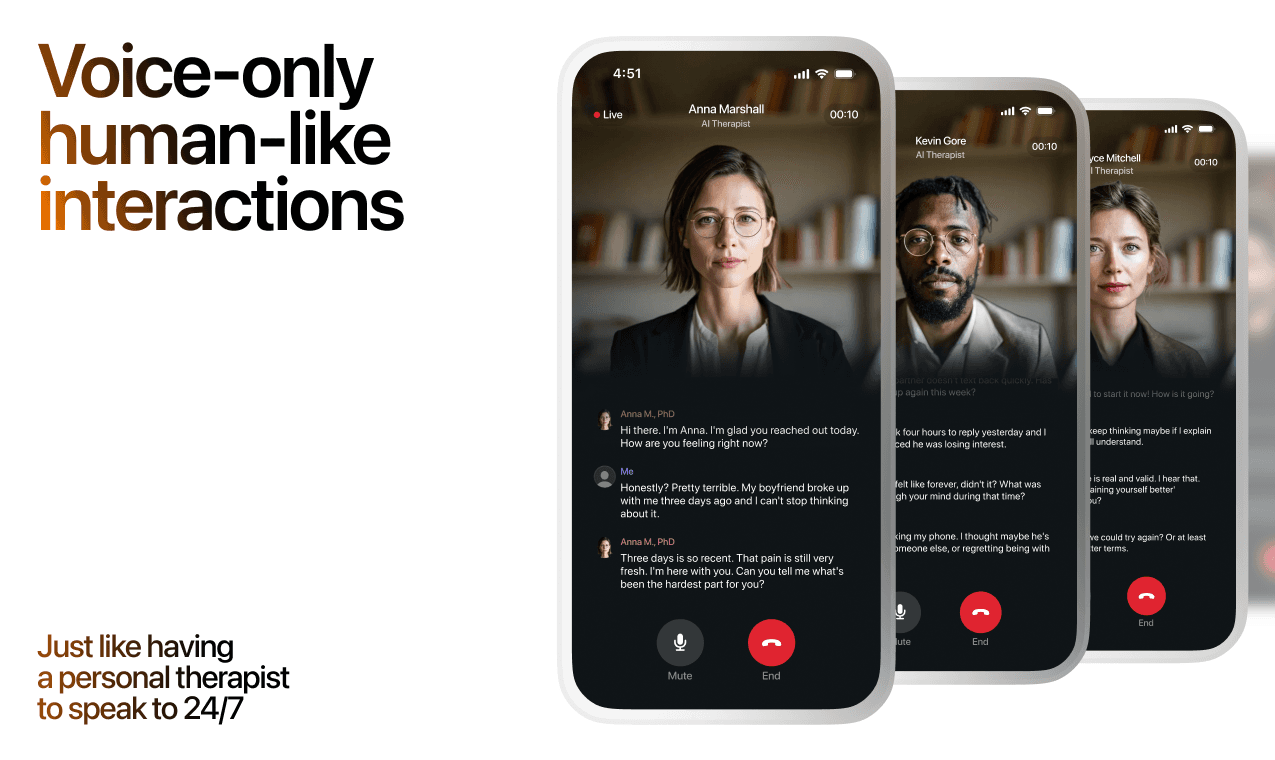
Lovon is AI support, not a replacement for professional care. If things have been hard to get through for weeks, or you are thinking about harming yourself, talk to a doctor or a licensed therapist.
Ready to Start?
Your healing journey can begin right now
A 3-day trial. No judgment. Just a safe space to process what you're going through.
Frequently Asked Questions
Why do I always compare myself to others?
Is it normal to compare yourself to others?
How do I stop comparing myself to others on Instagram?
How do I stop comparing myself to my partner's ex?
How do I stop comparing my relationship to other couples?
Can comparing yourself to others ever be healthy?
How do I stop being jealous of my friends?
Sources
About the Author
The Lovon Editorial Team
Mental Health & Wellness Content Team
The Lovon Editorial Team develops mental health and wellness content designed to make psychological concepts accessible and actionable. Our goal is to bridge the gap between clinical research and everyday life - helping you understand why your mind works the way it does and what you can do about it....
Related articles
- How to Stop Anger Outbursts Before They Happen (2026)
Learn how to stop anger outbursts before they happen in 2026 with trigger tracking, box breathing, and a pre-planned…
- Freudly alternatives in 2026
Compare Freudly alternatives: choose Lovon for voice-based emotional support, a licensed professional for clinical care…
- Doom Scrolling as Dissociation and Trauma Response Rather Than Lack of Willpower
You've done it again—opened your phone for "just a minute" and emerged an hour later, drained and disoriented, wondering…
- Is it normal to feel embarrassed talking to an AI?
Is it normal to feel embarrassed talking to an AI? Yes. Learn why speaking can feel awkward, how to start with a small…
See also
Quizzes
- Forgiveness Test: How Forgiving Are You, Even of Yourself?
See where forgiveness gets stuck for you, in 3 minutes.
- Emotion Recognition Test: Do You Read Feelings Right?
See where your reading of feelings slips, in 3 minutes.
Free tools
- Vent to an AI
Need to vent and there is nobody to call, or nobody you want to tell? Type it here. You are talking to an AI listener…
- Self-Love Meditation
Not loving every part of yourself at once, just being a little kinder than usual. Six minutes to notice how you talk to…
From the wiki
- How to stop maladaptive daydreaming?
Maladaptive daydreaming is immersive waking fantasy that eats hours, usually with music and pacing attached. You rarely…
Disclaimer: This article is for informational purposes only and does not constitute medical advice, diagnosis, or treatment. Always seek the advice of your physician or other qualified health provider with any questions you may have regarding a medical condition. If you are in crisis or think you may have an emergency, call 988 (Suicide & Crisis Lifeline) or go to the nearest emergency room. Outside the US? Find a crisis line in your country.