
How to Love Yourself and Build Real Self-Esteem
How to love yourself when you don't feel it yet: keep promises to yourself, fix your self-talk, set boundaries, and know your worth in a relationship.

Key Takeaways
- Loving yourself is mostly behavior, such as keeping small promises to yourself, talking to yourself fairly after a mistake, and setting limits, and the feeling tends to follow.
- Self-esteem that rests on approval, looks, or performance rises and crashes with them, so give your worth more to stand on, like how you treat people and whether you keep your word.
- Knowing your worth shows in what you accept: write down your minimums and practice the short sentences that protect them.
To love yourself, treat yourself the way you would treat someone you love, even on days you don't feel it: keep small promises to yourself, talk to yourself like a fair friend after a mistake, protect your time with clear limits, and stop handing your worth to other people's approval. The feeling usually follows the behavior, rarely the other way around.
- Keep one small promise to yourself every day, small enough that you actually keep it.
- Write down your harshest self-talk word for word, then rewrite it the way a fair friend would say it.
- Say one honest no this week where you would normally give an automatic yes.
- Treat sleep, food, and movement as care for someone you are responsible for, not as rewards.
- Notice what your worth is resting on, and move some of it to things you control.
- Make amends for what you owe, then stop retrying old mistakes in your head.
- Spend more time with people who leave you steadier and less with people who leave you smaller.
What does it actually mean to love yourself?
Loving yourself is not feeling amazing about yourself all the time, and it is not bubble baths. It is being on your own side: treating your needs as real, speaking to yourself without contempt, and not abandoning yourself to keep other people comfortable.
It helps to separate three things that usually get blurred together:
- Self-esteem is how you rate yourself. It rises after a good day and sinks after a rejection.
- Self-worth is the belief that you deserve basic respect whatever your rating is today. Self-worth vs self-esteem goes deeper into the difference.
- Self-compassion is how you treat yourself when things go wrong. The psychologist Kristin Neff describes it as three habits: being kind to yourself instead of judging harshly, seeing your struggles as part of being human rather than proof that something is wrong with you, and noticing painful feelings without drowning in them.[1]
Self-love, in practice, is mostly the second and third. You do not have to think you are great. You have to stop treating yourself like the enemy.
How to love yourself when you don't feel it yet
Most advice tells you to feel differently about yourself first. That is backwards. You do not wait to feel love for a friend before you help them move apartments. You show up, and the care is in the showing up. Self-respect works the same way: it is a set of behaviors, and the feeling builds from the evidence.
Keep small promises to yourself
You trust people who do what they say. The same goes for you. Every time you tell yourself "I'll go to bed earlier" or "I'll start Monday" and then don't, you collect proof that your word to yourself means nothing.
So make the promises small enough to keep:
- "I'll be in bed by 11:30 on weeknights."
- "I'll take a ten-minute walk after lunch."
- "I'll answer the one email I've been avoiding before noon."
Keep one promise for two weeks before you add another. When you break one, start again the next day without a lecture. The point is not discipline for its own sake. It is learning that you can count on yourself.
Look after the basics like they belong to someone you love
Sleep, food, water, movement, the doctor's appointment you keep pushing back. These are boring, and they are where self-respect actually shows. Real care is often unglamorous: paying the bill before the late fee, booking the dentist, going home when you are tired instead of staying out so you don't seem boring.
Watch for self-care that is really avoidance. Canceling plans, scrolling for three hours, or "treating yourself" to skip something you dread feels kind in the moment and usually leaves you feeling worse about yourself the next day.
How to change the way you talk to yourself
Notice the exact words, not just the mood. Most people's inner voice says things they would never say to anyone else: "You're so stupid." "No wonder nobody stays." "You ruin everything."
Try this the next time it happens:
- Write the sentence down word for word.
- Ask whether you would say it to a friend who did the same thing. If the answer is no, the voice is being unfair, not honest.
- Rewrite it the way a fair friend would: specific, true, and useful. "You're so stupid, you missed the deadline again" becomes "You missed the deadline. That's frustrating and fixable. Email her now and set a reminder for next time."
The fair version is not softer on the facts. It is softer on you, and that is the part that helps you change. A common fear is that going easy on yourself will make you lazy. Research points the other way: in a set of experiments, people who were encouraged to be self-compassionate after failing a hard test spent longer studying for a retest than people who were given a self-esteem boost instead.[2]
Why positive affirmations can backfire
Repeating "I love myself" in the mirror works for some people and makes others feel worse. In one study, people with low self-esteem who repeated "I'm a lovable person" ended up in a worse mood, and feeling worse about themselves, than people with low self-esteem who did not repeat it. People who already felt good about themselves got a small lift.[3] When a statement feels false, your mind argues with it.
Use sentences you can actually believe:
- "I'm learning to be on my side."
- "I handled that badly, and I can repair it."
- "I don't have to like everything about myself to treat myself decently."
The inner critic test shows when your critic speaks, how it talks to you, and what it pushes you to do, which tells you where to start. How to stop negative self-talk has a longer method for catching and answering it.
How do you build self-esteem that lasts?
Self-esteem built on compliments and wins is fragile, because it is out of your hands. Researchers call this contingent self-worth: when your sense of worth depends on looks, approval, grades, or performance, it climbs when those go well and drops when they don't.[4]
You do not need to stop caring about those things. You need more legs for your worth to stand on. Three ways to build self-esteem that holds up:
- Do slightly hard things in small doses. Confidence usually comes after action, not before. Pick one thing a little outside your comfort zone each week, like asking a question in a meeting or going to a class alone, and do it badly if you have to.
- Keep an evidence list. Each night, write down three things you handled that day. Not achievements: things you handled. "Called the insurance company." "Didn't reply to his text while I was angry." After a few weeks, this is a record your inner critic cannot easily argue with.
- Anchor your worth in how you act, not where you rank. Being honest, showing up for people, keeping your word. None of these depend on anyone else's rating.
The self-esteem test scores what your worth is resting on right now, including how you talk to yourself after a mistake.
How do you know your worth?
Knowing your worth is less a feeling than a list of what you will and won't accept. People who know their worth are not louder about it. They are clearer about their minimums, and they act on them.
Write down three to five non-negotiables. For example:
- "I don't stay in conversations where I'm being yelled at."
- "I don't chase people who only reach out when they're bored."
- "I get to rest without earning it first."
Then practice the sentences that protect them. Short ones work best, because long explanations invite debate:
- "I can't take that on this week."
- "No, but thanks for thinking of me."
- "I'm not going to keep talking while you're shouting. I'll come back in an hour."
If saying no leaves you guilty for hours, that is people-pleasing, and it is one of the most common ways people stop treating themselves with respect without noticing. People-pleasing and self-worth explains where the pattern comes from, and how to say no politely helps you write the exact words.
How to love yourself in a relationship
A relationship should add to your life, not replace it. These are the quiet ways people abandon themselves with a partner:
- Agreeing to things to avoid a fight, then resenting it.
- Dropping friends, hobbies, or opinions that used to be yours.
- Checking your partner's mood before deciding how you feel.
- Saying "it's fine" when it is not.
Loving yourself here means keeping your own life and saying the true thing kindly: "I'd rather not go this weekend. Can we do something just the two of us instead?" Or: "It hurt when you joked about my job in front of your friends. Please don't do that again."
You may have heard that you can't love anyone until you love yourself. That is not quite true. Plenty of people with shaky self-esteem love others well. What changes when you respect yourself is what you will put up with.
If your partner regularly puts you down, controls who you see or what you spend, or you feel afraid of them, that is not a self-esteem problem for you to fix alone. Rebuilding self-esteem after a toxic relationship covers what that kind of relationship does to your confidence. If you are afraid for your safety, the National Domestic Violence Hotline is 1-800-799-7233.
How to love yourself after a breakup
A breakup can make you rewrite your whole story: "I'm unlovable," "I wasted years," "I'll never have that again." Notice the leap. "They didn't want this relationship" is a fact. "I'm unlovable" is an interpretation, and a cruel one.
What helps:
- Don't decide what the breakup means about you in the first month. Your judgment about yourself is at its worst right now.
- Stop checking their profile, and their new partner's. Every look is a comparison you lose. How to stop comparing yourself to others covers this exact trap.
- Rebuild one thing that was yours before them, such as a friend you saw less, a sport, or a place you loved.
- Talk to yourself at night the way you would talk to a friend who just got dumped. The six-minute self-love meditation walks you through exactly that.
How do you accept the parts of yourself you don't like?
Sort them into two piles. In the first: things you can change and want to, like how you react when you're angry or how you handle money. Work on those, one at a time. In the second: things you can't change or don't need to, like your height, your past, or the fact that you sometimes feel jealous. Those need acceptance, not a fix.
Acceptance does not mean liking it. It means you stop fighting it every day. For the past, that usually takes three steps: name what happened, make amends to anyone you hurt if you can, and then close the file instead of retrying the case. What self-forgiveness is explains what that does and does not mean, and the self-acceptance test shows where you are still arguing with yourself.
The most common mistake: waiting to feel it first
Most people treat self-love as a feeling they have to reach before anything can change: once I love myself, I'll set boundaries, start exercising, leave the bad job. It works the other way. You set one boundary while still doubting you deserve it, and the next one is easier. The feeling follows the evidence.
The second most common mistake is trying to become so impressive that loving yourself is finally easy. The bar keeps moving. You do not have to earn basic decency from yourself.
When to get more help
Some self-criticism is normal. Talk to a doctor or a licensed therapist if you hate yourself most days, if the voice in your head never lets up, or if low self-worth is stopping you from working, eating, or seeing people. Self-compassion when you hate yourself is a gentler place to start. If you have thoughts of hurting yourself, call or text 988 to reach the Suicide & Crisis Lifeline.
Self-respect often starts with saying out loud what you have been putting up with, including from yourself. If there is one place you keep abandoning yourself, at work, with family, or with a partner, tell Lovon about it and work out the first small promise you will keep this week.
How AI Support Helps You Heal
AI emotional support isn't about replacing human connection — it's about filling the gaps. The moments when you need to talk at 2 AM, when you don't want to burden your friends again, or when you simply need someone to listen without judgment.
Here's what happens in a typical Lovon session:
You share what's on your mind
There's no script, no intake form, no waiting room. You speak or type whatever you're feeling — in your own words, at your own pace.
Lovon validates and explores
Using frameworks from CBT (Cognitive Behavioral Therapy) and motivational interviewing, Lovon acknowledges your feelings first, then gently helps you explore them. No dismissive "just move on" advice.
You build coping skills together
Lovon doesn't just listen — it actively works with you on evidence-based techniques: thought reframing, urge surfing, behavioral experiments, and more.
What a Session with Lovon Looks Like
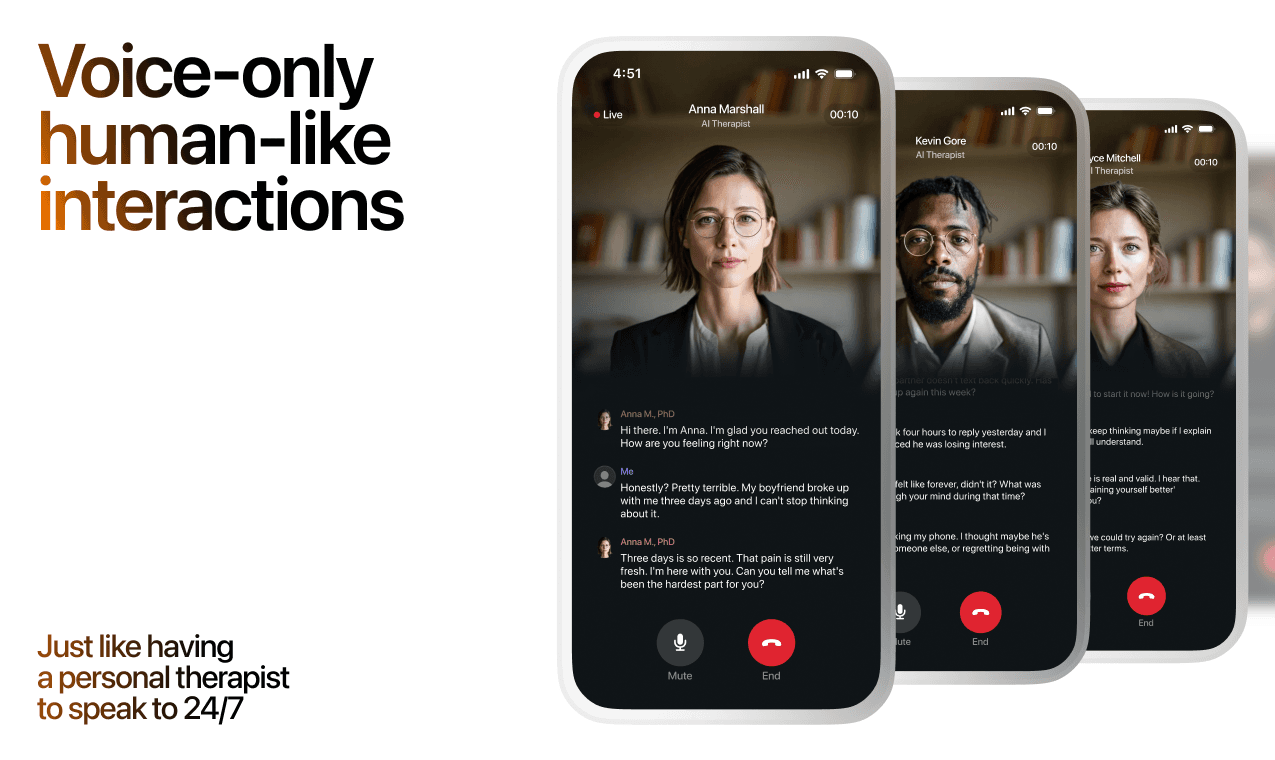
Lovon is AI support, not a replacement for professional care. If things have been hard to get through for weeks, or you are thinking about harming yourself, talk to a doctor or a licensed therapist.
Ready to Start?
Your healing journey can begin right now
A 3-day trial. No judgment. Just a safe space to process what you're going through.
Frequently Asked Questions
What does it mean to love yourself?
How do I start loving myself when I hate myself?
How can I build my self-esteem fast?
Can you love someone else if you don't love yourself?
Is self-love selfish?
How do I know my worth in a relationship?
Do positive affirmations work?
How long does it take to learn to love yourself?
Sources
About the Author
The Lovon Editorial Team
Mental Health & Wellness Content Team
The Lovon Editorial Team develops mental health and wellness content designed to make psychological concepts accessible and actionable. Our goal is to bridge the gap between clinical research and everyday life - helping you understand why your mind works the way it does and what you can do about it....
Related articles
- Chronic Guilt: Why You Feel Guilty All the Time (2026)
Chronic guilt runs even when you've done nothing wrong. Learn the 6 steps to identify its root cause and break the cycle…
- Self-Abandonment: What It Is and How to Stop It in 2026
Self-abandonment means ignoring your own needs to keep the peace. Learn the 2026 signs, six concrete steps to stop it…
- AI Coping Tools for Chronic Dieting and Food Guilt (2026)
AI coping tools for chronic dieting and food guilt: what to look for, top picks, what to avoid, and a 2026 verdict…
- Healthy Relationship Boundaries: How to Set Them in 2026
Learn how to set healthy relationship boundaries with a 7-step script, troubleshooting fixes, and FAQ. Clear steps that…
See also
Quizzes
- Forgiveness Test: How Forgiving Are You, Even of Yourself?
See where forgiveness gets stuck for you, in 3 minutes.
- Boundaries Test: Do I Have Healthy Boundaries? Free Quiz
See where your boundaries slip, in 3 minutes.
Free tools
- AI Anxiety Coach
This is a free AI anxiety coach you can use on this page. Tell it what you are anxious about, whether it is a thought…
- How to End a Friendship Without a Scene
A chat for working out how to end a friendship clearly, without a grievance list or a slow ghost. Tell it how long you…
From the wiki
- Will I ever find love?
No one can honestly promise you will. What is true is that the odds are not fixed at birth and not decided by your last…
Disclaimer: This article is for informational purposes only and does not constitute medical advice, diagnosis, or treatment. Always seek the advice of your physician or other qualified health provider with any questions you may have regarding a medical condition. If you are in crisis or think you may have an emergency, call 988 (Suicide & Crisis Lifeline) or go to the nearest emergency room. Outside the US? Find a crisis line in your country.