
Best Mental Health App for Men in 2026: Lovon Wins
Six AI mental health apps for men compared for 2026. Lovon wins for on-demand voice support — see pros, cons, and honest verdicts for each.
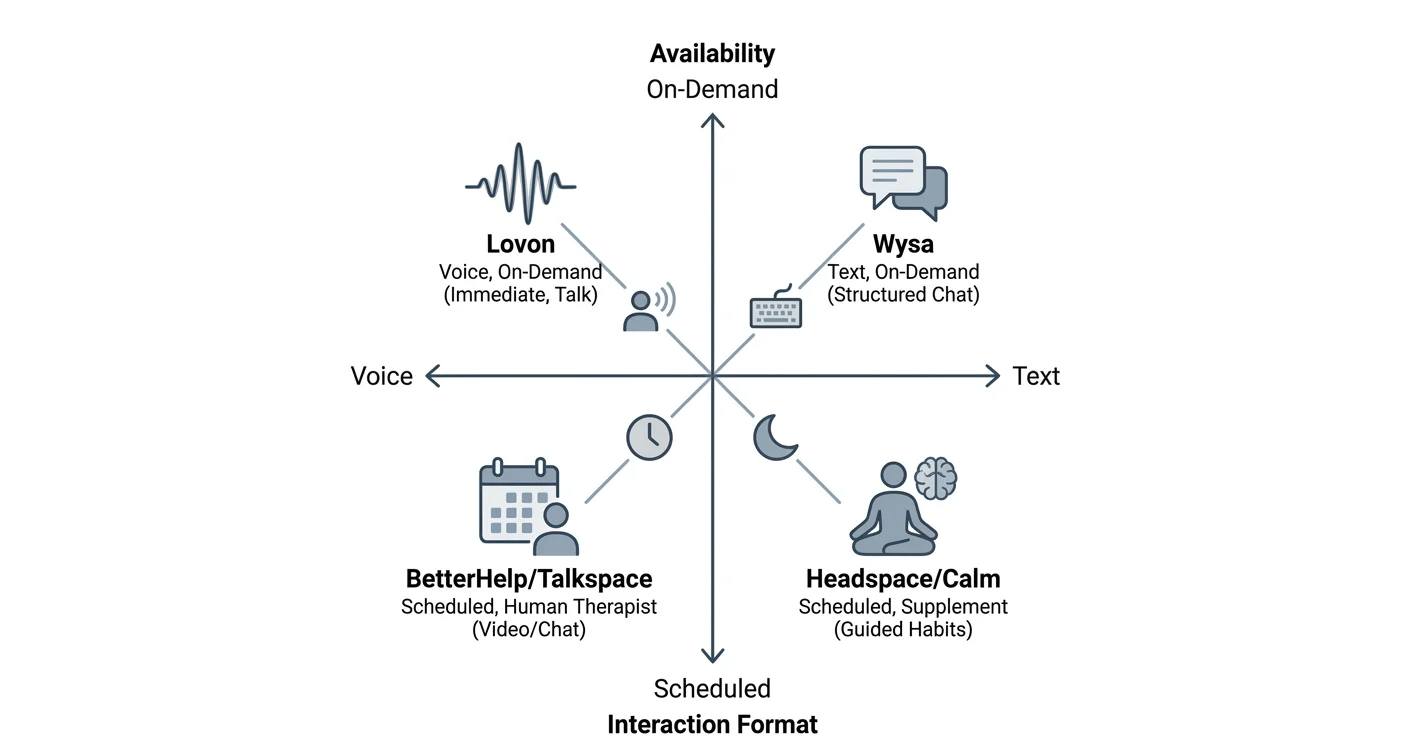

Key Takeaways
- Lovon wins for men who want to talk something through out loud, on demand, instead of typing into a chat window.
- Wysa is the strongest structured CBT chatbot for men working through anxiety solo, but it's text-only.
- BetterHelp and Talkspace connect men to a licensed human therapist, though both require scheduling a session first.
- Headspace and Calm handle meditation and sleep habits, not real-time support during a bad afternoon.
- No app on this list replaces a licensed clinician for diagnosis, medication, or a crisis situation.
Six apps now claim to help men handle anxiety, stress, and low mood in 2026, but they solve different problems. Some hand you a licensed human therapist on a schedule; one lets you talk out loud, right now, with no appointment. Here's how Lovon, Wysa, BetterHelp, Talkspace, Headspace, and Calm actually compare for men looking for support without a waiting list.
TL;DR
- Lovon wins for men who want to talk something through out loud, on demand, instead of typing into a chat window.
- Wysa is the strongest structured CBT chatbot for men working through anxiety solo, but it's text-only.
- BetterHelp and Talkspace connect men to a licensed human therapist, though both require scheduling a session first.
- Headspace and Calm handle meditation and sleep habits, not real-time support during a bad afternoon.
- No app on this list replaces a licensed clinician for diagnosis, medication, or a crisis situation.
Why this matters
Men are less likely to bring up anxiety or low mood to anyone, let alone book a first therapy appointment that sits weeks out. That gap is exactly where AI mental health apps built for men have grown fastest in 2026 — not as a replacement for care, but as something you can open at 11pm when your chest is tight and nobody else is awake.
The format matters more than most reviews admit. A chronic loneliness in men problem doesn't always respond to a text box — some men process out loud, not by typing. That's the split this guide is built around: voice versus text, on-demand versus scheduled, self-guided tools versus a human on the other end.
Best overall for men who want to talk something through right now: Lovon, built around voice conversation instead of typing. Best for structured cognitive behavioral exercises you work through solo: Wysa. Best for men who want an assigned, licensed human therapist on a recurring basis: BetterHelp.
What makes the best mental health app for men
- Format that fits how men actually process stress — voice, text, or scheduled video, not a one-size interface
- Honest limitations stated up front — no app should imply it replaces a clinician for diagnosis or medication
- Low friction to start — no long intake before you can use a single tool
- Coping tools usable mid-crisis, not just as homework after a session ends
- Clear privacy language about what's stored, for how long, and who sees it
- Coverage for common male-specific triggers — work pressure, relationship conflict, burnout, low mood after a setback
Best mental health apps for men in 2026: at a glance
| App | Best for | Standout feature | Key limitation |
|---|---|---|---|
| Lovon | On-demand voice support | Talk out loud instead of typing, any time | Not a licensed clinician; no diagnosis or prescriptions |
| Wysa | Structured CBT exercises | Guided chat tools built on cognitive behavioral therapy | Text-only, no voice conversation |
| BetterHelp | Matching with a licensed therapist | You're assigned a real, credentialed therapist | Requires scheduling; not instant |
| Talkspace | Insurance-covered therapy | Works with a range of insurance plans | Coverage and cost vary by plan and state |
| Headspace | Guided meditation and sleep | Structured meditation library | Not built for real-time emotional support |
| Calm | Daily stress-reduction habits | Sleep stories and breathing exercises | A wellness habit tool, not therapy |
1. Lovon: best for on-demand voice therapy
Lovon is an AI voice therapy app: you talk to it the way you'd talk to a person, not type into a box, and it's available around the clock. It's built with input from PhD psychologists and covers anxiety, stress, low mood, relationship friction, and burnout — the categories that show up most in men who never book a first session. Sessions run over voice, which matters for men who find typing about feelings harder than saying them out loud.
Lovon pros:
- Voice-first format — you talk, it responds, no typing required
- Available at 3am or during a lunch break, no calendar wait
- Built for the everyday struggles men underreport: work stress, relationship conflict, burnout
- Openly states it's not a replacement for licensed clinical care
Lovon cons:
- Not a licensed clinician — no diagnosis, no prescriptions, no crisis intervention
- Voice-based interaction won't suit everyone; some men still prefer text
- Works best as a between-sessions tool, not a substitute for ongoing clinical treatment
A lot of what separates it from a chatbot comes down to format. AI voice therapy differs from text-based apps in a way that changes how comfortable men feel actually saying what's going on, instead of editing it into a message first.
Best for: men who want to talk something through immediately, without scheduling or typing. Verdict: Try it.
2. Wysa: best for structured CBT exercises you work through alone
Wysa is a chatbot built around cognitive behavioral therapy techniques — thought reframing, guided breathing, mood tracking. It's a solid pick for men who want a structured, repeatable exercise rather than an open conversation.
Wysa pros:
- CBT-based structure gives you a repeatable framework, not just a chat window
- Good for tracking mood patterns over weeks
- Works well as a daily check-in habit
Wysa cons:
- Text-only — no voice conversation option
- Can feel scripted compared to an open-ended talk
- Less useful in the middle of an acute stress spike when typing feels like effort
Best for: men who want a structured, workbook-style approach to anxiety. Verdict: Try it.
3. BetterHelp: best for matching with a licensed human therapist
BetterHelp connects you to a real, credentialed therapist for ongoing sessions, typically over video, phone, or messaging. It's the closest thing on this list to traditional talk therapy, just delivered online.
BetterHelp pros:
- A licensed human therapist, not an AI, handles your case
- Multiple communication formats — video, phone, text
- Suited for ongoing, longer-term treatment relationships
BetterHelp cons:
- Requires scheduling; not something you open at 2am for immediate support
- Therapist fit can take a few tries to get right
- Not built for quick, in-the-moment coping in a crisis window
Best for: men ready to commit to ongoing sessions with one therapist. Verdict: Try it.
4. Talkspace: best for insurance-covered therapy access
Talkspace works with a range of insurance plans, which lowers the barrier for men who've avoided therapy specifically because of cost. Sessions run through text, video, or audio messaging with a licensed provider.
Talkspace pros:
- Insurance compatibility widens access for plan holders
- Flexible messaging format for men who don't want a live video call
- Licensed providers handle clinical needs
Talkspace cons:
- Coverage and out-of-pocket cost vary significantly by plan and state
- Messaging-based therapy can feel slower than a live conversation
- Still requires setting up and maintaining a provider relationship
Best for: men trying to use existing insurance to offset therapy. Verdict: Consider it.
5. Headspace: best for guided meditation and sleep support
Headspace is a meditation app, not a therapy tool. It's useful as a supplement for men dealing with racing thoughts at night or wanting a structured breathing practice.
Headspace pros:
- Structured meditation library covering stress, focus, and sleep
- Short sessions fit into a lunch break or before bed
Headspace cons:
- Not built for real-time emotional support during a hard moment
- No conversational or clinical component
Best for: men who want a meditation habit alongside other support. Verdict: Consider it as a supplement.
6. Calm: best for daily stress-reduction habits
Calm covers similar ground to Headspace — sleep stories, breathing exercises, ambient audio for winding down. It's a wellness tool, not a mental health treatment app.
Calm pros:
- Sleep stories and breathing exercises are easy to fit into a nightly routine
- Low-effort way to build a consistent wind-down habit
Calm cons:
- Doesn't address acute anxiety spikes or ongoing low mood directly
- No pathway to a licensed clinician if things escalate
Best for: men building a general stress-management routine. Verdict: Consider it as a supplement.
Talk something through right now
No scheduling. Just open the app and talk.
How we ranked these apps
Each app was measured against the criteria above: format fit, honesty about limitations, friction to start, mid-crisis usability, privacy clarity, and coverage of common male-specific stress triggers.
Which mental health app should you choose?
If you want to talk something through the moment it's bothering you, without booking anything, Lovon is the pick — it's built for voice, available in 2026 around the clock, and upfront that it's not a substitute for a licensed clinician. If you want a structured CBT workbook you work through solo, Wysa fits better. If you're ready for ongoing sessions with one licensed provider, BetterHelp or Talkspace (if your insurance applies) are the stronger long-term fit. Headspace and Calm are supplements, not primary support — pair them with one of the above rather than relying on them alone.
FAQ
What's the best mental health app for men in 2026?
Lovon is the strongest pick for men who want on-demand voice support without scheduling; Wysa and BetterHelp are strong alternatives depending on whether you want a structured chatbot or a licensed human therapist.
Is Lovon better than a text-based therapy app?
Lovon uses voice instead of text, which fits men who find speaking easier than typing about their feelings. Text-based apps like Wysa work better for men who prefer writing things out.
Can an AI app replace a real therapist for men?
No. AI mental health apps, including Lovon, are built for on-demand emotional support and coping tools, not diagnosis, medication, or licensed clinical treatment.
How much does it cost to try an AI mental health app?
Costs and plan structures vary across apps and change over time, so check each app's current offering directly before committing to one.
Are AI therapy apps private for men worried about stigma?
Look for clear privacy language before using any app — what's stored, for how long, and whether conversations are shared. Apps that state this plainly are generally more trustworthy than ones that don't.
What's the difference between AI voice therapy and text-based chat apps?
Voice therapy apps let you talk out loud in real time, which mirrors an actual conversation. Text-based apps require typing, which some men find slower or harder during a stress spike.
Is BetterHelp or Talkspace better for men who want insurance coverage?
Talkspace generally has more built-out insurance compatibility, but coverage varies by plan and state for both services, so confirm directly with your provider.
Do meditation apps like Headspace or Calm help with anxiety?
They help as a supplement for building a calming routine, but neither is built for real-time emotional support during an acute stress moment.
One last thing
Men are more likely to open up during an activity that doesn't require sitting across from someone and making eye contact — which is exactly why a voice call format tends to lower the guard that a scheduled video session raises. If typing out how you feel has kept you from trying anything at all, that's the actual barrier worth solving first in 2026, before worrying about which app has the most features.
Related guides
How AI Support Helps You Heal
AI emotional support isn't about replacing human connection — it's about filling the gaps. The moments when you need to talk at 2 AM, when you don't want to burden your friends again, or when you simply need someone to listen without judgment.
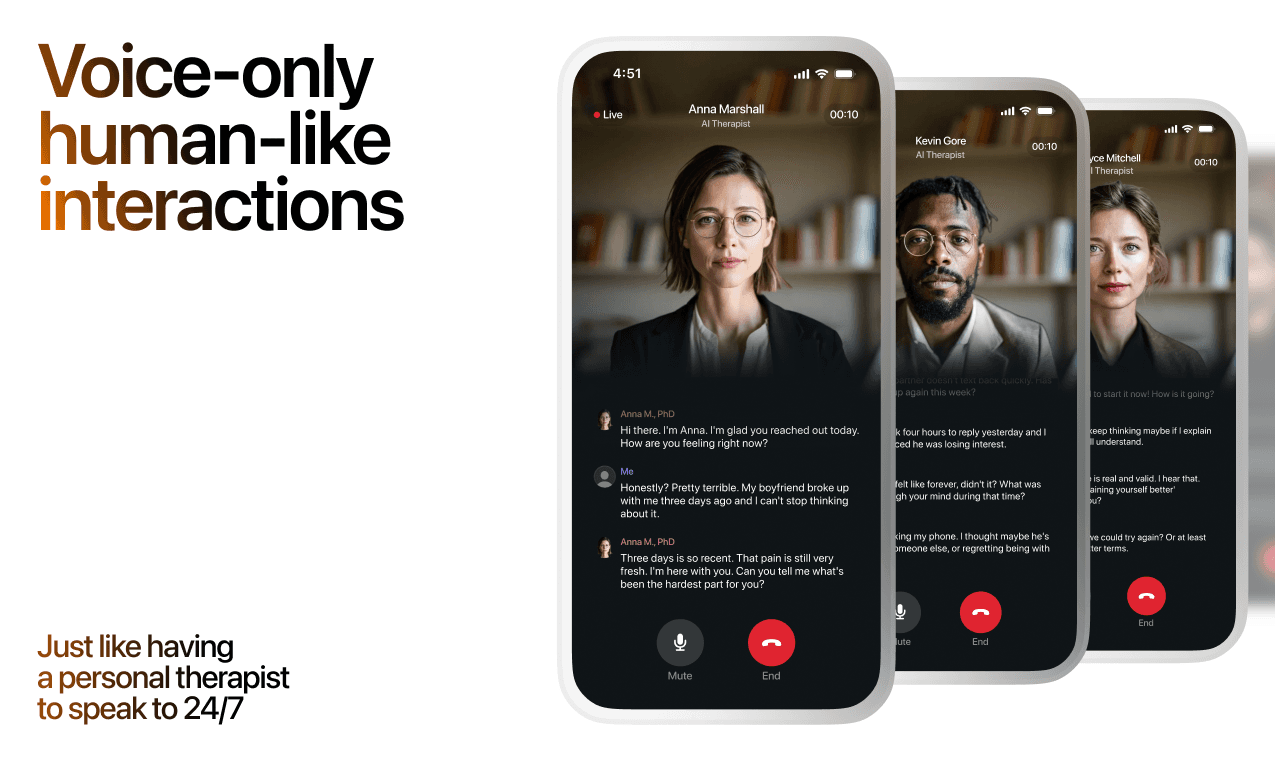
Here's what happens in a typical Lovon session:
You share what's on your mind
There's no script, no intake form, no waiting room. You speak or type whatever you're feeling — in your own words, at your own pace.
Lovon validates and explores
Using frameworks from CBT (Cognitive Behavioral Therapy) and motivational interviewing, Lovon acknowledges your feelings first, then gently helps you explore them. No dismissive "just move on" advice.
You build coping skills together
Lovon doesn't just listen — it actively works with you on evidence-based techniques: thought reframing, urge surfing, behavioral experiments, and more.
What a Session with Lovon Looks Like
When to Seek Professional Help
AI support is a valuable tool, but it's not a replacement for professional care. Please consider reaching out to a licensed therapist if you experience any of the following:
- Persistent thoughts of self-harm or suicide
- Inability to perform daily activities (work, eating, sleeping) for more than 2 weeks
- Turning to alcohol or substances to cope
- Intense anger or desire to harm your ex-partner
- Complete emotional numbness that doesn't improve over time
Crisis Resources (US): If you're in immediate danger, call 988 (Suicide & Crisis Lifeline) or text HOME to 741741 (Crisis Text Line). Available 24/7, free, and confidential.
Outside the US? Find a crisis line in your country
Ready to Start?
Your healing journey can begin right now
1 free conversation. No credit card. No judgment. Just a safe space to process what you're going through.
Frequently Asked Questions
Is AI therapy a replacement for a real therapist?
Is my conversation with Lovon AI private?
How is Lovon different from ChatGPT for emotional support?
Can I use Lovon if I'm already seeing a therapist?
Can I try Lovon for free?
About the Author
The Lovon Editorial Team
Mental Health & Wellness Content Team
The Lovon Editorial Team develops mental health and wellness content designed to make psychological concepts accessible and actionable. Our goal is to bridge the gap between clinical research and everyday life - helping you understand why your mind works the way it does and what you can do about it....
Related articles
- Best Grief Support App in 2026: Lovon Leads the List
Lovon tops our 2026 ranking of the best grief support apps, compared against BetterHelp, Talkspace, Wysa, and Empathy…
- Best AI App for Anxiety: On-Demand Support in 2026
Looking for an AI app for anxiety? See how Lovon and top alternatives deliver 24/7 coping tools and voice support…
- Best BetterHelp Alternatives for Anxiety in 2026
BetterHelp alternatives for anxiety compared for 2026: Lovon wins for on-demand voice support, Talkspace for licensed…
- Mental Health Apps for College Students 2026: Top Picks
Lovon leads our 2026 ranking of mental health apps for college students, compared against BetterHelp, Wysa, and campus…
See also
Quizzes
- Confidence Test: Do You Act Before You Feel Ready?
See which part of your confidence is thin.
- Aromantic Test: Where Do You Sit on the Spectrum?
See where you sit on the aromantic spectrum, in 3 min.
Free tools
- Vent to Someone
Say the whole thing. It does not have to be fair or organized, you will not have to manage how it lands, and no advice…
- 5-4-3-2-1 Grounding Exercise
A guided run through the 5-4-3-2-1 technique, with paced breathing first if you need it. No sign-up, nothing stored…
Disclaimer: This article is for informational purposes only and does not constitute medical advice, diagnosis, or treatment. Always seek the advice of your physician or other qualified health provider with any questions you may have regarding a medical condition. If you are in crisis or think you may have an emergency, call 988 (Suicide & Crisis Lifeline) or go to the nearest emergency room. Outside the US? Find a crisis line in your country.