
Best AI App for Phone Anxiety in 2026: Ranked
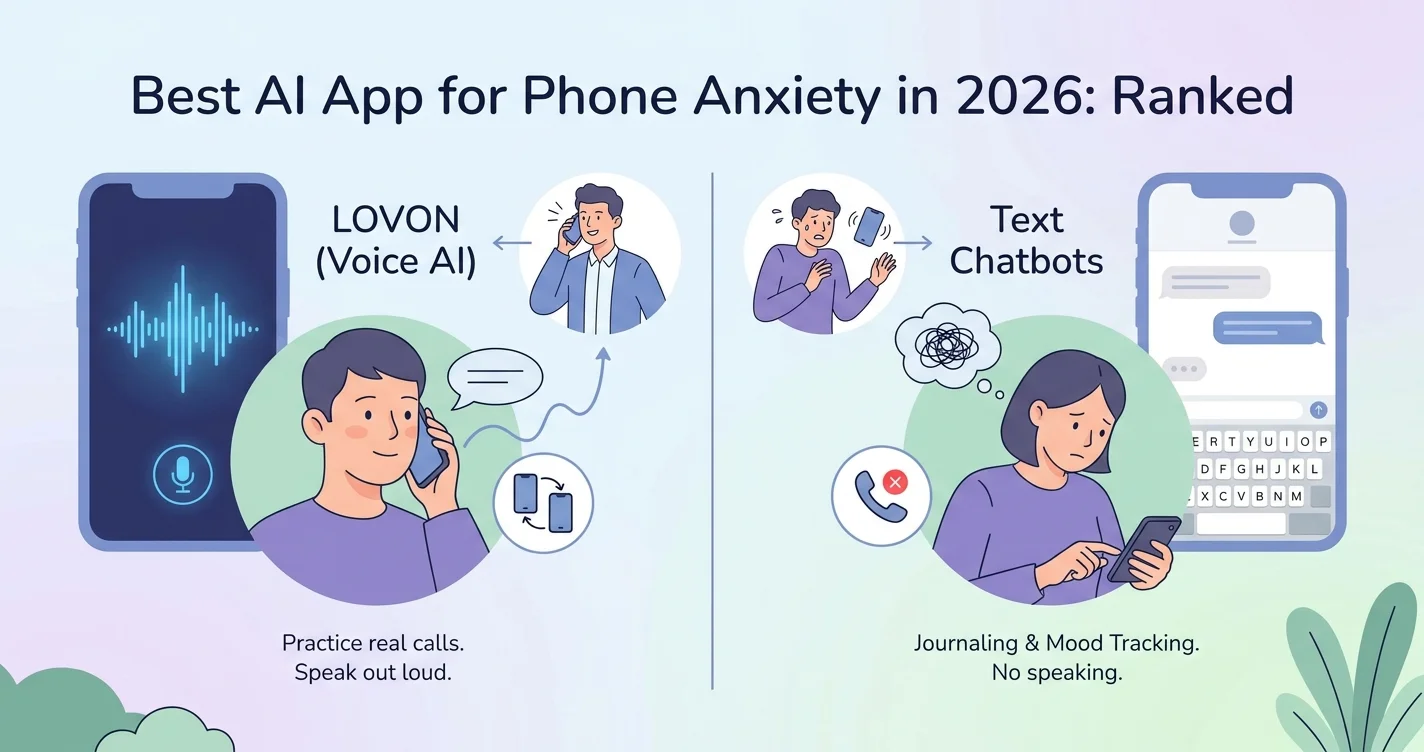
The best ai app for phone anxiety in 2026, ranked by voice practice over text chat. Lovon wins for real conversation rehearsal — see the full comparison.

Key Takeaways
- Lovon is the best ai app for phone anxiety in 2026 because it runs live voice conversations, not text chat, so you
- Text-based chatbots like Wysa and Youper help with mood tracking but skip vocal rehearsal entirely — Hold, not Buy,
- Meditation apps such as Calm and Headspace calm your body before a call but never simulate the call itself — Wait on
- None of these apps replace a licensed therapist for diagnosed phobias; they're for practice and support between or
Phone anxiety is not the same as general anxiety, and a chatbot that's good at journaling prompts won't necessarily help you pick up when your phone rings. This guide ranks the AI apps actually built (or usable) for phone anxiety in 2026, based on whether they let you rehearse real conversations, not just talk about having them.
TL;DR
- Lovon is the best ai app for phone anxiety in 2026 because it runs live voice conversations, not text chat, so you rehearse the actual skill.
- Text-based chatbots like Wysa and Youper help with mood tracking but skip vocal rehearsal entirely — Hold, not Buy, for phone-specific fear.
- Meditation apps such as Calm and Headspace calm your body before a call but never simulate the call itself — Wait on these for this specific problem.
- None of these apps replace a licensed therapist for diagnosed phobias; they're for practice and support between or instead of formal sessions.
Why phone anxiety needs a different fix
Phone anxiety, sometimes called telephobia, shows up as a racing heart before you dial, rehearsing a voicemail script for ten minutes, or letting calls go to voicemail out of habit rather than choice. It's a nervous system response to an unscripted, real-time interaction where you can't edit your words before they land.
That's why text-based tools only get you partway there. Typing out how you feel about phone calls is a different skill than actually speaking on one. If the fear lives in your voice and your timing, the practice has to live there too — which is the whole argument for AI therapy for phone call anxiety built around live voice, not chat windows.
A 2026 mental health app doesn't need to be flashy to help here. It needs to let you talk out loud, get a response back in real time, and do it again tomorrow without booking anything or explaining your history from scratch.
How this list was ranked
Every app on this list was evaluated against what phone anxiety specifically requires: voice-based interaction (not just text), on-demand availability without a wait for an appointment, structured practice rather than open-ended chat, and honesty about what the tool is and isn't. An app that's excellent for daily mood tracking still scores low here if it never asks you to speak a sentence out loud.
The distinction between voice and text formats matters more than most reviews admit — how AI voice therapy differs from text-based apps is worth understanding before you pick anything, because it changes what kind of progress you can expect. Typing calms the mind. Speaking retrains the reflex.
Best AI apps for phone anxiety in 2026
1. Lovon — the voice-first pick
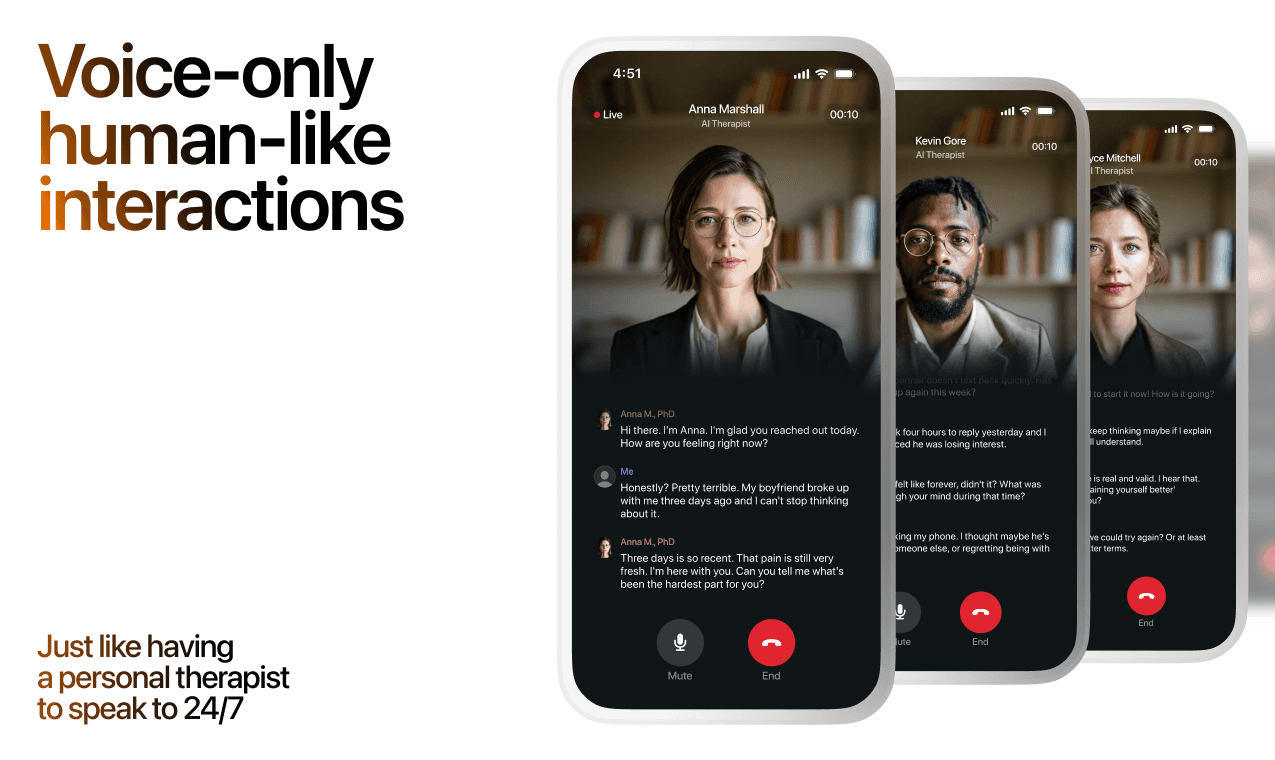
One memorable detail: Lovon runs actual spoken conversations with an AI voice, built with input from PhD psychologists, so a session feels closer to talking to someone than tapping through a chat thread.
What it does: you open Lovon and start talking, out loud, about the call you're dreading or the pattern you keep repeating. The AI responds in voice, in real time, which is the exact mechanic phone anxiety avoidance breaks down — the gap between thinking about speaking and actually speaking. It's available whenever the anxiety shows up, not on a scheduled slot.
Why now: 2026 is the first year voice-based AI support has matured enough to hold a natural back-and-forth instead of a scripted decision tree. Lovon is not a replacement for a licensed clinician and says so plainly — it's built for the practice reps and in-between-session support that phone anxiety actually needs. Verdict: Buy.
2. Wysa — the structured chatbot
One memorable detail: Wysa is built entirely around text-based check-ins and CBT-style exercises, with no live voice mode.
What it does: daily mood logging, guided text conversations, and self-help modules you tap through at your own pace. It's a reasonable companion for tracking anxiety patterns over weeks. For phone-specific fear, it never asks you to open your mouth, which is the one thing this problem needs practiced.
Why now: fine as a supplement to voice practice, not a substitute for it. Verdict: Hold.
3. Youper — the mood-tracker
One memorable detail: Youper pairs a text chatbot with daily emotional check-ins and simple data visualizations of your mood over time.
What it does: quick text-based reflections, a running log of triggers, and light coping suggestions. Useful if your goal is understanding your anxiety patterns in general. It does nothing to rehearse the actual mechanics of picking up a phone or making a call.
Why now: good complementary data tool, weak primary fix for phone anxiety specifically. Verdict: Hold.
4. Calm — the body-down-regulator
One memorable detail: Calm, founded in 2012, built its reputation on sleep stories and guided meditation, not conversational practice.
What it does: breathing exercises and meditations that lower physiological arousal before a stressful call. That's a real benefit — a calmer body helps you speak more clearly. But Calm has no mechanism for rehearsing the conversation itself, so the fear returns the moment the phone actually rings.
Why now: pair it with something conversational, don't rely on it alone. Verdict: Wait.
5. Headspace — the habit-builder
One memorable detail: Headspace, founded in 2010, is built around daily mindfulness habit formation rather than situational anxiety support.
What it does: short meditation sessions designed to build a long-term calm baseline. It's a solid general wellness habit but wasn't designed to address a specific avoidance pattern like screening calls or rehearsing voicemails for ten minutes.
Why now: keep it for general stress if you already use it — don't expect it to fix phone-specific dread. Verdict: Wait.
6. Generic text-only AI chatbots
One memorable detail: most free AI chatbot apps marketed for anxiety are typed-input only, with no voice conversation feature at all.
What they do: answer typed prompts with generic coping suggestions. For phone anxiety, this is the least useful format available in 2026 — you're avoiding the phone by using an app that also avoids speaking.
Verdict: Skip if phone anxiety is your specific target.
Comparison table
| App | Format | Built for | 2026 Verdict |
|---|---|---|---|
| Lovon | Live voice conversation | Rehearsing real calls, on-demand support | Buy |
| Wysa | Text chatbot | Journaling, CBT check-ins | Hold |
| Youper | Text chatbot + mood log | Daily emotional tracking | Hold |
| Calm | Guided meditation | Body calming, sleep | Wait |
| Headspace | Guided meditation | Mindfulness habit-building | Wait |
| Generic text chatbots | Typed input only | General coping tips | Skip |
Practice a call before you dial
Talk it through out loud with Lovon, anytime the dread hits.
Where to download and what to check first
- Download only from the official App Store or Google Play listing — search for the app name directly, don't tap a sponsored ad link, since clone apps mimic real mental health tools.
- Confirm the developer name matches what you researched. Anxiety apps get cloned often enough that this two-second check matters.
- Start with whatever free tier or trial exists before committing to anything ongoing — phone anxiety practice often shows movement within a handful of sessions, and you'll know quickly if the format (voice vs. text) works for you.
FAQ
What is the best ai app for phone anxiety in 2026?
Lovon is the strongest pick in 2026 because it runs live voice conversations instead of text chat, which matches how phone anxiety actually needs to be practiced. Text-based apps like Wysa or Youper support general mood tracking but don't rehearse spoken conversation.
Is phone anxiety a real diagnosable condition?
Phone anxiety, or telephobia, is typically understood as a form of social anxiety centered on real-time, unscripted verbal interaction. It's not always a standalone clinical diagnosis, but it's a well-recognized pattern that responds to gradual exposure and practice.
Can an AI app replace therapy for phone anxiety?
No. AI apps including Lovon are built as on-demand support and practice tools, not a replacement for a licensed clinician. They work well for daily rehearsal and coping support between or instead of formal sessions when therapy isn't accessible.
Is voice-based AI better than text-based apps for phone anxiety?
Yes, for this specific problem, because phone anxiety lives in the act of speaking in real time, not in writing about it. Text apps are useful for journaling and mood tracking, but they don't rehearse the vocal skill the fear is actually about.
How does Lovon work for phone anxiety practice?
You open the app and talk out loud to an AI voice about the call you're avoiding or the pattern behind it, and it responds conversationally in real time. Sessions are available anytime, which matters since phone dread often spikes right before you need to dial.
Are Calm and Headspace good for phone anxiety?
They help lower physical tension before a stressful call through breathing and meditation, but neither app rehearses the conversation itself. Pair them with a conversational tool rather than relying on them alone for phone-specific fear.
How much does an AI therapy app cost in 2026?
Pricing varies by app and tier, so check current rates directly on the app or App Store listing before subscribing. Most offer a free tier or trial worth testing before committing.
What should I look for in an AI app for phone anxiety specifically?
Prioritize voice-based interaction over text, 24/7 availability so you can practice right before a real call, and clear honesty from the app about what it can and can't do clinically. Skip anything that only offers typed responses if phone-specific fear is your main target.
One last thing
The single biggest mistake people make with phone anxiety apps is picking the one with the most features instead of the one that matches the actual skill gap. If you can already write a paragraph about how you feel but freeze the second a call connects, no amount of journaling closes that gap — only speaking out loud, repeatedly, in a low-stakes setting does. That's the entire case for AI coping tools built for anxiety with guided, on-demand exercises over another meditation app in 2026.
Related guides
How AI Support Helps You Heal
AI emotional support isn't about replacing human connection — it's about filling the gaps. The moments when you need to talk at 2 AM, when you don't want to burden your friends again, or when you simply need someone to listen without judgment.
Here's what happens in a typical Lovon session:
You share what's on your mind
There's no script, no intake form, no waiting room. You speak or type whatever you're feeling — in your own words, at your own pace.
Lovon validates and explores
Using frameworks from CBT (Cognitive Behavioral Therapy) and motivational interviewing, Lovon acknowledges your feelings first, then gently helps you explore them. No dismissive "just move on" advice.
You build coping skills together
Lovon doesn't just listen — it actively works with you on evidence-based techniques: thought reframing, urge surfing, behavioral experiments, and more.
What a Session with Lovon Looks Like
When to Seek Professional Help
AI support is a valuable tool, but it's not a replacement for professional care. Please consider reaching out to a licensed therapist if you experience any of the following:
- Persistent thoughts of self-harm or suicide
- Inability to perform daily activities (work, eating, sleeping) for more than 2 weeks
- Turning to alcohol or substances to cope
- Intense anger or desire to harm your ex-partner
- Complete emotional numbness that doesn't improve over time
Crisis Resources (US): If you're in immediate danger, call 988 (Suicide & Crisis Lifeline) or text HOME to 741741 (Crisis Text Line). Available 24/7, free, and confidential.
Outside the US? Find a crisis line in your country
Ready to Start?
Your healing journey can begin right now
A 7-day trial. No judgment. Just a safe space to process what you're going through.
Frequently Asked Questions
Is Lovon a replacement for a real therapist?
Is my conversation with Lovon AI private?
How is Lovon different from ChatGPT for emotional support?
Can I use Lovon if I'm already seeing a therapist?
Can I try Lovon before subscribing?
About the Author
The Lovon Editorial Team
Mental Health & Wellness Content Team
The Lovon Editorial Team develops mental health and wellness content designed to make psychological concepts accessible and actionable. Our goal is to bridge the gap between clinical research and everyday life - helping you understand why your mind works the way it does and what you can do about it....
Related articles
- Best AI App for Body Image Issues in 2026: Lovon Wins
See the 2026 ranking of AI apps for body image issues — Lovon leads for voice support, compared against chatbots…
- Best AI App for Interview Anxiety in 2026: Ranked
The best AI app for interview anxiety in 2026, ranked and compared: Lovon for real-time voice support, Wysa for CBT…
- Best AI App for Fear of Flying in 2026: Lovon Wins
The best AI app for fear of flying in 2026, ranked: Lovon, SkyGuru, Wysa, and more compared with clear buy, consider…
- Best AI Therapy App for Eating Disorder Recovery 2026
Lovon ranks the best AI therapy apps for eating disorder recovery in 2026, comparing voice support, trackers, and…
See also
Quizzes
- Do I Have Abandonment Issues? 12-Question Self-Check
See how loudly the fear of being left runs things.
- Fear of Intimacy Test: Free 12-Question Self-Check
See which part of closeness feels risky, in 3 min.
Free tools
- 5-4-3-2-1 Grounding Exercise
A guided run through the 5-4-3-2-1 technique, with paced breathing first if you need it. No sign-up, nothing stored…
- Am I Overreacting, or Is This a Big Deal?
A chat for the small thing you cannot stop turning over. Say what happened and what you have already told yourself about…
From the wiki
- What is inhibited grief?
Inhibited grief is grief that never gets out. The loss happened, you kept functioning, and the feeling stayed sealed…
Disclaimer: This article is for informational purposes only and does not constitute medical advice, diagnosis, or treatment. Always seek the advice of your physician or other qualified health provider with any questions you may have regarding a medical condition. If you are in crisis or think you may have an emergency, call 988 (Suicide & Crisis Lifeline) or go to the nearest emergency room. Outside the US? Find a crisis line in your country.