
AI Support App for Chronic Loneliness in Men (2026)
The best AI support app for chronic loneliness in men in 2026: voice-first, 24/7, no appointment needed. See the verdict on Lovon and what to avoid.

Key Takeaways
- Lovon's voice-first format works better for men who won't type out feelings — talking out loud lowers the barrier to
- Look for 24/7 access, not scheduled sessions — chronic loneliness doesn't wait for a 2pm slot.
- An AI support app for chronic loneliness in men should hand you coping tools, not just listen and nod.
- Text-only journaling apps and generic chatbots are a Skip for men who avoid writing about emotions.
- None of this replaces a licensed therapist for clinical depression or suicidal ideation — treat it as a companion,
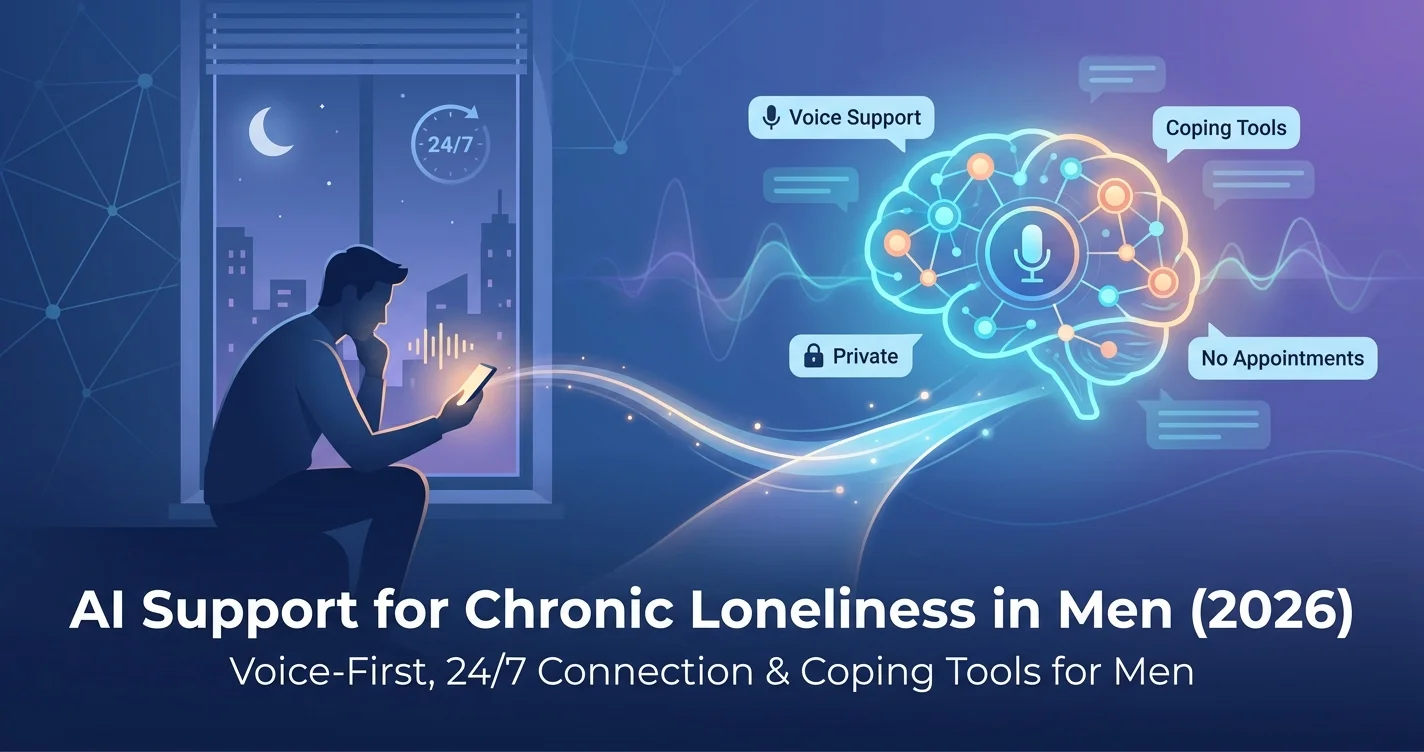
Chronic loneliness doesn't announce itself with a diagnosis code. It shows up as a Tuesday night with nobody to call, a phone full of contacts you never text first, and a quiet decision to just power through it again. This guide breaks down what actually helps men in that spot, and what an AI support app for chronic loneliness in men can and can't do about it.
TL;DR
- Lovon's voice-first format works better for men who won't type out feelings — talking out loud lowers the barrier to entry.
- Look for 24/7 access, not scheduled sessions — chronic loneliness doesn't wait for a 2pm slot.
- An AI support app for chronic loneliness in men should hand you coping tools, not just listen and nod.
- Text-only journaling apps and generic chatbots are a Skip for men who avoid writing about emotions.
- None of this replaces a licensed therapist for clinical depression or suicidal ideation — treat it as a companion, not a cure.
Why this matters
Men report lower rates of close friendship than they did decades ago, and the ones who do feel isolated are far less likely to bring it up first, to a friend or a professional. That combination — high loneliness, low disclosure — is exactly the gap an AI support app is built to sit inside.
The problem isn't that men don't feel lonely. It's that most support systems assume you'll type a paragraph about your feelings or book a session two weeks out. Neither matches how chronic loneliness actually behaves: it spikes at night, it spikes on Sundays, and it rarely waits for an appointment.
Who this is for
This guide is for a man in his late 20s to mid-50s who has functional isolation — he goes to work, maybe has a partner or kids, but has no one he calls just to talk. He's not in crisis. He's just tired of carrying it alone, and he's not going to walk into a therapist's office to say that out loud yet. If that's you, voice-based AI support removes the two biggest blockers: scheduling and the discomfort of admitting it to a person face to face.
What to look for in an AI support app for chronic loneliness in men
Voice, not just text
Typing out "I feel disconnected from everyone" is a wall for a lot of men. Talking it out loud, the way you'd vent to a friend in a car, is not. AI voice therapy differs from text-based apps in exactly this way — voice sessions surface emotional detail that typed check-ins tend to flatten out.
No appointment, no waiting room
Chronic loneliness doesn't clock out at 5pm. An app that requires you to book a slot for next Thursday misses the 11pm moment where the isolation actually hits. On-demand access is the entire point.
Built with clinical input, not a generic script
A chatbot trained on generic self-help text will loop the same three phrases at you. Look for tools built with input from licensed psychologists, because the difference shows up fast in how a session actually responds to what you say.
Coping tools, not just conversation
Talking helps, but a 10-minute session that ends with "thanks for sharing" and nothing else is a dead end. The better tools hand you something concrete afterward — a grounding exercise, a reframe, a next step.
Total privacy, zero exposure
Men who won't open up to a friend are not going to open up in a group forum or a public support thread. A private, one-on-one voice conversation removes the audience entirely.
Top picks for chronic loneliness support
The safe pick. Best AI Therapy App for Social Isolation and Loneliness walks through what a dedicated loneliness-focused AI session looks like end to end — session structure, what it asks, what it doesn't. It's built around the specific pattern of social withdrawal rather than generic mood tracking. One detail worth noting: sessions run on your schedule, available around the clock in 2026, not on a booked calendar slot. Verdict: Buy.
The wildcard. Emotional Support App for Loneliness and Isolation covers the middle ground — not full therapy, not a chat forum, just structured emotional check-ins. It's useful on the nights when you don't need a full session, just five minutes of being heard. Verdict: Consider if you want something lighter than a full voice session but heavier than a journal entry.
The DIY toolkit. How to Cope With Loneliness: Evidence-Based Approaches is the resource to pair with any app-based support, because it lays out the behavioral side — the actions that reduce loneliness independent of any tool, like scheduled low-stakes social contact. Verdict: Buy, especially if you want to understand the mechanism before trusting an app with it.
The reality check. Loneliness vs. Being Alone: How to Make the Distinction matters because a chunk of men chasing loneliness "fixes" are actually fine being alone and just need to name the difference. Skip the apps entirely if this piece describes you better than "chronic loneliness" does. Verdict: Consider — read this before you download anything.
Talk it out tonight, no appointment
Start a private voice session with Lovon whenever the isolation hits.
What to avoid
- Generic mood-tracker chatbots. They look like support but they're pattern-matching scripts with no clinical grounding — fine for logging a mood, useless for a real conversation about isolation.
- Public support forums. Anonymous doesn't mean private. Posting about feeling alone to a room of strangers online can leave a man feeling more exposed, not less.
- Text-only journaling apps as a sole tool. Writing has value, but if typing about feelings is the exact wall you're trying to get around, a text-first app just moves the wall instead of removing it.
How the picks compare
| Pick | Format | Availability | Best for | Verdict |
|---|---|---|---|---|
| Best AI Therapy App for Social Isolation | Voice sessions | 24/7 | Structured loneliness support | Buy |
| Emotional Support App for Loneliness | Voice check-ins | 24/7 | Light, short daily contact | Consider |
| Evidence-Based Coping Guide | Reading + action steps | Anytime | Understanding the mechanism | Buy |
| Loneliness vs. Being Alone Guide | Reading | Anytime | Self-diagnosis before you start | Consider |
FAQ
What's the best AI support app for chronic loneliness in men?
A voice-based app with 24/7 access and clinical input, like Lovon, tends to work better for men than text-only tools because talking out loud lowers the barrier that typing about feelings creates. Look for a session structure that hands you a coping tool afterward, not just a listening ear.
Is an AI therapist better than doing nothing when you feel isolated?
Yes, for most men the alternative to an AI voice session isn't a licensed therapist, it's silence. An AI support app gives you an outlet at 2am on a Tuesday when no other option exists at that hour.
How much does an AI voice therapy app cost compared to a real therapist?
Therapy without insurance runs well into triple digits per session in 2026, while AI voice apps typically run a fraction of that on a monthly basis. Check current pricing directly on the app before comparing.
Can an AI app actually help with chronic loneliness, or just distract you?
It helps most when paired with real behavioral steps like scheduled contact with people, not used as a total replacement for human connection. Treat the app as the on-ramp back into talking about it, not the destination.
Is it normal for men to struggle to talk about loneliness?
Yes, disclosure rates among men are consistently lower than among women even when reported loneliness levels are similar. That gap is exactly why voice-first, private tools exist.
Does an AI app like Lovon replace a licensed therapist?
No. Lovon is built with input from PhD psychologists but is explicitly not a replacement for licensed clinical care, especially for depression, suicidal ideation, or diagnosed conditions.
How do I start using an AI support app for loneliness tonight?
Open the app and start a voice session the moment the feeling shows up, rather than waiting for a scheduled time. The point of an on-demand tool is that it works at 11pm as well as it works at noon.
What's the difference between loneliness and being alone?
Being alone is a physical state; loneliness is the gap between the connection you want and the connection you have. A man can be surrounded by people and still be chronically lonely, which is the exact case an AI support app is built for.
One last thing
The hardest part isn't finding a tool, it's the first sentence. Men who use voice-based support tend to talk longer and more specifically than men who are handed a blank text box, because saying "I don't have anyone to call" out loud is easier than typing it and staring at it. Start with the sentence, not the search for the perfect app.
Related guides
How AI Support Helps You Heal
AI emotional support isn't about replacing human connection — it's about filling the gaps. The moments when you need to talk at 2 AM, when you don't want to burden your friends again, or when you simply need someone to listen without judgment.
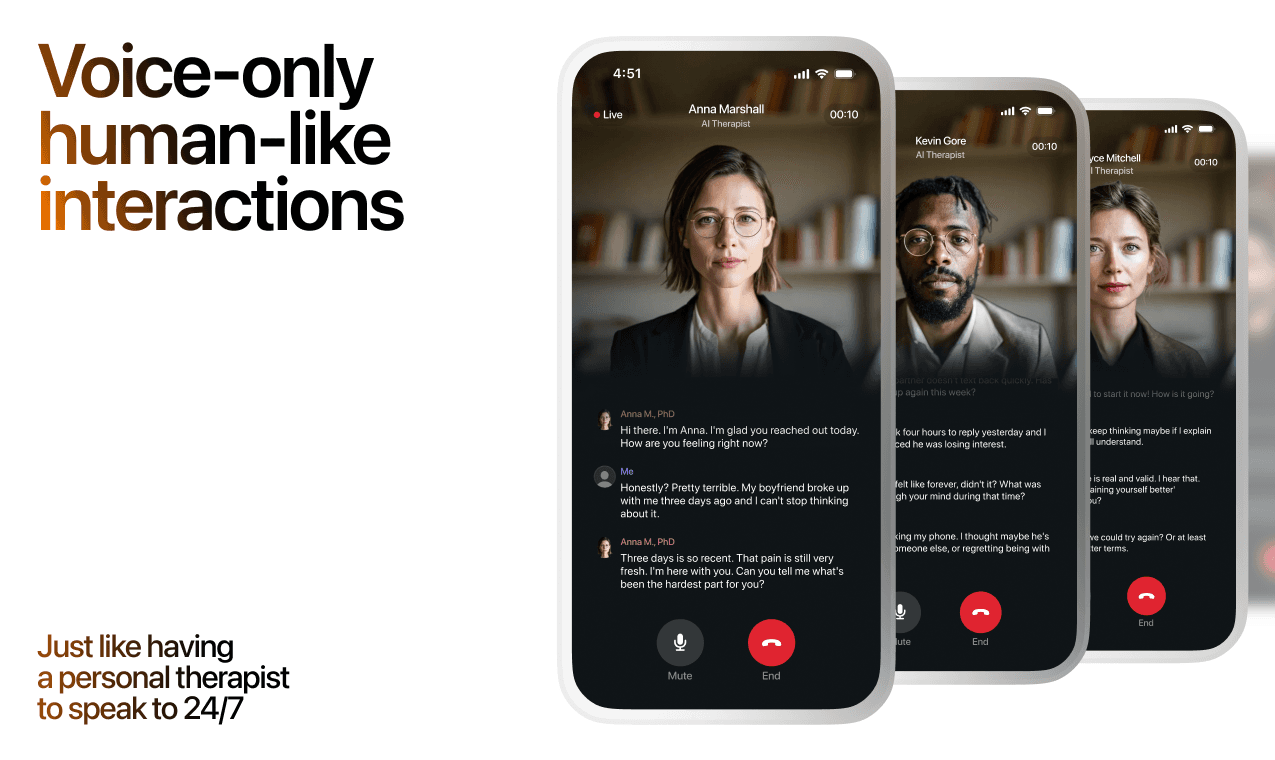
Here's what happens in a typical Lovon session:
You share what's on your mind
There's no script, no intake form, no waiting room. You speak or type whatever you're feeling — in your own words, at your own pace.
Lovon validates and explores
Using frameworks from CBT (Cognitive Behavioral Therapy) and motivational interviewing, Lovon acknowledges your feelings first, then gently helps you explore them. No dismissive "just move on" advice.
You build coping skills together
Lovon doesn't just listen — it actively works with you on evidence-based techniques: thought reframing, urge surfing, behavioral experiments, and more.
What a Session with Lovon Looks Like
When to Seek Professional Help
AI support is a valuable tool, but it's not a replacement for professional care. Please consider reaching out to a licensed therapist if you experience any of the following:
- Persistent thoughts of self-harm or suicide
- Inability to perform daily activities (work, eating, sleeping) for more than 2 weeks
- Turning to alcohol or substances to cope
- Intense anger or desire to harm your ex-partner
- Complete emotional numbness that doesn't improve over time
Crisis Resources (US): If you're in immediate danger, call 988 (Suicide & Crisis Lifeline) or text HOME to 741741 (Crisis Text Line). Available 24/7, free, and confidential.
Outside the US? Find a crisis line in your country
Ready to Start?
Your healing journey can begin right now
A 7-day trial. No judgment. Just a safe space to process what you're going through.
Frequently Asked Questions
Is Lovon a replacement for a real therapist?
Is my conversation with Lovon AI private?
How is Lovon different from ChatGPT for emotional support?
Can I use Lovon if I'm already seeing a therapist?
Can I try Lovon before subscribing?
About the Author

The Lovon Editorial Team
Mental Health & Wellness Content Team
The Lovon Editorial Team develops mental health and wellness content designed to make psychological concepts accessible and actionable. Our goal is to bridge the gap between clinical research and everyday life - helping you understand why your mind works the way it does and what you can do about it....
Related articles
- Free AI Therapist for Depression: Top Picks 2026
The best free AI therapist for depression in 2026. Lovon offers voice-based CBT sessions with no waitlist and no daily…
- High-Functioning Loneliness in Women: Causes & Coping 2026
High-functioning loneliness means feeling deeply alone while life looks full. Learn the 7-step coping plan built for…
- How to Journal for Mental Health: 2026 Beginner Guide
Learn how to journal for mental health in 2026 with a step-by-step beginner method, prompts, troubleshooting fixes, and…
- Voice Journaling App for Mental Health: 2026 Verdict
Voice journaling app for mental health, compared: what to look for, which formats to skip, and why AI-guided sessions…
See also
Quizzes
- Perfectionism Test: What Are Your Standards Costing?
See what your standards actually cost, in 3 minutes.
- Guilt Test: Is Your Guilt Doing Its Job?
See whether your guilt repairs or just hurts.
Free tools
- Write a Letter to Someone You Lost
Tell it who they were to you and what you never got to say, and it writes the letter back in your words. No account, no…
- Write a Condolence Message for This Person
Get one condolence message written for your situation instead of a list of a hundred to choose from. Tell it who died…
From the wiki
- Why do I feel lonely all of a sudden?
Sudden loneliness usually traces back to something that quietly ended in the last few months: a routine, a shared class…
Disclaimer: This article is for informational purposes only and does not constitute medical advice, diagnosis, or treatment. Always seek the advice of your physician or other qualified health provider with any questions you may have regarding a medical condition. If you are in crisis or think you may have an emergency, call 988 (Suicide & Crisis Lifeline) or go to the nearest emergency room. Outside the US? Find a crisis line in your country.