
Mental health support for graduate students: complete 2026 guide
Mental health support for graduate students in 2026: campus counseling, peer groups, and on-demand tools like Lovon compared, plus a 7-step action plan.

Key Takeaways
- Graduate students report anxiety and depression at roughly six times the general population rate, per a 2018 Nature
- Mental health support for graduate students works best as a stack: campus counseling, a peer group inside your
- Campus counseling centers commonly cap free sessions per semester — know your limit before finals week hits.
- 988 and campus emergency lines exist for crisis moments; AI tools and peer groups are not built to replace them.
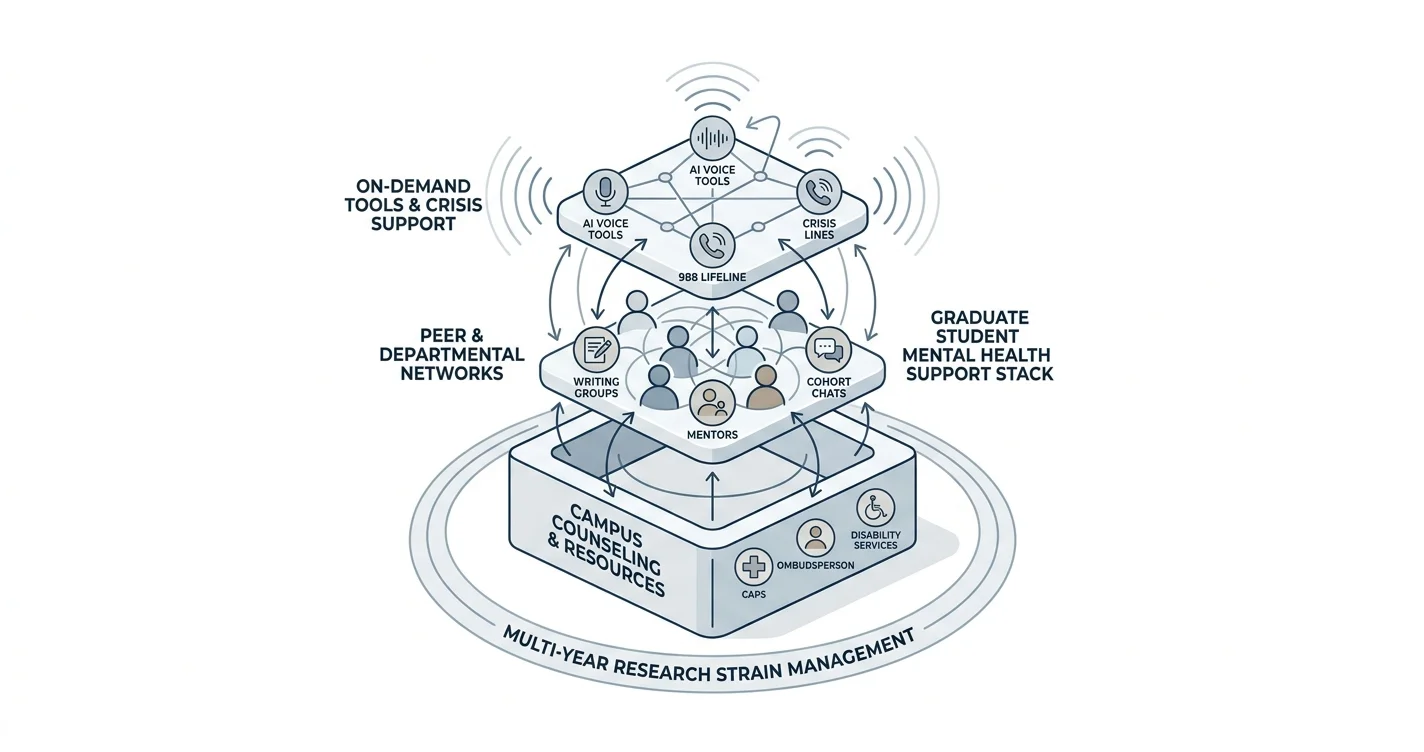
Mental health support for graduate students is the mix of campus counseling, peer networks, and always-available tools built to handle the specific strain of multi-year research programs — funding uncertainty, advisor power imbalances, and dissertation isolation that undergraduate support systems rarely account for. The stress cycle runs longer and less predictably than a semester, so support has to be available on that same erratic schedule.
TL;DR
- Graduate students report anxiety and depression at roughly six times the general population rate, per a 2018 Nature Biotechnology survey of PhD students.
- Mental health support for graduate students works best as a stack: campus counseling, a peer group inside your department, and an on-demand tool for the hours in between.
- Campus counseling centers commonly cap free sessions per semester — know your limit before finals week hits.
- 988 and campus emergency lines exist for crisis moments; AI tools and peer groups are not built to replace them.
Why mental health support for graduate students matters
A 2018 survey published in Nature Biotechnology found graduate students experience anxiety and depression at about six times the rate of the general adult population. The causes aren't abstract: an open-ended timeline, an advisor who controls both your funding and your degree, and a cohort that shrinks every year as people leave or finish ahead of you.
Grad school also strips out the built-in structures undergrad had — dorms, a fixed class schedule, a resident advisor down the hall. Research phases can run for months with almost no structured contact, and that's when isolation and rumination take over. That's the gap a tool like Lovon fits into: a voice conversation you can have at 1 a.m. before a defense, not a replacement for your therapist or your advisor relationship.
Build your support system in seven steps
Map your campus resources before you need them
Most graduate students find their counseling center's rules the week they're already in crisis. Do this earlier.
- Counseling and psychological services (CAPS) intake process and session cap
- Disability services for accommodation and extension paperwork
- The ombudsperson or graduate school dean of students office
- Your health insurance's mental health rider and copay structure
- Any TA/RA union hardship or mental health fund your program offers
Build a peer support structure inside your department
Isolation, not workload alone, drives most of the burnout that shows up mid-program. A structure beats a good intention every time.
- A standing weekly writing or accountability group with two or three peers
- A senior grad student or postdoc mentor outside your advisor relationship
- Your program's grad student organization or union
- A cross-cohort group chat with people past the isolating dissertation-writing stage
- A small "committee of care" — a few people who check on you without being asked
Set boundaries with your advisor early
Advisor conflict is one of the most cited stressors in graduate research, and most students never negotiate expectations until something breaks.
- A written weekly check-in cadence agreed on in your first month
- Explicit expectations on turnaround time for drafts and emails
- A documented escalation path through the ombudsperson if the relationship deteriorates
- A secondary mentor or committee member you can approach without your advisor present
- Your program coordinator's contact for funding or timeline disputes
Track your stress across the semester, not just during crunch
Most programs only notice a student is struggling at finals or during a defense. By then the pattern is months old.
- A weekly one-line journal entry on sleep, appetite, and mood
- A workload log that flags weeks running over your usual hours
- A simple 1-10 stress rating checked before and after major deadlines
- Sleep tracking around conference submissions and grant deadlines
- A recurring reminder to reassess every eight weeks, not just at finals
Use on-demand tools for the gaps between appointments
Campus counseling and peer groups run on office hours. Academic stress doesn't. This is where AI-based support enters — after the structure above is in place, not instead of it.
- A crisis text line or campus after-hours phone line for urgent moments
- Voice-based AI stress counseling for talking through an anxiety spike before a meeting
- A short breathing or grounding exercise before walking into an advisor meeting
- A journaling habit for logging thought patterns during a writing block
- A recurring reminder to book campus counseling before the wait list fills
AI voice tools such as Lovon aren't a diagnosis and won't replace your therapist, but for the 1 a.m. spiral before a proposal defense, a voice-based check-in is faster than waiting for office hours to open.
Talk through it before the meeting
Have a voice conversation with Lovon anytime, day or night.
Address financial and structural stressors directly
Stipend anxiety is a leading driver of graduate mental health strain, and it's rarely treated as a mental health issue on campus.
- Emergency fund or hardship grant applications through the graduate school
- Campus food pantries, most of which don't require proof of need
- Subsidized or sliding-scale therapy through student health, separate from the CAPS session cap
- External funding or completion grants if a stipend gap is approaching
- A look at what therapy costs without insurance in 2026 before assuming off-campus care is out of reach
Know your escalation options before a crisis, not during one
- 988 Suicide & Crisis Lifeline, by call or text, nationwide
- Campus CAPS emergency or after-hours line
- The ombudsperson for advisor conflict that has become unsafe
- Medical leave of absence policy, and how it affects funding and visa status
- Disability services for a deadline extension tied to a documented mental health need
Comparing mental health support options for graduate students
| Option | Best for | Key limitation |
|---|---|---|
| Campus counseling (CAPS) | Free or low-cost sessions, on-campus | Session caps and long waits during finals |
| Peer support / writing group | Daily accountability, reducing isolation | Not equipped for clinical symptoms |
| 988 Crisis Lifeline | Immediate crisis moments | Not a substitute for ongoing care |
| AI voice therapy app (e.g. Lovon) | On-demand talk support between sessions, off-hours | Not a licensed clinician, no diagnosis or medication management |
| Off-campus private therapist | Ongoing clinical care, continuity | Cost and availability without insurance |
The verdict for 2026: no single option on this table covers advisor stress, isolation, and crisis moments alone — the students who hold up best stack at least three of them.
Common mistakes graduate students make with mental health support
- Waiting until the defense or finals week to seek help, when CAPS wait lists are longest
- Treating an unresponsive or controlling advisor relationship as normal instead of escalating it
- Assuming free counseling sessions reset every semester without checking the actual cap
- Isolating completely during the writing phase, exactly when rumination and depression symptoms tend to peak
- Filing stipend stress under "money problem" instead of the direct mental health driver the data shows it is
FAQ
What is the best mental health support for graduate students in 2026?
The strongest setup combines free campus counseling, a peer group inside your department, and an on-demand tool for the hours counseling centers are closed. No single option covers advisor stress, isolation, and crisis moments alone.
Why do graduate students have higher rates of anxiety and depression?
A 2018 Nature Biotechnology survey found PhD students report anxiety and depression at roughly six times the general population rate, driven by funding uncertainty, advisor power imbalances, and open-ended timelines rather than a fixed semester structure.
Is AI therapy a substitute for a campus counselor?
No. AI voice tools like Lovon give on-demand emotional support and coping exercises but do not diagnose, prescribe, or replace a licensed clinician; campus counseling stays the clinical backbone.
How much does therapy cost for a graduate student without insurance in 2026?
Costs vary by provider and location, and student health plans often include a mental health rider with a lower copay than off-campus rates; check your plan details before assuming therapy is unaffordable.
What should I do if my advisor is the source of my stress?
Document specific incidents, set a written check-in cadence, and escalate to the ombudsperson or graduate school dean of students office if the relationship affects your mental health or your ability to work.
Where can graduate students get free mental health support?
Campus CAPS, the 988 Suicide and Crisis Lifeline, and student-run peer groups are typically free; many programs also have hardship funds covering a set number of external therapy sessions.
Can I take a leave of absence for mental health reasons?
Most graduate programs have a formal medical leave policy; check how it affects your funding, health insurance, and visa status (for international students) before requesting one, since terms vary by school.
How is AI voice therapy different from text-based mental health apps?
Voice conversation carries tone and pacing that text chat misses, closer to how you'd talk through advisor stress out loud; it works best as a between-sessions tool, not a first-line treatment for diagnosed conditions.
One last thing
The worst isolation stretch for graduate students usually isn't finals week — it's the six months after coursework ends and before the defense, when structured contact with your cohort disappears almost entirely. Set up your peer check-ins and your on-demand support now, in 2026, before that gap opens, not after you're already inside it.
Related guides
How AI Support Helps You Heal
AI emotional support isn't about replacing human connection — it's about filling the gaps. The moments when you need to talk at 2 AM, when you don't want to burden your friends again, or when you simply need someone to listen without judgment.
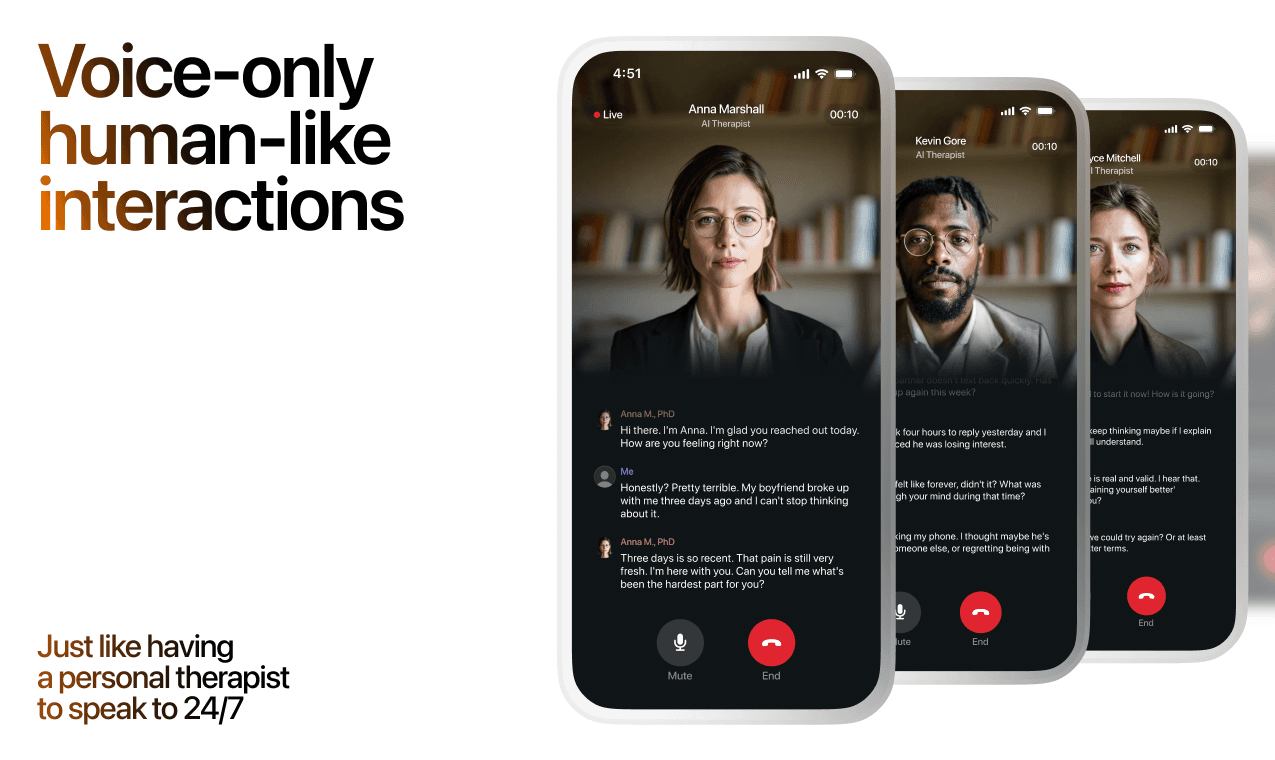
Here's what happens in a typical Lovon session:
You share what's on your mind
There's no script, no intake form, no waiting room. You speak or type whatever you're feeling — in your own words, at your own pace.
Lovon validates and explores
Using frameworks from CBT (Cognitive Behavioral Therapy) and motivational interviewing, Lovon acknowledges your feelings first, then gently helps you explore them. No dismissive "just move on" advice.
You build coping skills together
Lovon doesn't just listen — it actively works with you on evidence-based techniques: thought reframing, urge surfing, behavioral experiments, and more.
What a Session with Lovon Looks Like
When to Seek Professional Help
AI support is a valuable tool, but it's not a replacement for professional care. Please consider reaching out to a licensed therapist if you experience any of the following:
- Persistent thoughts of self-harm or suicide
- Inability to perform daily activities (work, eating, sleeping) for more than 2 weeks
- Turning to alcohol or substances to cope
- Intense anger or desire to harm your ex-partner
- Complete emotional numbness that doesn't improve over time
Crisis Resources (US): If you're in immediate danger, call 988 (Suicide & Crisis Lifeline) or text HOME to 741741 (Crisis Text Line). Available 24/7, free, and confidential.
Outside the US? Find a crisis line in your country
Ready to Start?
Your healing journey can begin right now
1 free conversation. No credit card. No judgment. Just a safe space to process what you're going through.
Frequently Asked Questions
Is AI therapy a replacement for a real therapist?
Is my conversation with Lovon AI private?
How is Lovon different from ChatGPT for emotional support?
Can I use Lovon if I'm already seeing a therapist?
Can I try Lovon for free?
About the Author
The Lovon Editorial Team
Mental Health & Wellness Content Team
The Lovon Editorial Team develops mental health and wellness content designed to make psychological concepts accessible and actionable. Our goal is to bridge the gap between clinical research and everyday life - helping you understand why your mind works the way it does and what you can do about it....
Related articles
- Emotional Support App for Loneliness: What Wins in 2026
Compares emotional support apps for loneliness in 2026 — what to look for, top picks, and verdicts. Lovon rated the top…
- AI Therapy for Postpartum Depression: What Works in 2026
AI therapy for postpartum depression works best when it's voice-based and available at 3am — see what to look for, what…
- Mental health app for lawyers: complete 2026 guide
Mental health app for lawyers in 2026: compare AI voice therapy, EAPs, and therapists for anxiety, burnout, and…
- AI support for HR professionals: complete 2026 guide
AI support for HR professionals means same-day voice coping tools between EAP sessions in 2026 — see what Lovon can and…
See also
Quizzes
- Perfectionism Test: What Are Your Standards Costing?
See what your standards actually cost, in 3 minutes.
- Shame Test: Do You Read Mistakes as Verdicts?
See which exit your shame takes, in 3 minutes.
Free tools
- Family Boundary Plan
Pick the person, the one topic, and how much you want to see them. You get a three-rung ladder, the guilt lines to…
- Self-Esteem Check-In
Eight statements, one read on three sides of self-esteem: your self-talk, how you act with people, and what you do with…
Disclaimer: This article is for informational purposes only and does not constitute medical advice, diagnosis, or treatment. Always seek the advice of your physician or other qualified health provider with any questions you may have regarding a medical condition. If you are in crisis or think you may have an emergency, call 988 (Suicide & Crisis Lifeline) or go to the nearest emergency room. Outside the US? Find a crisis line in your country.