
Can journaling before bed improve sleep quality?
Can journaling before bed improve sleep? A short to-do list can help you settle. Learn what research supports, what to write, and when to seek help.

Key Takeaways
- Can journaling before bed improve sleep? Research supports short to-do lists for sleep onset, not guaranteed all-night improvement.
- Baylor University researchers compared bedtime to-do lists with lists of completed activities; the to-do group fell asleep faster.
- Keep bedtime journaling practical: name unfinished tasks, choose a next action, and stop before writing becomes rumination.
- Lovon offers voice-based emotional support, not licensed clinical care or an established treatment for insomnia.
Yes—journaling before bed can help you fall asleep, especially when you use it to put unfinished tasks on paper rather than keep rehearsing them. Evidence is stronger for falling asleep sooner than for improving every aspect of sleep quality, and writing that turns into prolonged worry can leave you more alert.
TL;DR
- Can journaling before bed improve sleep? Research supports short to-do lists for sleep onset, not guaranteed all-night improvement.
- Baylor University researchers compared bedtime to-do lists with lists of completed activities; the to-do group fell asleep faster.
- Keep bedtime journaling practical: name unfinished tasks, choose a next action, and stop before writing becomes rumination.
- Lovon offers voice-based emotional support, not licensed clinical care or an established treatment for insomnia.
Can journaling before bed improve sleep quality?
Bedtime journaling has evidence for helping with sleep onset, but that is not the same as proving better sleep throughout the night. Falling asleep, staying asleep, and feeling rested the next day are separate outcomes. A useful bedtime habit does not necessarily improve all of them.
In a Baylor University laboratory study published in the Journal of Experimental Psychology: General, 57 adults aged 18–30 spent 5 minutes writing before bed. Participants who wrote about upcoming tasks fell asleep faster than participants who wrote about recently completed activities, with sleep measured through overnight monitoring.
The study, titled The Effects of Bedtime Writing on Difficulty Falling Asleep: A Polysomnographic Study Comparing To-Do Lists and Completed Activity Lists, supports a specific approach. It does not establish that every journal format treats insomnia or improves long-term sleep quality.
For your 2026 bedtime routine, treat journaling as a small experiment rather than a promise. If you are new to writing about your thoughts, this beginner’s guide to journaling for mental health explains the broader practice.
Why this matters
You can feel physically tired while your mind keeps checking tomorrow’s responsibilities. A short written plan gives those reminders somewhere to sit outside your head. You do not have to resolve every concern before resting.
The distinction matters: writing down a next action is different from investigating every possible bad outcome. The goal is to finish the writing session with less to mentally manage—not with a longer argument to continue in bed.
What kind of bedtime journaling should you try?
Choose the format that matches what is keeping you mentally busy. The comparison below separates the practical uses and limitations; it does not rank every method as a proven sleep treatment.
| Format | Best for | Practical benefit | Limitation |
|---|---|---|---|
| To-do list | Unfinished tasks and tomorrow’s reminders | Turns open tasks into a written plan; directly studied for sleep onset | Can become an overwhelming workload inventory |
| Brief worry note | A concern that needs attention later | Separates the concern from the next action | Can become repetitive reassurance-seeking |
| Gratitude note | A gentle, positive closing reflection | Gives your writing a different focus from problem-solving | Does not resolve practical worries; sleep benefits are not guaranteed |
| Open-ended emotional writing | Exploring feelings when you have space to process them | Allows fuller reflection | Intense topics can be activating immediately before bed |
To-do lists: best for unfinished tasks
Start here if bedtime brings a stream of reminders about work, appointments, errands, or messages. Write the task plainly, then name a manageable next action. Keep the list separate from actually doing the tasks.
For example, instead of mentally rehearsing an entire presentation, write that you will review the opening during tomorrow’s workday. You have recorded a decision. Opening your work files would turn the exercise back into work.
Brief worry notes: best for concerns you cannot solve tonight
Name the concern without writing a full case against yourself. Then distinguish between something you can act on later and something outside your control.
For an upcoming conversation, your next action might be to decide what you want to ask. You do not need to predict the other person’s response or rehearse every version of the exchange.
Gratitude notes: best for a gentler closing focus
If gratitude feels natural, record an ordinary moment you appreciated. It does not need to be profound. Avoid turning the exercise into an instruction to feel positive about a difficult day.
Gratitude writing and task-list writing serve different purposes. The bedtime to-do study does not prove that a gratitude journal produces the same sleep effect.
Emotional writing: best for reflection earlier in the evening
Writing openly about sadness, anger, or conflict can be meaningful, but bedtime is not always the right setting. If you finish more upset or mentally engaged, move that reflection earlier.
You are not failing at journaling. You are learning which topics fit a wind-down routine and which deserve more time or support.
How to try a bounded bedtime writing routine in 2026
Use the study’s 5-minute writing period as a starting format, not a medically established dose. Choose a quiet place outside the bed, and keep the exercise focused on putting things down rather than solving everything.
- Name the concern. Identify what keeps returning to mind. Use plain words rather than a detailed account of the whole day.
- List tomorrow’s tasks. Record the unfinished items you are trying to remember. Do not expand the list into a complete life overhaul.
- Choose next actions. Give actionable concerns a small, concrete follow-up. Leave uncontrollable outcomes unresolved rather than forcing an answer.
- Close the page. Put the notebook away when the exercise ends. Avoid rereading until you feel completely certain that nothing is missing.
The stopping point is part of the exercise. A list that keeps growing can become another source of pressure, so let the page be useful without making it exhaustive.
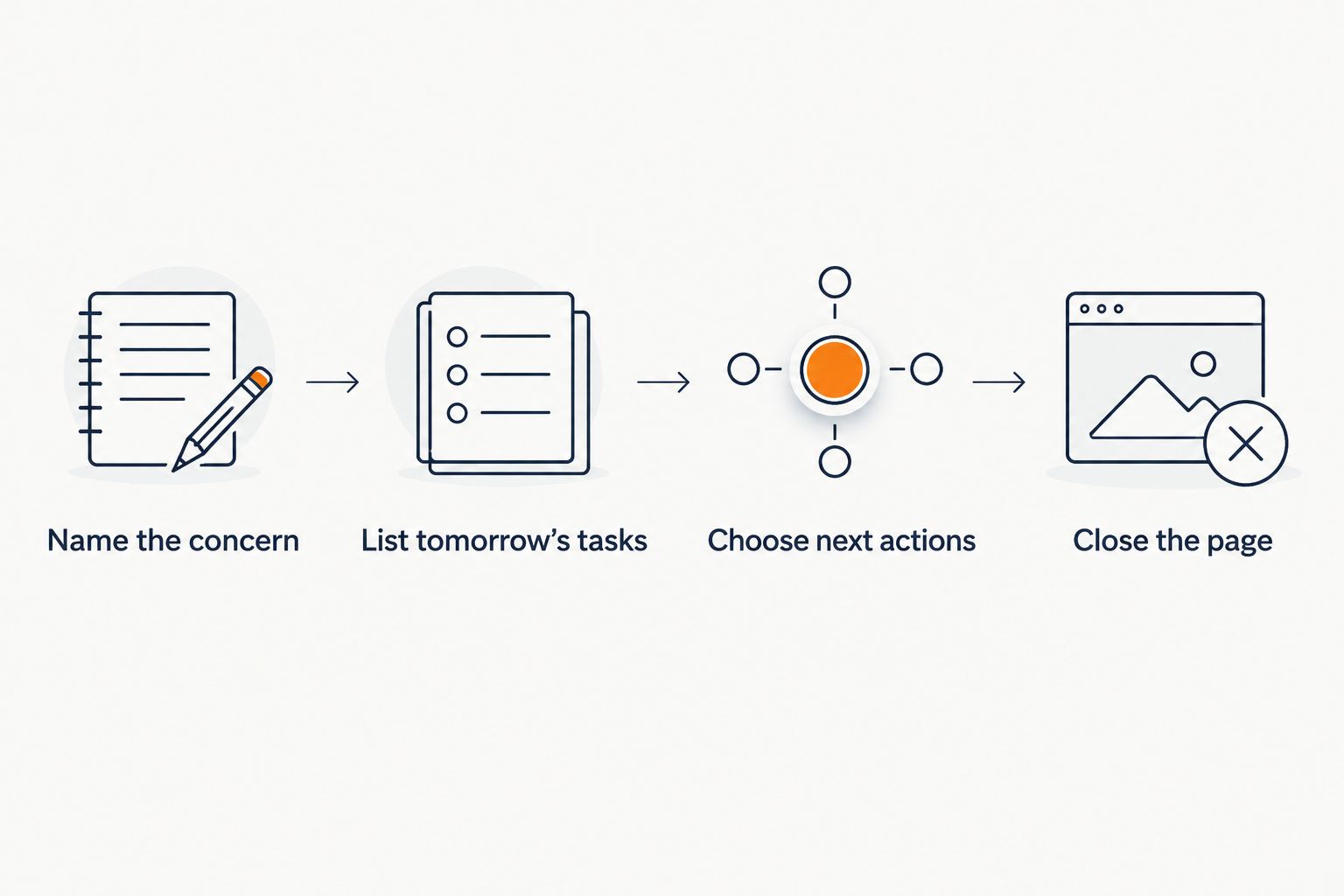 A bedtime writing sequence from naming a concern to closing the page
End with a next action and a stopping point, not an attempt to solve everything tonight.
After writing, return to your usual quiet wind-down. Resist checking email, sending the message you just remembered, or researching the concern you recorded. Those actions change the task from setting something aside to engaging with it again.
What should I write before bed?
Use these prompts as starting points, not a checklist you must complete. Pick the one that fits tonight’s concern, then stop when you have captured what matters.
- For unfinished work: What needs attention tomorrow, and what is the first useful action?
- For a recurring worry: Is there an action I can take later, or am I trying to control an uncertain outcome?
- For self-criticism: What happened, and what would be a fairer description than blaming myself?
- For an emotionally difficult day: What am I feeling, and what support would help outside bedtime?
- For a quiet closing reflection: What was an ordinary moment I appreciated today?
Keep your language factual and kind. A note about forgetting an errand does not need to become a judgment about your character. You are making a record, not writing a verdict on yourself.
Why the effect of bedtime journaling varies
Bedtime journaling is not one uniform activity. What you write, how you respond, and why you are struggling to sleep all affect whether it belongs in your routine.
- Writing topic: Upcoming tasks, gratitude, and emotionally intense memories involve different kinds of attention. Evidence for one format does not automatically apply to another.
- Level of detail: A clear next action is different from elaborating every possible problem. Notice when useful specificity becomes repeated analysis.
- Your response: Feeling more settled and feeling more distressed are different signals. Do not continue a format simply because it is described as healthy.
- The stopping point: A bounded exercise differs from writing until you feel perfectly reassured. Repeated checking can keep the concern active.
- The sleep problem: Journaling addresses thoughts on a page; it does not assess snoring, breathing pauses, pain, medication effects, or other possible contributors to disrupted sleep.
The useful question in 2026 is not whether you completed a perfect journaling streak. It is whether this particular exercise helps you set concerns aside without delaying rest.
How can I tell whether bedtime journaling helps me?
Look for a practical pattern rather than a perfect night. After waking, briefly note whether writing left you calmer, whether falling asleep felt easier, and how you feel during the day. Avoid repeatedly checking the clock overnight to measure your performance.
Change the format if writing consistently leaves you more alert or upset. You can try a shorter task-focused note, move reflection earlier, or stop bedtime writing altogether. A habit is useful because it helps you—not because you can force yourself to maintain it.
Keep the rest of your routine reasonably consistent while you judge the effect. If you change many habits at once, it becomes harder to tell which change made a difference.
Is paper better than a phone for bedtime journaling?
Paper is a practical starting point because it keeps the exercise separate from notifications, messages, and browsing. That is a reason to choose it, not proof that handwriting itself produces better sleep.
If you use a phone, keep the task contained and put the device away afterward. A brief note followed by scrolling is no longer just a journaling routine. Choose the format you can leave behind when you finish.
Can talking through feelings replace writing?
Talking is another way to reflect when writing feels difficult. However, the evidence from a written bedtime to-do exercise does not establish that a voice conversation has the same effect on sleep.
Lovon is best for people seeking on-demand voice-based emotional support, not clinical treatment for insomnia. The Lovon mental health app offers conversations, coping tools, and self-reflection guidance. It is not a licensed clinician or a replacement for licensed clinical care.
Lovon’s voice-based mental health support fits a different purpose from a written task list: talking through everyday feelings. Its limitation in this context is equally clear—Lovon should not be presented as a proven sleep treatment. Choose support based on what you need, not an assumed sleep benefit.
When should I seek help instead of relying on journaling?
Seek professional advice when sleep difficulties persist, interfere with daily functioning, or leave you struggling to stay awake safely. Loud snoring, witnessed breathing pauses, or waking while gasping also deserve medical attention rather than another journaling prompt.
For chronic insomnia, cognitive behavioral therapy for insomnia, often called CBT-I, is a recommended treatment. It addresses sleep-related patterns through a structured approach; general journaling is not an equivalent substitute.
As you review sleep advice in 2026, keep supportive habits separate from treatment claims. A notebook can help you organize thoughts while a clinician assesses a sleep problem. You do not have to choose between self-care and getting help.
FAQ
Can journaling before bed improve sleep if I overthink?
Bedtime journaling can help with falling asleep when it turns unfinished tasks into a short written plan. If writing becomes repeated analysis or leaves you more distressed, change the format or move it earlier.
How long should I journal before going to sleep?
A 5-minute writing period was used in the Baylor University bedtime to-do study. That is a researched starting format, not a proven ideal duration for every person.
Should I write about tomorrow or what happened today?
Writing about upcoming tasks has more direct support from the bedtime study than writing about completed activities. The study does not establish that tomorrow-focused writing improves every aspect of sleep quality.
Can journaling before bed make anxiety worse?
Bedtime writing can leave you more upset or alert if it becomes repetitive worry or intense emotional processing. Stop the exercise when that happens, and consider reflecting earlier or seeking support.
Is gratitude journaling better than a to-do list for sleep?
The bedtime to-do study does not establish that gratitude journaling is better for sleep. Choose gratitude for a gentle closing reflection, without assuming it has the same evidence as task-focused writing.
Do I need to journal every night for it to work?
The bedtime study does not establish that nightly journaling is necessary. Judge the exercise by whether it helps you settle, rather than treating an unbroken streak as the goal.
Can journaling cure insomnia without treatment?
Journaling is not an established cure for chronic insomnia. If sleep problems persist or affect your daytime functioning, seek an assessment and ask about treatments such as CBT-I.
One last thing
The most useful bedtime entry can be practical rather than deeply revealing. The task-focused study did not require participants to resolve their emotions or uncover a hidden explanation for their sleep difficulties.
For tonight—and for a sustainable 2026 routine—write enough to remember, then stop. Rest does not require a finished to-do list, a perfectly calm mind, or an explanation for every feeling.
Related guides
How AI Support Helps You Heal
AI emotional support isn't about replacing human connection — it's about filling the gaps. The moments when you need to talk at 2 AM, when you don't want to burden your friends again, or when you simply need someone to listen without judgment.
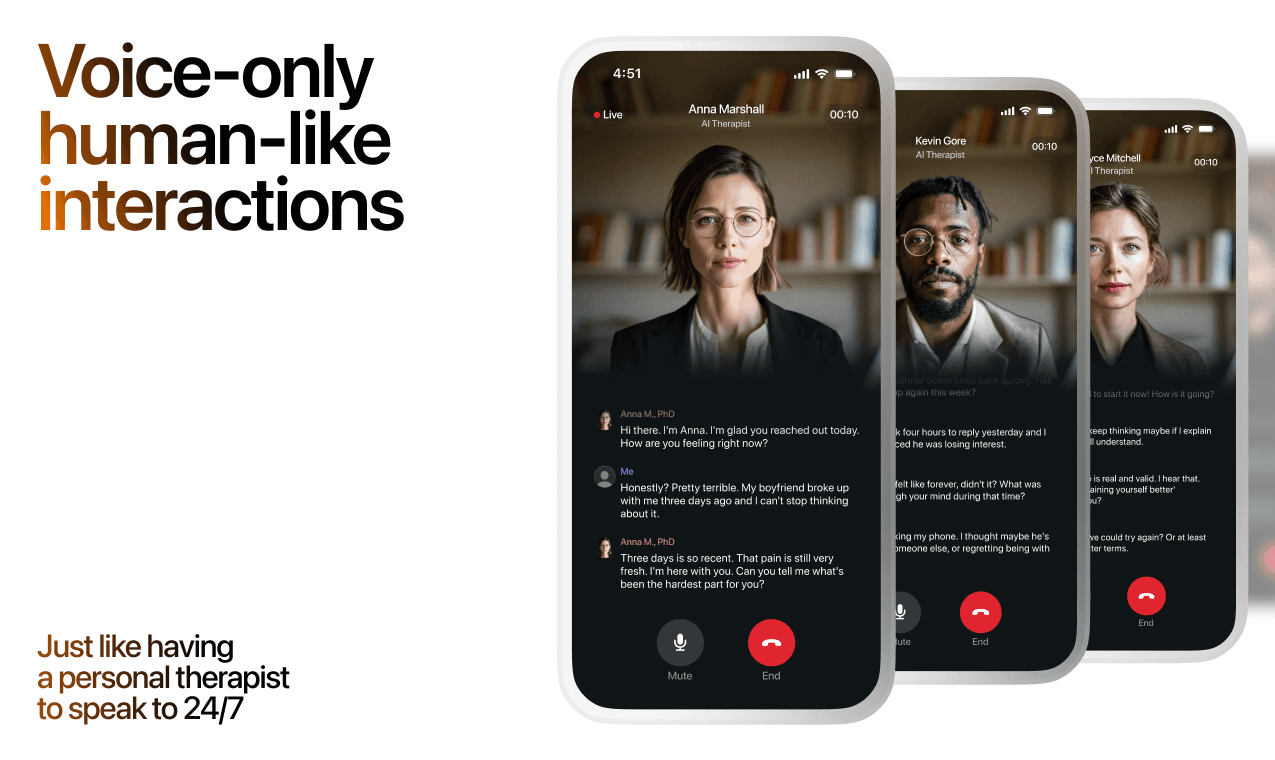
Here's what happens in a typical Lovon session:
You share what's on your mind
There's no script, no intake form, no waiting room. You speak or type whatever you're feeling — in your own words, at your own pace.
Lovon validates and explores
Using frameworks from CBT (Cognitive Behavioral Therapy) and motivational interviewing, Lovon acknowledges your feelings first, then gently helps you explore them. No dismissive "just move on" advice.
You build coping skills together
Lovon doesn't just listen — it actively works with you on evidence-based techniques: thought reframing, urge surfing, behavioral experiments, and more.
What a Session with Lovon Looks Like
Lovon is AI support, not a replacement for professional care. If things have been hard to get through for weeks, or you are thinking about harming yourself, talk to a doctor or a licensed therapist.
Ready to Start?
Your healing journey can begin right now
A 3-day trial. No judgment. Just a safe space to process what you're going through.
Frequently Asked Questions
Is Lovon a replacement for a real therapist?
Is my conversation with Lovon AI private?
How is Lovon different from ChatGPT for emotional support?
Can I use Lovon if I'm already seeing a therapist?
Can I try Lovon before subscribing?
About the Author

The Lovon Editorial Team
Mental Health & Wellness Content Team
The Lovon Editorial Team develops mental health and wellness content designed to make psychological concepts accessible and actionable. Our goal is to bridge the gap between clinical research and everyday life - helping you understand why your mind works the way it does and what you can do about it....
Related articles
- Best AI apps for caregiver burnout in 2026
Compare the best AI apps for caregiver burnout. Choose Lovon for voice support, or a writing assistant for practical…
- Can a panic attack happen while you are asleep?
Can a panic attack happen while sleeping? Yes. Learn the signs of nocturnal panic, what to do after waking, and when…
- How much sleep do you need to lower anxiety?
How much sleep do you need to lower anxiety? Most adults should aim for 7–9 hours in 2026. Learn why sleep quality…
- How long does it take to feel better with AI therapy?
AI therapy eases stress within one session, but real relief from anxiety or low mood takes 6 to 8 weeks of steady use…
See also
Quizzes
- Perfectionism Test: What Are Your Standards Costing?
See what your standards actually cost, in 3 minutes.
- Emotional Granularity Test: How Precisely Do You Feel?
See how finely you tell your feelings apart, in 3 minutes.
Free tools
- AI Mental Health Coach
This is a free AI mental health coach for ordinary hard stretches: stress, low days, worry that will not switch off, a…
- Sleep Meditation for Anxiety
For lying in bed with a mind that will not stop. About twelve minutes of slower breathing, a place to put the worries…
From the wiki
- What to do if you have no friends?
Pick one activity that repeats weekly with the same people, and go for six to eight weeks straight. Repetition, not…
Disclaimer: This article is for informational purposes only and does not constitute medical advice, diagnosis, or treatment. Always seek the advice of your physician or other qualified health provider with any questions you may have regarding a medical condition. If you are in crisis or think you may have an emergency, call 988 (Suicide & Crisis Lifeline) or go to the nearest emergency room. Outside the US? Find a crisis line in your country.