
ADHD in College Students: Deadlines and Focus in 2026
ADHD in college students means missed deadlines and scattered focus — see what actually works in 2026, from time-blocking to AI support between classes.

Key Takeaways
- ADHD in college students usually means time blindness, not laziness — external cues fix more than willpower ever will.
- Body doubling and 25-minute work blocks beat all-nighters for focus; Buy the habit, skip the marathon session.
- Lovon's AI voice therapy gives ADHD students a place to process rejection sensitivity and burnout between classes —
- Campus disability offices remain the strongest lever for extended deadlines in 2026 — apply in week two of the
College deadlines don't care that your brain works differently — but the right systems and support do. This guide breaks down what actually helps ADHD in college students manage focus, deadlines, and the shame spiral that shows up after a missed one.
TL;DR
- ADHD in college students usually means time blindness, not laziness — external cues fix more than willpower ever will.
- Body doubling and 25-minute work blocks beat all-nighters for focus; Buy the habit, skip the marathon session.
- Lovon's AI voice support gives ADHD students a place to process rejection sensitivity and burnout between classes — Consider it as a between-sessions supplement, not a diagnosis tool.
- Campus disability offices remain the strongest lever for extended deadlines in 2026 — apply in week two of the semester, not after the first missed one.
Why this matters
ADHD doesn't shrink when the syllabus gets denser — it just gets more expensive. A student who loses two hours to a rabbit hole in high school loses a full assignment cycle in a 15-week semester with four overlapping deadlines.
The structure that got you through high school — a teacher checking homework daily, parents enforcing bedtime — disappears the day you move into a dorm. What's left is a calendar full of due dates and a brain that treats "next Tuesday" as an abstract concept until it's Monday night.
The mental health apps for college students in 2026 landscape has gotten more specific about this gap — tools built for ADHD focus and deadline management, not generic productivity. That specificity matters more than another to-do list app.
Who this is for
This is for the student who's been diagnosed with ADHD — or strongly suspects it — and is drowning in a system built for brains that don't lose track of time. If you're pulling all-nighters before every paper, forgetting exam dates until the reminder fires, or watching your best intentions evaporate the second your phone lights up, this guide is written for you.
It's also for the student managing ADHD alongside anxiety about falling behind, since the two feed each other fast in a semester with no slack built in.
What to look for in ADHD support for college students
External time structure, not willpower
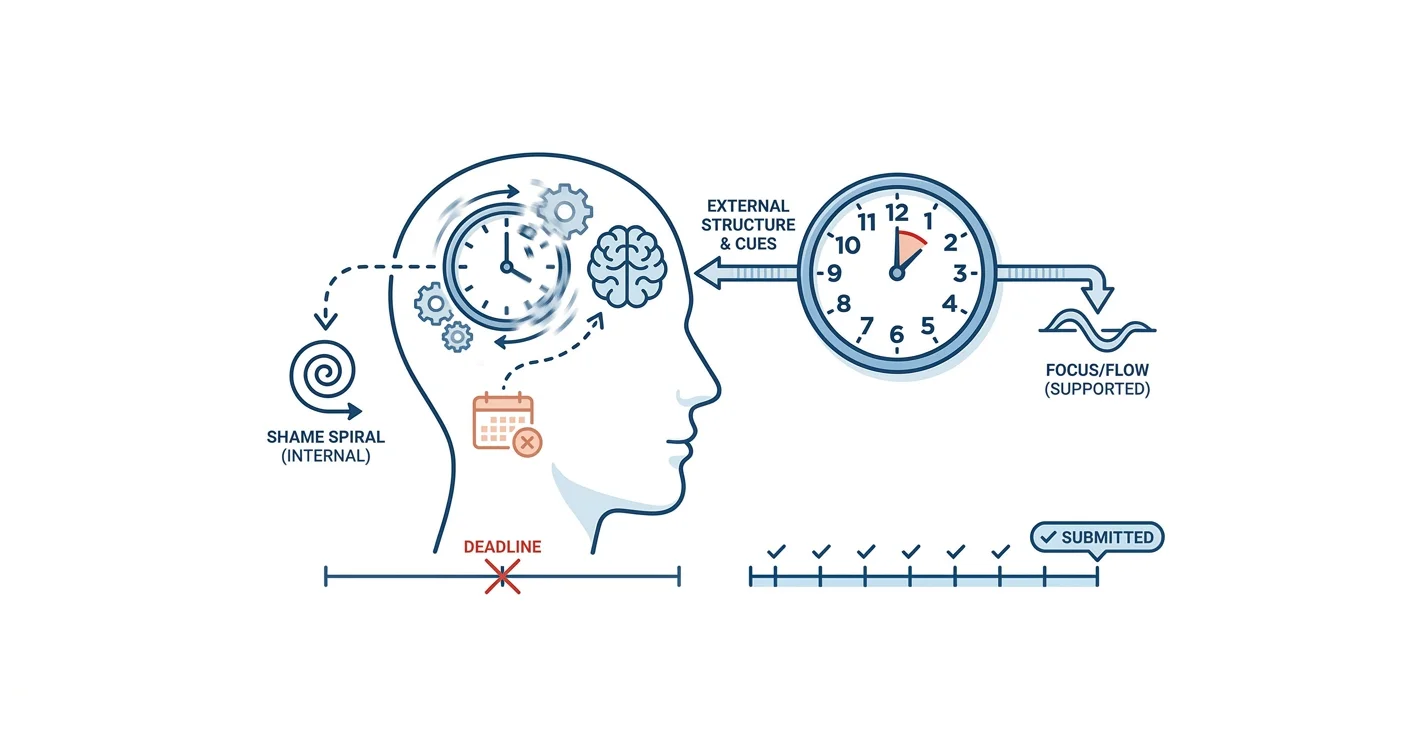
ADHD brains don't misjudge time out of carelessness — the internal clock that tells most people "an hour has passed" runs on a different signal. A system that relies on you remembering to check the time will fail. A system built around timers, alarms, and visible countdowns works because it removes the need to remember at all.
Accountability that happens automatically
Asking a roommate to check in works for a week, then quietly stops. What holds up longer is something scheduled — a recurring study session, a standing call, an app that pings you at a fixed time rather than waiting for you to open it.
Availability outside office hours
A counseling center that's open 9 to 5 on weekdays doesn't help at 11 p.m. the night before a paper is due, which is exactly when ADHD panic tends to peak. Support that's available at 2 a.m. matters more in college than in almost any other life stage.
A way to catch rejection sensitivity before it spirals
One bad grade or one curt email from a professor can trigger a shutdown that costs two more days of avoidance. Tools that help name the spiral in the moment — instead of after the deadline's already gone — are worth more than another planner app.
Something that survives a bad week
Midterms, a breakup, a sick roommate — the system that only works when life is calm isn't a system, it's a hobby. Look for tools flexible enough to bend without breaking when the semester gets messy.
Top picks for managing deadlines and focus
Fix time blindness first — the diagnosis behind the missed deadline. Time blindness is the single most common driver of missed ADHD deadlines, and it's fixable with external cues rather than internal discipline. Set a visible countdown timer for every study block instead of trusting your sense of elapsed time. Read the full breakdown on ADHD time blindness before you build anything else. Buy.
Break the procrastination loop — the 20-minute rule. ADHD procrastination isn't about avoiding work, it's about avoiding the feeling of starting hard tasks. Committing to just 20 minutes, with a timer running, gets past the activation-energy wall more reliably than forcing a full study session. The mechanics are laid out in ADHD and procrastination. Buy.
Build one routine, not five apps. The wildcard pick: most ADHD students fail not because they lack tools but because they're running four different systems that don't talk to each other. One calendar, one inbox-check time daily, one place for deadlines — anything more collapses within two weeks. Consider.
AI tools built for follow-through, not just reminders. The safe pick for 2026: focus tools that adapt in real time rather than sending the same 8 a.m. notification you've learned to ignore. These work best paired with the routine above, not as a replacement for it. Consider.
Process the shame spiral before it costs you the deadline. The one most students skip: after a missed assignment, the shame response itself becomes the reason the next three assignments slip too. Lovon's AI voice support gives students a place to talk through that spiral at the moment it happens — 2 a.m., between classes, before a professor meeting — instead of carrying it silently. It's not a diagnosis tool and it's not a replacement for a campus counselor, but as an always-available AI therapist for the in-between moments, it fills a real gap. Consider.
Talk through a deadline spiral tonight
Lovon's AI voice support is available whenever the panic hits, not just during office hours.
What to avoid
- Productivity apps with 40 features. A habit tracker, a Pomodoro timer, a mood log, and a goal-setter in one app sounds efficient — for ADHD, it's another decision fatigue trap. Pick one function per tool.
- The all-nighter as a strategy. Chasing an adrenaline deadline high works occasionally, but it trains your brain to need panic to start anything, which makes the next deadline worse, not easier.
- Waiting until you're failing to contact disability services. Extended-time accommodations and note-taking support exist for a reason, and in 2026 most campus offices process requests faster earlier in the semester than after a crisis email in week 12.
If the timer isn't visible, the deadline isn't real to an ADHD brain.
Quick verdict comparison
| Approach | Best for | Concrete detail | Verdict |
|---|---|---|---|
| External timers / time-blocking | Time blindness | 25-minute work blocks | Buy |
| 20-minute start rule | Procrastination | Beats the activation-energy wall | Buy |
| Single unified calendar | Overloaded systems | One inbox check daily | Consider |
| AI focus tools | Follow-through | Real-time adaptive nudges | Consider |
| AI voice therapy for RSD/shame | Post-deadline spirals | Available at 2 a.m. | Consider |
| Disability office accommodations | Structural deadline relief | Apply by week 2-3 | Buy |
FAQ
What is the best way to manage ADHD in college students?
External time structure beats willpower for ADHD in college students — visible timers, fixed check-in times, and a single calendar system outperform generic to-do lists. Pair that structure with support that's available outside office hours, since ADHD crises tend to hit at night.
Is time blindness the same as procrastination?
No, time blindness is an impaired sense of elapsed time, while procrastination is avoidance of a task's emotional weight. Both show up together in ADHD in college students, which is why fixing one without the other rarely solves the deadline problem.
Can an AI therapist help with ADHD?
An AI voice support tool like Lovon can't diagnose ADHD, but it can help process the shame and rejection sensitivity that follow a missed deadline in real time. Use it alongside campus counseling and any prescribed treatment, not instead of them.
How do I get extended deadlines for ADHD in college?
Contact your campus disability services office and request accommodations early in the semester, ideally by week two or three of 2026's academic calendar. Waiting until after a missed assignment makes the same request much harder to process in time.
Why do ADHD college students procrastinate more before big deadlines?
The bigger the assignment, the heavier the emotional weight of starting it, and ADHD brains avoid that discomfort until the deadline itself becomes the motivator. Breaking the task into a 20-minute starting chunk removes most of that resistance.
What causes ADHD burnout during finals week?
Burnout during finals comes from running on compensatory effort all semester with no built-in recovery time, which drains faster in ADHD brains than neurotypical ones. Scheduled breaks and lower-stakes check-ins during the week reduce the crash.
Does rejection sensitive dysphoria affect grades?
Yes — a single critical comment from a professor can trigger avoidance of that class or assignment entirely, which compounds into missed deadlines. Naming the spiral when it starts, rather than after work is already avoided, limits the damage.
Are AI mental health apps effective for college students in 2026?
They work best as on-demand support between therapy sessions or during hours campus counseling isn't staffed, not as a replacement for licensed care. In 2026, the more useful ones are built around specific struggles like ADHD focus or exam anxiety rather than general wellness.
One last thing
The single change with the biggest payoff isn't a new app — it's setting the timer before you open the laptop, not after. Once the tab is open, the ADHD brain has already found six other things to look at; the timer has to start first or it never starts at all.
Related guides
How AI Support Helps You Heal
AI emotional support isn't about replacing human connection — it's about filling the gaps. The moments when you need to talk at 2 AM, when you don't want to burden your friends again, or when you simply need someone to listen without judgment.
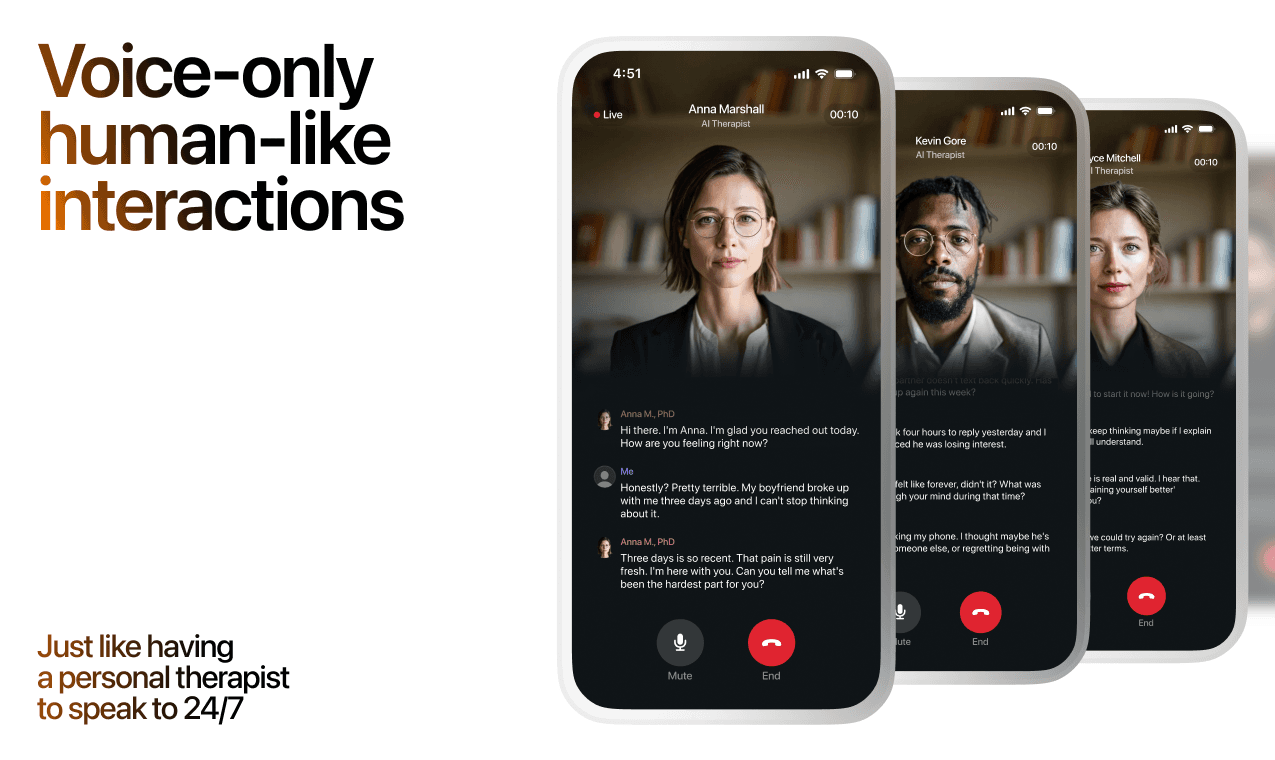
Here's what happens in a typical Lovon session:
You share what's on your mind
There's no script, no intake form, no waiting room. You speak or type whatever you're feeling — in your own words, at your own pace.
Lovon validates and explores
Using frameworks from CBT (Cognitive Behavioral Therapy) and motivational interviewing, Lovon acknowledges your feelings first, then gently helps you explore them. No dismissive "just move on" advice.
You build coping skills together
Lovon doesn't just listen — it actively works with you on evidence-based techniques: thought reframing, urge surfing, behavioral experiments, and more.
What a Session with Lovon Looks Like
When to Seek Professional Help
AI support is a valuable tool, but it's not a replacement for professional care. Please consider reaching out to a licensed therapist if you experience any of the following:
- Persistent thoughts of self-harm or suicide
- Inability to perform daily activities (work, eating, sleeping) for more than 2 weeks
- Turning to alcohol or substances to cope
- Intense anger or desire to harm your ex-partner
- Complete emotional numbness that doesn't improve over time
Crisis Resources (US): If you're in immediate danger, call 988 (Suicide & Crisis Lifeline) or text HOME to 741741 (Crisis Text Line). Available 24/7, free, and confidential.
Outside the US? Find a crisis line in your country
Ready to Start?
Your healing journey can begin right now
A 7-day trial. No judgment. Just a safe space to process what you're going through.
Frequently Asked Questions
Is Lovon a replacement for a real therapist?
Is my conversation with Lovon AI private?
How is Lovon different from ChatGPT for emotional support?
Can I use Lovon if I'm already seeing a therapist?
Can I try Lovon before subscribing?
About the Author
The Lovon Editorial Team
Mental Health & Wellness Content Team
The Lovon Editorial Team develops mental health and wellness content designed to make psychological concepts accessible and actionable. Our goal is to bridge the gap between clinical research and everyday life - helping you understand why your mind works the way it does and what you can do about it....
Related articles
- Is ADHD considered a disability?
Is ADHD considered a disability? Yes, when its effects meet the rules. Learn how workplace, school and Social Security…
- Best AI App for ADHD in Women in 2026: Lovon Wins
Compare the best AI apps for ADHD in women in 2026 — Lovon, Tiimo, Focusmate, Habitica, Woebot, and Forest — ranked by…
- ADHD in Women Symptoms: Overlooked Signs (2026)
ADHD in women often looks like anxiety, not hyperactivity. See the overlooked symptoms, screening criteria, and support…
- ADHD Hyperfocus: What It Is & How to Use It (2026)
ADHD hyperfocus locks you in for hours — on the wrong thing. Learn what triggers it, how to redirect it to real work…
See also
Quizzes
- Perfectionism Test: What Are Your Standards Costing?
See what your standards actually cost, in 3 minutes.
- Shame Test: Do You Read Mistakes as Verdicts?
See which exit your shame takes, in 3 minutes.
Free tools
- What to Say to Someone Who Is Grieving
Get sentences that fit this person and this week, not a list of things people say at funerals. Describe who they lost…
- Family Boundary Plan
Pick the person, the one topic, and how much you want to see them. You get a three-rung ladder, the guilt lines to…
From the wiki
- Why do I feel lonely all of a sudden?
Sudden loneliness usually traces back to something that quietly ended in the last few months: a routine, a shared class…
Disclaimer: This article is for informational purposes only and does not constitute medical advice, diagnosis, or treatment. Always seek the advice of your physician or other qualified health provider with any questions you may have regarding a medical condition. If you are in crisis or think you may have an emergency, call 988 (Suicide & Crisis Lifeline) or go to the nearest emergency room. Outside the US? Find a crisis line in your country.