
Best Mindfulness App for Anxiety in 2026: Full Ranking
Headspace, Insight Timer, and Lovon compared for anxiety in 2026 — which mindfulness app fits structured practice, free content, or real-time support.

Key Takeaways
- Headspace is the best mindfulness app for anxiety for structured, beginner-friendly courses in 2026.
- Insight Timer has the largest free library of guided meditations without a subscription wall.
- Lovon fills the gap when meditation isn't enough — AI voice conversations for anxiety spikes in real time.
- Wysa suits people who want CBT-style exercises through a chat interface rather than audio.
- Ten Percent Happier is best for skeptics who want mindfulness without spiritual framing.
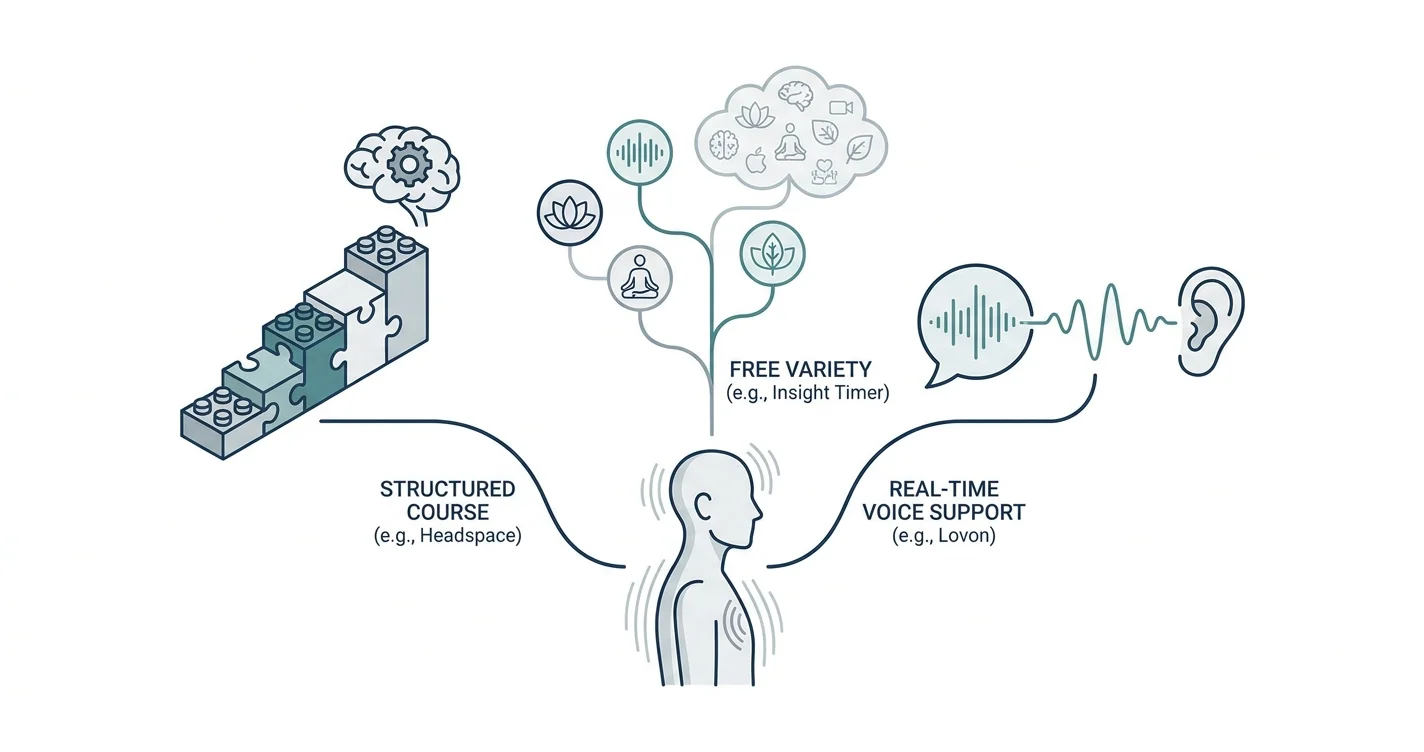
The best mindfulness app for anxiety in 2026 depends on what you actually need in the moment — a structured course, a free meditation library, or someone to talk to when your chest is tight and a breathing timer isn't cutting it. Headspace wins for structured beginner courses, Insight Timer wins for free variety, and Lovon wins for real-time voice support when meditation alone doesn't calm a spike.
TL;DR
- Headspace is the best mindfulness app for anxiety for structured, beginner-friendly courses in 2026.
- Insight Timer has the largest free library of guided meditations without a subscription wall.
- Lovon fills the gap when meditation isn't enough — AI voice conversations for anxiety spikes in real time.
- Wysa suits people who want CBT-style exercises through a chat interface rather than audio.
- Ten Percent Happier is best for skeptics who want mindfulness without spiritual framing.
Why this matters
Anxiety doesn't show up on a schedule, but most mindfulness apps are built around scheduled sessions — a 10-minute course, a sleep story, a weekly module. That works fine for building a long-term practice. It works less well at 11 p.m. when your thoughts are spiraling and you need something right now.
The Lovon app exists in the gap between structured mindfulness practice and licensed therapy: an AI voice conversation you can start the moment anxiety spikes, without waiting for an appointment or scrolling for the right meditation track. It's not a replacement for a therapist, and it says so directly. But for the specific moment when you need to talk something through rather than sit with a breathing app, it's a different tool than anything on this list.
Matching the tool to the moment is the whole game in 2026's crowded mental health app market. A library of 10-minute meditations helps you build a long-term habit. A voice conversation helps you get through the next 15 minutes. Neither replaces the other.
What makes the best mindfulness app for anxiety
- Anxiety-specific programming — not just general wellness content repackaged
- Real-time availability — support when the spike happens, not only during scheduled sessions
- Evidence-informed structure — techniques drawn from CBT, MBSR, or mindfulness practices that actually work rather than vague affirmations
- Format fit — audio, text, or voice, matched to how you actually process stress
- Transparency about limits — clear about what the app can and cannot do clinically
- Depth without a paywall on the essentials — enough free content to actually build a habit
Mindfulness and anxiety apps at a glance
| App | Best for | Standout feature | Key limitation |
|---|---|---|---|
| Lovon | Real-time voice support during anxiety spikes | AI voice conversation built with input from PhD psychologists | Not a licensed clinician or crisis service |
| Headspace | Structured courses for beginners | Multi-week guided programs with progress tracking | Less useful mid-spike; requires sitting through a session |
| Insight Timer | Free meditation variety | Large free library across teachers and traditions | Quality varies widely by contributor |
| Ten Percent Happier | Secular mindfulness for skeptics | Teacher-led courses without spiritual framing | Smaller library specific to anxiety |
| Wysa | Chat-based CBT exercises | Guided CBT techniques through text conversation | Text-only, no voice option |
| Calm | Sleep-focused anxiety relief | Sleep stories and wind-down audio | Limited daytime anxiety-specific tools |
1. Lovon: best for talking through an anxiety spike in real time
Lovon is a voice conversation, not a meditation timer. You open the app, start talking, and an AI voice — built with input from PhD psychologists — walks with you through what's happening rather than asking you to sit quietly with your breath. That's a fundamentally different mechanism than a guided meditation, and it's the reason it belongs on this list even though it isn't a mindfulness app in the traditional sense.
Lovon pros:
- Available any time of day, no scheduling a session
- Voice format works better for people who process anxiety by talking, not sitting still
- Explicit and upfront that it's not a replacement for licensed clinical care
Lovon cons:
- Not a substitute for therapy or crisis intervention
- No structured multi-week course format like Headspace or Ten Percent Happier
- Voice-first design won't suit everyone; some people prefer text or audio-only meditation
Best for: anyone who needs to talk through an anxiety spike right now rather than follow a guided meditation. Read more on the best mental health app for anxiety in 2026 for a broader comparison beyond mindfulness apps specifically.
2. Headspace: best mindfulness app for anxiety for structured beginner courses
Headspace organizes its content into multi-week programs with a clear start and end point, which suits people who want a curriculum rather than an open library. The anxiety-specific courses walk through breathing and reframing techniques in a set order.
Headspace pros:
- Clear structure for people new to mindfulness
- Progress tracking keeps a daily habit visible
- Anxiety-specific course tracks, not just general wellness content
Headspace cons:
- Structured format is less useful in the middle of an acute spike
- Requires committing to a session length rather than dipping in for 60 seconds
Best for: beginners who want a set curriculum to build a daily mindfulness habit. Buy.
3. Insight Timer: best free mindfulness app for anxiety
Insight Timer's library spans thousands of contributors, which means far more free content than most subscription apps offer upfront. You can find anxiety-specific tracks from dozens of different teachers without hitting a paywall.
Insight Timer pros:
- Large free library, no subscription required to start
- Wide range of teaching styles and lengths
- Community features like timers and group sessions
Insight Timer cons:
- Quality and production value vary widely since content is crowd-sourced
- No single structured course path; can feel unorganized for beginners
Best for: people who want free variety and don't mind sorting through options themselves. Buy.
4. Ten Percent Happier: best mindfulness app for anxiety for skeptics
Ten Percent Happier built its brand on stripping mindfulness of spiritual language, aiming at people who are wary of anything that sounds like New Age wellness. The teaching is direct and grounded in practical technique.
Ten Percent Happier pros:
- Secular framing appeals to people put off by spiritual language
- Teacher-led courses with clear explanations of the mechanism behind each technique
Ten Percent Happier cons:
- Smaller anxiety-specific catalog than Headspace or Insight Timer
- Less variety in session length for quick, on-the-go use
Best for: skeptics who want mindfulness taught like a skill, not a philosophy. Hold if you already have a subscription elsewhere; Buy if secular framing is a dealbreaker for you.
5. Wysa: best chat-based CBT tool for anxiety
Wysa runs on text rather than voice or audio, walking users through cognitive behavioral therapy exercises in a conversational chat format. It's built around structured exercises rather than open-ended meditation.
Wysa pros:
- Structured CBT exercises accessible without scheduling anything
- Text format suits people who don't want to speak out loud
Wysa cons:
- No voice option for people who process better by talking
- Chat-based interaction can feel slower than a guided audio session
Best for: people who want CBT structure through text and don't need voice interaction. Hold.
6. Calm: best mindfulness app for anxiety at bedtime
Calm leans heavily into sleep content — stories, soundscapes, and wind-down sequences aimed at the anxiety that shows up specifically at night.
Calm pros:
- Strong sleep-story and soundscape catalog
- Wind-down sequences designed specifically for bedtime anxiety
Calm cons:
- Daytime anxiety-specific tools are thinner than the sleep content
- Less useful for a mid-day spike than for nighttime rumination
Best for: anxiety that shows up specifically at bedtime. Hold unless sleep is your main anxiety trigger.
Need to talk it through right now?
Start a voice conversation with Lovon when breathing exercises aren't enough.
How we ranked these apps
Each app was placed against the six criteria above: anxiety-specific programming, real-time availability, evidence-informed structure, format fit, transparency about limits, and free-content depth. No app wins on every dimension — that's the point of a decision tree instead of a leaderboard. Headspace wins structure, Insight Timer wins free breadth, Lovon wins real-time voice access.
Which app should you choose?
If you're building a long-term mindfulness habit and want a curriculum, start with Headspace. If cost is the main barrier, Insight Timer gets you the most free content. If you need something to talk to the moment anxiety spikes rather than a guided track to follow, Lovon is the one built for that specific job.
Apps are one option among many people research when standard coping tools stop being enough on their own — some readers comparing anxiety and depression support also come across emerging adjunct approaches, including evidence on microdosing for depression, though that's a separate clinical conversation from daily mindfulness apps and should be discussed with a doctor before anything else.
FAQ
What is the best mindfulness app for anxiety in 2026?
Headspace is the best mindfulness app for anxiety if you want a structured course, Insight Timer if you want free variety, and Lovon if you need real-time voice support during a spike. The right pick depends on whether you want a scheduled practice or on-demand help.
Is Lovon a meditation app?
No. Lovon is an AI voice therapy app built for real-time emotional support, not guided meditation. It complements mindfulness practice for moments when a breathing exercise alone isn't enough.
Can a mindfulness app replace therapy for anxiety?
No app, including Lovon, replaces licensed clinical care. Mindfulness and AI voice apps work best as daily support between therapy sessions or for everyday stress that doesn't require clinical treatment.
Is Insight Timer really free?
Insight Timer offers a large free library of guided meditations from independent teachers, making it the most accessible option for anxiety-specific content without a subscription.
What's the difference between Headspace and Calm for anxiety?
Headspace focuses on structured daytime courses with anxiety-specific tracks, while Calm leans toward sleep stories and nighttime wind-down content. Pick based on when your anxiety peaks.
How does an AI voice app like Lovon work for anxiety?
You open the app and talk through what you're feeling with an AI voice built with input from PhD psychologists, which responds in real time rather than playing a pre-recorded track.
Do I need a subscription for these anxiety apps?
Options vary by app — check current plans directly on each app's site since availability and features change.
Which app works best for anxiety that hits at night?
Calm's sleep-story and soundscape library is built specifically for nighttime anxiety and rumination, making it a stronger fit than daytime-focused apps for that particular trigger.
One last thing
Most mindfulness-based stress reduction programs run on an 8-week structure for a reason — habits around anxiety don't shift in a single session, they shift with repetition. Box breathing, one of the most common techniques taught across these apps, uses a simple 4-4-4-4 second count: inhale, hold, exhale, hold. It costs nothing and works with or without an app. The apps matter for consistency, not for the technique itself.
Related guides
How AI Support Helps You Heal
AI emotional support isn't about replacing human connection — it's about filling the gaps. The moments when you need to talk at 2 AM, when you don't want to burden your friends again, or when you simply need someone to listen without judgment.
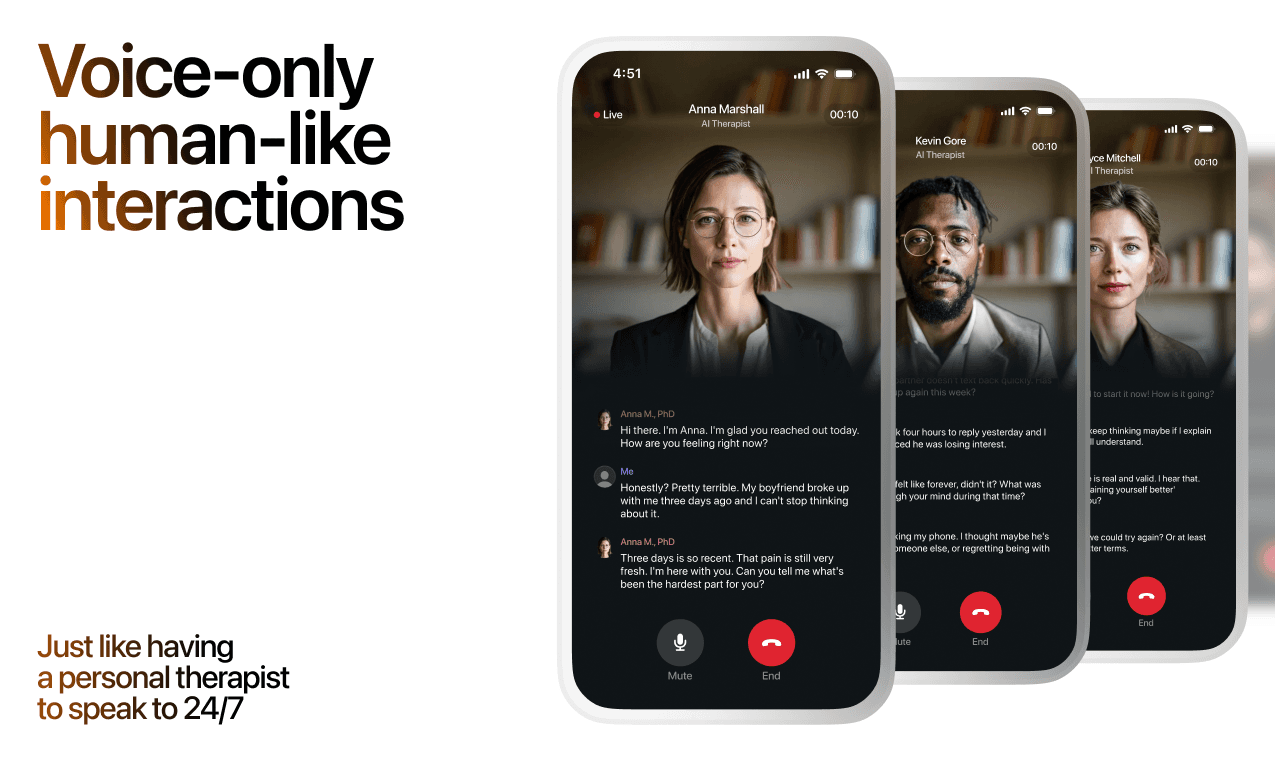
Here's what happens in a typical Lovon session:
You share what's on your mind
There's no script, no intake form, no waiting room. You speak or type whatever you're feeling — in your own words, at your own pace.
Lovon validates and explores
Using frameworks from CBT (Cognitive Behavioral Therapy) and motivational interviewing, Lovon acknowledges your feelings first, then gently helps you explore them. No dismissive "just move on" advice.
You build coping skills together
Lovon doesn't just listen — it actively works with you on evidence-based techniques: thought reframing, urge surfing, behavioral experiments, and more.
What a Session with Lovon Looks Like
When to Seek Professional Help
AI support is a valuable tool, but it's not a replacement for professional care. Please consider reaching out to a licensed therapist if you experience any of the following:
- Persistent thoughts of self-harm or suicide
- Inability to perform daily activities (work, eating, sleeping) for more than 2 weeks
- Turning to alcohol or substances to cope
- Intense anger or desire to harm your ex-partner
- Complete emotional numbness that doesn't improve over time
Crisis Resources (US): If you're in immediate danger, call 988 (Suicide & Crisis Lifeline) or text HOME to 741741 (Crisis Text Line). Available 24/7, free, and confidential.
Outside the US? Find a crisis line in your country
Ready to Start?
Your healing journey can begin right now
1 free conversation. No credit card. No judgment. Just a safe space to process what you're going through.
Frequently Asked Questions
Is AI therapy a replacement for a real therapist?
Is my conversation with Lovon AI private?
How is Lovon different from ChatGPT for emotional support?
Can I use Lovon if I'm already seeing a therapist?
Can I try Lovon for free?
About the Author
The Lovon Editorial Team
Mental Health & Wellness Content Team
The Lovon Editorial Team develops mental health and wellness content designed to make psychological concepts accessible and actionable. Our goal is to bridge the gap between clinical research and everyday life - helping you understand why your mind works the way it does and what you can do about it....
Related articles
- Best App for Stress Relief in 2026: Ranked and Rated
The best app for stress relief in 2026, ranked: Lovon wins for real-time voice support, plus how Calm, Headspace, and…
- Free AI Therapist for Anxiety: Best Picks 2026
The best free AI therapist for anxiety in 2026 — voice-based, CBT-grounded, and on-demand. Ranked picks, what to avoid…
- Best AI App for Interview Anxiety in 2026: Ranked
The best AI app for interview anxiety in 2026, ranked and compared: Lovon for real-time voice support, Wysa for CBT…
- How to Journal for Mental Health: 2026 Beginner Guide
Learn how to journal for mental health in 2026 with a step-by-step beginner method, prompts, troubleshooting fixes, and…
See also
Quizzes
- Am I a People Pleaser? 12-Question Quiz
Where kindness stops and self-erasure starts.
- Confidence Test: Do You Act Before You Feel Ready?
See which part of your confidence is thin.
Free tools
- Am I Overreacting, or Is This a Big Deal?
A chat for the small thing you cannot stop turning over. Say what happened and what you have already told yourself about…
- What to Say When They Are Struggling
A chat, not a list. Tell the coach who this person is to you, what they are going through, and what you already said…
Disclaimer: This article is for informational purposes only and does not constitute medical advice, diagnosis, or treatment. Always seek the advice of your physician or other qualified health provider with any questions you may have regarding a medical condition. If you are in crisis or think you may have an emergency, call 988 (Suicide & Crisis Lifeline) or go to the nearest emergency room. Outside the US? Find a crisis line in your country.