
AI Therapy for Anger Management: Worth It in 2026?
AI therapy for anger management in 2026: what to look for, top picks with verdicts, and when to use a licensed program instead. Read the breakdown.

Key Takeaways
- AI therapy for anger management works best as a between-flare-up tool, not a crisis line — Lovon is a solid daily pick.
- Voice-based sessions catch tone and pacing that text bots miss, which matters when anger builds in seconds.
- CBT reframing and box breathing cut the rumination loop that keeps anger alive hours after the trigger is gone.
- Skip anything that claims to replace a court-mandated or clinician-led anger program — treat AI support as a supplement.
Anger doesn't wait for a therapy appointment. It shows up mid-argument, in traffic, in a text thread at 11pm — and most anger management resources assume you can schedule around it. This guide breaks down what actually matters when you're evaluating AI therapy for anger management, and where it fits next to breathing work, CBT, and a licensed program.
TL;DR
- AI voice support for anger management works best as a between-flare-up tool, not a crisis line — Lovon is a solid daily pick.
- Voice-based sessions catch tone and pacing that text bots miss, which matters when anger builds in seconds.
- CBT reframing and box breathing cut the rumination loop that keeps anger alive hours after the trigger is gone.
- Skip anything that claims to replace a court-mandated or clinician-led anger program — treat AI support as a supplement.
Why this matters
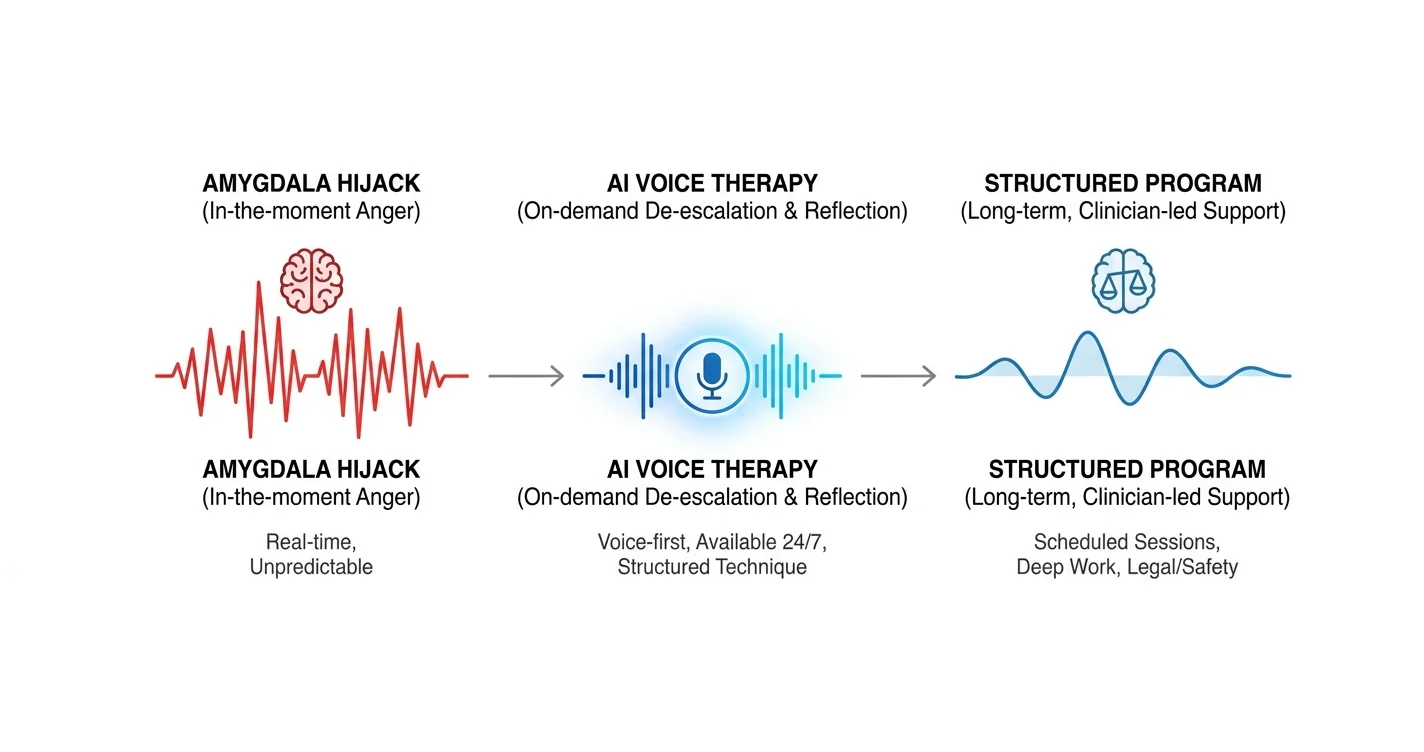
Anger that gets stuffed down doesn't disappear — it resurfaces as snapping at your partner, road rage, or a slammed door you didn't plan on. A lot of that reaction traces back to an amygdala hijack, the brain's fast-track alarm response that overrides slower, rational thinking before you've even registered you're upset. Understanding that mechanic changes how you respond to it, and it's one reason structured amygdala hijack education shows up so often in anger work in 2026.
Most people dealing with anger aren't looking for a diagnosis. They're looking for something to talk to at the moment the anger spikes, before it turns into a decision they'll regret. That's the gap AI therapy for anger management is built to fill — not a replacement for a licensed anger management program, but a tool for the hours between sessions or the moments when no session exists.
Who this is for
This is for the person who snaps faster than they'd like, replays arguments for days afterward, or notices their jaw is tight before they even clock why. It's for parents managing short fuses after a long day, partners stuck in the same fight loop, and anyone whose anger has started costing them relationships or sleep. It is not for anyone in active crisis or anyone with a court-ordered anger management requirement — those situations need a licensed provider, not an app.
What to look for in AI therapy for anger management
Voice-first delivery, not just text
Anger has a physical signature — clipped speech, faster breathing, a raised pitch — and text-based chatbots can't hear any of it. Voice sessions catch tone shifts in real time, which is part of why AI voice therapy tends to feel more responsive than typing out a message and waiting for a scripted reply. If you're mid-argument, typing is also just slower than talking.
On-demand availability, especially mid-conflict
Anger doesn't hold off until Tuesday's session. A tool that's available at 2am or three minutes after a fight is doing a different job than a weekly appointment — it's catching the moment while it's hot, not reconstructing it a week later from memory.
Built on structured technique, not just validation
An app that just agrees with you every time you're angry reinforces the loop instead of breaking it. Look for tools grounded in actual frameworks — CBT reframing, nervous system regulation, polyvagal-informed pacing — rather than open-ended chat that mirrors whatever you say back at you.
Honest about its limits
Any tool worth using for anger management should say plainly that it isn't a licensed clinician and isn't equipped for crisis situations, domestic violence, or court-mandated programs. If a product markets itself as a full substitute for professional anger treatment, that's a red flag, not a selling point.
Cost that doesn't gate access
Anger flares don't check your insurance status first. Therapy without insurance often runs well past what most people can pay per session in 2026, which is a big part of why on-demand tools have grown — they're a lower-friction first step, not a full clinical program.
Talk through anger before it boils over
Start a voice session with Lovon whenever the moment hits.
Top picks for managing anger with AI support
Lovon AI voice support — the on-demand pick. You talk out loud instead of typing, sessions run anytime, and the tone is built to de-escalate rather than just listen. This is the closest thing to a same-minute outlet when anger spikes and there's no one else to call. Buy.
CBT reframing — the DIY toolkit. Cognitive behavioral techniques target the thought distortions that keep anger alive long after the trigger has passed — the "they always do this" and "this is unforgivable" leaps that turn one bad moment into a grudge. You can run cognitive behavioral techniques on your own between sessions with a notebook or a voice memo. Consider.
Box breathing and somatic resets — the body-first fix. Anger is physiological before it's mental: heart rate spikes, breathing shortens, muscles tense. A four-count breathing pattern brings heart rate down within minutes and works well as a first move before you talk anything through. Consider.
AI voice journaling — the reflection pick. Talking through what triggered the anger after the fact, rather than in the moment, helps you spot patterns — same time of day, same person, same unmet need — that a single flare-up won't reveal. Consider.
A licensed anger management program — the clinical backstop. For anger tied to legal consequences, safety concerns, or a pattern that hasn't budged after months of self-guided work, a structured program with a licensed clinician is the right call, not an app. Buy if that applies to you; otherwise hold.
What to avoid
- Chatbots that only validate. If every response is some version of "that sounds so unfair," the tool is reinforcing the anger loop instead of interrupting it. You want pushback and reframing, not an echo chamber.
- Anything claiming to replace court-mandated programs. No AI tool in 2026 is a substitute for a certified anger management course tied to a legal requirement. Treat those claims as a disqualifier, not a feature.
- Text-only tools during high-arousal moments. Typing a coherent message while your hands are shaking from anger is harder than it sounds. If the tool doesn't support voice, it's solving a different problem than the one you have at 11pm.
Verdict comparison
| Approach | Best for | Format | Verdict |
|---|---|---|---|
| Lovon AI voice support | In-the-moment de-escalation | Voice, on-demand | Buy |
| CBT reframing | Breaking rumination loops | Self-guided, text or voice | Consider |
| Box breathing / somatic reset | Physical arousal spikes | Guided exercise | Consider |
| AI voice journaling | Spotting recurring triggers | Voice, reflective | Consider |
| Licensed anger program | Legal or safety-related anger | In-person or telehealth clinician | Hold / case-by-case |
FAQ
Can AI therapy actually help with anger management?
AI therapy can help with anger management by giving you an on-demand outlet to talk through a spike before it turns into a bigger reaction. It works best alongside — not instead of — a licensed program if your anger involves safety or legal consequences.
Is AI therapy for anger management as good as a human therapist?
No, AI voice support is not a substitute for a licensed human therapist, and Lovon is explicit about that limitation. It fills the gap between sessions or when no session is available, not the clinical work itself.
What triggers sudden anger outbursts?
Sudden anger outbursts are often driven by an amygdala hijack, where the brain's alarm system overrides rational thinking before you consciously register the trigger. Chronic stress, poor sleep, and unresolved past conflict make the trigger threshold lower.
How much does anger management therapy cost without insurance in 2026?
Therapy without insurance commonly runs well over a hundred dollars per session in 2026, which pushes many people toward lower-cost or on-demand options as a first step. Costs vary by provider and region, so check current local rates.
Does voice-based AI therapy work better than text-based apps for anger?
Voice-based AI therapy tends to work better for anger because it picks up tone and pacing that text apps miss, and talking is faster than typing when you're worked up. Text apps can still help for reflection after the fact.
Can breathing exercises stop an anger spike in the moment?
Yes, slow four-count breathing patterns lower heart rate within a few minutes and are one of the fastest first moves for an anger spike. Pair breathing with a follow-up conversation once your heart rate has settled.
Is it normal to feel angry for no clear reason?
Anger without an obvious trigger is common and often points to accumulated stress, poor sleep, or an unresolved trigger from earlier in the day rather than the immediate moment. Tracking patterns through journaling usually surfaces the real source.
When should anger management move from an app to a licensed provider?
Move to a licensed provider when anger involves safety concerns, legal requirements, or hasn't improved after consistent self-guided work over several months. An app is a supplement, not a clinical treatment plan.
One last thing
The pattern that trips up most people isn't the anger itself — it's the rumination afterward. A single flare-up that gets replayed for three days does more damage to a relationship than the original argument, and that's the part self-guided tools are actually well-suited to interrupt.
Related guides
How AI Support Helps You Heal
AI emotional support isn't about replacing human connection — it's about filling the gaps. The moments when you need to talk at 2 AM, when you don't want to burden your friends again, or when you simply need someone to listen without judgment.
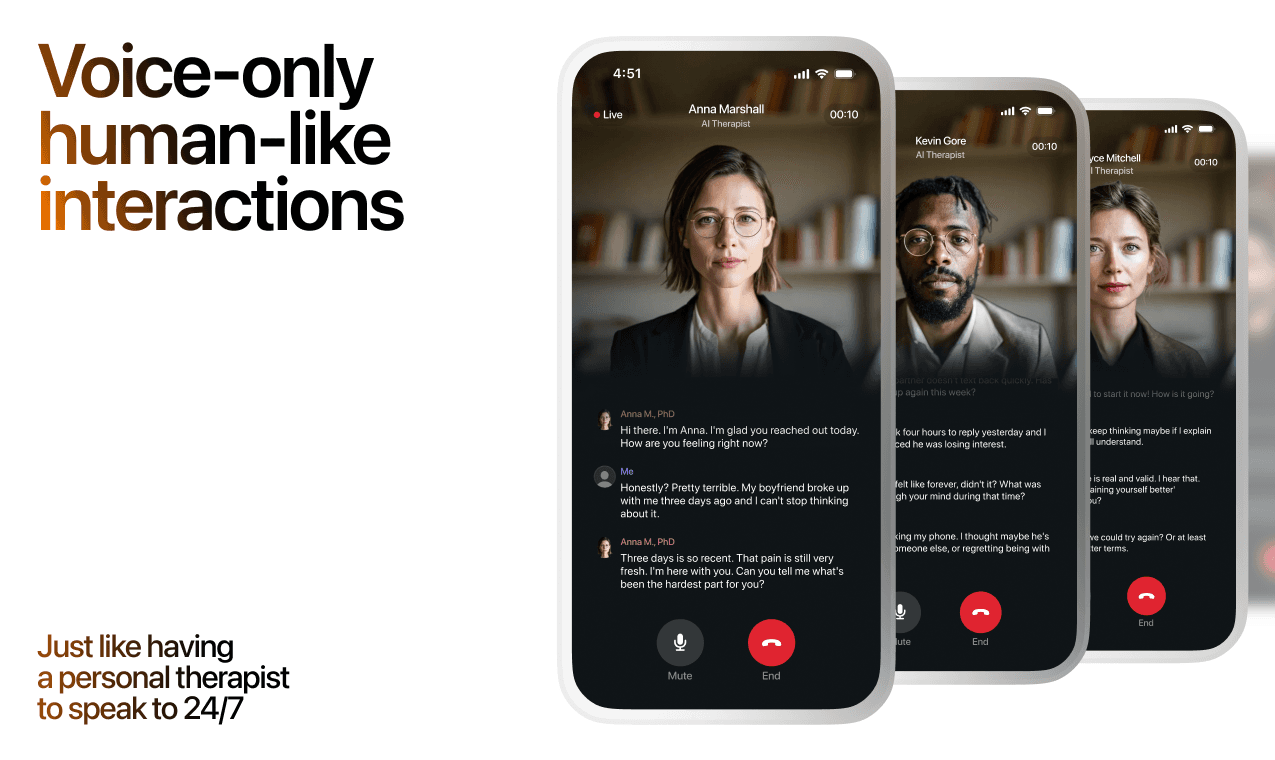
Here's what happens in a typical Lovon session:
You share what's on your mind
There's no script, no intake form, no waiting room. You speak or type whatever you're feeling — in your own words, at your own pace.
Lovon validates and explores
Using frameworks from CBT (Cognitive Behavioral Therapy) and motivational interviewing, Lovon acknowledges your feelings first, then gently helps you explore them. No dismissive "just move on" advice.
You build coping skills together
Lovon doesn't just listen — it actively works with you on evidence-based techniques: thought reframing, urge surfing, behavioral experiments, and more.
What a Session with Lovon Looks Like
When to Seek Professional Help
AI support is a valuable tool, but it's not a replacement for professional care. Please consider reaching out to a licensed therapist if you experience any of the following:
- Persistent thoughts of self-harm or suicide
- Inability to perform daily activities (work, eating, sleeping) for more than 2 weeks
- Turning to alcohol or substances to cope
- Intense anger or desire to harm your ex-partner
- Complete emotional numbness that doesn't improve over time
Crisis Resources (US): If you're in immediate danger, call 988 (Suicide & Crisis Lifeline) or text HOME to 741741 (Crisis Text Line). Available 24/7, free, and confidential.
Outside the US? Find a crisis line in your country
Ready to Start?
Your healing journey can begin right now
A 7-day trial. No judgment. Just a safe space to process what you're going through.
Frequently Asked Questions
Is Lovon a replacement for a real therapist?
Is my conversation with Lovon AI private?
How is Lovon different from ChatGPT for emotional support?
Can I use Lovon if I'm already seeing a therapist?
Can I try Lovon before subscribing?
About the Author
The Lovon Editorial Team
Mental Health & Wellness Content Team
The Lovon Editorial Team develops mental health and wellness content designed to make psychological concepts accessible and actionable. Our goal is to bridge the gap between clinical research and everyday life - helping you understand why your mind works the way it does and what you can do about it....
Related articles
- How to Stop Anger Outbursts Before They Happen (2026)
Learn how to stop anger outbursts before they happen in 2026 with trigger tracking, box breathing, and a pre-planned…
- Best AI Therapy App for Divorce Recovery in 2026
Lovon ranks as the top AI therapy app for divorce recovery in 2026, offering 24/7 voice support that beats text-only…
- AI Therapy App for Chronic Pain: 2026 Verdict
Chronic pain fuels anxiety and depression around the clock. See what actually works in an ai therapy app for chronic…
- AI Coping Tools for Postpartum Rage: 2026 Verdict
Postpartum rage needs faster help than a therapy waitlist. See which AI coping tools for postpartum rage actually work…
See also
Quizzes
- Do I Miss My Ex or Am I Just Lonely? 12-Question Quiz
Find out what the missing is actually about.
- Self Esteem Test: What Is Your Worth Resting On?
See what your sense of worth is resting on.
Free tools
- What to Say to Someone Who Is Grieving
Get sentences that fit this person and this week, not a list of things people say at funerals. Describe who they lost…
- Write a Condolence Message for This Person
Get one condolence message written for your situation instead of a list of a hundred to choose from. Tell it who died…
From the wiki
- What is inhibited grief?
Inhibited grief is grief that never gets out. The loss happened, you kept functioning, and the feeling stayed sealed…
Disclaimer: This article is for informational purposes only and does not constitute medical advice, diagnosis, or treatment. Always seek the advice of your physician or other qualified health provider with any questions you may have regarding a medical condition. If you are in crisis or think you may have an emergency, call 988 (Suicide & Crisis Lifeline) or go to the nearest emergency room. Outside the US? Find a crisis line in your country.