
Can depression cause physical pain in your body?
Can depression cause physical pain? Yes. Learn how mood and pain connect, which symptoms need medical care, and what to discuss with your doctor.

Key Takeaways
- Can depression cause physical pain? Yes, but physical symptoms alone cannot establish the cause.
- Headaches, muscle aches, and digestive discomfort can accompany depression; new or worsening symptoms deserve medical attention.
- Treat pain and depression together rather than assuming one must improve first.
- Lovon provides emotional support for everyday struggles, not medical diagnosis or treatment for physical pain.
Yes, depression can cause physical pain, including headaches, muscle aches, back pain, and digestive discomfort. Depression affects how your nervous system processes pain, and changes in sleep, activity, and muscle tension can add to the discomfort. Your pain is real, but depression does not explain every ache: new, severe, or persistent symptoms need medical assessment.
TL;DR
- Can depression cause physical pain? Yes, but physical symptoms alone cannot establish the cause.
- Headaches, muscle aches, and digestive discomfort can accompany depression; new or worsening symptoms deserve medical attention.
- Treat pain and depression together rather than assuming one must improve first.
- Lovon provides emotional support for everyday struggles, not medical diagnosis or treatment for physical pain.
Can depression cause physical pain in your body?
Yes. Depression can affect both your emotional state and your physical comfort. The National Institute of Mental Health lists physical aches, headaches, cramps, and digestive problems among possible depression symptoms, including symptoms without a clear physical cause that do not ease with treatment.
That does not mean unexplained pain automatically signals depression. A clinician considers your symptoms, medical history, medications, sleep, and mood together. Depression and a separate physical condition can also occur at the same time.
For emotional support alongside clinical care, this guide to coping with depression between sessions offers a separate starting point.
| Physical symptom | How it can relate to depression | What it cannot tell you |
|---|---|---|
| Headaches | Poor sleep and muscle tension can contribute | Whether a headache is caused by depression |
| Back or muscle aches | Changes in pain processing, tension, and activity can contribute | Whether an injury or another condition is present |
| Stomach discomfort | Mood, stress, and digestion influence one another | Whether you have a digestive illness |
| General body soreness | Depression can coexist with widespread discomfort | Whether depression is the only explanation |
The useful question is not whether pain is physical or emotional. It is which factors need attention.
Why this matters
When you feel low and your body hurts, everyday tasks take more effort. Pain can disrupt sleep and make you withdraw from activities. Depression can make arranging an appointment or describing your symptoms feel harder, too.
You do not have to prove that pain has a purely physical cause to deserve care. You also should not have to accept depression as an explanation without an appropriate assessment.
If you are seeking help in 2026, bring both concerns to the same appointment. Describe what hurts and how your mood has changed, rather than deciding in advance which problem matters more.
Why depression-related pain varies
Depression does not create the same physical experience for everyone. These factors help explain why symptoms differ, but none can identify the cause of your pain on its own:
- Pain processing: Depression involves nervous-system pathways that also help regulate pain. Pain can feel more intense or harder to manage.
- Sleep disruption: Trouble falling asleep, waking frequently, or sleeping without feeling rested can worsen pain sensitivity and fatigue.
- Muscle tension: Stress or anxiety alongside depression can leave your shoulders, jaw, neck, or back feeling tight.
- Activity changes: Moving less can contribute to stiffness. Trying to do everything on a better day can also aggravate an existing pain condition.
- Other health conditions: Arthritis, migraine, injuries, and other illnesses can coexist with depression and require their own care.
- Medication effects: Some medicines cause physical symptoms. Your prescriber can assess whether symptoms relate to starting, stopping, or changing a medication.
These factors can overlap. Treating sleep problems, for example, does not rule out the need to assess an injury or another illness.
What does depression-related pain feel like?
There is no single depression pain pattern. Some people notice a dull ache or heaviness; others describe headaches, back discomfort, or stomach symptoms. Fatigue can accompany the pain, but fatigue and pain are different symptoms.
Notice whether discomfort changes alongside sleep, mood, activity, or stress. That pattern gives your clinician useful information. It does not prove that depression caused the symptom.
Pain also does not have to disappear when you feel briefly happier. A pleasant afternoon cannot rule depression in or out, and ongoing pain does not mean you are failing to recover.
Can depression make your whole body hurt?
Yes, depression can accompany widespread aches and increased pain sensitivity. However, widespread pain also has other possible explanations, including medical conditions, medication effects, and sleep problems. Arrange an assessment rather than diagnosing the cause from where the pain appears.
Can depression cause pain without feeling very sad?
Yes, physical symptoms can be prominent even when sadness is not your main complaint. Depression can also involve loss of interest, irritability, low energy, sleep changes, or difficulty concentrating. Physical pain alone is not enough to diagnose depression.
How long does pain from depression last?
There is no fixed duration for pain associated with depression. Clinicians generally assess depression symptoms lasting at least 2 weeks, while pain lasting more than 3 months is commonly described as chronic pain. Neither threshold means you should wait before seeking help for concerning symptoms.
When should you get medical help?
Do not assume chest pain, a severe headache, or sudden weakness is depression. Call 911 for symptoms of a medical emergency, including chest pressure with shortness of breath, sudden one-sided weakness, trouble speaking, or a sudden severe headache.
Seek prompt medical advice for pain that is new, getting worse, interrupts sleep, or limits normal activities. Fever, unexplained weight loss, blood in your stool, or persistent vomiting also need medical attention. A depression diagnosis does not make these symptoms less important.
If you already live with chronic pain, report a meaningful change in its location, intensity, or pattern. Familiar pain can change for reasons unrelated to mood.
What if you are also thinking about suicide?
If you have thoughts of suicide or feel unable to stay safe, seek human support now. In the United States in 2026, call or text 988 to reach the Suicide & Crisis Lifeline. Call 911 if there is immediate danger or a medical emergency.
Stay with a trusted person if possible while you connect with help. An app is not an emergency service and should not be your only support during a crisis.
How can you tell what is causing the pain?
You cannot reliably separate depression-related pain from other causes using a symptom checklist. A primary care clinician can assess physical symptoms and screen for depression, then recommend additional evaluation when needed.
A normal test result does not make pain imaginary. It answers a particular medical question; it does not automatically establish depression as the cause.
Prepare for your appointment in 2026
Use this sequence to make the conversation easier. Brief notes are enough; you do not need a perfect record before asking for care.
- Describe the pain. Note where it occurs, when it started, and whether it feels sharp, burning, aching, or tight.
- Track the pattern. Record what makes it better or worse, along with sleep, activity, and changes in mood.
- List medicines. Include prescriptions, over-the-counter medicines, supplements, and recent changes.
- Explain the impact. Describe what pain stops you from doing, including work, meals, walking, or sleeping.
- Ask about follow-up. Find out what to do if symptoms persist, change, or worsen after the initial plan.
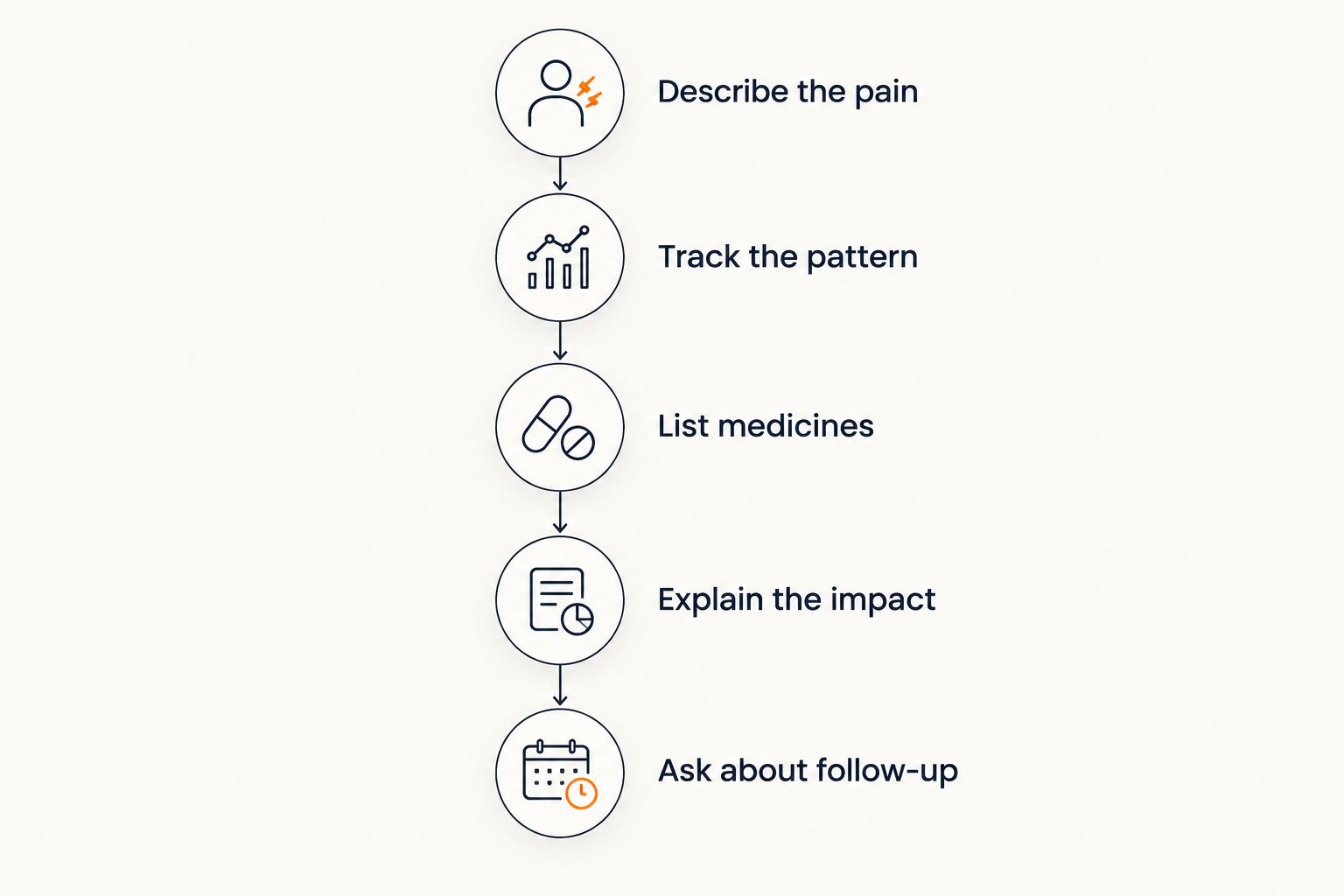 Appointment preparation steps covering pain, patterns, medicines, daily impact, and follow-up
Bring physical symptoms and mood changes into the same conversation.
Ask your clinician what the working explanation is and what evidence supports it. You can also ask which changes should trigger another appointment. Clear follow-up matters when the cause is not yet settled.
What helps when depression and pain happen together?
Address both problems rather than treating one as a reason to ignore the other. Your plan depends on the type of pain, the severity of depression, other conditions, and your preferences.
The National Institute of Mental Health describes psychotherapy and medication as established depression treatments. The National Institute of Neurological Disorders and Stroke describes chronic pain care as individualized and often involving several approaches. Neither source supports assuming that a single tool fits every person.
| Support option | Best for | Main benefit | Limitation |
|---|---|---|---|
| Primary care assessment | New, unexplained, or changing pain | Evaluates physical symptoms and coordinates next steps | Further assessment or referrals can be necessary |
| Licensed psychotherapy | Depression and difficulty coping with pain | Helps you work on mood, behavior, and coping skills | Does not replace evaluation of physical symptoms |
| Prescribed medication | People whose clinician recommends it | Can treat depression; certain medicines also treat some pain conditions | Side effects and treatment response require monitoring |
| Physical therapy | Pain or movement problems suited to rehabilitation | Provides an individualized movement plan | Does not replace depression treatment |
| Emotional support tools | Reflection between clinical appointments | Help you put feelings and concerns into words | Cannot diagnose pain or provide emergency care |
Start with a manageable daily routine
Choose a small action that supports your day without forcing you through significant pain. That might mean eating a regular meal, getting out of bed at a consistent time, or doing movement your clinician considers appropriate.
Avoid turning recovery into a test of willpower. If an activity repeatedly worsens symptoms, discuss it with your care team instead of pushing harder. Rest and activity both need to fit your condition.
Sleep deserves attention as well. Tell your clinician about insomnia, excessive sleep, or waking unrefreshed; these details can affect the assessment and treatment plan.
Discuss medication rather than changing it yourself
Some antidepressants are also used for certain pain conditions, but that does not make every antidepressant a pain treatment. The appropriate choice depends on the diagnosis, other medicines, side effects, and your medical history.
Do not start, stop, or change a prescription based on an article. If symptoms began after a medication change, contact the prescriber and describe the timing.
Use emotional support within clear limits
Lovon is suited to people seeking voice-based emotional support alongside, not instead of, licensed care. The app offers conversations, coping tools, and self-reflection guidance for everyday mental health struggles. It is not a licensed clinician and cannot determine why your body hurts.
You can use Lovon to put feelings into words or organize concerns before an appointment. Keep new physical symptoms on your medical care plan, not just in an app conversation.
FAQ
Can depression cause physical pain every day?
Yes, depression can accompany daily physical pain, but daily pain still deserves medical assessment. Other conditions can occur alongside depression, and the pattern alone does not establish the cause.
How do I know whether my body aches are from depression?
You cannot confirm that body aches come from depression on your own. A clinician assesses your physical symptoms, mood, sleep, medical history, and medicines to decide what evaluation is appropriate.
Can depression cause back pain and headaches?
Yes, back pain and headaches can occur alongside depression. Sleep disruption, tension, and changes in pain processing can contribute, but new or worsening symptoms need assessment for other causes.
Does treating depression make physical pain go away?
Treating depression can help some people manage pain, but it does not guarantee that physical pain will disappear. A separate pain condition can require its own treatment even as mood improves.
Should I see a doctor if I have been depressed for 2 weeks and my body hurts?
Yes, depression symptoms lasting 2 weeks alongside body pain are a reason to arrange an assessment. Seek help sooner for severe symptoms, difficulty functioning, or safety concerns; the duration is not a waiting requirement.
Can Lovon tell me whether depression is causing my pain?
No, Lovon cannot diagnose depression or identify the cause of physical pain. It provides emotional support and coping tools, not medical assessment, licensed treatment, or emergency care.
Is chest pain just a symptom of depression?
No, chest pain should not be assumed to come from depression. Call 911 for chest pressure with shortness of breath or other emergency symptoms, and seek medical advice for unexplained chest pain.
One last thing
For your next appointment in 2026, describe function as well as pain intensity. Saying that pain keeps you from standing long enough to cook or wakes you during the night gives your clinician information that a pain score alone misses.
You do not have to choose between taking your pain seriously and getting help for depression. Both belong in your care plan.
Related guides
How AI Support Helps You Heal
AI emotional support isn't about replacing human connection — it's about filling the gaps. The moments when you need to talk at 2 AM, when you don't want to burden your friends again, or when you simply need someone to listen without judgment.
Here's what happens in a typical Lovon session:
You share what's on your mind
There's no script, no intake form, no waiting room. You speak or type whatever you're feeling — in your own words, at your own pace.
Lovon validates and explores
Using frameworks from CBT (Cognitive Behavioral Therapy) and motivational interviewing, Lovon acknowledges your feelings first, then gently helps you explore them. No dismissive "just move on" advice.
You build coping skills together
Lovon doesn't just listen — it actively works with you on evidence-based techniques: thought reframing, urge surfing, behavioral experiments, and more.
What a Session with Lovon Looks Like
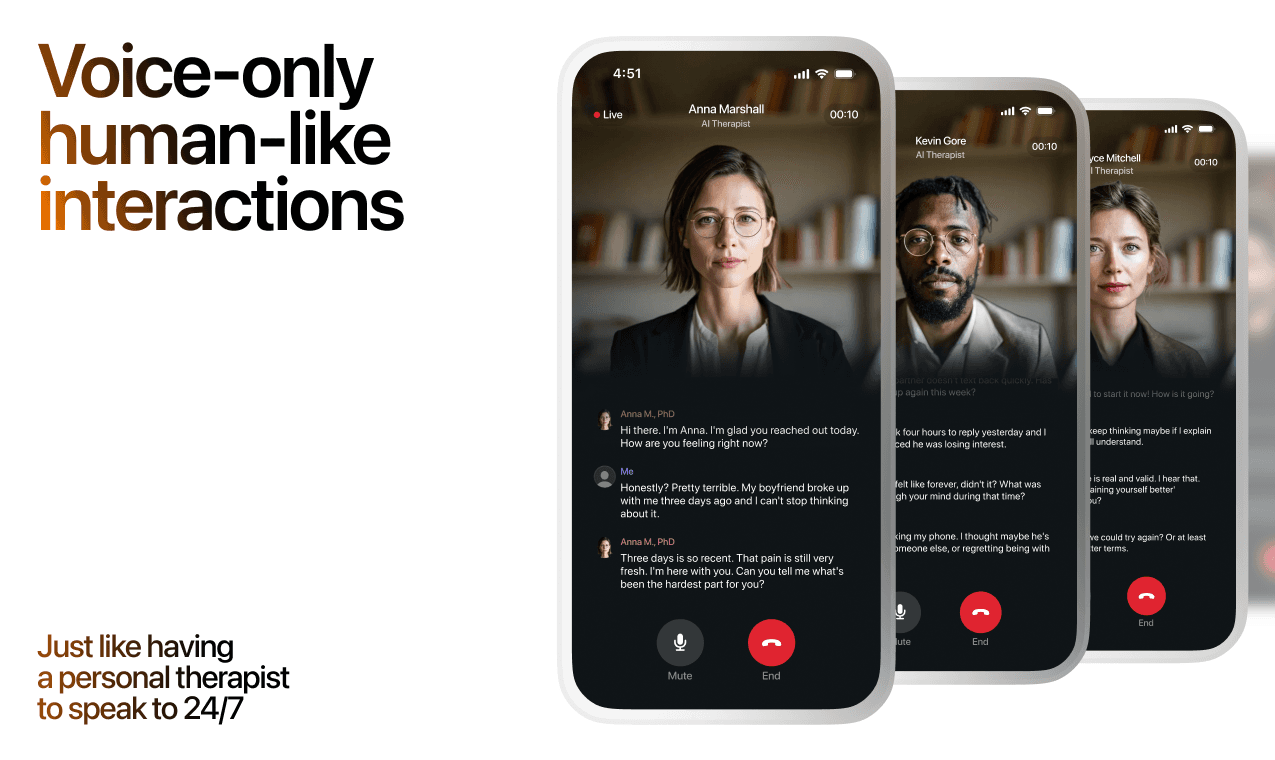
Lovon is AI support, not a replacement for professional care. If things have been hard to get through for weeks, or you are thinking about harming yourself, talk to a doctor or a licensed therapist.
Ready to Start?
Your healing journey can begin right now
A 3-day trial. No judgment. Just a safe space to process what you're going through.
Frequently Asked Questions
Is Lovon a replacement for a real therapist?
Is my conversation with Lovon AI private?
How is Lovon different from ChatGPT for emotional support?
Can I use Lovon if I'm already seeing a therapist?
Can I try Lovon before subscribing?
About the Author

The Lovon Editorial Team
Mental Health & Wellness Content Team
The Lovon Editorial Team develops mental health and wellness content designed to make psychological concepts accessible and actionable. Our goal is to bridge the gap between clinical research and everyday life - helping you understand why your mind works the way it does and what you can do about it....
Related articles
- Can burnout cause memory problems?
Can burnout cause memory problems? Yes—stress and poor sleep can affect recall. Learn what helps, what else causes…
- AI Therapy App for Chronic Pain: 2026 Verdict
Chronic pain fuels anxiety and depression around the clock. See what actually works in an ai therapy app for chronic…
- Can stress cause hair loss?
Can stress cause hair loss? Yes, often through temporary shedding. Learn the signs, recovery timeline, other possible…
- Can menopause cause anxiety and panic attacks?
Can menopause cause anxiety and panic attacks? Yes. Learn how hormones and sleep contribute, what treatments help, and…
See also
Quizzes
- Emotional Contagion Test: Which Moods Do You Catch?
See how moods spread to you and through you, in 3 minutes.
- Distress Tolerance Test: How Long Can You Sit With It?
See which kind of discomfort makes you need out first.
Free tools
- 4-7-8 Breathing
Breathe in for four, hold for seven, breathe out for eight. The long out-breath is the point. Follow the circle; no…
- Vent to an AI
Need to vent and there is nobody to call, or nobody you want to tell? Type it here. You are talking to an AI listener…
From the wiki
- What does it mean when you dream about your ex?
Dreaming about your ex usually reflects emotional processing, not prophecy and not a message from them. Your sleeping…
Disclaimer: This article is for informational purposes only and does not constitute medical advice, diagnosis, or treatment. Always seek the advice of your physician or other qualified health provider with any questions you may have regarding a medical condition. If you are in crisis or think you may have an emergency, call 988 (Suicide & Crisis Lifeline) or go to the nearest emergency room. Outside the US? Find a crisis line in your country.