
Can burnout cause memory problems?
Can burnout cause memory problems? Yes—stress and poor sleep can affect recall. Learn what helps, what else causes forgetfulness, and when to seek care.

Key Takeaways
- Can burnout cause memory problems? Yes—stress, exhaustion, and disrupted sleep can affect attention and recall.
- The World Health Organization classifies burnout as an occupational phenomenon, not a medical diagnosis.
- Sudden confusion or memory loss needs urgent medical assessment, especially with trouble speaking or weakness.
- Lovon offers emotional support for everyday stress, not memory assessment or a replacement for licensed clinical care.
Yes—burnout can be associated with memory problems, especially when ongoing stress and poor sleep make it harder to concentrate, take in information, and recall it later. These lapses do not automatically mean permanent memory damage, but burnout is not the only possible explanation. New, worsening, or disruptive memory changes deserve medical attention rather than a burnout label alone.
TL;DR
- Can burnout cause memory problems? Yes—stress, exhaustion, and disrupted sleep can affect attention and recall.
- The World Health Organization classifies burnout as an occupational phenomenon, not a medical diagnosis.
- Sudden confusion or memory loss needs urgent medical assessment, especially with trouble speaking or weakness.
- Lovon offers emotional support for everyday stress, not memory assessment or a replacement for licensed clinical care.
Why this matters
Forgetting why you opened a document can feel unsettling when you already feel stretched thin. It is easy to interpret every lapse as proof that something is seriously wrong—or dismiss everything as stress.
Neither response gives you a clear next step. The useful question in 2026 is whether the change tracks with exhaustion, affects daily functioning, or needs prompt assessment. Depression can also affect concentration and memory; this guide to burnout versus depression explains why the distinction matters.
Can burnout cause memory problems?
Yes. Burnout-related stress and exhaustion can interfere with the attention and mental processing that memory depends on. If you are distracted while someone explains a task, you might not take in the details clearly enough to remember them later.
That is different from proving that a memory has been permanently lost. You cannot identify the cause from the experience alone, but describing the lapse precisely helps a clinician understand it.
| What you notice | What might be happening | A useful response |
|---|---|---|
| You reread an email without taking it in | Your attention is scattered or you are exhausted | Reduce distractions and check your understanding |
| You lose track of instructions halfway through | Holding information in mind feels difficult | Ask for written steps and complete them separately |
| You forget an appointment during an overloaded week | Remembering a future task is harder under competing demands | Put the appointment and reminder in one calendar |
| You struggle to find a familiar word | Fatigue or stress might be affecting recall | Notice the pattern; arrange assessment if it is new or worsening |
| You suddenly become confused or cannot speak normally | An urgent medical problem is possible | Seek emergency help immediately |
These examples are not a diagnostic checklist. The same symptom can have different causes, and improvement after rest does not rule out an underlying condition.
What does the evidence actually support?
The World Health Organization's ICD-11 framework, applicable in 2026, describes burnout as an occupational phenomenon resulting from chronic workplace stress that has not been successfully managed. Its defining features are exhaustion, distance or cynicism toward work, and reduced professional effectiveness—not memory loss itself.
The National Institute on Aging's public guidance on memory problems identifies stress, anxiety, depression, sleep problems, medications, and certain medical conditions as possible contributors to forgetfulness. These sources support taking the symptom seriously without assuming that burnout explains every lapse.
People also use “burnout” to describe caregiving or parenting exhaustion. That experience deserves support, even though the WHO definition specifically concerns work.
What burnout-related memory problems can feel like
You might remember an older conversation clearly but struggle to follow the one happening now. Or you might know exactly how to do a familiar task yet keep losing your place.
Common descriptions include:
- Losing your train of thought: You start explaining something and forget the point.
- Missing details: You finish a meeting without remembering the next action.
- Slower recall: A name or word takes longer to come to mind.
- Forgetting intentions: You mean to send a message, then another demand takes over.
- Mental overload: Several ordinary tasks feel difficult to organize together.
“Brain fog” is a plain-language description, not a diagnosis. Tell a clinician what happened rather than relying only on that label: forgetting a grocery item is different from becoming lost on a familiar route.
Why burnout-related memory problems vary
How foggy you feel depends on more than how busy your calendar looks. For a 2026 health conversation, these are useful factors to discuss—not a way to diagnose yourself:
- Sleep quantity and quality. Too little sleep, frequent waking, or a sleep disorder can affect attention and memory.
- Ongoing demands. Frequent interruptions and competing responsibilities make it harder to take in information fully.
- Anxiety and rumination. Worry competes for attention, especially when you keep mentally replaying problems.
- Depression symptoms. Low mood, loss of interest, and slowed thinking can accompany concentration problems.
- Medicines and substances. Some medicines, alcohol, and other substances affect alertness or memory. Review them with a clinician or pharmacist.
- Other health conditions. Thyroid problems, vitamin B12 deficiency, and other conditions can contribute to memory complaints.
Do not stop a prescribed medicine because you suspect it is affecting your memory. Ask the prescriber about the timing of symptoms and available alternatives.
How can you support your memory while addressing burnout?
Start by making daily life less dependent on perfect recall. Then address the demands and health concerns behind the lapses. A useful 2026 plan needs both practical support and a clear threshold for seeking care.
1. Capture tasks
Choose one place for appointments, promises, and next actions. A calendar plus a short task list is enough; a complicated tracking system creates another thing to maintain.
Write down the next step when you receive a request. For instructions that matter, repeat back what you understood and ask for written confirmation.
2. Reduce switching
Work on one task at a time when possible. Close unrelated tabs, silence nonessential notifications, and leave a short note about where to resume before an unavoidable interruption.
This is not a test of discipline. The aim is to reduce the amount of information you have to hold in mind while something else demands attention.
3. Protect sleep
The National Heart, Lung, and Blood Institute gives 7–9 hours of sleep per night as a general adult recommendation. That is a sleep guideline, not a promised treatment or recovery deadline for burnout-related memory problems.
Keep a reasonably consistent sleep schedule and discuss persistent insomnia, loud snoring, gasping during sleep, or pronounced daytime sleepiness with a healthcare professional. Spending enough time in bed does not guarantee restorative sleep.
4. Reduce demands
Identify a responsibility that can be postponed, shared, simplified, or removed. If work is driving the exhaustion, discuss priorities, workload, or available leave rather than adding more recovery tasks to the same schedule.
A useful request names the conflict: ask your manager which deadline takes priority when both cannot reasonably be met. You do not need to disclose private health details to explain that competing demands need a decision.
5. Seek assessment
Book an appointment if memory changes persist, worsen, worry you, or interfere with everyday life. Bring concrete examples, your medication list, and a description of your sleep and mood.
Do not wait until you have completed every self-help step. Assessment and workload changes can happen together.
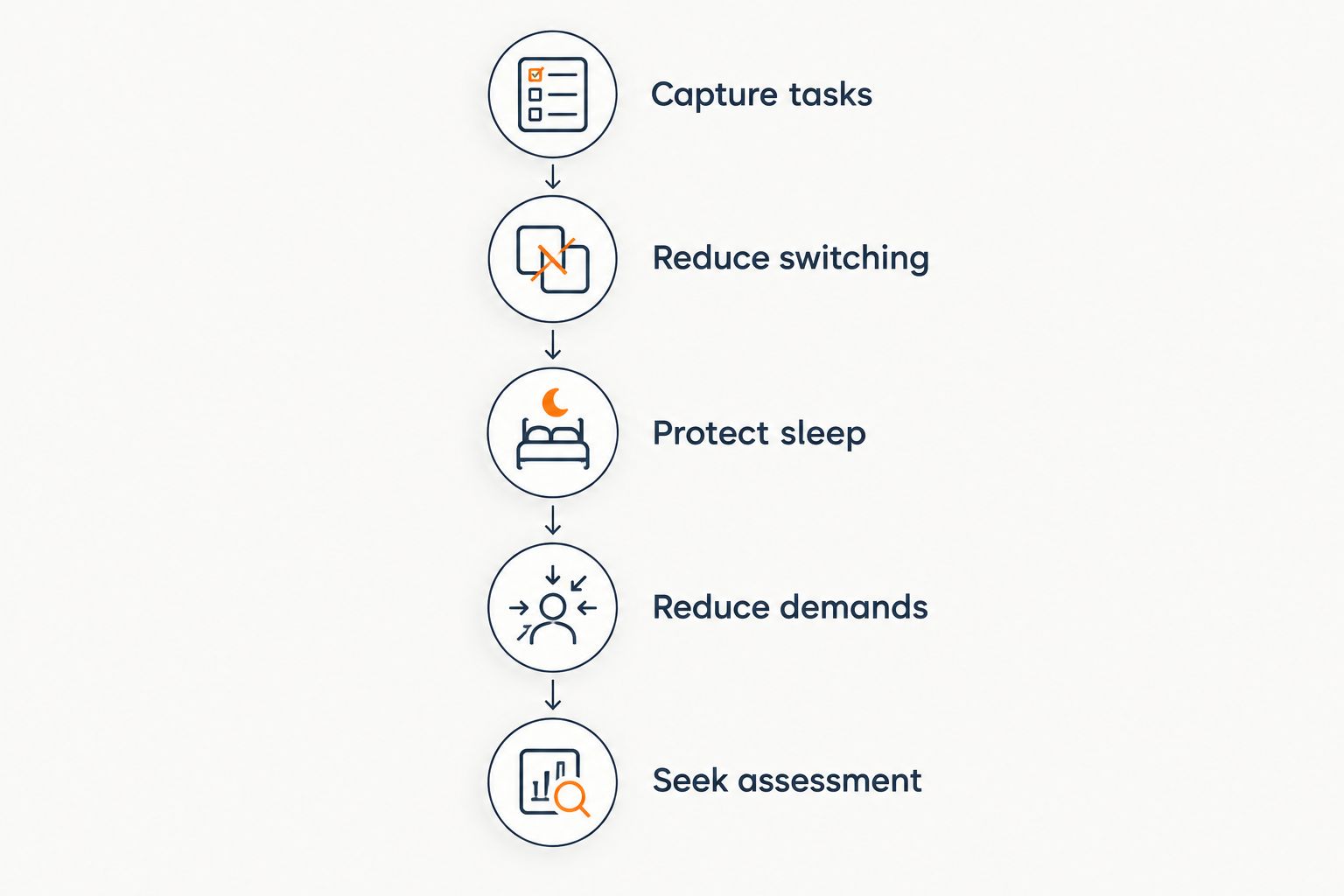 Steps for supporting memory, reducing overload, and seeking medical assessment
Support your memory while addressing the demands and health concerns behind the lapses.
Where does movement fit?
Movement supports general health, but it is not a test you must pass before getting help. Start with an activity that fits your health and current capacity.
For adults, CDC guidance recommends at least 150 minutes of moderate-intensity activity per week and muscle-strengthening activity on 2 days per week. Those are general health targets—not a prescription for brain fog—and some activity is better than none. Ask a clinician about suitable activity if a health condition limits you.
Which kind of support fits your situation?
Choose support based on what you need help with, not which option sounds most convenient. In 2026, an emotional-support app and a medical assessment still serve different purposes.
| Support option | Best for | Main benefit | Important limitation |
|---|---|---|---|
| Practical memory aids | Managing everyday tasks while you address the cause | Reduce reliance on recall | Do not explain or treat new memory changes |
| Primary care assessment | New, persistent, worsening, or disruptive symptoms | Evaluates possible medical, sleep, medication, and mood contributors | Does not remove workplace or caregiving pressures by itself |
| Licensed mental health care | Stress, anxiety, depression, or coping difficulties affecting daily life | Provides professional assessment and treatment within the clinician's scope | Does not replace medical evaluation when memory symptoms warrant it |
| Lovon | Talking through everyday stress and practicing coping tools | Offers on-demand voice conversations and self-reflection guidance | Is not a licensed clinician and cannot diagnose memory problems |
Lovon is best for people seeking voice-based emotional support for everyday stress, not clinical assessment of memory changes. Its role is to help you talk through what feels difficult and explore coping tools—not establish whether forgetfulness comes from burnout or another condition.
When should memory problems get medical attention?
Arrange a healthcare appointment when lapses are a clear change from your usual functioning, keep recurring, or affect responsibilities. Examples include repeated missed medication doses, trouble managing familiar tasks, or concerns noticed by someone close to you.
Tell the clinician when symptoms began, whether they are progressing, and whether anything changed around that time. Include recent illness, head injury, medication changes, sleep disruption, alcohol or substance use, and mood symptoms.
Sudden confusion or sudden memory loss needs urgent medical assessment. Call 911 if it comes with possible stroke symptoms such as trouble speaking, facial drooping, weakness, vision changes, or a sudden severe headache. Do not assume an abrupt change is burnout or wait for sleep to fix it.
If forgetfulness creates an immediate safety risk, ask someone you trust to help with the affected task while you seek advice. That can include driving, cooking, or managing medicines.
Will my memory return to normal after burnout?
Memory and concentration can improve when contributing stress, sleep problems, or mood symptoms improve. There is no reliable universal recovery deadline, and a better day does not establish the cause.
Look for functional changes rather than repeatedly testing yourself: following conversations more easily, completing familiar tasks, or needing fewer reminders. Persistent or worsening symptoms still warrant assessment, even after you reduce your workload.
Does burnout-related forgetfulness mean I have dementia?
Burnout-related forgetfulness does not by itself mean you have dementia. Stress, poor sleep, anxiety, depression, and medical conditions can all affect thinking.
You also cannot rule dementia or another condition out through an online symptom comparison. A clinician can assess the pattern, progression, and effect on daily functioning.
Can a weekend off fix burnout brain fog?
A weekend off does not provide a reliable test or cure for burnout-related brain fog. Rest can help you feel clearer, but returning to the same unmanageable demands can leave the underlying problem unchanged.
Use time away to notice what changes and identify what needs to be different afterward. Avoid turning recovery into another performance target.
FAQ
Can burnout cause memory problems even if I am sleeping enough?
Yes, burnout-related stress can affect attention even when you spend enough time in bed. Sleep quality, mood symptoms, medicines, and other health conditions also matter, so persistent changes deserve assessment.
What does burnout brain fog feel like?
Burnout brain fog can feel like scattered attention, slower recall, losing your train of thought, or difficulty following instructions. These experiences are not specific to burnout and do not establish a diagnosis.
How long do memory problems from burnout last?
There is no reliable universal timeline for burnout-related memory problems. Duration depends on the contributors, and persistent or worsening symptoms need medical assessment rather than waiting for a predicted recovery date.
Can burnout cause permanent memory loss?
Memory lapses during burnout do not by themselves show permanent memory loss. A healthcare professional should assess persistent, worsening, or disruptive symptoms instead of assuming either permanent damage or a harmless cause.
Should I see a doctor for memory problems if I think I am burned out?
Yes—see a healthcare professional if memory problems are new, persistent, worsening, concerning, or affecting daily life. Seek urgent help for sudden confusion or memory loss, especially with weakness or trouble speaking.
Can an emotional-support app diagnose burnout-related memory loss?
No. Lovon is an emotional-support app, not a licensed clinician or a diagnostic service. Use professional medical care to assess memory changes and apps only as optional support for everyday coping.
Can anxiety and burnout both affect my memory?
Yes, anxiety and burnout-related stress can both interfere with attention and recall. Symptoms overlap, so describe the pattern, sleep changes, and effect on daily life to a qualified professional.
One last thing
A memory problem can begin as an attention problem. If you were too overloaded to take in an instruction clearly, trying harder to recall it later does not solve the original difficulty.
Before your next demanding conversation, open a note and ask for the next action in writing. That small adjustment supports you now, while you address the bigger question of why your thinking feels different.
Related guides
How AI Support Helps You Heal
AI emotional support isn't about replacing human connection — it's about filling the gaps. The moments when you need to talk at 2 AM, when you don't want to burden your friends again, or when you simply need someone to listen without judgment.
Here's what happens in a typical Lovon session:
You share what's on your mind
There's no script, no intake form, no waiting room. You speak or type whatever you're feeling — in your own words, at your own pace.
Lovon validates and explores
Using frameworks from CBT (Cognitive Behavioral Therapy) and motivational interviewing, Lovon acknowledges your feelings first, then gently helps you explore them. No dismissive "just move on" advice.
You build coping skills together
Lovon doesn't just listen — it actively works with you on evidence-based techniques: thought reframing, urge surfing, behavioral experiments, and more.
What a Session with Lovon Looks Like

Lovon is AI support, not a replacement for professional care. If things have been hard to get through for weeks, or you are thinking about harming yourself, talk to a doctor or a licensed therapist.
Ready to Start?
Your healing journey can begin right now
A 3-day trial. No judgment. Just a safe space to process what you're going through.
Frequently Asked Questions
Is Lovon a replacement for a real therapist?
Is my conversation with Lovon AI private?
How is Lovon different from ChatGPT for emotional support?
Can I use Lovon if I'm already seeing a therapist?
Can I try Lovon before subscribing?
About the Author
The Lovon Editorial Team
Mental Health & Wellness Content Team
The Lovon Editorial Team develops mental health and wellness content designed to make psychological concepts accessible and actionable. Our goal is to bridge the gap between clinical research and everyday life - helping you understand why your mind works the way it does and what you can do about it....
Related articles
- Can depression cause physical pain in your body?
Can depression cause physical pain? Yes. Learn how mood and pain connect, which symptoms need medical care, and what to…
- Is adult ADHD real or just an excuse?
Is adult ADHD real? Yes. Learn how clinicians assess lasting symptoms, what else can affect attention, and how to take…
- Can chronic stress cause physical illness?
Can chronic stress cause physical illness? Yes. Learn how it affects sleep, blood pressure and existing conditions, plus…
- Does drinking alcohol make anxiety worse the next day?
Alcohol makes anxiety worse next day for some people. Learn why it happens, what helps, and which symptoms need urgent…
See also
Quizzes
- Thin Thick Boundaries Test: Where Do Your Lines Blur?
See where your boundaries run thin, in 3 minutes.
- Loneliness Test: How Lonely Am I? 3 Kinds of Loneliness
See which kind of loneliness is thin, in 3 minutes.
Free tools
- Body Scan Meditation
Ten minutes, from your toes to the top of your head, noticing what is there without trying to fix it. Follow the voice…
- 4-7-8 Breathing
Breathe in for four, hold for seven, breathe out for eight. The long out-breath is the point. Follow the circle; no…
From the wiki
- Why do I keep dreaming about my ex?
Recurring dreams about an ex usually mean your brain is still consolidating a relationship that took up years of memory…
Disclaimer: This article is for informational purposes only and does not constitute medical advice, diagnosis, or treatment. Always seek the advice of your physician or other qualified health provider with any questions you may have regarding a medical condition. If you are in crisis or think you may have an emergency, call 988 (Suicide & Crisis Lifeline) or go to the nearest emergency room. Outside the US? Find a crisis line in your country.