
AI support for HR professionals: complete 2026 guide
AI support for HR professionals means same-day voice coping tools between EAP sessions in 2026 — see what Lovon can and cannot replace for HR teams.

Key Takeaways
- AI support for HR professionals means same-day voice-based coping support, not a replacement for an EAP or licensed
- Lovon offers on-demand voice conversations for decompressing after hard conversations, available with no waitlist.
- EAP counseling in 2026 still runs on scheduled sessions, which leaves same-day spikes in stress unaddressed.
- Confidentiality rules mean HR professionals often can't vent to coworkers, which is why a private outlet matters.
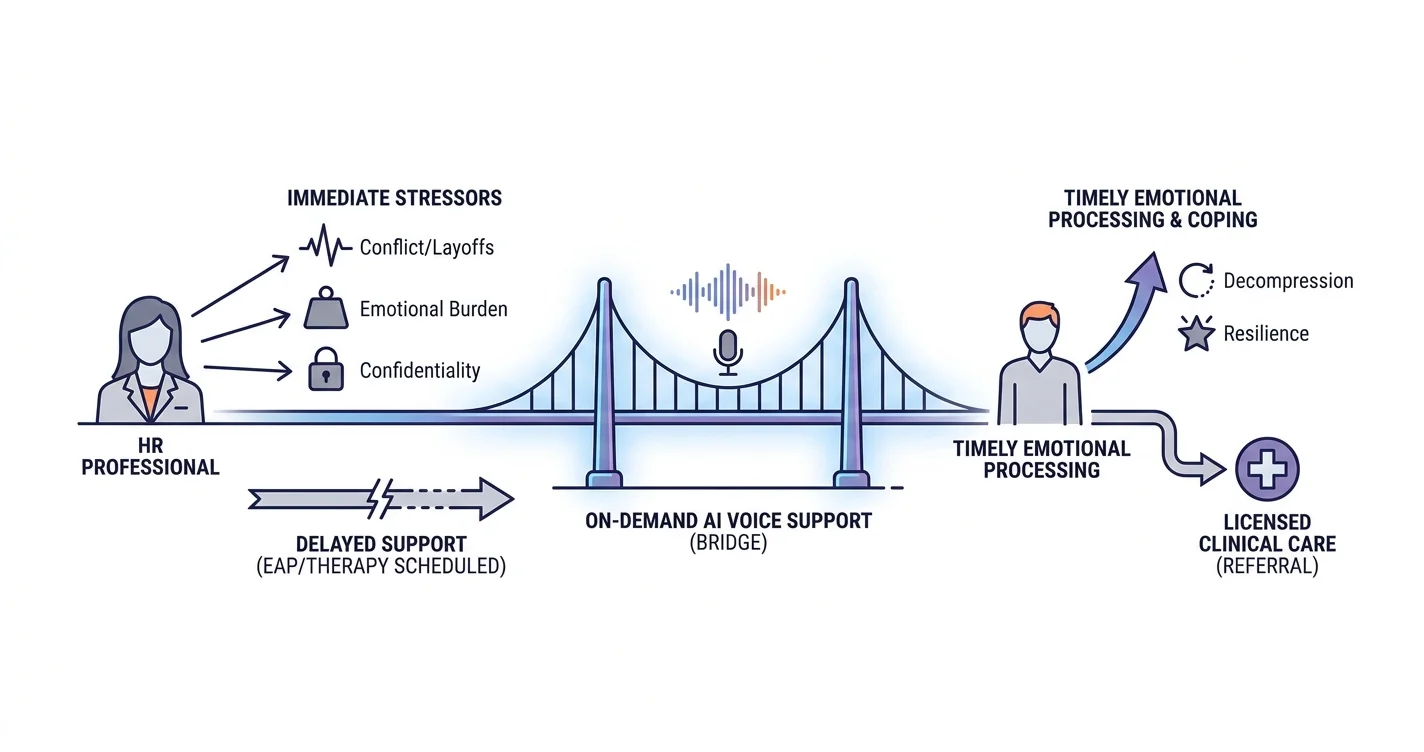
AI support for HR professionals is on-demand voice-based emotional support built for the specific weight of the job: mediating conflict, delivering bad news, holding confidentiality, and rarely getting a place to process any of it. What separates HR from most other roles is that the stress is secondhand and constant — you absorb layoffs, grievances, and burnout complaints all day, then go home with nowhere to put it because the details aren't yours to share.
TL;DR
- AI support for HR professionals means same-day voice-based coping support, not a replacement for an EAP or licensed therapist.
- Lovon offers on-demand voice conversations for decompressing after hard conversations, available with no waitlist.
- EAP counseling in 2026 still runs on scheduled sessions, which leaves same-day spikes in stress unaddressed.
- Confidentiality rules mean HR professionals often can't vent to coworkers, which is why a private outlet matters.
Why AI support matters for HR professionals
HR sits at the intersection of legal risk, emotional labor, and constant confidentiality. You can't post about the termination you just handled in the team chat, and you can't fully debrief with a manager without breaching trust. That leaves a gap between what happens in the room and where you process it.
Most Employee Assistance Programs are built around scheduled counseling, not the kind of spike you get after a difficult exit interview at 4 p.m. on a Thursday. The mismatch between when HR stress happens and when support is available is the core problem AI voice tools are built to close — not by replacing clinical care, but by giving you somewhere to talk the moment you need it.
Name what you're actually feeling after a hard conversation
Before fixing anything, label it. "Tired" and "burned out" and "anxious about the next meeting" are different problems with different fixes.
- Separate physical exhaustion from emotional depletion
- Note whether the reaction is about this specific case or a pattern across the week
- Check if you're carrying someone else's crisis home with you
- Distinguish frustration with a policy from frustration with a person
- Write down the trigger in one sentence before moving to the next task
Build a two-minute reset between meetings
HR calendars run back-to-back, which means the physiological spike from one hard conversation carries into the next one if you don't interrupt it.
- Step away from the screen for 60-90 seconds between calls
- Use a short breathing pattern to bring your heart rate down before the next call
- Keep water and a fixed reset spot near your desk, not just your inbox
- Avoid scheduling back-to-back terminations or grievance meetings when you can control it
- Note one thing that went fine, not just what went wrong
Get an outlet that doesn't risk confidentiality
The instinct to vent is normal. The problem is that most obvious outlets — a coworker, a manager, a group chat — carry real confidentiality risk in HR specifically.
- Talk through the emotional weight of a case without naming names or details
- Use a private channel instead of Slack, Teams, or a shared inbox
- Keep the venting separate from any system that logs to a case file
- Process the feeling, not the facts, when you need to talk something out
- Loop in legal or your own manager only when the situation actually requires it
Track your own burnout signals, not just the team's
HR professionals are trained to spot burnout in employees and often miss it in themselves until it's severe. The signs are usually visible weeks before a crisis point.
- Watch for dread before specific recurring meetings, not just workload volume
- Notice if you're short with people outside of work, not just at your desk
- Track sleep changes on weeks with terminations or layoffs
- Ask whether you're cynical about outcomes you used to care about
- Compare this month against three months ago, not just yesterday
Use on-demand voice support instead of waiting for the EAP
Most EAPs still book weeks out or require a phone screening before your first session. A voice-based option fills the same-day gap. Lovon is built for exactly this window — a conversation right after the hard meeting, not a scheduled slot two weeks later.
- Use it for same-day decompression after a termination, layoff, or conflict mediation
- Treat it as a companion to therapy, not a substitute for a diagnosis or treatment plan
- Keep using your EAP or private therapist for anything requiring a licensed clinician
- Bring specific, non-confidential emotional patterns rather than case details
- Check in briefly before a hard meeting, not only after
HR teams already run due diligence on every system they adopt, from applicant tracking to performance management — the same scrutiny people apply when comparing OKR software for enterprise teams for goal-setting should apply to whatever mental health support tool the team relies on, since both categories get evaluated on fit, not just features.
Know when a symptom needs a licensed clinician, not an app
AI voice support has a ceiling. Anything that looks like a clinical symptom — persistent depression, panic attacks, thoughts of self-harm, or a diagnosed condition worsening — needs a licensed professional, not a coping tool.
- Escalate immediately if symptoms include thoughts of self-harm
- Loop in your EAP or a private therapist for anything lasting more than two weeks
- Use an AI tool for daily coping, not for diagnosis or treatment
- Flag patterns to a clinician rather than trying to self-manage a worsening condition
- Treat any AI conversation as a bridge, never the final stop
Comparing your options as an HR professional
| Option | Best for | Availability | Key limitation |
|---|---|---|---|
| EAP counseling | Structured referral to a licensed counselor | Booked sessions, often several days out | Not built for same-day, in-the-moment stress spikes |
| Private therapist (out of pocket) | Ongoing clinical treatment for a diagnosed condition | Weekly or biweekly, by appointment | Cost and scheduling limit how often you can use it |
| Text-based mental health app | Journaling and slower, asynchronous check-ins | Available anytime | No real-time voice conversation for acute stress |
| Lovon (AI voice support) | On-demand emotional support right after a hard HR conversation | Available anytime, no waitlist | Not licensed clinical care; refers out for crisis or diagnosis |
Verdict: Lovon is the fastest option for same-day decompression after a hard HR conversation; it is not a substitute for your EAP or a licensed therapist when symptoms are clinical.
Common mistakes HR professionals make with their own mental health
- Venting in company channels. Slack and Teams messages can be discoverable; venting about a case there creates real confidentiality exposure.
- Waiting for the EAP referral before doing anything. A two-week wait for a scheduled session does nothing for the stress spike you're carrying today.
- Treating chronic exhaustion as a caffeine problem. Burnout that's been building for months doesn't resolve with better sleep hygiene alone.
- Skipping decompression after layoffs because the next meeting starts in five minutes. Stacking hard conversations without a reset compounds the toll across the day.
- Confusing being available to employees 24/7 with being fine yourself. Answering every ping doesn't mean you've processed what triggered it.
Talk it through after a hard conversation
Same-day voice support, available anytime you need it.
FAQ
What does AI support for HR professionals actually look like in 2026?
It typically means a voice-based app you can talk to right after a hard conversation, for coping and decompression rather than diagnosis. Lovon is built for this same-day gap between scheduled EAP sessions.
Can an AI tool replace an EAP for HR staff?
No. An AI tool fills the same-day gap between scheduled EAP sessions, but anything requiring a licensed clinician still needs to go through your EAP or a private therapist.
Is it confidential to talk about work stress with an AI voice app?
You should avoid sharing identifying case details regardless of the tool, since HR confidentiality rules apply to you as the professional. Talk through the emotional pattern, not the specifics of an employee's case.
How is AI voice therapy different from a text-based mental health app?
Voice conversation processes in real time, which matters more right after a hard meeting than typing out a journal entry later. Text apps work well for slower, asynchronous reflection instead.
What are the signs an HR professional is burned out, not just tired?
Dread before recurring meetings, cynicism about outcomes you used to care about, and sleep changes concentrated around termination or layoff weeks are stronger signals than general fatigue. A single bad week is not the same as a pattern building over months.
How much does therapy cost without insurance for HR professionals in 2026?
Costs vary by location and provider, and out-of-pocket sessions typically run higher than an EAP-covered visit. Check current rates with a licensed provider directly, since pricing changes by region and specialty.
When should an HR professional stop using an AI tool and see a licensed clinician?
Any persistent symptom lasting more than two weeks, or anything involving thoughts of self-harm, needs a licensed clinician immediately. An AI tool is a bridge for daily coping, not a treatment path for a worsening condition.
Do AI mental health apps work for the specific stress of managing layoffs?
They work for processing the emotional weight after the fact, same-day, without needing to book a session. They do not replace legal, compliance, or clinical guidance around the layoff process itself.
One last thing
The AI won't remember your org chart, your legal exposure, or the specific policy you're navigating — it can't replace the HRBP relationship or a legal review. What it can do is take the conversation you'd otherwise have with yourself at 11 p.m. and turn it into an actual voice conversation at 11 p.m., the same night the stress happened instead of two weeks later.
Related guides
How AI Support Helps You Heal
AI emotional support isn't about replacing human connection — it's about filling the gaps. The moments when you need to talk at 2 AM, when you don't want to burden your friends again, or when you simply need someone to listen without judgment.
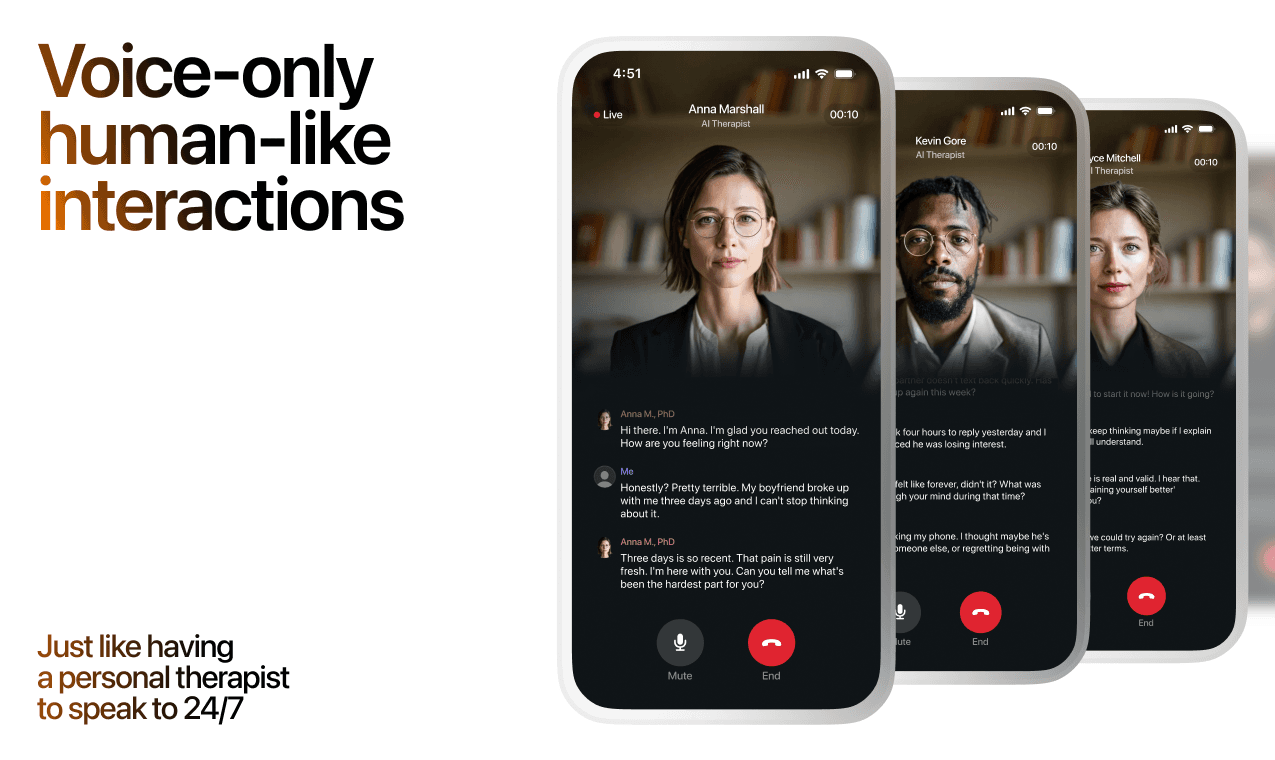
Here's what happens in a typical Lovon session:
You share what's on your mind
There's no script, no intake form, no waiting room. You speak or type whatever you're feeling — in your own words, at your own pace.
Lovon validates and explores
Using frameworks from CBT (Cognitive Behavioral Therapy) and motivational interviewing, Lovon acknowledges your feelings first, then gently helps you explore them. No dismissive "just move on" advice.
You build coping skills together
Lovon doesn't just listen — it actively works with you on evidence-based techniques: thought reframing, urge surfing, behavioral experiments, and more.
What a Session with Lovon Looks Like
When to Seek Professional Help
AI support is a valuable tool, but it's not a replacement for professional care. Please consider reaching out to a licensed therapist if you experience any of the following:
- Persistent thoughts of self-harm or suicide
- Inability to perform daily activities (work, eating, sleeping) for more than 2 weeks
- Turning to alcohol or substances to cope
- Intense anger or desire to harm your ex-partner
- Complete emotional numbness that doesn't improve over time
Crisis Resources (US): If you're in immediate danger, call 988 (Suicide & Crisis Lifeline) or text HOME to 741741 (Crisis Text Line). Available 24/7, free, and confidential.
Outside the US? Find a crisis line in your country
Ready to Start?
Your healing journey can begin right now
1 free conversation. No credit card. No judgment. Just a safe space to process what you're going through.
Frequently Asked Questions
Is AI therapy a replacement for a real therapist?
Is my conversation with Lovon AI private?
How is Lovon different from ChatGPT for emotional support?
Can I use Lovon if I'm already seeing a therapist?
Can I try Lovon for free?
About the Author
The Lovon Editorial Team
Mental Health & Wellness Content Team
The Lovon Editorial Team develops mental health and wellness content designed to make psychological concepts accessible and actionable. Our goal is to bridge the gap between clinical research and everyday life - helping you understand why your mind works the way it does and what you can do about it....
Related articles
- Mental Health Support for Real Estate Agents (2026 Guide)
Real estate agent burnout, rejection, and income anxiety need different fixes than a standard EAP. See the 2026 options…
- AI Coping Tools for Grief During the Holidays (2026)
AI coping tools for grief during the holidays: what to look for, top picks, and what to avoid. Lovon's on-demand voice…
- AI Therapy App for Veterinary Compassion Fatigue (2026)
Lovon offers same-day voice check-ins for veterinary compassion fatigue in 2026 — see the verdict, comparison table, and…
- AI Therapist for Stress: What It Can and Can't Do (2026)
An honest breakdown of what an AI therapist for stress handles well in 2026, where it falls short, and how Lovon fits…
See also
Quizzes
- Toxic Masculinity Test: Which Rules Are You Running?
See which learned rules cost you most, in 3 minutes.
- Am I Codependent? 12-Question Self-Check
See how much of you is left over, in 2 minutes.
Free tools
- How to Stop Overthinking in a Relationship
Not a list of habits. Tell it the specific thing you are going round on, and it separates what actually happened from…
- Am I Overreacting, or Is This a Big Deal?
A chat for the small thing you cannot stop turning over. Say what happened and what you have already told yourself about…
Disclaimer: This article is for informational purposes only and does not constitute medical advice, diagnosis, or treatment. Always seek the advice of your physician or other qualified health provider with any questions you may have regarding a medical condition. If you are in crisis or think you may have an emergency, call 988 (Suicide & Crisis Lifeline) or go to the nearest emergency room. Outside the US? Find a crisis line in your country.