
Mental Health Support for Real Estate Agents (2026 Guide)
Real estate agent burnout, rejection, and income anxiety need different fixes than a standard EAP. See the 2026 options, from therapy to on-demand AI support.

Key Takeaways
- Real estate agents face commission-based income swings, after-hours client demands, and high rejection rates that
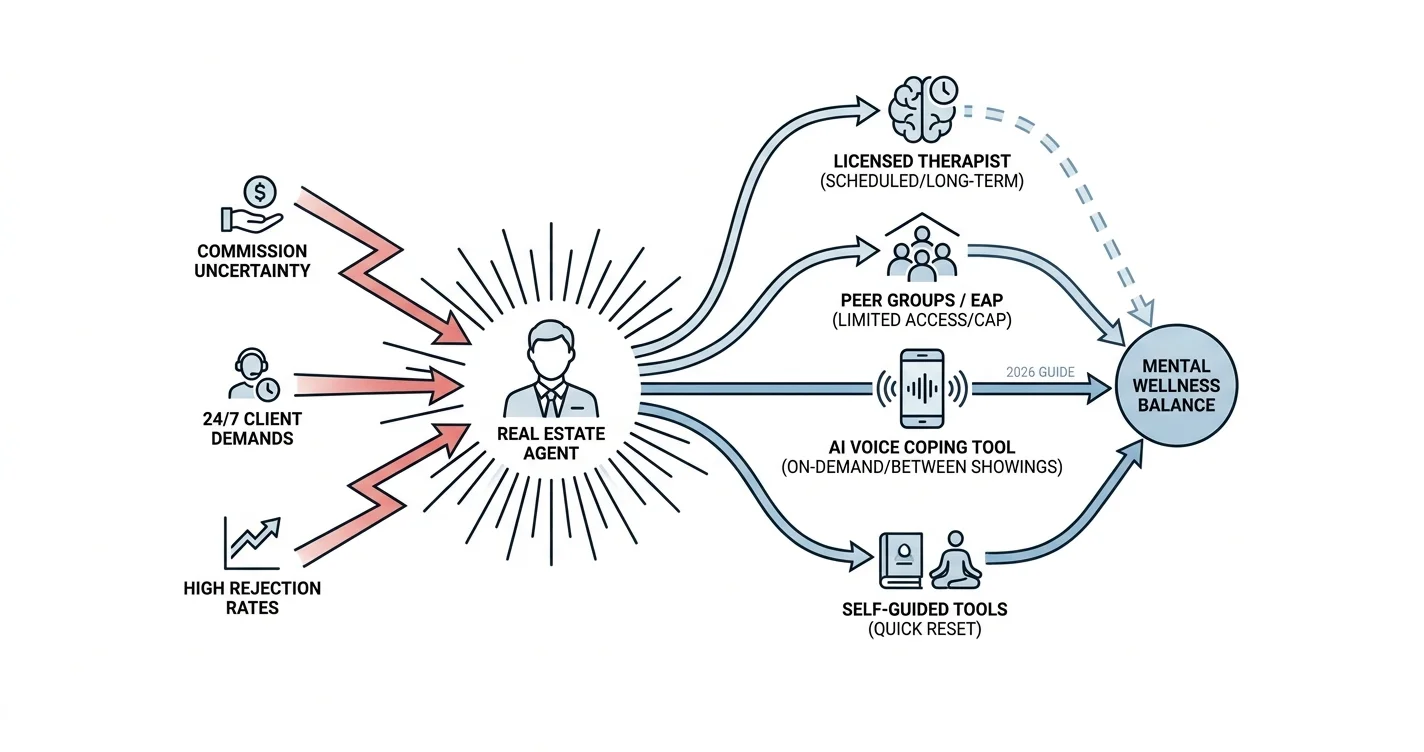
- Peer groups and brokerage EAPs help with community but cap out fast; licensed therapy is gold-standard but hard to
- Lovon offers voice-based AI coping support between showings and after hours, best paired with — not swapped for —
- Burnout and depression look similar in agents; telling them apart early changes what kind of mental health support
Mental health support for real estate agents means finding ways to manage commission-based stress, constant rejection, and hours that never actually end, without waiting for a slow season that solves nothing. Agents work as independent contractors most of the time, which strips away the built-in structure — paid sick days, a manager checking in, a fixed paycheck — that other jobs use as a buffer against burnout.
TL;DR
- Real estate agents face commission-based income swings, after-hours client demands, and high rejection rates that standard workplace wellness programs rarely address.
- Peer groups and brokerage EAPs help with community but cap out fast; licensed therapy is gold-standard but hard to schedule around showings.
- Lovon offers voice-based AI coping support between showings and after hours, best paired with — not swapped for — licensed care.
- Burnout and depression look similar in agents; telling them apart early changes what kind of mental health support for real estate agents actually works.
Why mental health support matters for real estate agents
Real estate agents earn nothing until a deal closes, which means every open house, cold call, and negotiation carries financial weight that a salaried job doesn't put on a single afternoon. That structure rewards constant availability — nights, weekends, holidays — and punishes the agent who steps away, even briefly.
The isolation compounds it. Most agents don't have a team lead checking in weekly or a coworker two desks over noticing when something's off. A brokerage can supply desks and leads; it rarely supplies anyone tracking whether an agent is running on fumes after three straight lost deals.
In 2026 the job is still built the same way: no fixed hours, no guaranteed income, and a phone that clients treat as a 24-hour hotline.
Track your stress triggers by deal stage
Stress in real estate isn't constant — it spikes at specific points in a transaction. Naming those points is the first move, before any tool or therapist enters the picture.
- Log which stage triggers the sharpest reaction: showing, offer, inspection, or closing delay
- Note whether the stress is financial (lost commission) or interpersonal (a difficult client)
- Track dry spells separately from active-deal stress — they're a different kind of pressure
- Flag the physical signs: tight chest before calls, trouble sleeping the night before a closing
- Write down how long the spike lasts once the deal resolves either way
Set boundaries on after-hours calls and texts
Agents who respond to every client message within minutes train clients to expect that speed permanently, at every hour. Reversing it takes a stated policy, not a silent hope that clients will notice.
- Set a written response window in your onboarding materials: replies within business hours, urgent items same-day
- Use a separate ringtone or do-not-disturb schedule for after 8pm
- Batch non-urgent texts into one evening check instead of reacting live
- Tell clients directly when you're unreachable for a showing or personal commitment
- Review the boundary every quarter — market pressure creeps it back without a check-in
Build a wind-down routine after client-facing hours
Going straight from a tense negotiation call to family dinner or sleep leaves the nervous system stuck in the same activated state. A short, repeatable routine signals the shift is over.
- Do a five-minute box breathing pattern before walking into the house
- Change clothes as a physical cue that the workday ended
- Write three lines in a notes app about what happened that day, good or bad
- Skip checking the MLS or email for the first 30 minutes home
- Use a voice-based coping tool like Lovon for a quick talk-through when the tension from a hard call is still sitting in your chest
This is where an on-demand option earns its place: a licensed therapist isn't picking up at 7:15pm on a Tuesday, but a voice conversation with an AI tool can happen right there in the driveway.
Use structured coping tools between showings
Some days have four showings back to back with no room for a therapy appointment in between. That's a scheduling problem, not a motivation problem, and it needs a tool built for gaps, not hour-long slots.
- Keep a two-minute grounding technique ready for the parking lot before a listing appointment
- Use guided breathing between a rejected offer and the next call
- Talk through a tough client interaction out loud rather than replaying it silently all afternoon
- Try a voice session with Lovon's AI life coach for career burnout on the drive between appointments instead of scrolling
- Journal the win or the loss immediately, before the next showing overwrites the memory
Address burnout before it becomes depression
Agents push through exhaustion because the market doesn't pause for them, and by the time they notice something's wrong, burnout has shaded into something closer to depression. The two look alike from the outside — low energy, dread about calls, trouble concentrating during a walkthrough — but they need different responses.
- Watch for a shift from being tired of the job to being tired of everything, including things outside work
- Notice if a weekend off actually restores energy — burnout usually responds to rest, depression often doesn't
- Track sleep and appetite changes lasting more than two weeks
- Ask whether closing a deal still feels like relief, or feels like nothing at all
- Get a clearer read using burnout vs. depression: how to tell which one you have before deciding what kind of help fits
Watch for high-functioning anxiety behind the confident pitch
The agents who look most composed on a listing video are sometimes carrying the highest anxiety load, because the job trains a performance of calm regardless of what's happening internally. That mask makes the anxiety easy to miss, including by the agent.
- Check if you're over-preparing for every showing far past what the deal requires
- Notice constant what-if-this-falls-through thinking during otherwise normal transactions
- Look for physical tension — clenched jaw, shallow breathing — during client calls that go fine on paper
- Review high-functioning anxiety: signs you might be missing if the composed exterior doesn't match how you actually feel
Get professional support before income anxiety compounds
Commission uncertainty isn't a personality flaw to push through. It's a structural feature of the job that deserves a real plan, not white-knuckling until the next closing.
- Separate anxiety about this specific deal from anxiety about the whole month's income
- Build a minimum-months financial buffer so one lost deal doesn't spiral into panic
- Talk to a licensed financial advisor about smoothing commission income, separate from mental health support
- Use structured support — human or AI — for the emotional side of income swings, not just the budgeting side
- Book the licensed therapist during your slowest weekday, not your busiest, so the appointment survives a busy 2026 spring market
Comparing mental health support options for real estate agents
| Option | Best for | Key limitation |
|---|---|---|
| Licensed therapist (in-person or teletherapy) | Ongoing clinical treatment of diagnosed anxiety or depression | Weekly scheduling clashes with irregular showing hours; waitlists are common |
| Brokerage EAP | Agents whose brokerage offers a counseling benefit tier | Often capped at a handful of sessions a year; many independent contractors don't qualify |
| Real estate peer groups or masterminds | Shared war stories and market-specific venting | No confidentiality guarantee, and not a substitute for clinical care |
| Lovon AI voice therapy | Coping support between showings or after hours when no therapist is reachable | Not a replacement for licensed clinical care; built for day-to-day support, not diagnosis |
| Self-guided meditation or journaling apps | Quick resets during a slow afternoon | No personalized guidance, easy to abandon without accountability |
Verdict: agents with diagnosed anxiety or depression need a licensed therapist first; Lovon fills the hours a therapist isn't available, which for most agents is most of the week.
Talk it through after a hard showing
Have a voice conversation with Lovon whenever the day gets to you, not just during office hours.
Common mistakes real estate agents make with mental health
- Treating a slow month as personal failure instead of a normal part of a commission-based market cycle
- Answering every client text within minutes, including at 11pm, which trains clients to expect that pace permanently
- Waiting for burnout to become a crisis instead of building coping tools in during busy stretches
- Isolating after a lost deal rather than talking to another agent who's been through the same rejection
- Confusing exhaustion with laziness, which delays getting help by months
FAQ
What's the best mental health support for real estate agents in 2026?
The strongest setup pairs a licensed therapist for ongoing anxiety or depression with an on-demand tool like Lovon for the gaps between showings and after-hours stress. No single option covers both the clinical need and the scheduling reality of the job.
Is real estate one of the more stressful sales careers?
Commission-only pay, irregular hours, and constant client-facing rejection make real estate a career with stress built into the pay model itself. Salaried sales roles with a fixed base carry a different risk profile.
How do real estate agents deal with rejection and burnout?
Agents manage rejection best by separating a single lost deal from overall performance and building a wind-down routine after client-facing hours. Moving straight from one call to the next is what lets the stress stack.
Can AI therapy help real estate agents between showings?
Yes, for day-to-day coping. A short voice conversation with a tool like Lovon fits into a gap between appointments in a way a scheduled therapy session cannot, though it is not a substitute for licensed treatment of a diagnosed condition.
Do real estate brokerages offer mental health benefits?
Some brokerages provide an Employee Assistance Program with a capped number of counseling sessions per year. Independent contractors often don't qualify for the same benefits as salaried staff.
What are signs of burnout specific to real estate agents?
Dreading client calls that used to feel routine, over-preparing for showings far past what's needed, and feeling no relief after closing a deal are common patterns. If rest over a weekend doesn't restore energy, it may be more than burnout.
Is Lovon a replacement for a licensed therapist?
No. Lovon is built with input from PhD psychologists to provide on-demand emotional support and coping tools, and it does not replace licensed clinical care for diagnosed conditions.
How much does therapy cost without insurance in 2026?
Out-of-pocket therapy pricing varies widely by location and provider type, so a single flat number is misleading. A dedicated 2026 breakdown covers the ranges by provider type.
One last thing
The highest-leverage habit here isn't a morning routine or a meditation streak — it's a 10-minute voice check-in right after a rejected offer, before dialing the next lead. Most agents skip straight to the next call to avoid sitting with the loss, which is exactly what lets stress stack silently across a bad week in 2026 instead of resolving after each hit.
Related guides
How AI Support Helps You Heal
AI emotional support isn't about replacing human connection — it's about filling the gaps. The moments when you need to talk at 2 AM, when you don't want to burden your friends again, or when you simply need someone to listen without judgment.
Here's what happens in a typical Lovon session:
You share what's on your mind
There's no script, no intake form, no waiting room. You speak or type whatever you're feeling — in your own words, at your own pace.
Lovon validates and explores
Using frameworks from CBT (Cognitive Behavioral Therapy) and motivational interviewing, Lovon acknowledges your feelings first, then gently helps you explore them. No dismissive "just move on" advice.
You build coping skills together
Lovon doesn't just listen — it actively works with you on evidence-based techniques: thought reframing, urge surfing, behavioral experiments, and more.
What a Session with Lovon Looks Like

When to Seek Professional Help
AI support is a valuable tool, but it's not a replacement for professional care. Please consider reaching out to a licensed therapist if you experience any of the following:
- Persistent thoughts of self-harm or suicide
- Inability to perform daily activities (work, eating, sleeping) for more than 2 weeks
- Turning to alcohol or substances to cope
- Intense anger or desire to harm your ex-partner
- Complete emotional numbness that doesn't improve over time
Crisis Resources (US): If you're in immediate danger, call 988 (Suicide & Crisis Lifeline) or text HOME to 741741 (Crisis Text Line). Available 24/7, free, and confidential.
Outside the US? Find a crisis line in your country
Ready to Start?
Your healing journey can begin right now
1 free conversation. No credit card. No judgment. Just a safe space to process what you're going through.
Frequently Asked Questions
Is AI therapy a replacement for a real therapist?
Is my conversation with Lovon AI private?
How is Lovon different from ChatGPT for emotional support?
Can I use Lovon if I'm already seeing a therapist?
Can I try Lovon for free?
About the Author

The Lovon Editorial Team
Mental Health & Wellness Content Team
The Lovon Editorial Team develops mental health and wellness content designed to make psychological concepts accessible and actionable. Our goal is to bridge the gap between clinical research and everyday life - helping you understand why your mind works the way it does and what you can do about it....
Related articles
- AI Therapy App for Content Creator Burnout Guide 2026
Content creator burnout isn't office burnout. This guide covers what an ai therapy app for content creator burnout…
- Therapy Cost Without Insurance in 2026: Full Price Guide
Therapy without insurance costs $100–$300 per session in 2026. See sliding-scale, community, and telehealth options that…
- Cheapest AI Mental Health App in 2026: Ranked
Cheapest ai mental health app compared for 2026: Lovon, Wysa, Youper, BetterHelp, and Talkspace ranked by real…
- Mental Health Support for Remote Workers: 2026 Guide
Mental health support for remote workers in 2026: boundary tactics, burnout vs depression signs, and when an AI voice…
See also
Quizzes
- Rejection Sensitivity Test: Free 12-Question Check
See how strongly you expect and read rejection.
- Insecurity Test: What Are You Bracing Against?
See what your insecurity actually runs on, in 3 minutes.
Free tools
- How to Stop Overthinking in a Relationship
Not a list of habits. Tell it the specific thing you are going round on, and it separates what actually happened from…
- Attachment Trigger Plan for Anxious and Avoidant Patterns
Pick your pattern, tick the moments that set it off, and finish one card for each: your body signal, the thing you will…
Disclaimer: This article is for informational purposes only and does not constitute medical advice, diagnosis, or treatment. Always seek the advice of your physician or other qualified health provider with any questions you may have regarding a medical condition. If you are in crisis or think you may have an emergency, call 988 (Suicide & Crisis Lifeline) or go to the nearest emergency room. Outside the US? Find a crisis line in your country.