
How long does burnout recovery usually take?
How long does burnout recovery take? There is no fixed deadline. Learn what progress looks like, which demands to change, and when to seek professional support.

Key Takeaways
- How long does burnout recovery take? There is no universal deadline; reduced demands matter more than a countdown.
- Burnout recovery and stress management require attention to workload, rest, support, and persistent symptoms.
- Lovon offers emotional support through voice conversations, not clinical assessment or a guaranteed burnout recovery
- Persistent exhaustion, low mood, or difficulty functioning deserves professional assessment rather than more
Burnout recovery has no single established average or fixed deadline in 2026. How long it takes depends on the strain you are under, how much that strain changes, and whether another health condition is contributing; feeling better during a break is not the same as being ready for your usual workload.
TL;DR
- How long does burnout recovery take? There is no universal deadline; reduced demands matter more than a countdown.
- Burnout recovery and stress management require attention to workload, rest, support, and persistent symptoms.
- Lovon offers emotional support through voice conversations, not clinical assessment or a guaranteed burnout recovery timeline.
- Persistent exhaustion, low mood, or difficulty functioning deserves professional assessment rather than more pressure to recover.
How long does burnout recovery usually take?
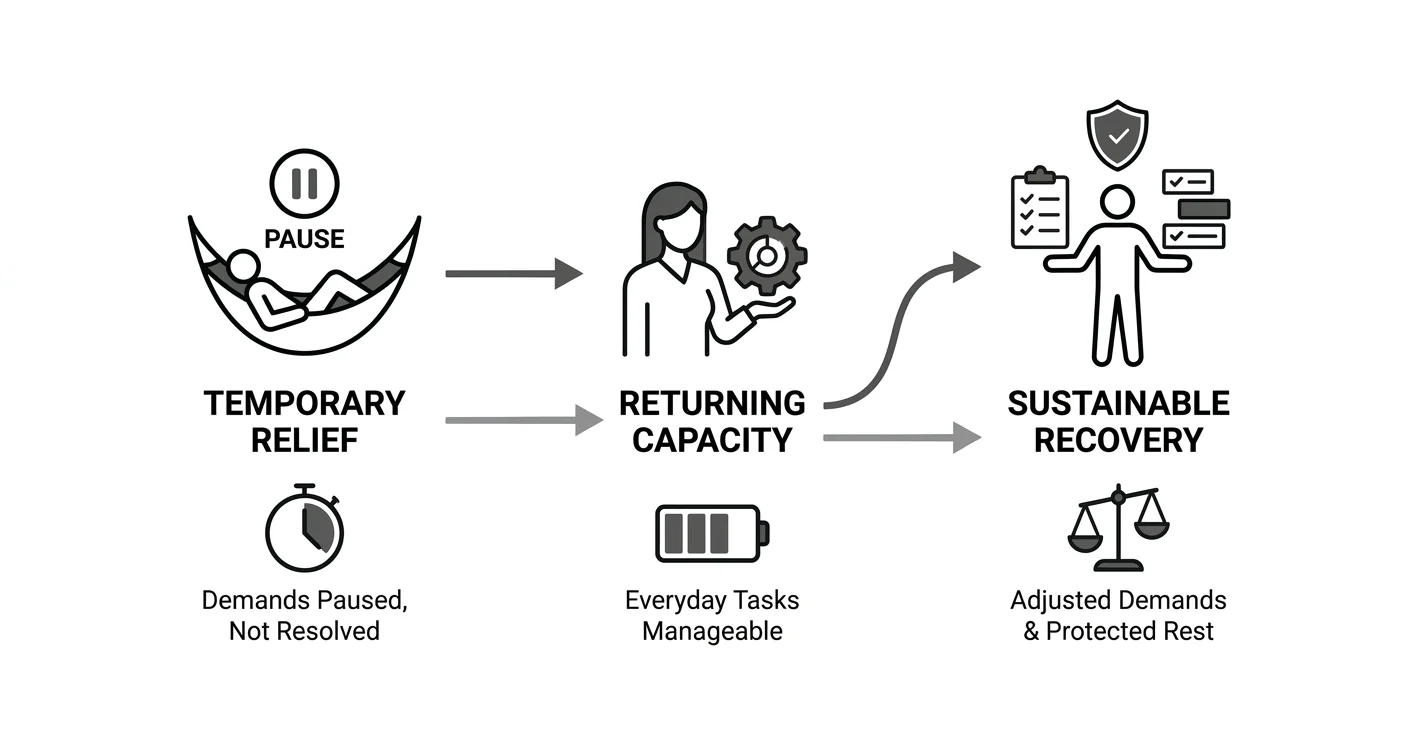
There is no reliable recovery clock that applies to everyone with burnout. A useful distinction is between temporary relief, returning capacity, and sustainable recovery. These are different outcomes, not stages with preset durations.
| Recovery milestone | What you notice | What it does not prove |
|---|---|---|
| Temporary relief | You feel less overwhelmed when demands stop | That you can safely resume the same workload |
| Returning capacity | Everyday tasks feel more manageable | That every symptom has resolved |
| Sustainable recovery | You can meet adjusted demands while protecting rest | That you will never experience stress again |
A vacation can create temporary relief without fixing the conditions that exhausted you. The same distinction explains why self-care alone does not fix burnout: personal coping cannot substitute for a manageable workload.
For your 2026 recovery plan, use functioning as the reference point rather than an online deadline. Can you eat regularly, concentrate on an ordinary task, and finish the day without feeling completely depleted? Those observations help you describe your situation to a clinician and decide what needs to change.
Why this matters
A promised recovery date can become another demand. If you expect yourself to feel normal by a particular deadline, an exhausted day starts looking like a personal failure instead of information about your current capacity.
Burnout also needs a careful label. The World Health Organization’s ICD-11 describes burnout as an occupational phenomenon arising from chronic workplace stress that has not been successfully managed, not as a medical diagnosis. People also use the word for caregiving and other forms of prolonged overload, but those situations deserve their own assessment.
Do not assume that every persistent symptom is burnout. Depression, sleep disorders, medication effects, and physical health problems can also cause fatigue or difficulty concentrating. A recovery plan starts with understanding what you are dealing with, not assigning yourself a countdown.
Temporary relief is not full recovery
Feeling better when you step away from work is meaningful. It tells you that the environment or demands deserve attention. It does not establish that rest alone has resolved the problem.
Notice what happens when you return. If the same schedule immediately brings back exhaustion, dread, or detachment, treat that as a reason to review the workload—not as proof that you rested incorrectly.
You do not need to test your recovery by pushing yourself to exhaustion. Instead, discuss manageable responsibilities and a review process with your manager or clinician. Where leave is involved, ask how returning duties will be decided and who will help adjust them.
Returning capacity means ordinary life feels more manageable
Returning capacity is about what you can do without repeatedly exceeding your limits. You might find it easier to prepare food, answer a message, follow a conversation, or complete a routine task.
Look across different parts of life. Being able to work while having no energy left to eat, wash, or connect with anyone is not a sustainable balance. Productivity alone is a poor measure of wellbeing.
For a 2026 check-in, write down what feels easier and what still feels costly. Keep the description plain: sleeping more consistently, struggling with meetings, or needing help with household responsibilities. You do not need a complicated score to explain your experience.
Sustainable recovery includes changed conditions
Sustainable recovery is not simply tolerating your old routine again. It includes conditions that let you meet responsibilities without sacrificing basic needs.
Those changes can involve clearer priorities, fewer competing tasks, protected time away from work, or practical help at home. Choose changes that address the actual source of overload rather than adding another wellness obligation.
Some constraints are outside your control. Financial pressure, staffing shortages, and caring responsibilities do not disappear because you set an intention. When you cannot remove a demand, identify where another person, workplace process, or professional service can share the burden.
Why burnout recovery varies
Your recovery needs depend on more than the intensity of your exhaustion. Consider these factors when deciding what support to seek:
- Ongoing demands: Rest cannot remove the workload or conflict you return to. Identify what is still draining you.
- Opportunity to rest: Interrupted sleep, unpredictable schedules, and responsibilities outside work affect your ability to recover.
- Practical support: Help with tasks changes your load; encouragement alone does not complete those tasks.
- Health conditions: Persistent fatigue or low mood needs assessment rather than an automatic burnout label.
- Control over responsibilities: Clear priorities and realistic expectations make it easier to protect your available capacity.
- Pressure to overextend: Perfectionism and difficulty saying no deserve attention, without making you responsible for an unhealthy environment.
These factors are reasons to personalize the plan, not a formula for predicting a finish date. The next useful question is what can change, not how quickly you can force yourself to improve.
What can you do while recovering from burnout?
Start with a small plan that reduces pressure rather than adding it. In 2026, the basic aim remains the same: understand your symptoms, address excessive demands, and protect everyday needs.
Name the load
Write down the responsibilities that are consuming your energy. Separate essential tasks from optional commitments and expectations that nobody has clearly agreed on.
Be specific. A list that says repeated urgent requests or evening work messages gives you something to discuss; a list that says everything is terrible leaves the problem harder to address.
Reduce demands
Choose a concrete adjustment to ask for. That might mean a clearer order of priorities, handing over a task, postponing a nonessential commitment, or arranging help with a household responsibility.
You do not need to present a complete solution. State the problem and the adjustment you need, then ask the relevant person what they can change. Where work is involved, keep a record of agreed expectations.
Protect basics
Make room for regular meals, sleep, and movement that fits your health and energy. These are basic needs, not rewards you earn by completing every task.
Avoid turning recovery into an intensive improvement project. A routine that leaves you feeling guilty or more overloaded needs simplifying. If physical activity worsens unexplained fatigue, discuss that with a clinician instead of pushing through.
Review functioning
Notice whether your adjustments make daily life more manageable. Track useful observations, such as fewer interrupted nights or less dread before starting work, rather than demanding constant improvement.
Bring persistent or worsening symptoms to a healthcare professional. You do not have to finish a self-help plan before asking for care.
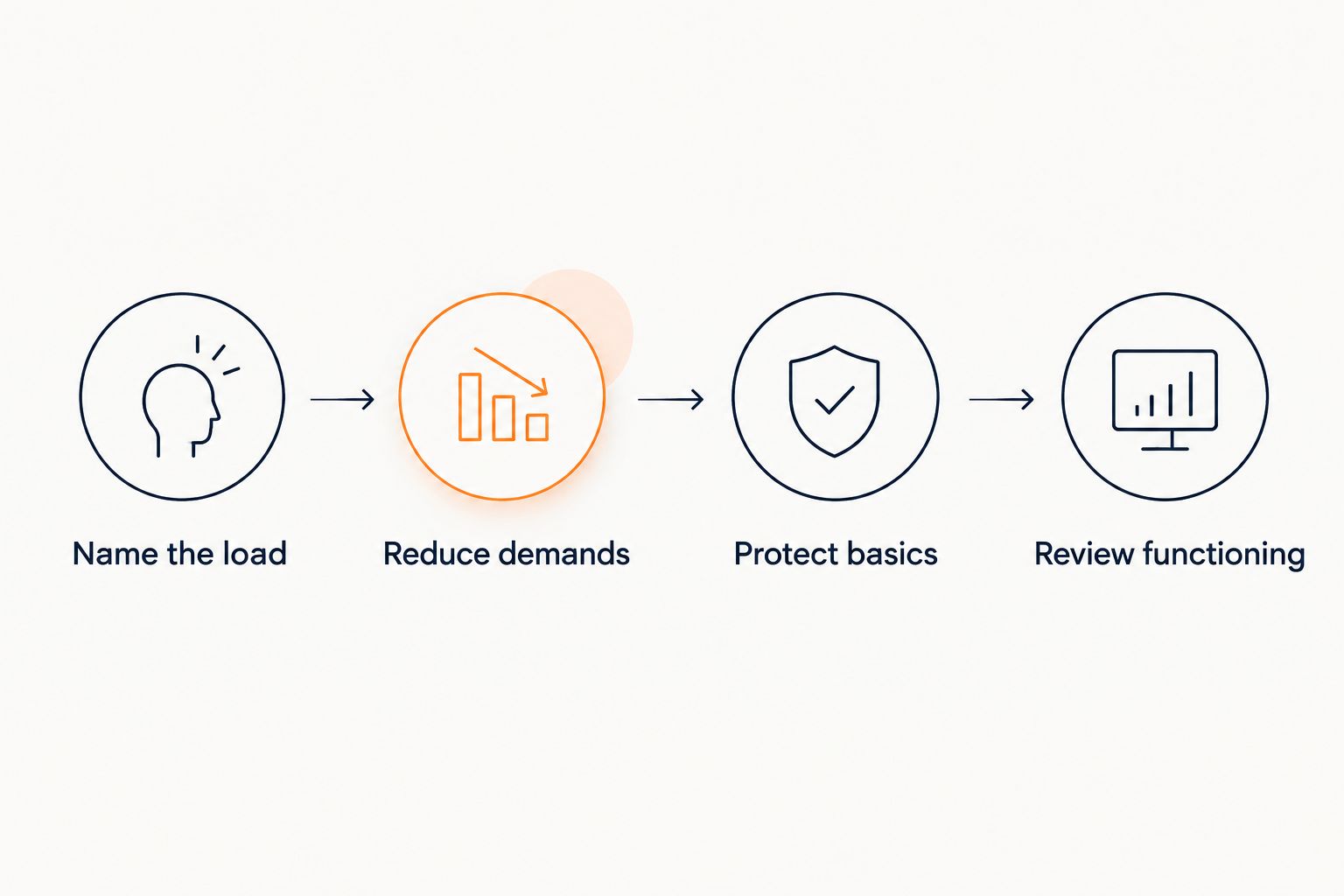 Four steps for identifying overload, changing demands, protecting basic needs, and reviewing functioning.
A recovery plan should reduce pressure, not become another demanding project.
How much does sleep matter during burnout recovery?
Sleep deserves attention, but it is not a cure for an excessive workload. The American Academy of Sleep Medicine and Sleep Research Society recommend that adults aged 18–60 sleep 7 or more hours per night regularly; that recommendation is not a burnout recovery deadline.
Give yourself a realistic opportunity to sleep and look at what interrupts it. Work messages, household responsibilities, pain, and persistent worry require different responses. Simply spending longer in bed does not identify the cause of unrefreshing sleep.
When considering sleep accessories for better rest, separate environmental comfort from health symptoms: a more comfortable bedroom does not explain ongoing exhaustion, loud snoring, or repeated waking. Those symptoms deserve a conversation with a clinician.
If you are sleeping adequately but still struggling to function, do not keep extending your recovery deadline without assessment. Describe how you sleep, how you feel on waking, and what daily activities have become difficult.
What support fits your situation?
Different forms of support serve different purposes. Lovon is best for people seeking on-demand voice-based emotional support, not clinical burnout treatment. You can use Lovon to talk through everyday stress, reflect on your feelings, and explore coping tools.
Lovon’s mental health app is not a licensed clinician. It cannot replace a medical assessment, determine whether symptoms are depression, or decide when you are fit to return to work. No app should become your only support when your functioning is deteriorating.
| Support option | Best for | What it offers | Limitation |
|---|---|---|---|
| Primary care clinician | Persistent fatigue or physical symptoms | Assessment of possible health contributors and next steps | Cannot directly change your workplace demands |
| Licensed mental health professional | Low mood, anxiety, or difficulty functioning | Clinical assessment and treatment within their scope | Treatment does not substitute for practical workload changes |
| Workplace support | Work-related overload | Discussion of priorities, duties, and possible adjustments | Not a substitute for healthcare |
| Lovon mental health app | Everyday reflection and emotional support | On-demand voice conversations and coping tools | Not a clinician, diagnostic service, or emergency resource |
You do not need to choose a single category of support. Practical changes and professional care can address different parts of the same problem. Choose help according to the task you need it to do.
Can you recover from burnout while still working?
There is no fixed recovery deadline for people who continue working. The key question is whether your duties and working conditions allow meaningful rest and manageable demands.
Ask for specific adjustments rather than a vague promise to take it easier. Examples include agreeing on priorities, reducing competing assignments, or protecting time when you are not expected to respond. If you cannot manage basic daily activities, discuss work capacity and leave with a clinician.
Does taking time off guarantee burnout recovery?
There is no fixed amount of leave that guarantees recovery. Time away removes some demands, but returning to unchanged conditions can leave the underlying problem unresolved.
Before returning, clarify what will be different. Agree on duties, boundaries, and how you will raise concerns if the workload remains unmanageable. Rest and a return plan serve different purposes; you need to consider both.
When should you seek professional help instead of waiting?
Seek assessment when symptoms persist, worsen, or interfere with eating, sleeping, relationships, or basic responsibilities. Low mood or loss of interest lasting 2 weeks or longer is a recognized reason to seek help for possible depression; it is not proof of a diagnosis or a burnout timeline.
In 2026, do not wait for a supposed recovery window to close before asking for care. You can describe what you are experiencing without deciding whether it is burnout, depression, or something else.
If you have thoughts of suicide or feel unsafe, call or text 988 in the United States for crisis support. Call 911 for an immediate medical emergency or imminent danger. An emotional support app is not an emergency service.
FAQ
How long does burnout recovery take in 2026?
Burnout recovery has no single established average or fixed deadline in 2026. Your ongoing demands, opportunity to rest, functioning, and health needs determine what support and changes are appropriate.
Can a weekend off fix burnout?
A weekend off does not establish that burnout has resolved. Feeling better away from demands is different from being able to return to a sustainable routine.
How do I know if I am recovering from burnout?
Look for more manageable daily functioning alongside changes to the demands that exhausted you. Improved concentration, more consistent rest, and energy for basic needs are useful observations, not diagnostic tests.
Should I quit my job to recover from burnout?
Quitting is not a universal burnout recovery requirement. Discuss your symptoms, work capacity, possible adjustments, and practical circumstances before making a major decision.
Can burnout feel like depression?
Burnout and depression can share experiences such as exhaustion, reduced motivation, and difficulty concentrating. A qualified professional can assess persistent symptoms; an online comparison cannot diagnose you.
Can Lovon help me during burnout recovery?
Lovon offers voice-based emotional support, coping tools, and self-reflection guidance for everyday mental health struggles. It is not a licensed clinician and does not replace clinical care or changes to an excessive workload.
What if I sleep enough but still feel exhausted?
Persistent exhaustion despite adequate sleep deserves medical assessment. Tell a clinician about your sleep quality, other symptoms, medications, and difficulty with everyday activities.
One last thing
Before adding a recovery habit, identify a demand you can reduce or share. Ask yourself what you are trying to recover from, then make the next action address that pressure. A calmer evening matters, but a manageable tomorrow matters too.
Related guides
How AI Support Helps You Heal
AI emotional support isn't about replacing human connection — it's about filling the gaps. The moments when you need to talk at 2 AM, when you don't want to burden your friends again, or when you simply need someone to listen without judgment.
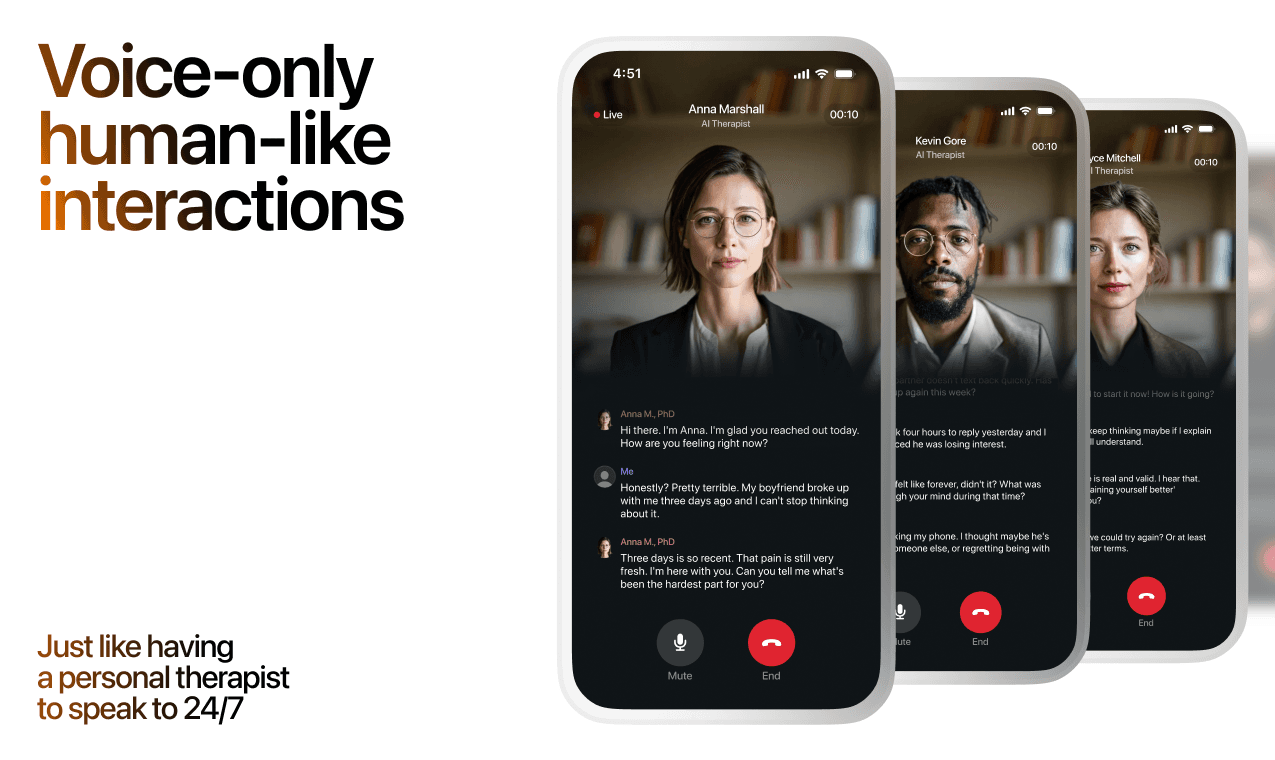
Here's what happens in a typical Lovon session:
You share what's on your mind
There's no script, no intake form, no waiting room. You speak or type whatever you're feeling — in your own words, at your own pace.
Lovon validates and explores
Using frameworks from CBT (Cognitive Behavioral Therapy) and motivational interviewing, Lovon acknowledges your feelings first, then gently helps you explore them. No dismissive "just move on" advice.
You build coping skills together
Lovon doesn't just listen — it actively works with you on evidence-based techniques: thought reframing, urge surfing, behavioral experiments, and more.
What a Session with Lovon Looks Like
When to Seek Professional Help
AI support is a valuable tool, but it's not a replacement for professional care. Please consider reaching out to a licensed therapist if you experience any of the following:
- Persistent thoughts of self-harm or suicide
- Inability to perform daily activities (work, eating, sleeping) for more than 2 weeks
- Turning to alcohol or substances to cope
- Intense anger or desire to harm your ex-partner
- Complete emotional numbness that doesn't improve over time
Crisis Resources (US): If you're in immediate danger, call 988 (Suicide & Crisis Lifeline) or text HOME to 741741 (Crisis Text Line). Available 24/7, free, and confidential.
Outside the US? Find a crisis line in your country
Ready to Start?
Your healing journey can begin right now
A 7-day trial. No judgment. Just a safe space to process what you're going through.
Frequently Asked Questions
Is Lovon a replacement for a real therapist?
Is my conversation with Lovon AI private?
How is Lovon different from ChatGPT for emotional support?
Can I use Lovon if I'm already seeing a therapist?
Can I try Lovon before subscribing?
About the Author
The Lovon Editorial Team
Mental Health & Wellness Content Team
The Lovon Editorial Team develops mental health and wellness content designed to make psychological concepts accessible and actionable. Our goal is to bridge the gap between clinical research and everyday life - helping you understand why your mind works the way it does and what you can do about it....
Related articles
- How long does it take to build a new habit?
How long does it take to build a new habit? Think weeks to months, not a fixed deadline. Learn what the research means…
- How long does an anxiety attack usually last?
How long does an anxiety attack last? There is no set time. Learn why the 5 to 20 minutes cited for most panic attacks…
- Can journaling really reduce stress?
Can journaling really reduce stress? Yes, it can help, but not everyone benefits. Learn what research shows, which…
- Can anxiety come back after years of being fine?
Can anxiety come back after years of being fine? Yes. Learn what a return of symptoms means, what to do now, and when to…
See also
Quizzes
- Shame Test: Do You Read Mistakes as Verdicts?
See which exit your shame takes, in 3 minutes.
- Empath Test: Do Other People's Moods Become Yours?
See how much of other people's moods you take on.
Free tools
- What to Say When a Pet Dies
Get a message you can actually send to someone whose dog or cat just died: one that uses the animal's name, treats the…
- How to Reconnect With an Old Friend
A chat for how to reconnect with an old friend, starting with the text you have been meaning to send for a year. Tell it…
From the wiki
- What to do if you have no friends?
Pick one activity that repeats weekly with the same people, and go for six to eight weeks straight. Repetition, not…
Disclaimer: This article is for informational purposes only and does not constitute medical advice, diagnosis, or treatment. Always seek the advice of your physician or other qualified health provider with any questions you may have regarding a medical condition. If you are in crisis or think you may have an emergency, call 988 (Suicide & Crisis Lifeline) or go to the nearest emergency room. Outside the US? Find a crisis line in your country.