
Does taking a mental health day actually help?
Does a mental health day actually help? Yes, for short-term relief. Learn how to rest, plan your return, and recognize when you need more support.

Key Takeaways
- Does a mental health day actually help? Yes, as short-term stress relief—not as a cure for burnout or depression.
- Choose rest, manageable tasks, or connection based on what is draining you; avoid turning recovery into another assignment.
- CDC recommends at least 7 hours of sleep for adults ages 18–60; protect sleep rather than scheduling more activities.
- Persistent symptoms or trouble functioning call for professional support, not repeated attempts to recover alone.
Yes—a mental health day can help by giving you space to rest, reduce immediate demands, and notice what you need. It is a short-term support, not a treatment for depression, an anxiety disorder, or ongoing burnout, and returning to the same pressures without changes can leave the underlying problem untouched.
TL;DR
- Does a mental health day actually help? Yes, as short-term stress relief—not as a cure for burnout or depression.
- Choose rest, manageable tasks, or connection based on what is draining you; avoid turning recovery into another assignment.
- CDC recommends at least 7 hours of sleep for adults ages 18–60; protect sleep rather than scheduling more activities.
- Persistent symptoms or trouble functioning call for professional support, not repeated attempts to recover alone.
Does a mental health day actually help?
A mental health day helps when it creates a real break from the demands wearing you down. That might mean stepping away from work messages, catching up on basic needs, or making room for a difficult feeling you have been pushing aside.
The benefit does not have to look dramatic. Feeling less rushed, eating regularly, or having enough attention for a conversation can be useful outcomes. You do not need to finish the day cheerful to justify taking it.
The goal is less strain, not perfect recovery. If you tend to turn time off into a performance, this guide to overcoming perfectionism paralysis offers a related starting point.
Choose the shape of your day around your main need:
| Approach | Best for | What to try | Benefit | Limitation |
|---|---|---|---|---|
| Quiet recovery | Feeling overloaded or physically worn out | Reduce interruptions, eat, rest, and keep plans light | Creates space away from demands | Does not resolve ongoing workload or conflict |
| Practical relief | A specific unfinished task weighing on you | Handle an essential appointment or manageable task | Addresses a concrete source of stress | Easily becomes another full workday |
| Support and connection | Feeling alone or needing help | Contact someone you trust or arrange professional support | Makes room for support instead of handling everything alone | Requires energy, access, and a suitable person |
These approaches can overlap. Choose a starting point rather than building an ideal schedule.
Why this matters
A day off and a healthier daily life solve different problems. A break gives you breathing room; a sustainable workload, safer relationships, and appropriate care address what keeps draining you.
For your 2026 self-care plan, separate those jobs. Ask what would make today gentler, then ask what needs to change after today. Neither question requires you to blame yourself.
A mental health day is also not equally accessible to everyone. Work rules, caregiving, school, and household responsibilities affect what you can step away from. A shorter protected break is still a reasonable option when a full day is unavailable.
How to spend a mental health day without making it another job
Start with what you need, not what a wellness checklist says you should accomplish. Use the following sequence as a guide, not a standard you have to meet.
Name the need
Finish this sentence: the hardest part right now is ____. Be specific enough to choose a response. Exhaustion, too many decisions, loneliness, and dread about a particular conversation call for different kinds of support.
You do not need a diagnosis to describe your experience. You also do not need to understand every cause before taking a break. Naming the immediate difficulty is enough to begin.
Reduce demands
Choose what can wait, what needs a handoff, and what genuinely cannot stop. If possible, silence work notifications and let necessary contacts know when you will be unavailable.
Avoid making yourself reachable just in case if that means watching your phone all day. If you must stay available for a dependent or essential responsibility, keep that channel open and reduce unrelated interruptions.
Meet basics
Eat something manageable, drink water, and make room for sleep. Keep taking prescribed medication as directed. A mental health day is not a reason to change or stop treatment on your own.
For your 2026 rest plan, use established sleep guidance rather than treating sleep as a reward. The CDC recommends at least 7 hours of sleep for adults ages 18–60. That is adult sleep guidance, not a promise that a particular amount will fix your distress.
Choose support
Decide whether you want quiet, company, or help with a specific problem. A familiar activity, a conversation with someone safe, or arranging an appointment are all reasonable choices.
Keep the choice small enough to feel possible. You can change your mind if an activity leaves you more drained; you do not have to complete a plan simply because you wrote it down.
Plan re-entry
Before the day ends, identify the first necessary task for your return and something that can wait. If the same demand repeatedly overwhelms you, write down the adjustment or conversation you need to request.
Keep this brief. Preparing to return should not take over the time you set aside to recover.
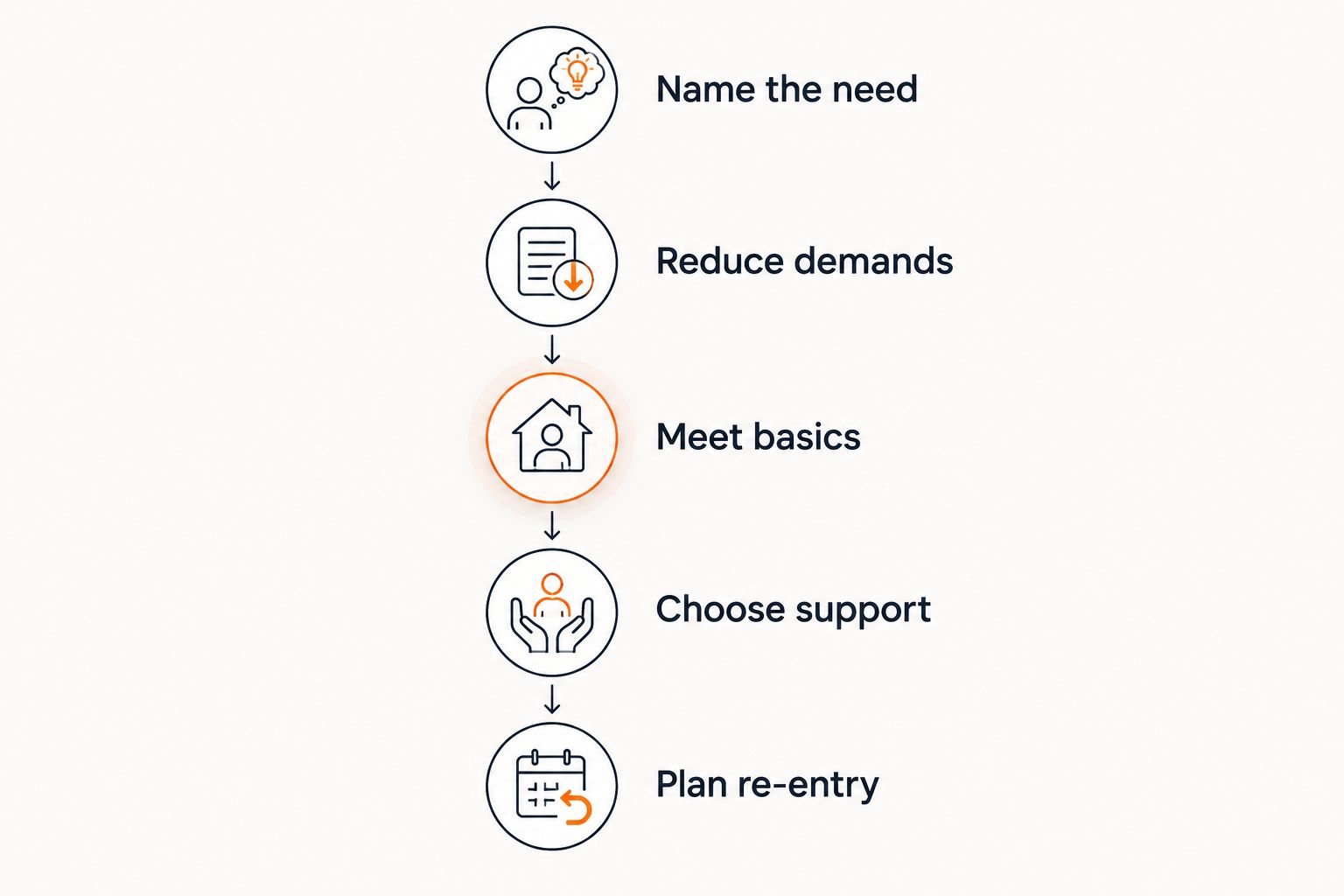 A simple sequence for planning a mental health day around your needs rather than a long checklist.
Start with what is draining you, then choose a manageable response.
Why the benefit of a mental health day varies
There is no guaranteed reset. The same day off can feel different depending on what you are dealing with and how much protection the break actually provides.
- The source of strain: Time away does not remove an unresolved conflict, unsafe situation, or unmanageable workload.
- Your physical needs: Missed sleep, meals, or medical care deserve attention alongside emotional stress.
- How much you can disconnect: A day spent answering messages is not the same break as time with fewer demands.
- Responsibilities that remain: Caregiving and household needs affect the space available for rest.
- The support around you: Practical help and someone safe to talk with change what you have to carry alone.
- Whether symptoms persist: Ongoing anxiety, low mood, or difficulty functioning needs attention beyond the day's schedule.
Use these factors to adjust expectations, not to judge whether you rested correctly. If the break helps only briefly, take that information seriously.
What if I feel guilty about taking the day off?
Guilt does not prove that you are doing something wrong. You can care about your responsibilities and still need time away from them.
Separate the practical question from the emotional one. The practical question is whether you have followed the relevant absence process and handled essential responsibilities. The emotional question is whether you believe you must be completely depleted before you deserve rest.
For your 2026 time-off planning, check your current workplace or school policy rather than assuming that a mental health day has a particular leave category. Requirements differ. Ask what information is needed without assuming that you must share your full personal history.
Avoid spending the day repeatedly defending the decision to yourself. Return to the need you named at the start. Rest does not need to produce a visible achievement to count as rest.
Does resting help, or am I avoiding the problem?
Rest and avoidance are not interchangeable. A break can support you while you prepare to address something difficult; avoiding every necessary conversation or responsibility leaves the problem unaddressed.
Look at what happens around the break. Are you giving yourself room to return with support, or repeatedly postponing something important without a plan? The answer is a reason to adjust the next step, not a reason to shame yourself.
If anxiety is making an essential task feel impossible, consider asking a licensed mental health professional for help. You do not have to force yourself through overwhelming distress to prove that your break was legitimate.
A useful day off makes room for your needs without asking it to solve your whole life. Keep that distinction when deciding what comes next.
What if a mental health day does not help?
A mental health day that does not bring relief is not evidence that you failed at self-care. It tells you that time away, by itself, has not met the need.
Notice whether distress returns only around a particular situation or follows you across work, relationships, and time off. Also notice changes in sleep, appetite, interest, concentration, and your ability to manage everyday tasks. These observations can help you explain what is happening to a clinician; they cannot diagnose the cause.
For your 2026 care decisions, use 2 weeks as a reason to seek assessment when persistent low mood or loss of interest is present. The National Institute of Mental Health describes major depression as involving symptoms most of the day, nearly every day, for at least 2 weeks, with interference in daily activities. Do not wait for that threshold if symptoms are severe or you are struggling to function.
Persistent exhaustion also deserves medical attention rather than an automatic assumption of burnout. A healthcare professional can assess mental and physical contributors and discuss appropriate care.
Where does an emotional support app fit?
If talking helps you sort through feelings, an app can be an optional part of your break. Lovon is best for people seeking on-demand AI voice support for everyday emotional struggles, not clinical treatment.
The Lovon mental health app offers voice conversations, coping tools, and self-reflection guidance. You can use that format to put feelings into words or think about what support to seek next. Its limitation matters: it is not a licensed clinician and does not replace professional assessment or treatment.
You do not need to use an app to make your day worthwhile. Choose a conversation, a paper notebook, quiet time, or another approach that fits your needs. Do not treat an app's response as a diagnosis or proof that you are safe.
How do I know whether the day helped?
Look for a practical difference rather than a complete mood change. Are basic tasks more manageable? Did you identify a need, ask for help, or make space for something you had been neglecting?
You can also notice what stayed difficult. If you feel rested but still dread an unchanged workload, the next step concerns workload—not finding a better way to relax. If low mood remains present across settings, seek professional support rather than repeatedly testing whether another day off will fix it.
For a simple 2026 check-in, write down what helped, what did not, and what needs attention next. No score is required. The point is to make a useful decision, not to grade your recovery.
When should I get help right away?
Get immediate human support if you are thinking about suicide, feel unable to keep yourself safe, or are in immediate danger. A mental health day or an AI conversation is not crisis care.
In the United States, call or text 988 to reach the Suicide & Crisis Lifeline. Call 911 for an immediate life-threatening emergency. If possible, tell someone you trust what is happening and ask them to stay with you while you get help.
FAQ
Does a mental health day actually help with stress?
Yes, a mental health day can provide short-term relief by reducing demands and making room for rest and support. It does not remove an ongoing source of stress or replace treatment.
Is it okay to spend my mental health day doing nothing?
Yes, you do not need a productive schedule to justify rest. Keep basic needs such as food, water, and prescribed medication in view, and seek help if basic self-care feels unmanageable.
Can a mental health day fix burnout?
A mental health day is not a complete solution to ongoing burnout. Time away needs to sit alongside attention to the demands, boundaries, and support affecting your daily life.
How much sleep should I aim for on a mental health day?
At least 7 hours is the CDC recommendation for adults ages 18–60. Sleep needs vary, and persistent exhaustion or sleep difficulties deserve medical attention rather than repeated attempts to catch up.
Should I take a mental health day or see a therapist?
You can take a mental health day and seek therapy; they serve different purposes. Contact a licensed professional when symptoms persist, distress feels difficult to manage, or everyday functioning is affected.
Can Lovon help me reflect during a day off?
Lovon offers AI voice conversations, coping tools, and self-reflection guidance for everyday emotional struggles. It is an optional support tool, not a licensed clinician or a replacement for clinical care.
Can I use Lovon if I feel unsafe?
Lovon is not a substitute for crisis support. In the United States, call or text 988 if you are in emotional crisis, and call 911 for an immediate life-threatening emergency.
One last thing
Before returning to your usual routine, choose a specific request: a clearer priority, help with a responsibility, a protected break, or an appointment. Make the request small enough to act on.
You do not have to feel completely better for the day to have mattered. But if every return brings you straight back to the same distress, stop asking the break to do the work of a larger change.
Related guides
How AI Support Helps You Heal
AI emotional support isn't about replacing human connection — it's about filling the gaps. The moments when you need to talk at 2 AM, when you don't want to burden your friends again, or when you simply need someone to listen without judgment.
Here's what happens in a typical Lovon session:
You share what's on your mind
There's no script, no intake form, no waiting room. You speak or type whatever you're feeling — in your own words, at your own pace.
Lovon validates and explores
Using frameworks from CBT (Cognitive Behavioral Therapy) and motivational interviewing, Lovon acknowledges your feelings first, then gently helps you explore them. No dismissive "just move on" advice.
You build coping skills together
Lovon doesn't just listen — it actively works with you on evidence-based techniques: thought reframing, urge surfing, behavioral experiments, and more.
What a Session with Lovon Looks Like
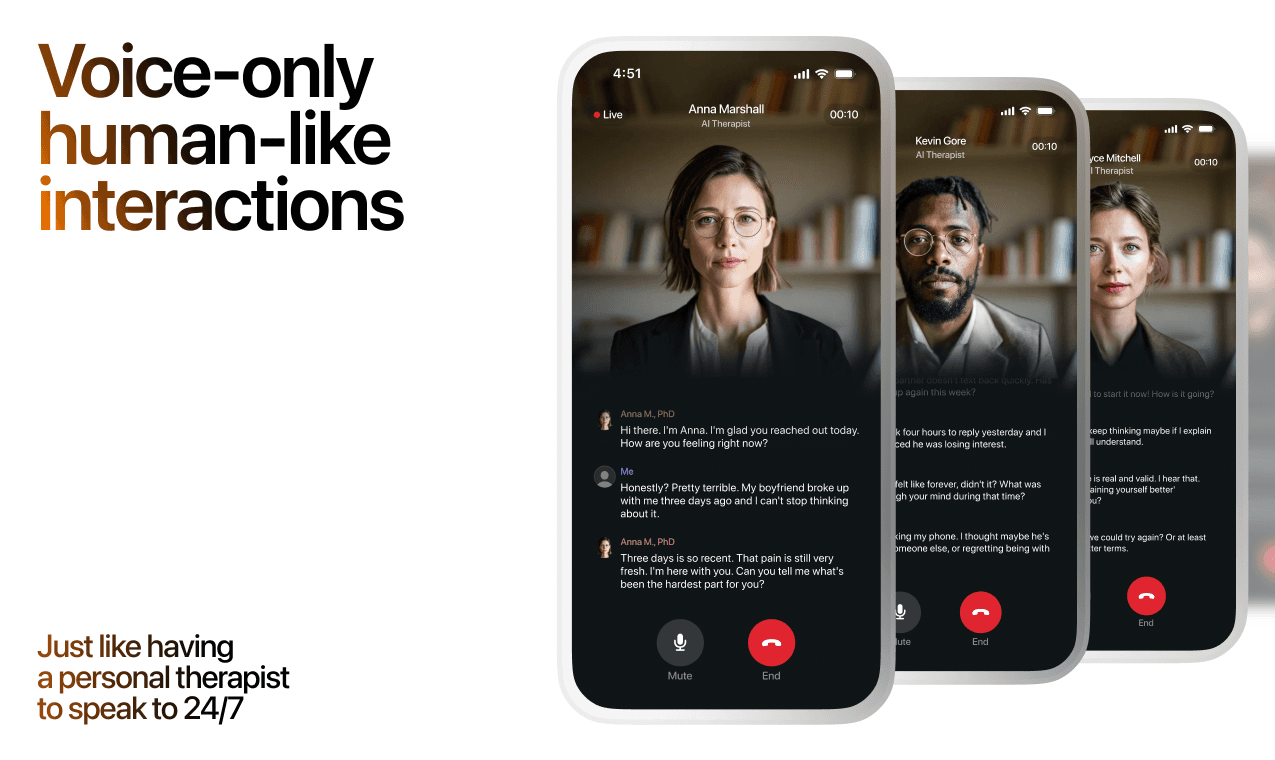
Lovon is AI support, not a replacement for professional care. If things have been hard to get through for weeks, or you are thinking about harming yourself, talk to a doctor or a licensed therapist.
Ready to Start?
Your healing journey can begin right now
A 3-day trial. No judgment. Just a safe space to process what you're going through.
Frequently Asked Questions
Is Lovon a replacement for a real therapist?
Is my conversation with Lovon AI private?
How is Lovon different from ChatGPT for emotional support?
Can I use Lovon if I'm already seeing a therapist?
Can I try Lovon before subscribing?
About the Author
The Lovon Editorial Team
Mental Health & Wellness Content Team
The Lovon Editorial Team develops mental health and wellness content designed to make psychological concepts accessible and actionable. Our goal is to bridge the gap between clinical research and everyday life - helping you understand why your mind works the way it does and what you can do about it....
Related articles
- Best AI App for Burnout Recovery in 2026: Ranked
Lovon leads our 2026 ranking of the best AI app for burnout recovery, compared against Woebot, Wysa, Calm, Headspace…
- Burnout vs Depression: How to Tell in 2026 (Guide)
Burnout vs depression explained with a 7-step self-check for 2026. Learn the key symptom differences, when to rest, and…
- Functional Depression: Signs You're Not Just Tired (2026)
Functional depression keeps you going while draining everything. Learn the 8 signs, how it differs from burnout, and…
- AI therapy for restaurant and hospitality workers: complete 2026 guide
AI mental health support for restaurant workers fits after-shift stress and burnout. See when Lovon helps, where it…
See also
Quizzes
- Shame Test: Do You Read Mistakes as Verdicts?
See which exit your shame takes, in 3 minutes.
- Guilt Test: Do I Have a Guilt Complex? Excessive Guilt Quiz
See whether your guilt repairs or just hurts.
Free tools
- 4-7-8 Breathing
Breathe in for four, hold for seven, breathe out for eight. The long out-breath is the point. Follow the circle; no…
- AI Mental Health Coach
This is a free AI mental health coach for ordinary hard stretches: stress, low days, worry that will not switch off, a…
From the wiki
- Why do I feel lonely all of a sudden?
Sudden loneliness usually traces back to something that quietly ended in the last few months: a routine, a shared class…
Disclaimer: This article is for informational purposes only and does not constitute medical advice, diagnosis, or treatment. Always seek the advice of your physician or other qualified health provider with any questions you may have regarding a medical condition. If you are in crisis or think you may have an emergency, call 988 (Suicide & Crisis Lifeline) or go to the nearest emergency room. Outside the US? Find a crisis line in your country.