
Can lack of social interaction cause depression?
Can isolation cause depression? Yes, it can contribute. Learn how isolation and low mood connect, which signs need care, and how to reach out for support.

Key Takeaways
- Can isolation cause depression? Yes, it can contribute, but isolation alone does not establish a diagnosis.
- Social isolation means limited contact; loneliness means feeling disconnected, even around other people.
- Persistent low mood or lost interest for 2 weeks warrants a conversation with a healthcare professional.
- Lovon offers emotional support through voice conversations, not licensed treatment or a replacement for human connection.
Yes—lack of social interaction can contribute to depression, especially when isolation is unwanted or leaves you without meaningful support. The relationship also runs the other way: depression can make you withdraw, so isolation is a risk factor and a possible symptom, not proof of a diagnosis.
TL;DR
- Can isolation cause depression? Yes, it can contribute, but isolation alone does not establish a diagnosis.
- Social isolation means limited contact; loneliness means feeling disconnected, even around other people.
- Persistent low mood or lost interest for 2 weeks warrants a conversation with a healthcare professional.
- Lovon offers emotional support through voice conversations, not licensed treatment or a replacement for human connection.
Can lack of social interaction cause depression?
Yes. Social isolation can increase your risk of depression, but it is not a single, inevitable cause. Your health, circumstances, relationships, and history also matter. Some people enjoy substantial time alone without becoming depressed; others feel deeply lonely despite daily contact.
Separating loneliness from being alone helps you identify what is actually missing. More invitations will not necessarily solve a lack of emotional closeness.
| Experience | What it means | How it relates to depression | What to notice |
|---|---|---|---|
| Chosen solitude | Time alone that you want | Not inherently a sign of depression | You feel restored and can reconnect when you choose |
| Social isolation | Limited contact or participation | Can reduce access to support and contribute to risk | Your routine leaves little room for meaningful interaction |
| Loneliness | A gap between the connection you want and experience | Is associated with depressive symptoms | You feel unseen, unsupported, or disconnected |
| Depression-related withdrawal | Pulling away as mood, interest, or energy declines | Can be a symptom that deepens isolation | You stop responding or enjoying contact you previously valued |
These experiences overlap, but they are not interchangeable. The useful question is not simply whether you spend time alone. It is whether you have the connection you need and whether your mood or daily functioning has changed.
Why this matters
Isolation and depression can form a difficult loop. You feel low, cancel plans, lose opportunities for support, and then find reaching out even harder. That pattern is not a character flaw.
For your mental health in 2026, distinguish a connection problem that needs attention from symptoms that need clinical assessment. You can work on both at once. You do not have to rebuild a social life before asking for treatment.
The National Institute of Mental Health's depression guidance describes withdrawal, loss of interest, sleep changes, and difficulty functioning among signs that deserve attention. CDC guidance on social connection addresses isolation and loneliness as health concerns, not personal failures.
How isolation and depression reinforce each other
Limited connection can remove ordinary sources of comfort, perspective, and practical help. Without someone to talk with, you might spend more time replaying worries or interpreting setbacks without another viewpoint. Daily activities can also lose structure when there is nobody to meet or check in with.
Depression can make the next interaction feel unusually demanding. Answering a message requires energy; choosing words feels difficult; an invitation sounds like another obligation. Withdrawal can bring immediate relief while making your world smaller over time.
Watch for this repeating pattern:
- Low mood: You feel flat, discouraged, or less interested in things.
- Withdrawal: You avoid messages, plans, or familiar activities.
- Less support: Fewer conversations leave less room for reassurance or help.
- More disconnection: You feel further away from others, and reaching out gets harder.
Recognizing the loop gives you places to interrupt it. You can ask for help with the withdrawal itself rather than waiting until you feel sociable again.
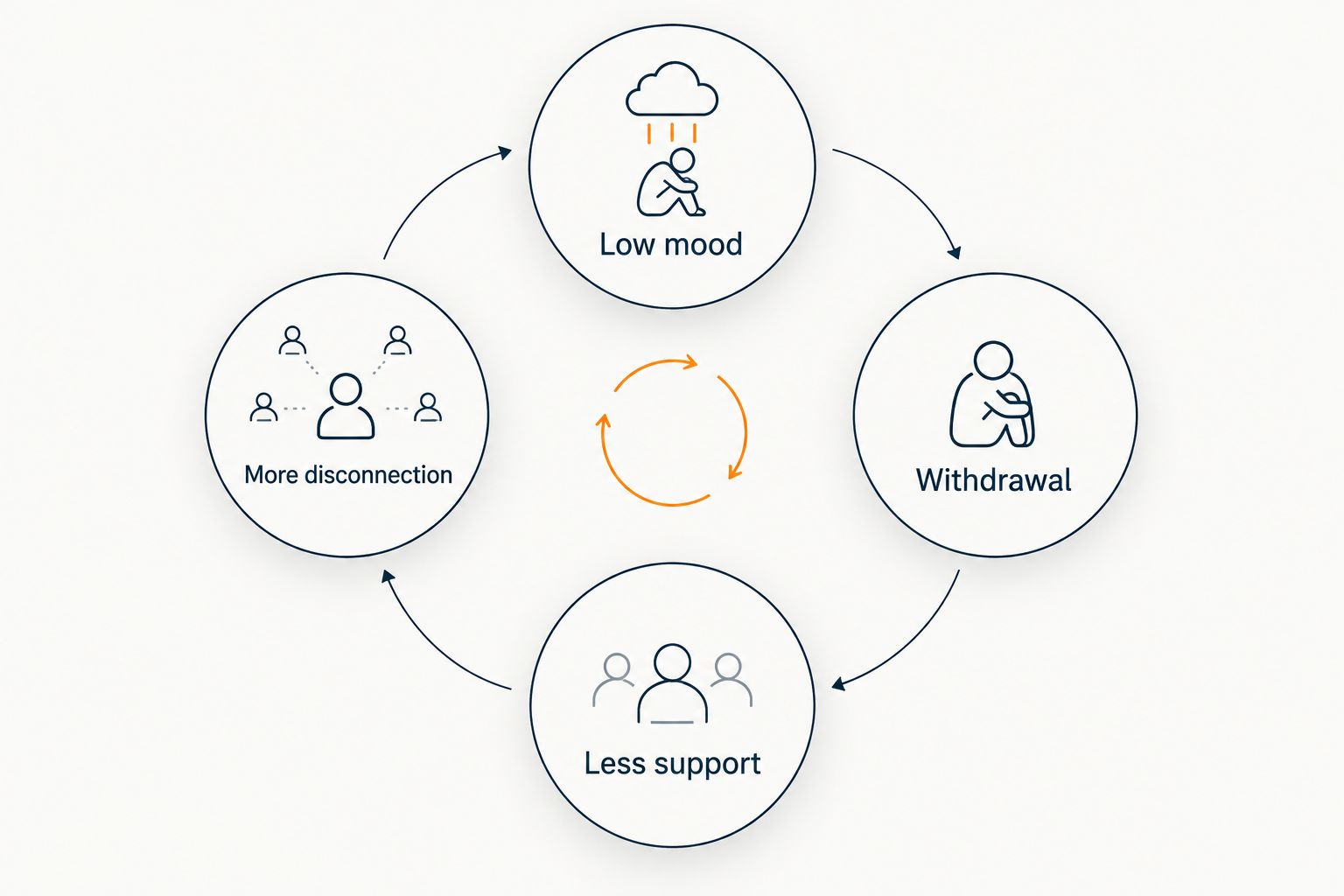 A loop connecting low mood, withdrawal, less support, and more disconnection
You can seek support before you feel ready to socialize.
Why the effect of isolation varies
There is no universal amount of social contact that protects everyone from depression. Your needs and circumstances matter more than matching someone else's calendar. A busy social life is not the same as a supportive one.
- Choice and control: Wanted solitude feels different from being cut off by circumstances you cannot change.
- Relationship quality: Contact with someone who listens offers something different from contact marked by criticism or conflict.
- Existing symptoms: Low energy, anxiety, or loss of interest can make reconnecting harder and deserve attention themselves.
- Practical barriers: Illness, disability, caregiving, transportation problems, and work schedules can restrict opportunities to connect.
- Life changes: Moving, bereavement, retirement, or a relationship ending can disrupt familiar sources of support.
- Available help: Having someone you can contact during a difficult moment differs from having acquaintances you do not feel safe confiding in.
Match the response to the barrier. If transportation keeps you isolated, advice to attend more events misses the problem. If you feel alone in an unhealthy relationship, increasing time together is not automatically the answer.
When does being isolated become a reason to seek help?
Seek a professional assessment when low mood, lost interest, or other symptoms persist, worsen, or interfere with everyday life. You do not need certainty about the cause. A primary care clinician or licensed mental health professional can help assess depression and other explanations.
NIMH describes major depression as involving symptoms most of the day, nearly every day, for at least 2 weeks, with depressed mood or loss of interest among the core symptoms. Clinical criteria also consider at least 5 symptoms, their impact, and other possible causes. Those numbers guide assessment; they are not a self-diagnosis checklist.
Changes to bring up include:
- Feeling sad, empty, hopeless, or unusually irritable.
- Losing interest in activities or people you normally care about.
- Sleeping much more or less than usual.
- Changes in appetite, energy, concentration, or decision-making.
- Struggling with work, household tasks, hygiene, or other responsibilities.
- Feeling worthless or thinking about death or suicide.
Do not wait 2 weeks if symptoms are severe or you feel unsafe. In the United States in 2026, call or text 988 for the Suicide & Crisis Lifeline, available 24 hours a day. If you are in immediate danger or experiencing a medical emergency, call 911 or go to an emergency department.
What can you do when reaching out feels exhausting?
Start with a manageable action, not a demand to become outgoing. The aim is to make support easier to reach. These steps are a starting point, not a treatment plan or a deadline for feeling better.
Name what you need
Ask yourself whether you need company, emotional understanding, practical help, or professional care. Be specific. Wanting someone nearby while you eat dinner is different from needing help arranging a medical appointment.
If everything feels unclear, describe the difficulty rather than solving it first. You can tell someone that you have been withdrawing and do not know what kind of help would feel useful yet.
Choose a low-pressure person or setting
Pick someone who generally treats you with care. A short message or a familiar shared activity can feel more manageable than a crowded gathering. You do not owe anyone a polished explanation.
If you have no safe person to contact, consider a community activity, a moderated peer group, or a healthcare professional. Reconnection does not have to begin with repairing a strained relationship.
Make the request concrete
Ask for an action the other person can understand: a phone call, a walk, company during an errand, or help finding care. A clear request reduces the guesswork. It also lets the other person respond honestly about what they can offer.
For a connection plan in 2026, choose a format you can actually use. A voice call, an accessible online group, or an in-person visit can each serve a purpose; the format matters less than whether the interaction feels supportive.
Notice the effect without grading yourself
Afterward, notice whether you feel more supported, unchanged, or drained. One awkward conversation does not settle whether connection can help. It might tell you to change the person, setting, or level of effort.
Avoid turning reconnection into another performance target. If you keep canceling because you feel exhausted, hopeless, or unable to cope, bring that information to a clinician rather than responding with harsher self-discipline.
Keep clinical care on the plan
Social contact and depression treatment are not competing choices. If symptoms suggest depression, arrange an assessment while taking small steps toward connection. A friend can support you, but a friend cannot be responsible for diagnosing or treating you.
Which kind of support fits your situation?
Choose support by the need it meets, not by how easy it is to access. Everyday companionship, clinical treatment, and digital reflection serve different purposes. None should be presented as interchangeable.
| Support option | Best for | What it offers | Limits |
|---|---|---|---|
| Trusted personal contact | Companionship and practical support | Shared time, listening, and help with everyday tasks | Friends and family are not automatically trained to assess depression |
| Peer support group | Shared experience and belonging | Contact with people facing related challenges | Quality and moderation vary; peer support does not replace clinical care |
| Licensed mental health professional | Assessment and treatment | Clinical evaluation and an individualized care plan | Finding a suitable clinician can involve access and scheduling barriers |
| AI voice support | Nonclinical reflection between human conversations | A place to express feelings and explore coping tools | Cannot provide a human relationship, licensed care, or emergency response |
Lovon is best for people seeking nonclinical voice-based emotional support, not depression treatment or a substitute for human connection. The app offers conversations, coping tools, and self-reflection guidance. Its role is supplementary: use it alongside efforts to reach people and appropriate care, not to make withdrawal easier to maintain.
That distinction matters when choosing mental health support in 2026. A tool that helps you put feelings into words can have a place without being a therapist. If using any app repeatedly delays a needed call, appointment, or conversation, reassess its role.
Can living alone cause depression?
Living alone does not automatically cause depression. Living arrangements do not tell you how connected someone feels, how much support they have, or whether they are experiencing symptoms.
You can live alone and maintain close relationships. You can also live with family or a partner and feel disconnected. Focus on access to meaningful support rather than assuming a shared home is protective by itself.
How long does isolation take to affect your mood?
There is no established countdown after which isolation causes depression. The 2 weeks used in depression assessment refers to symptom duration, not a safe limit for being alone.
Pay attention to changes rather than counting isolated days. If your mood, interest, sleep, or ability to function is declining, seek support even when the isolation is recent.
Is socializing enough to treat depression?
Socializing alone is not a reliable treatment plan for depression. Supportive relationships can help, but depression can require psychotherapy, medication, or both, depending on a clinician's assessment and your circumstances.
If reconnecting does not lift your mood, that is not evidence that you failed. Tell your healthcare professional what you tried and what remains difficult. Keep the connection that feels helpful without making it carry the entire treatment burden.
FAQ
Can isolation cause depression even if I like being alone?
Isolation can contribute to depression, but enjoying solitude does not mean you are depressed. Notice whether alone time feels restorative or whether you are losing interest, withdrawing, or struggling to function.
Can I be lonely even when I see people every day?
Yes, you can feel lonely despite daily social contact. Loneliness concerns the connection you experience, not simply how many people you encounter.
How do I know whether I am lonely or depressed?
Loneliness is feeling disconnected; depression involves a broader pattern of mood, interest, and other symptoms. They can occur together, so persistent symptoms or difficulty functioning deserve professional assessment.
Should I wait 2 weeks before getting help?
No, you do not need to wait 2 weeks to ask for help. Seek support sooner if symptoms are distressing, worsening, interfering with daily life, or affecting your safety.
Does online contact count as social interaction?
Yes, online contact is social interaction. Notice whether your conversations provide mutual attention and support rather than assuming all screen time meets your need for connection.
Can Lovon replace talking to friends or a therapist?
No, Lovon cannot replace human relationships or a licensed therapist. Its AI voice conversations offer supplementary emotional support and reflection, not clinical treatment or crisis care.
What should I do if isolation comes with suicidal thoughts?
In the United States, call or text 988 for immediate crisis support. If you are in immediate danger or have a medical emergency, call 911 or go to an emergency department.
One last thing
Do not make feeling better a requirement for letting someone know you are struggling. You can ask for quiet company, admit that replying is hard, or request help making an appointment. Connection does not have to look cheerful to count.
If you take one step from this 2026 guide, make it a specific request to a safe person or a healthcare professional. You do not need to prove that isolation caused your symptoms before you deserve support.
Related guides
How AI Support Helps You Heal
AI emotional support isn't about replacing human connection — it's about filling the gaps. The moments when you need to talk at 2 AM, when you don't want to burden your friends again, or when you simply need someone to listen without judgment.
Here's what happens in a typical Lovon session:
You share what's on your mind
There's no script, no intake form, no waiting room. You speak or type whatever you're feeling — in your own words, at your own pace.
Lovon validates and explores
Using frameworks from CBT (Cognitive Behavioral Therapy) and motivational interviewing, Lovon acknowledges your feelings first, then gently helps you explore them. No dismissive "just move on" advice.
You build coping skills together
Lovon doesn't just listen — it actively works with you on evidence-based techniques: thought reframing, urge surfing, behavioral experiments, and more.
What a Session with Lovon Looks Like
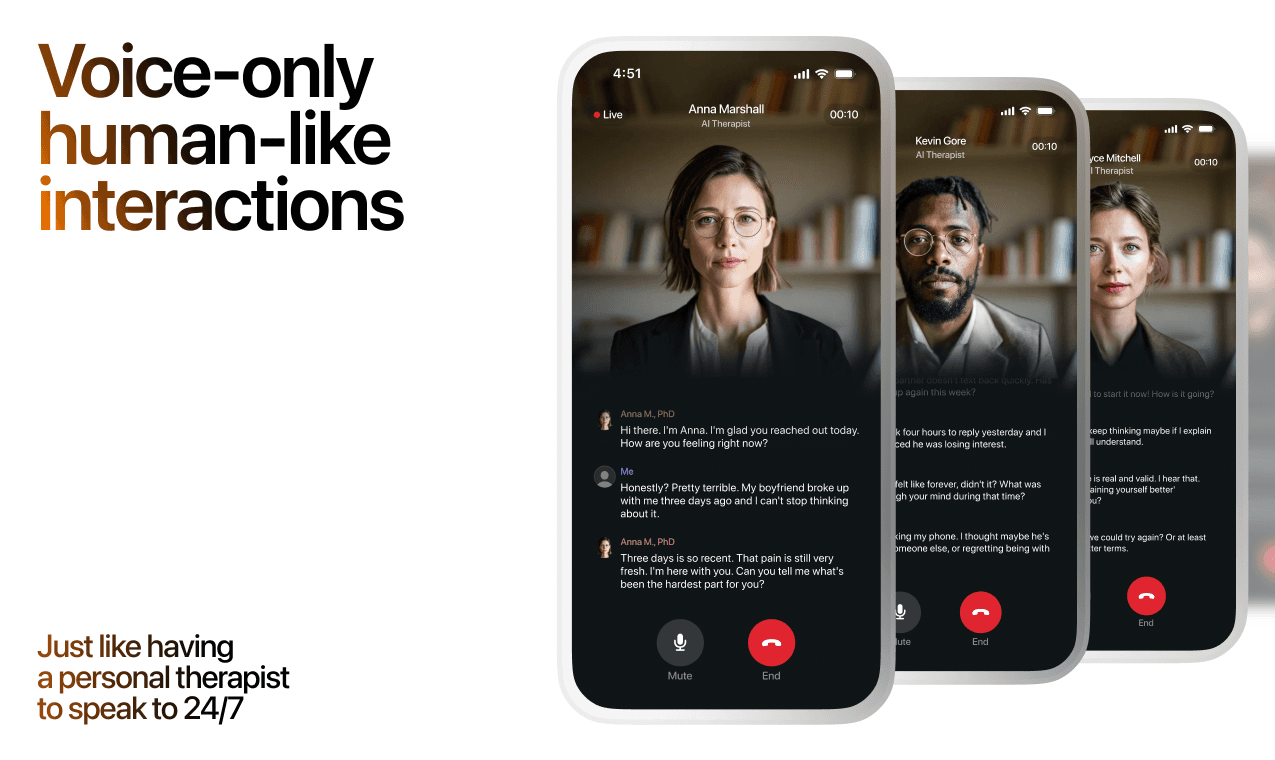
Lovon is AI support, not a replacement for professional care. If things have been hard to get through for weeks, or you are thinking about harming yourself, talk to a doctor or a licensed therapist.
Ready to Start?
Your healing journey can begin right now
A 3-day trial. No judgment. Just a safe space to process what you're going through.
Frequently Asked Questions
Is Lovon a replacement for a real therapist?
Is my conversation with Lovon AI private?
How is Lovon different from ChatGPT for emotional support?
Can I use Lovon if I'm already seeing a therapist?
Can I try Lovon before subscribing?
About the Author
The Lovon Editorial Team
Mental Health & Wellness Content Team
The Lovon Editorial Team develops mental health and wellness content designed to make psychological concepts accessible and actionable. Our goal is to bridge the gap between clinical research and everyday life - helping you understand why your mind works the way it does and what you can do about it....
Related articles
- Mental Health Decline Indicators Through Irritability Changes Appetite Shifts Low Energy Social Isolation Declining Hygiene
Mental health doesn't typically deteriorate overnight. Instead, it sends signals—subtle at first, then increasingly…
- Can financial stress cause a relationship to break down?
Can financial stress cause a relationship to break down? Yes, but separation is not inevitable. Learn how to address…
- Can menopause cause anxiety and panic attacks?
Can menopause cause anxiety and panic attacks? Yes. Learn how hormones and sleep contribute, what treatments help, and…
- Can poor gut health affect your mental health?
Can gut health affect mental health? Yes, but it is not the whole story. Learn what the gut-brain link means, what…
See also
Quizzes
- Empath Test: Do Other People's Moods Become Yours?
See how much of other people's moods you take on.
- Distress Tolerance Test: How Long Can You Sit With It?
See which kind of discomfort makes you need out first.
Free tools
- How to Stop Overthinking in a Relationship
Not a list of habits. Tell it the specific thing you are going round on, and it separates what actually happened from…
- AI Anxiety Coach
This is a free AI anxiety coach you can use on this page. Tell it what you are anxious about, whether it is a thought…
From the wiki
- Why do I feel lonely all of a sudden?
Sudden loneliness usually traces back to something that quietly ended in the last few months: a routine, a shared class…
Disclaimer: This article is for informational purposes only and does not constitute medical advice, diagnosis, or treatment. Always seek the advice of your physician or other qualified health provider with any questions you may have regarding a medical condition. If you are in crisis or think you may have an emergency, call 988 (Suicide & Crisis Lifeline) or go to the nearest emergency room. Outside the US? Find a crisis line in your country.