
Can financial stress cause a relationship to break down?
Can financial stress cause a relationship to break down? Yes, but separation is not inevitable. Learn how to address money conflict, protect trust, and get help.

Key Takeaways
- Can financial stress cause a relationship to break down? Yes, but money problems do not make separation inevitable.
- Money conflict needs practical planning and respectful communication; a budget alone does not repair broken trust.
- Financial anxiety does not excuse threats, humiliation, or controlling a partner’s access to money.
- Lovon offers emotional support for individual reflection, not licensed couples therapy or financial advice.
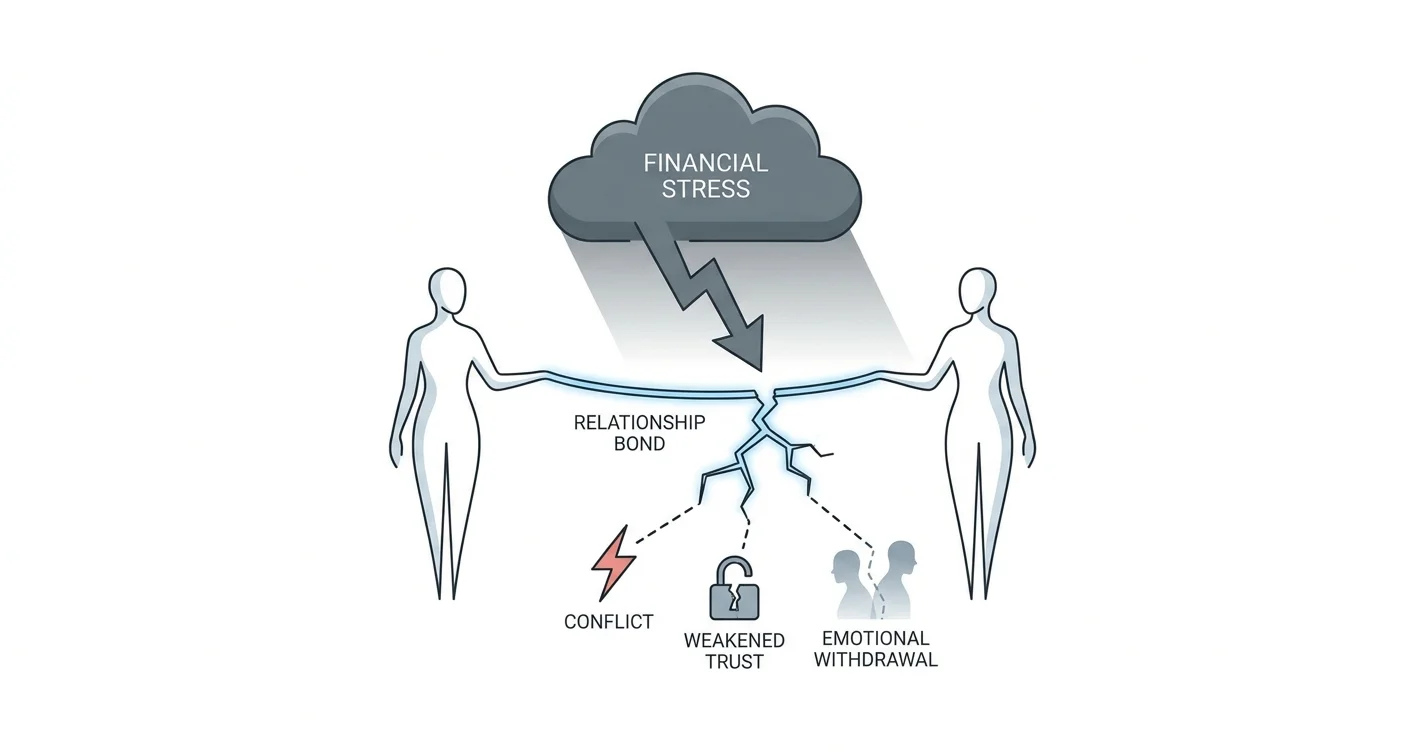
Yes, financial stress can contribute to a relationship breaking down by increasing conflict, weakening trust, and leaving less energy for connection. The damage is not only about unpaid bills; secrecy, blame, and unequal responsibility can turn a money problem into a relationship problem. Financial pressure does not make separation inevitable, and you can work on practical decisions and emotional safety together.
TL;DR
- Can financial stress cause a relationship to break down? Yes, but money problems do not make separation inevitable.
- Money conflict needs practical planning and respectful communication; a budget alone does not repair broken trust.
- Financial anxiety does not excuse threats, humiliation, or controlling a partner’s access to money.
- Lovon offers emotional support for individual reflection, not licensed couples therapy or financial advice.
Can financial stress cause a relationship to break down?
Yes. Financial stress can strain a relationship through repeated arguments, emotional withdrawal, and damaged trust. A disagreement about spending becomes harder to resolve when it turns into a judgment about your partner’s character.
There is no single income level, debt amount, or number of arguments that determines whether a relationship will end. Look at how you treat each other under pressure, whether both people can speak honestly, and whether agreed changes actually happen.
Start by separating these tasks:
- Identify the financial problem. Name the bill, income gap, debt, or decision you need to address.
- Identify the relationship problem. Name the blame, avoidance, secrecy, or unfair workload surrounding it.
- Choose a next step for each. A payment inquiry addresses the bill; an apology and a communication boundary address how you handled it.
For practical conversation guidance, read how to stop fighting about money in a relationship.
Why this matters
You can love someone and still feel frightened, resentful, or alone when money becomes uncertain. Those feelings deserve attention. They are not proof that you have stopped caring or that your relationship is beyond repair.
Financial difficulties also have real material consequences. Emotional coping does not replace housing, food, reliable income, or help with debt, and a calmer conversation cannot create resources that are not there.
For your 2026 household plan, keep both needs visible: what has to happen financially, and what has to change between you. Do not ask a budget to solve disrespect, or ask reassurance to solve an unpaid bill. Each problem needs its own response.
How money stress can damage your connection
Arguments become personal
A discussion about a purchase can shift into accusations about selfishness, competence, or commitment. Once the conversation becomes an attack, the original decision gets lost.
Describe the action and its effect instead of assigning a character flaw. Explain that an unexpected purchase changed the bill plan, then ask how you will handle similar decisions together.
Avoidance leaves one partner carrying the worry
Ignoring account statements or refusing to discuss money leaves practical decisions unresolved. If you become responsible for every reminder and difficult call, frustration can build around the workload as well as the finances.
Taking a pause is different from refusing to return. Agree on when you will revisit the issue and who will bring the information you need.
Secrecy damages trust
Hidden debt, undisclosed spending, or misleading information creates a trust problem alongside the financial one. You cannot make a shared plan using information that is deliberately incomplete.
If you hid something, acknowledge the choice without blaming your partner’s reaction. If you were misled, you do not have to offer immediate forgiveness to prove that you want repair.
Connection gets pushed aside
When every conversation concerns bills, you can begin to experience your partner mainly as another source of pressure. Affection, curiosity, and ordinary companionship get less attention.
Protect some contact that is not a financial meeting. A walk or an uninterrupted conversation will not remove debt, but it gives you space to relate as people rather than only as problem-solvers.
Why financial stress affects relationships differently
The same practical difficulty does not create the same relationship experience for everyone. Use these factors to understand your situation, not to assign blame:
- Financial visibility: Can both partners understand the obligations and decisions that affect them?
- Responsibility: Does one person carry all the planning, reminders, and worry?
- Trust: Are both people honest about relevant spending, debt, and commitments?
- Communication: Can you disagree without insults, threats, or punishment?
- Shared priorities: Have you discussed what security, independence, and fairness mean to each of you?
- Access to help: Do you need practical financial guidance, emotional support, or protection from controlling behavior?
These are conversation prompts, not a relationship score. A serious safety concern matters more than how many other areas seem manageable.
How to talk about money without making the fight worse
Use this sequence for a 2026 money conversation when both people can participate safely. It is a suggested structure, not a treatment or a guarantee that your partner will respond well.
1. Check safety
Before discussing accounts or spending, ask whether you can disagree without fear. If your partner threatens you, monitors you, or punishes questions about money, skip the joint conversation and seek confidential support.
You do not need to make a difficult topic sound gentler to earn basic safety. A communication exercise is not a solution to coercion.
2. Name the issue
Choose a specific decision rather than opening with everything that has gone wrong. Bring the relevant information and distinguish what you know from what you still need to confirm.
Stay with the current issue. An overdue bill does not require a verdict on every financial choice either person has ever made.
3. Share the feeling
Explain what the situation brings up for you: fear about housing, embarrassment about debt, or resentment about carrying the planning alone. Present the feeling as your experience, not as proof of your partner’s intention.
Ask what the situation means to your partner, too. Understanding their fear does not require agreeing with their behavior.
4. Choose an action
Make the next step concrete: gather the statements, ask a creditor about options, review upcoming obligations, or arrange professional guidance. Decide who will do it and when you will check back.
Avoid promises that neither person can reasonably keep. An honest account of what you can do is more useful than reassurance offered just to end the conversation.
5. Review together
Return to the practical action and the way you spoke to each other. Did the task happen, and did both people have room to ask questions?
If the discussion becomes insulting or overwhelming, pause and agree on a return point when safe. Do not use the pause to punish your partner or avoid the issue indefinitely.
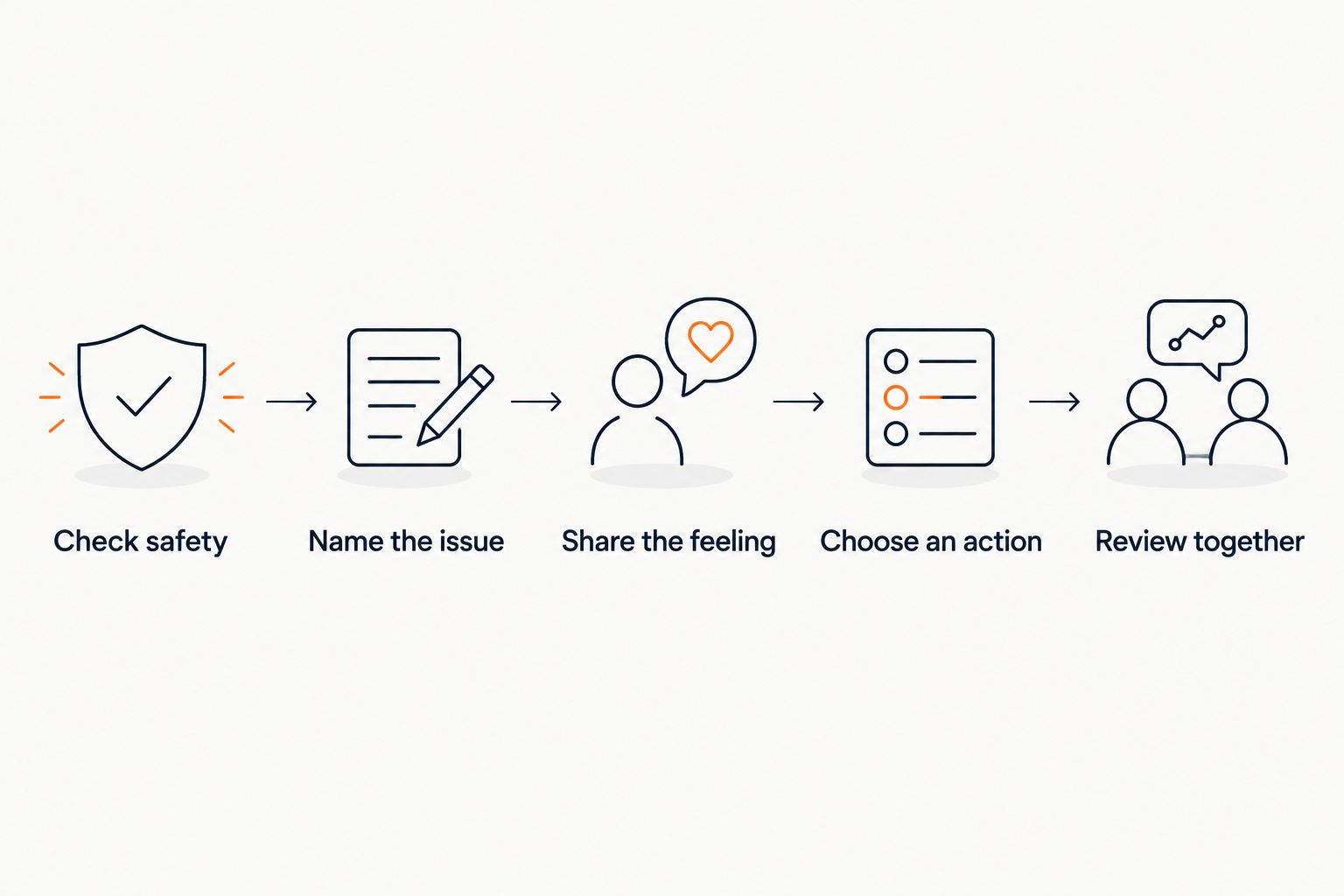 A conversation sequence from checking safety to reviewing a shared action
Check safety before trying to solve a money disagreement together.
What if your money priorities do not match?
You might associate saving with safety while your partner associates spending with freedom or connection. Neither preference automatically makes someone irresponsible. The important question is whether you can agree on decisions that affect both people.
Discuss the meaning before debating the rule. Ask what each person fears losing, which obligations need protection, and which choices should remain individual.
Fairness also needs context. An equal split does not automatically reflect differences in income, caregiving, health, or unpaid household work, so discuss the arrangement rather than treating one formula as universally right.
If you repeatedly agree in conversation but act differently afterward, address that gap directly. A shared priority is not established simply because both people said yes during an argument.
When money conflict becomes a safety concern
Financial abuse involves using money or access to resources to control another person. Warning signs include taking your earnings, preventing you from working, forcing debt in your name, or withholding necessities to punish you.
Stress does not excuse financial abuse. A partner can feel anxious about money without having the right to intimidate you or remove your autonomy.
If these behaviors are present, seek individual, confidential support rather than relying on a joint budgeting exercise. The National Domestic Violence Hotline provides U.S. support for people experiencing relationship abuse, including financial abuse. Use a safer device if you believe your activity is monitored.
For a 2026 safety plan, prioritize support you can access without increasing danger. Avoid confronting a controlling partner alone if you fear retaliation, and do not make sudden changes to shared finances without considering safety and relevant legal guidance.
If you are in immediate danger, contact emergency services. If you have thoughts of suicide or feel unable to stay safe, contact the U.S. 988 Suicide & Crisis Lifeline by calling or texting 988.
Which kind of support fits your situation in 2026?
Choose support for the problem you actually need help with. Emotional reflection, couples therapy, financial guidance, and abuse support serve different purposes; none should be presented as interchangeable.
| Support | Best for | What it offers | Limit to understand |
|---|---|---|---|
| Lovon | Individual reflection on everyday financial stress | Voice conversations, emotional support, coping tools, and self-reflection guidance | Not a licensed clinician, financial adviser, or replacement for clinical care |
| Licensed couples therapist | Repeated conflict when both partners can participate safely | Professional help examining communication and relationship patterns | Does not manage your accounts; joint work requires attention to safety |
| Qualified financial counselor | Understanding debt and practical financial choices | Guidance focused on financial obligations and possible next steps | Does not replace relationship therapy or mental health care |
| Domestic abuse advocate | Financial control, intimidation, or fear | Support focused on safety and access to resources | Does not substitute for emergency services or individualized legal advice |
Lovon is best for individuals seeking voice-based emotional support and self-reflection around everyday money stress, not clinical treatment. That role fits preparation: naming your feelings before a difficult conversation rather than asking an app to decide who is right.
Lovon’s voice support does not replace a licensed clinician or resolve the financial problem itself. If distress disrupts daily life, seek professional assessment rather than relying on an app alone.
Can a relationship recover from financial stress?
Yes, a relationship can recover from financial stress when both partners participate in practical problem-solving and respectful repair. Recovery does not require pretending the strain never happened.
Look for actions you can observe: honest information, completed tasks, fewer personal attacks, and willingness to revisit an agreement. Promises matter less when the same harmful behavior keeps repeating.
Should I leave my partner because of money problems?
Money problems alone do not determine whether you should leave. Consider safety, trust, accountability, and whether both people are willing to address the situation.
You are not required to stay through threats, coercion, or repeated deception. If separation would affect housing, children, or shared obligations, seek individualized legal and practical guidance before making commitments.
Is earning more money enough to fix the relationship?
More income can ease a financial shortfall, but it does not automatically repair secrecy, contempt, or unequal responsibility. Those patterns need attention even if the bills become easier to cover.
Ask what would remain difficult if the immediate money pressure disappeared. Your answer helps separate a resource problem from a relationship pattern.
FAQ
Can financial stress make me feel less connected to my partner?
Yes, financial stress can leave you feeling less connected when worry, arguments, and practical demands take over. That feeling alone does not prove the relationship is over; examine how you treat each other and whether both people want to repair the connection.
How do I bring up money without blaming my partner?
Start with a specific financial issue and explain its effect on you without attacking your partner’s character. Ask for a concrete next step and give your partner room to describe their concerns.
What if my partner refuses to talk about finances?
Ask for a specific time to discuss a specific decision rather than continuing an unproductive argument. Repeated refusal to share information that affects you is a relationship concern, especially if it comes with intimidation or control.
Is hiding debt a relationship problem or a money problem?
Hiding debt that affects shared decisions is both a financial problem and a trust problem. Repair requires accurate information and accountability, not only a plan for the debt.
Is couples therapy the right choice for money fights?
Licensed couples therapy is an option for repeated money conflict when both partners can participate safely. If you fear retaliation or experience financial control, seek confidential individual support first.
Can Lovon help me cope with financial anxiety?
Lovon offers voice-based emotional support, coping tools, and self-reflection guidance for everyday stress. It is not a licensed clinician or financial adviser and does not replace clinical care.
What should we put in a relationship money plan for 2026?
A relationship money plan for 2026 should identify current obligations, who handles each task, and when you will review decisions together. Include expectations for honesty and respectful communication, not just financial tasks.
One last thing
Before your next money conversation, write down what needs solving and what needs repairing. Keep the distinction clear.
An unexpected expense might need a practical plan. A humiliating comment needs acknowledgment and a change in behavior; solving the expense does not cancel the hurt.
You can take financial pressure seriously without treating each other as the enemy. Start with an action you can carry out and a boundary you can uphold. If your partner will not respect that boundary, treat the refusal as information rather than another communication task for you to perfect.
Related guides
How AI Support Helps You Heal
AI emotional support isn't about replacing human connection — it's about filling the gaps. The moments when you need to talk at 2 AM, when you don't want to burden your friends again, or when you simply need someone to listen without judgment.
Here's what happens in a typical Lovon session:
You share what's on your mind
There's no script, no intake form, no waiting room. You speak or type whatever you're feeling — in your own words, at your own pace.
Lovon validates and explores
Using frameworks from CBT (Cognitive Behavioral Therapy) and motivational interviewing, Lovon acknowledges your feelings first, then gently helps you explore them. No dismissive "just move on" advice.
You build coping skills together
Lovon doesn't just listen — it actively works with you on evidence-based techniques: thought reframing, urge surfing, behavioral experiments, and more.
What a Session with Lovon Looks Like

When to Seek Professional Help
AI support is a valuable tool, but it's not a replacement for professional care. Please consider reaching out to a licensed therapist if you experience any of the following:
- Persistent thoughts of self-harm or suicide
- Inability to perform daily activities (work, eating, sleeping) for more than 2 weeks
- Turning to alcohol or substances to cope
- Intense anger or desire to harm your ex-partner
- Complete emotional numbness that doesn't improve over time
Crisis Resources (US): If you're in immediate danger, call 988 (Suicide & Crisis Lifeline) or text HOME to 741741 (Crisis Text Line). Available 24/7, free, and confidential.
Outside the US? Find a crisis line in your country
Ready to Start?
Your healing journey can begin right now
A 7-day trial. No judgment. Just a safe space to process what you're going through.
Frequently Asked Questions
Is Lovon a replacement for a real therapist?
Is my conversation with Lovon AI private?
How is Lovon different from ChatGPT for emotional support?
Can I use Lovon if I'm already seeing a therapist?
Can I try Lovon before subscribing?
About the Author

The Lovon Editorial Team
Mental Health & Wellness Content Team
The Lovon Editorial Team develops mental health and wellness content designed to make psychological concepts accessible and actionable. Our goal is to bridge the gap between clinical research and everyday life - helping you understand why your mind works the way it does and what you can do about it....
Related articles
- Rumination and Depression: How to Break the Loop (2026)
Rumination and depression fuel each other. These 8 evidence-based steps interrupt the cycle, reduce repetitive negative…
- AI Therapy App for Financial Anxiety: 2026 Verdict
The best ai therapy app for financial anxiety in 2026 pairs 24/7 voice sessions with real coping tools. See the picks…
- Can ADHD be managed without medication?
Can ADHD be managed without medication? Yes, for some adults. Learn which therapy, routines, and supports help, where…
- Is it safe to share your feelings with an AI therapist?
Is it safe to share feelings with an AI therapist in 2026? Yes for daily stress and anxiety, not for crisis. See the…
See also
Quizzes
- Overfunctioning in Relationship Test: 12 Questions
See how far the load has tilted, in 3 minutes.
- Toxic Femininity Test: Are You Running an Old Script?
See which learned script is running your relationship.
Free tools
- Words of Encouragement for Him When He Is Struggling
Words of encouragement for him that fit what he is actually going through, for when your usual lines are not landing…
- 5-4-3-2-1 Grounding Exercise
A guided run through the 5-4-3-2-1 technique, with paced breathing first if you need it. No sign-up, nothing stored…
From the wiki
- Why do I feel sad when I'm alone?
Being alone does not create the sadness. It removes the noise that was keeping it out of earshot, so whatever queued up…
Disclaimer: This article is for informational purposes only and does not constitute medical advice, diagnosis, or treatment. Always seek the advice of your physician or other qualified health provider with any questions you may have regarding a medical condition. If you are in crisis or think you may have an emergency, call 988 (Suicide & Crisis Lifeline) or go to the nearest emergency room. Outside the US? Find a crisis line in your country.