
End of Year Reflection Questions: 60 to Close Out 2026
End of year reflection questions in three passes: what happened, what it taught you, and what to carry into 2027, plus resolution ideas that tend to stick.

Key Takeaways
- A year-end reflection works best in three passes: what actually happened, what it taught you, and one or two things to carry forward.
- Look at evidence before memory: your calendar, photos and mood log are more honest than how the year feels in late December.
- Resolutions framed as something to start tend to last longer than ones framed as something to stop, and any fresh start date works, not only January 1.
End of year reflection works best as three short passes: look back at what actually happened, notice what it taught you, and choose one or two things to carry into the new year. The 60 questions below are grouped that way. Set aside 30 to 60 minutes, answer the ones that catch you, skip the rest, and keep your answers somewhere you can find next December.
Short on time? Answer these ten:
- What were the three biggest things that happened to me this year?
- What am I proudest of?
- What was the hardest part, and what got me through it?
- Who mattered most this year?
- What drained me most?
- What gave me energy?
- When did I feel most like myself?
- What do I want to leave behind in this year?
- What do I want more of next year?
- What is one thing I will start in January?
If you would rather answer with room to write, the journal prompts tool gives you reflection prompts picked for your mood and topic with a space to type underneath, so you can work through a few each evening instead of all at once.
Before you start: gather the facts
Memory is a poor narrator of a whole year. The last two months and the most dramatic moments crowd out everything else, so December can make a decent year feel bad or a hard year feel blank. Spend ten minutes on evidence first:
- Scroll your calendar month by month. Note trips, milestones, hard weeks and the people you saw.
- Scroll your photos. You will remember things you had forgotten you did.
- Look at any mood or journal records. If you used the mood tracker, its year in pixels shows the shape of your year at a glance: the good stretches, the low ones and when they happened.
- Jot one line per month. Twelve lines is enough to see the year whole.
Looking back: questions about the year
- What were the three biggest things that happened to me this year?
- What surprised me?
- What did I start that I am glad I started?
- What did I finish?
- What am I proudest of, including things nobody else saw?
- What was the hardest part of the year?
- What got me through it?
- What did I spend the most time on, and was it worth it?
- What is a small moment I want to remember?
- Where did I go, and which place stayed with me?
- What did I learn how to do?
- If this year had a title, what would it be?
Feelings and wellbeing
- How did I feel most of the time this year, in one or two words?
- When was I happiest?
- When was I lowest, and what was going on?
- How did I sleep, on the whole?
- What helped me feel better when things were hard?
- What did I do too much of?
- What did I do too little of?
- How kind was I to myself this year, honestly?
If question 13 is hard, the feelings wheel gets you past "fine" and "tired." If your honest answer is that you have felt low or worn out most of the year, that is worth acting on: the CORE-10 check puts a number on psychological distress, and the burnout test shows whether exhaustion has spread across work and energy.
Relationships
- Who did I feel closest to this year?
- Who did I lose touch with, and do I want to reconnect?
- Who showed up for me when it counted?
- Who did I show up for?
- Which relationship took more than it gave?
- What conversation have I been putting off?
- What did I learn about what I need from people?
- Who do I want to thank before the year ends?
If question 25 or 26 lands, the family boundary plan helps you decide what to say and what you will do if the other person pushes back.
Work and energy
- What part of my work did I enjoy most?
- What part drained me most?
- What did I achieve that I have not given myself credit for?
- Where did I say yes when I wanted to say no?
- Did I take real time off?
- What skill grew the most?
- What would I change about how I work, if I could change one thing?
- Is this work still taking me where I want to go?
The energy audit maps what drains and what charges you across a typical week, which turns questions 29 and 30 into something you can plan around.
Letting go
- What am I still carrying from this year that I want to put down?
- What mistake do I need to forgive myself for?
- Is there someone I need to forgive, or stop waiting on?
- What did I hold on to longer than I should have?
- What worry turned out not to matter?
- What can I stop pretending about?
Writing what you are letting go of on paper, then deciding what to do with it, helps. A brain dump sorts it into do, schedule and let go, which makes the let-go pile visible.
Looking ahead: new year reflection questions
- What do I want next year to feel like?
- What is one habit that would make the biggest difference?
- What will I say no to more often?
- Who do I want to see more of?
- What is one thing I want to learn?
- What is one thing I want to stop putting off?
- What do I need more of: rest, fun, people, challenge or quiet?
- What would a really good ordinary Tuesday look like?
- What is one risk I want to take?
- How will I know, in June, that the year is going well?
If question 49 stumps you, the wheel of life scores eight areas of your life so you can see which one most needs attention, and pick it as your focus for the year.
Year in review questions for couples and friends
Doing this with a partner or a close friend adds things you would never see alone. Take turns answering:
- What was our best day together this year?
- What was hardest for us, and how did we handle it?
- When did you feel most supported by me?
- When did you need more from me?
- What is something new we did together?
- What do you want us to do more of next year?
- What is one tradition we should start?
- What are you looking forward to, for us?
The couples check-in turns this into a weekly habit for two on one phone, so next December you have a record to look back on.
Turning reflection into New Year resolutions that last
Resolutions have a bad reputation, but the evidence is more encouraging than the jokes. In one study that followed people for six months, 46 percent of those who made New Year resolutions were still succeeding, compared with 4 percent of people who wanted to make a similar change but did not make a resolution.[1] The outcomes were self-reported, but the gap is large.
How you phrase the goal matters. In an experiment with 1,066 people, 55 percent of those who responded at the one-year follow-up considered themselves successful. Goals framed as something to start or move toward succeeded more often than goals framed as something to stop or avoid: 58.9 percent versus 47.1 percent.[2] In everyday terms, "eat fruit with breakfast" tends to beat "stop eating sweets."
And January 1 is not the only start date. Researchers found that people are more likely to act on goals right after any "temporal landmark": the start of a new week, month or semester, a birthday or a holiday. They called it the fresh start effect.[3] If your resolution slips in February, March 1 is a perfectly good restart.
Write it as a start, not a stop
"Go to bed by 11 on weeknights" instead of "stop staying up late." "Call Mom on Sundays" instead of "stop neglecting family."
Make it small and specific
Say when, where and how often. "Walk outside for 15 minutes before work, Monday, Wednesday and Friday" can be kept. "Be healthier" cannot.
Pick one or two, not ten
Your reflection will surface many things. Choose the one or two that would change the most and let the rest wait.
Plan your first restart now
Put the first day of every month in your calendar as a check-in date. When a resolution slips, that is your fresh start.
New Year resolution ideas, framed to stick
- Walk outside within an hour of waking, three mornings a week.
- Go to bed by a set time on weeknights.
- Call or see one friend every week.
- Cook one new recipe every Sunday.
- Read for 15 minutes before sleep instead of scrolling.
- Do a 60-second mental health check-in every morning.
- Write three good things in a gratitude journal each night.
- Take one full day off screens each month.
- Plan one thing to look forward to every month.
- Say one honest "no" a week.
- Try one new class, club or hobby by March.
- Have one real check-in conversation with your partner each week.
If this year was hard
Not every year is one to celebrate. After a loss, a breakup, an illness or a year of just getting through, the usual questions about achievements can feel cruel. Use gentler ones: What got me through? Who showed up? What am I still carrying? What do I need now? You do not have to find a lesson in what happened.
If the holidays make it heavier, holiday stress covers grief and loneliness in the season, and our grief guide goes further. If low mood has lasted weeks at a time, consider making "talk to a doctor or a licensed therapist" your first resolution.
Track it: make next December easier
The hardest part of a year-end review is remembering the year. Make it easy for future you:
- Log your mood daily in the mood tracker. Next December, your year in pixels does half the reflecting for you.
- Do a ten-minute review on the first of each month. Three questions: What happened? What did I learn? What do I want next month?
- Save this year's answers with a date. Rereading them next year is often the most interesting part.
Sometimes a year is easier to make sense of out loud than on paper, especially one that went sideways. Tell Lovon, an AI coach you talk to by voice, what this year was really like, and find the one thing you want to carry into the next.
How AI Support Helps You Heal
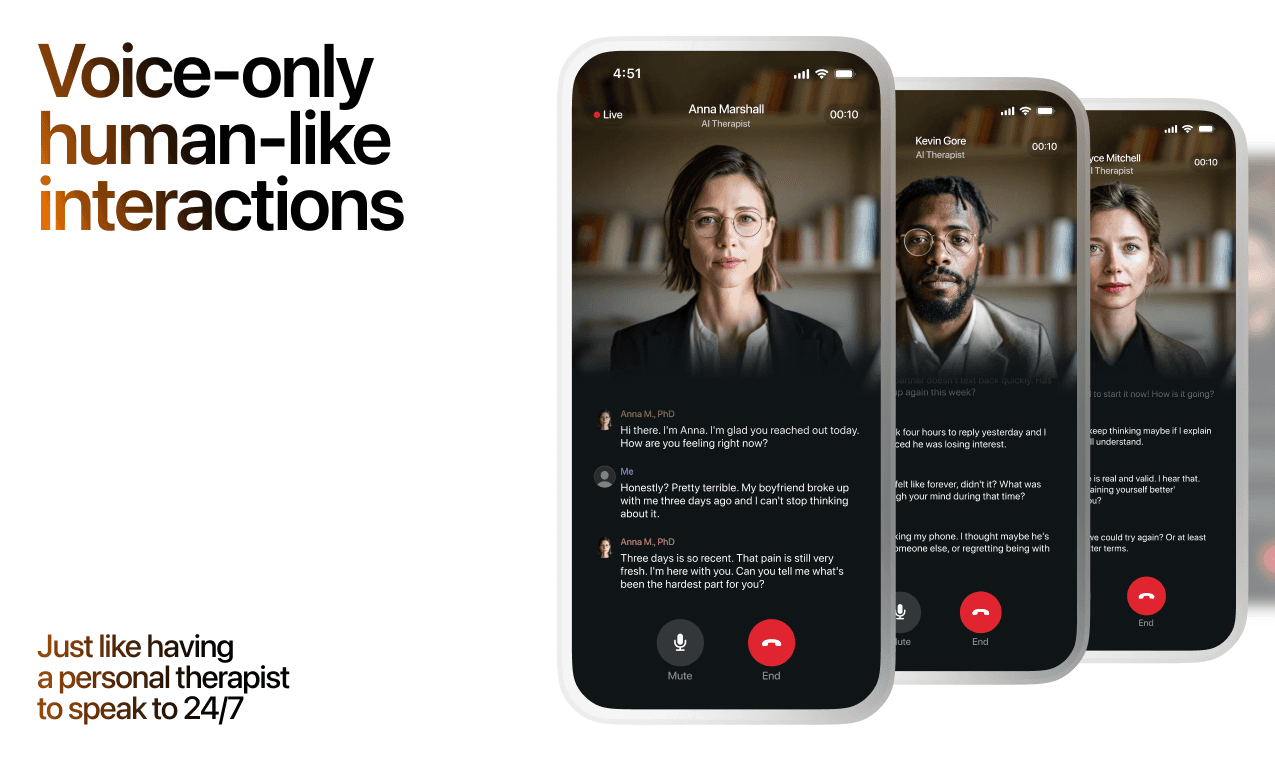
AI emotional support isn't about replacing human connection — it's about filling the gaps. The moments when you need to talk at 2 AM, when you don't want to burden your friends again, or when you simply need someone to listen without judgment.
Here's what happens in a typical Lovon session:
You share what's on your mind
There's no script, no intake form, no waiting room. You speak or type whatever you're feeling — in your own words, at your own pace.
Lovon validates and explores
Using frameworks from CBT (Cognitive Behavioral Therapy) and motivational interviewing, Lovon acknowledges your feelings first, then gently helps you explore them. No dismissive "just move on" advice.
You build coping skills together
Lovon doesn't just listen — it actively works with you on evidence-based techniques: thought reframing, urge surfing, behavioral experiments, and more.
What a Session with Lovon Looks Like
Lovon is AI support, not a replacement for professional care. If things have been hard to get through for weeks, or you are thinking about harming yourself, talk to a doctor or a licensed therapist.
Ready to Start?
Your healing journey can begin right now
A 3-day trial. No judgment. Just a safe space to process what you're going through.
Frequently Asked Questions
What are good end of year reflection questions?
How do you do a year in review for yourself?
What should I reflect on at the end of the year?
What are good new year reflection questions?
Do New Year resolutions actually work?
What are some good New Year resolution ideas?
How do I reflect on a hard year?
Sources
About the Author
The Lovon Editorial Team
Mental Health & Wellness Content Team
The Lovon Editorial Team develops mental health and wellness content designed to make psychological concepts accessible and actionable. Our goal is to bridge the gap between clinical research and everyday life - helping you understand why your mind works the way it does and what you can do about it....
Related articles
- How to Break a Trauma Response Cycle (2026 Guide)
Learn how to break a trauma response cycle with 7 concrete steps, troubleshooting fixes, and where AI voice therapy fits…
- What Is a Good HRV? Normal HRV by Age and Device
What is a good HRV? Normal HRV by age from large studies and WHOOP data, why Apple and Garmin numbers differ, and how to…
- How to Stop Comparing Yourself to Others, Online and Off
How to stop comparing yourself to others: a one-minute reset, how to fix your feed, and what to do about friends, work…
- Self-Care Ideas: 70 That Actually Help, Plus a Checklist
70 self care ideas sorted by what you are running low on, a printable self care checklist for every day and week, and…
See also
Quizzes
- Digital Stress Test: Texting, Likes and Read Receipts
See which part of being online wears on you, in 3 minutes.
- Defense Mechanisms Test: Which Ones Do You Use Most?
See what your defenses do with hard feelings, in 3 minutes.
Free tools
- Stress Level Test
How stressed have you been lately? Ten quick statements about the last two weeks give you a score, show where stress is…
- How to Stop Overthinking in a Relationship
Not a list of habits. Tell it the specific thing you are going round on, and it separates what actually happened from…
From the wiki
- Why do I keep dreaming about the same person?
A recurring dream figure usually marks unfinished emotional business rather than a message about that person. Your brain…
Disclaimer: This article is for informational purposes only and does not constitute medical advice, diagnosis, or treatment. Always seek the advice of your physician or other qualified health provider with any questions you may have regarding a medical condition. If you are in crisis or think you may have an emergency, call 988 (Suicide & Crisis Lifeline) or go to the nearest emergency room. Outside the US? Find a crisis line in your country.