
What Is a Good HRV? Normal HRV by Age and Device
What is a good HRV? Normal HRV by age from large studies and WHOOP data, why Apple and Garmin numbers differ, and how to judge your own baseline.

Key Takeaways
- A good HRV is one that holds steady or rises against your own baseline over weeks. There is no single healthy number that fits everyone.
- HRV falls with age: in a German study of 1,906 healthy adults, average RMSSD was about 40 to 43 ms at ages 25 to 34 and about 19 ms at 65 to 74.
- Only compare readings from the same device, the same metric and the same time of night, because Apple Watch reports SDNN while WHOOP and Garmin report RMSSD.
A good HRV is one that is normal for you and holds steady or rises against your own baseline over weeks. There is no single healthy number, because heart rate variability falls with age and differs between devices. As a rough guide, the middle half of 25-year-olds in WHOOP's member data sit at about 45 to 100 ms overnight, and 45-year-olds at about 30 to 60 ms.
Here is what a careful lab study found for average HRV by age. These are means from 1,906 healthy adults in Germany, measured with a 5-minute ECG while lying down after a rest,[2] so they run lower than the overnight averages most wearables show:
| Age | RMSSD, women | RMSSD, men | SDNN, women | SDNN, men |
|---|---|---|---|---|
| 25 to 34 | 43 ms | 40 ms | 49 ms | 50 ms |
| 35 to 44 | 35 ms | 32 ms | 45 ms | 45 ms |
| 45 to 54 | 26 ms | 23 ms | 37 ms | 37 ms |
| 55 to 64 | 21 ms | 20 ms | 31 ms | 33 ms |
| 65 to 74 | 19 ms | 19 ms | 28 ms | 30 ms |
To see where your own reading lands, use the HRV by Age tool. It asks for your age, your device and your number, tells you whether your device reports RMSSD or SDNN, and places your reading against published age-based reference values, so you are not judging an Apple Watch number against a chart built for a ring.
Wearable data runs higher than the lab table. Across WHOOP members, the average overnight HRV is 65 ms for men and 62 ms for women. The middle half of 25-year-old men sit at about 50 to 100 ms, falling to about 35 to 60 ms at 45, and women of the same ages sit at about 45 to 90 and 30 to 55 (WHOOP member data).
What HRV actually measures
Your heart does not beat like a metronome. At 60 beats a minute, some beats come slightly less than a second apart and others slightly more. HRV is how much those gaps vary, measured in milliseconds. That variation is steered by your autonomic nervous system: higher HRV generally reflects more rest-and-digest (parasympathetic) influence, and lower HRV reflects more fight-or-flight (sympathetic) activity, as Garmin's HRV guide puts it. If the stress side of that system is new to you, the fight or flight response explains what it does in the body.
Two calculations show up on consumer devices:
- RMSSD (root mean square of successive differences) looks at how much each gap differs from the next one. WHOOP and Garmin report RMSSD, averaged across your sleep.
- SDNN (standard deviation of normal-to-normal intervals) looks at how spread out the gaps are across the whole reading. Apple Watch calculates HRV as SDNN from short readings it takes in the background when you are still, by default about every four hours, according to Apple's heart rate white paper.
These are different numbers. An Apple Watch SDNN of 45 and a WHOOP RMSSD of 45 do not mean the same thing. The length and timing of the reading matter too: researchers warn that norms from 24-hour, 5-minute and shorter recordings are not interchangeable.[3] If you wear an Apple Watch, does Apple Watch track stress covers how its HRV readings work in more detail.
What is a normal HRV by age?
The clearest pattern in every dataset is that HRV falls with age. The largest study to date pulled readings from more than 8.2 million Fitbit users and found that HRV dropped fastest between ages 20 and 40 and more slowly after that. It also found a strong daily rhythm, with HRV peaking between about 5 and 8 am and bottoming out in the late evening. At 6 to 7 am, women aged 40 to 41 averaged roughly 38 to 43 ms of RMSSD, depending on the Fitbit model.[1]
The German lab study shows the same slide decade by decade, and it found that the differences between men and women faded in the oldest age groups.[2]
The other thing these datasets show is how wide "normal" is. In the lab study, the spread around each average is roughly half the average itself: women aged 25 to 34 averaged 42.9 ms of RMSSD, give or take 22.8 ms.[2] Two healthy 30-year-olds can sit at 20 ms and 65 ms. Oura's HRV guide says typical values run from under 20 to over 200 milliseconds, and WHOOP notes that the most common overnight HRV among its members is about 40 ms for men and 37 ms for women, below the averages, because a small group with very high HRV pulls the averages up.
So what counts as a good HRV for you?
A good HRV is a stable one that sits inside or a little above your own usual range. Population charts tell you whether your number is unusual for your age. Your own history tells you whether today is unusual for you, and that is the question that matters day to day.
Garmin's approach is a useful model even if you wear something else. It needs about three weeks of overnight readings to set your personal baseline range (for example, 33 to 45 ms), then checks your 7-day average against it. A 7-day average inside your range is "balanced"; outside it is "unbalanced"; well below it is "low"; and if your whole baseline drops below age-based standards, Garmin calls it "poor."
Here is how to read your own number:
| What you see | What it usually means | What to do |
|---|---|---|
| Inside your usual range | Normal day-to-day variation | Nothing |
| One low morning after a late night, drinks or a hard workout | An expected dip | Keep the day lighter and sleep well tonight |
| 7-day average sliding below your range for a week or two | Strain is building | Read low HRV and look at sleep, stress and training |
| 7-day average rising over months | Fitness and recovery improving | Keep doing what you are doing |
| Far above your usual range while you feel worn out | Possible overreaching | Back off training for a few days |
| Erratic, very high readings with irregular rhythm alerts | Irregular beats can distort HRV | See a doctor |
Is higher HRV always better?
Mostly, but not always. Higher HRV is generally linked with fitness and good recovery, and across the Fitbit data more daily steps went with higher HRV, though the authors stress that this is a correlation, not proof that steps cause it.[1] Two exceptions are worth knowing.
First, Garmin notes that HRV far above your personal baseline has been linked to functional overreaching, especially when training involves large amounts of low-intensity exercise. A sudden jump while you feel exhausted is not a reason to celebrate.
Second, irregular heartbeats can push the number up. Apple says SDNN may be influenced by non-normal beats when there are many of them, and the Fitbit study notes that RMSSD is sensitive to erratic beats.[1] A surprisingly high HRV next to an irregular rhythm notification is a reason to see a doctor, not a fitness win.
If you want to move a low number up the safe way, how to improve HRV covers sleep timing, alcohol, breathing and training.
How each device reports HRV
| Device | What it reports | When it measures | Read more |
|---|---|---|---|
| Apple Watch | SDNN | Short readings while you are still, day and night | Apple Watch and stress |
| Garmin | RMSSD, nightly average and 7-day average | Throughout sleep in 5-minute windows | Garmin stress score |
| Oura | Nightly average of 5-minute samples | During sleep only | Oura readiness score |
| WHOOP | RMSSD, weighted toward deep sleep | During sleep | WHOOP recovery score |
Most devices fold HRV into a bigger score, such as Garmin's Body Battery, Oura's Readiness or WHOOP's Recovery. The Stress Score Checker explains what those combined numbers mean when you are not sure how much of the score is your HRV.
Track it
One HRV reading tells you very little. A few weeks of readings, next to a note about your life, tell you a lot. A simple routine:
- Use one number from one device. The overnight or morning average is the most consistent. Look at it once in the morning, not throughout the day.
- Write down your 7-day average every Sunday. That single weekly number smooths out the noise of bad nights.
- Log the context next to it. Hours slept, drinks, hard workouts, illness and stressful days. The 60-second mental health check-in records mood, energy, stress, sleep and connection in one go, so after a month you can see whether your low-HRV weeks line up with how you felt.
- Check your sleep debt. Short nights are the most common reason HRV slides. The sleep calculator adds up your week, and sleep debt explains how to pay it back.
- Compare with your age once a month, not daily. Run your 7-day average through the HRV by Age tool to see whether your baseline itself is drifting.
If your HRV has been low for weeks and you also feel flat, irritable or exhausted, the number may be reflecting stress you already feel. The mood tracker is a quick way to see whether your mood follows the same curve.
When to talk to a doctor
HRV is a wellness signal. It cannot diagnose anything, and a low number on its own is not a medical problem. Talk to a doctor if:
- your HRV stays well below your usual range for two weeks or more and you cannot find a reason
- a low or erratic HRV comes with a racing or irregular heartbeat, shortness of breath, dizziness or new exhaustion that sleep does not fix
- your watch gives you irregular rhythm notifications
- you started a new medication and your numbers changed sharply
Chest pain or fainting needs emergency care, whatever your watch says. And if a low stretch comes with weeks of low mood, worry or burnout, a doctor or licensed therapist is the right next step; the burnout test can help you put words to what is going on before that appointment.
A number on a screen rarely tells you why the week felt heavy. If your HRV has been sliding and you want to work out what changed, say it out loud to Lovon, an AI coach you talk to by voice. Lovon does not see your watch data, so you tell it the number and what has been going on, and it helps you sort out which change to make first.
How AI Support Helps You Heal
AI emotional support isn't about replacing human connection — it's about filling the gaps. The moments when you need to talk at 2 AM, when you don't want to burden your friends again, or when you simply need someone to listen without judgment.
Here's what happens in a typical Lovon session:
You share what's on your mind
There's no script, no intake form, no waiting room. You speak or type whatever you're feeling — in your own words, at your own pace.
Lovon validates and explores
Using frameworks from CBT (Cognitive Behavioral Therapy) and motivational interviewing, Lovon acknowledges your feelings first, then gently helps you explore them. No dismissive "just move on" advice.
You build coping skills together
Lovon doesn't just listen — it actively works with you on evidence-based techniques: thought reframing, urge surfing, behavioral experiments, and more.
What a Session with Lovon Looks Like
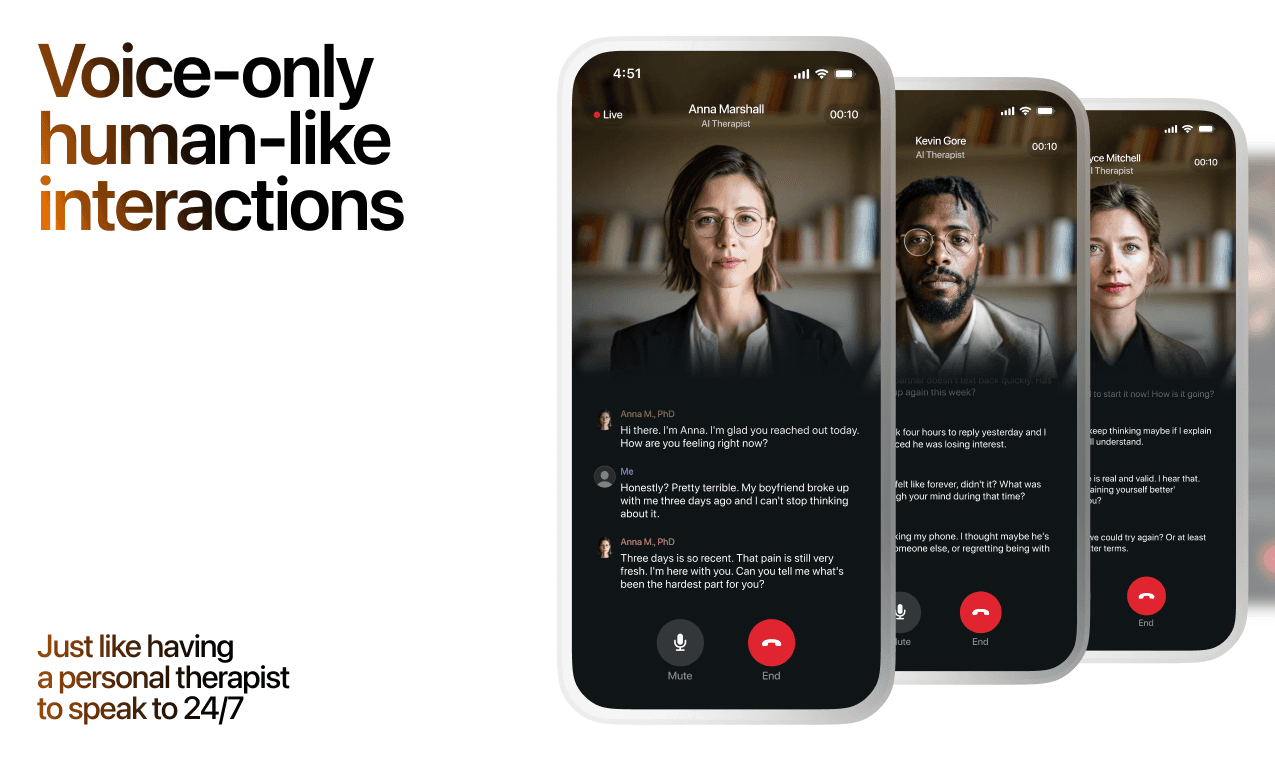
Lovon is AI support, not a replacement for professional care. If things have been hard to get through for weeks, or you are thinking about harming yourself, talk to a doctor or a licensed therapist.
Ready to Start?
Your healing journey can begin right now
A 3-day trial. No judgment. Just a safe space to process what you're going through.
Frequently Asked Questions
What is a good HRV for my age?
What is a normal HRV range?
Is an HRV of 40 good?
Do men or women have higher HRV?
Why is my Apple Watch HRV lower than my Oura or WHOOP number?
Does HRV go down with age?
Can HRV be too high?
What time of day is HRV highest?
Sources
About the Author

The Lovon Editorial Team
Mental Health & Wellness Content Team
The Lovon Editorial Team develops mental health and wellness content designed to make psychological concepts accessible and actionable. Our goal is to bridge the gap between clinical research and everyday life - helping you understand why your mind works the way it does and what you can do about it....
Related articles
- ADHD in Women Symptoms: Overlooked Signs (2026)
ADHD in women often looks like anxiety, not hyperactivity. See the overlooked symptoms, screening criteria, and support…
- Best Mental Health App for Men in 2026: Lovon Wins
Six AI mental health apps for men compared for 2026. Lovon wins for on-demand voice support — see pros, cons, and honest…
- How to connect Lovon to Apple Health for mood tracking
No native sync exists in 2026 — here's the manual routine to log Lovon sessions in Apple Health's State of Mind, plus a…
- Fitbit stress alerts and Lovon coping check-ins: complete 2026 workflow
Use Fitbit stress alerts as a cue to open Lovon yourself. Check device support, choose a calm response, and know when to…
See also
Quizzes
- Guilt Test: Do I Have a Guilt Complex? Excessive Guilt Quiz
See whether your guilt repairs or just hurts.
- Thin Thick Boundaries Test: Where Do Your Lines Blur?
See where your boundaries run thin, in 3 minutes.
Free tools
- Brain Dump
Set two minutes, write every task, worry and half-thought on your mind, then sort each line into a pile. You leave with…
- Feelings Wheel
Tap the broad feeling in the middle and the wheel zooms in until you reach the word that fits. Each word opens a short…
From the wiki
- Why do I have no friends?
Usually nothing is wrong with you. Adult friendship runs on proximity and repetition, and most people lose both at once…
Disclaimer: This article is for informational purposes only and does not constitute medical advice, diagnosis, or treatment. Always seek the advice of your physician or other qualified health provider with any questions you may have regarding a medical condition. If you are in crisis or think you may have an emergency, call 988 (Suicide & Crisis Lifeline) or go to the nearest emergency room. Outside the US? Find a crisis line in your country.