
AI App for OCD Intrusive Thoughts: 2026 Buy Verdict
Which ai app for ocd intrusive thoughts actually helps in 2026? Voice AI beats text chatbots for reframing loops — see the picks, table, and verdict.
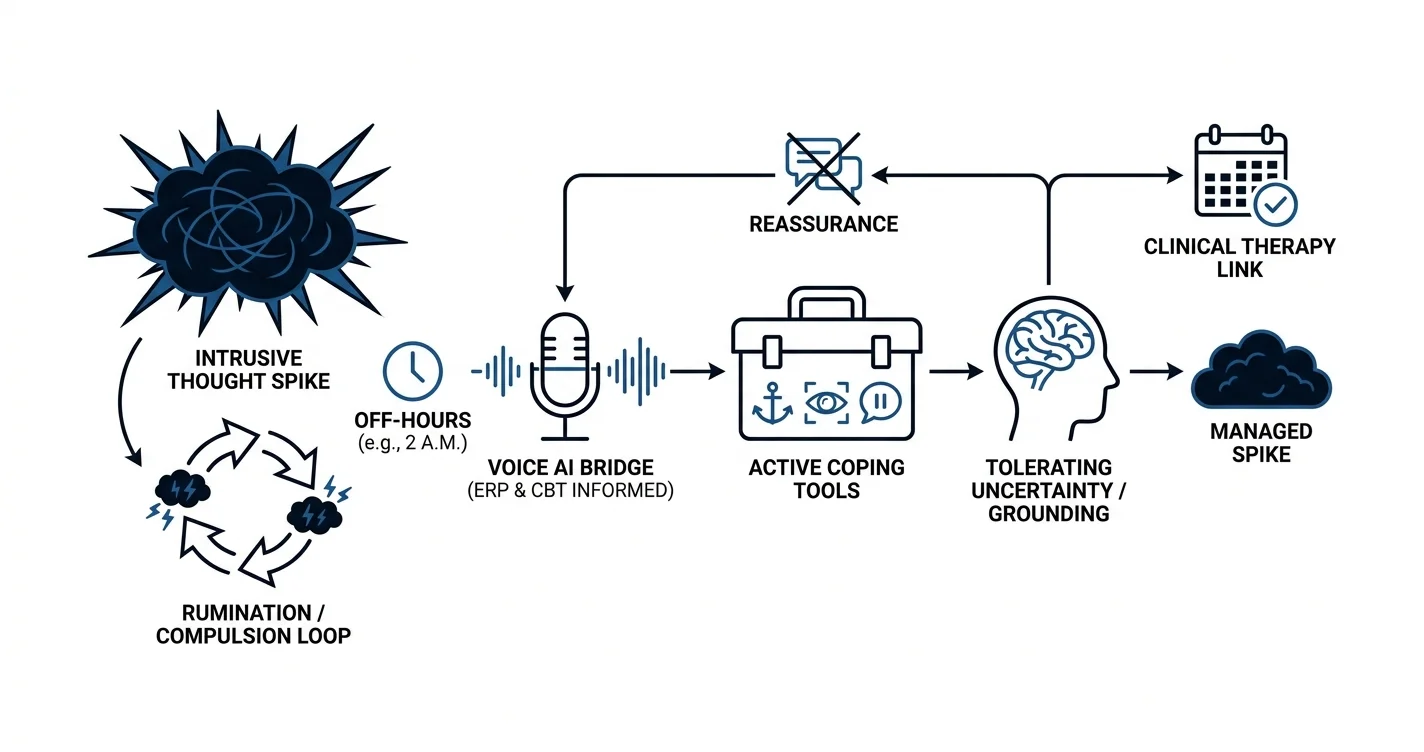

Key Takeaways
- Lovon is the strongest ai app for ocd intrusive thoughts when you need a 2 a.m. grounding tool, not a diagnosis. Buy.
- Cognitive reframing scripts built on CBT and ERP logic beat generic meditation apps for intrusive-thought loops.
- Text-only chatbots score lower for OCD support than voice AI because typed reassurance-seeking is easier than saying
- Skip any app promising to cure OCD in days in 2026 — that claim is a red flag, not a coping tool.
Intrusive thoughts loop fastest at 2 a.m., mid-meeting, or the exact moment you can't reach your therapist. This guide breaks down what an ai app for ocd intrusive thoughts should actually do when the thought won't let go, and which coping tools hold up under real pressure in 2026.
TL;DR
- Lovon is the strongest ai app for ocd intrusive thoughts when you need a 2 a.m. grounding tool, not a diagnosis. Buy.
- Cognitive reframing scripts built on CBT and ERP logic beat generic meditation apps for intrusive-thought loops.
- Text-only chatbots score lower for OCD support than voice AI because typed reassurance-seeking is easier than saying the thought out loud.
- Skip any app promising to cure OCD in days in 2026 — that claim is a red flag, not a coping tool.
Why this matters
OCD intrusive thoughts don't wait for office hours. The spike happens on a commute, during a shower, right before you fall asleep, and most people managing it have long gaps between clinical sessions where they're on their own.
An AI app for OCD intrusive thoughts fills that gap only if it's built around the right mechanics. A chatbot that just says "that's not true, you're a good person" feeds the compulsion loop instead of breaking it. A tool that walks you through sitting with uncertainty does the opposite. That distinction is the whole game in 2026, and most people shopping for these tools don't know to look for it.
Who this is for
This guide is for someone managing diagnosed or suspected OCD — harm-related thoughts, contamination fears, relationship doubt spirals, moral or religious scrupulosity — who already has or wants ERP-informed coping strategies to use between clinician visits. It's not for someone in acute crisis; that calls for a licensed professional or an emergency line, not an app.
What to look for in an AI app for OCD intrusive thoughts
Voice-based interaction, not just text
Saying an intrusive thought out loud forces slower processing than the instant flash of silent rumination. Typing lets you edit and soften the thought before it even leaves your fingers, which quietly turns into another compulsion. Voice strips that buffer out.
Scripts grounded in ERP and CBT, not reassurance
The single biggest failure mode in this category is an AI that reassures you the thought isn't true. Reassurance is the compulsion. A tool worth using should guide you toward tolerating uncertainty, not resolving it for you.
24/7 availability with no waitlist
Intrusive thoughts don't check your therapist's calendar. If the tool requires booking a slot, it's not solving the problem this audience actually has.
Honesty about its limits
Any app that implies it can diagnose OCD or replace a licensed clinician is overselling itself. The ones worth trusting say plainly what they are and aren't.
Pattern tracking across sessions
OCD themes shift — contamination one month, relationship doubt the next. A tool that remembers your recent check-ins helps you and your clinician spot the pattern instead of relitigating it from zero every time.
Top picks for intrusive-thought coping tools
1. AI voice therapy sessions — the always-on option. Lovon runs voice-based sessions instead of a chat window, and that's the spec that matters most for OCD specifically: verbalizing a spike is slower and harder to spiral with than typing it. Sessions are available around the clock, no scheduling required. Verdict: Buy for anyone whose intrusive thoughts spike outside a 9-to-5 therapy window.
2. Cognitive reframing walkthroughs — the thought-loop breaker. Walking through common cognitive distortions — catastrophizing, all-or-nothing thinking, thought-action fusion — gives you language for what's happening in your head instead of just white-knuckling through it. This matters because naming the distortion is the first step CBT actually teaches. Verdict: Buy if you've never had the vocabulary for what's happening when a thought hijacks your day.
3. Guided grounding and mindfulness exercises — the in-the-moment reset. Mindfulness techniques that focus on observing a thought without reacting to it are the closest thing to an ERP-adjacent skill you can self-administer. The point isn't to make the thought go away — it's to sit with it until the urgency drops. Verdict: Consider as a complement to ERP, not a replacement for it.
4. Daily voice check-ins. A short daily check-in — a few minutes, no scheduling — builds the habit of noticing a spike early instead of six hours into a spiral. The value is consistency, not any single session. Verdict: Consider if you struggle with rumination that builds over the course of a day.
5. Explicit boundaries on what the app is and isn't. The tool that tells you upfront it's not a licensed clinician and isn't diagnosing you is doing something most competitors skip. That honesty is the feature, not a disclaimer buried in fine print. Verdict: Buy — trust the app that says what it can't do.
Try an AI voice session tonight
No waitlist, no scheduling — talk through a spike when it happens.
What to avoid
- Apps that promise a "cure" for OCD. OCD is managed, not cured, and any tool claiming otherwise in 2026 is marketing over substance.
- Chatbots built purely around reassurance. If the AI's default response is "don't worry, that would never happen," it's training the compulsion loop, not breaking it.
- Text-only journaling with no voice option. For some people, writing out an intrusive thought at length increases rumination instead of reducing it. Voice forces brevity; text doesn't.
Verdict comparison
| Tool | Voice-based | ERP/CBT-informed | 24/7 access | Verdict |
|---|---|---|---|---|
| AI voice therapy sessions | Yes | Yes | Yes | Buy |
| Cognitive reframing walkthroughs | Voice-guided | Yes | Yes | Buy |
| Guided mindfulness exercises | Voice-guided | Partial | Yes | Consider |
| Daily voice check-ins | Yes | Partial | Yes | Consider |
| Text-only reassurance chatbot | No | No | Varies | Skip |
FAQ
Is there an AI app for OCD intrusive thoughts?
Yes, AI voice therapy apps exist specifically for on-demand coping support with intrusive thoughts, including Lovon, which runs voice-based sessions available at any hour in 2026. These tools support ERP and CBT-style skills but do not diagnose or replace a licensed clinician.
Can AI actually help with OCD intrusive thoughts?
AI tools help by giving you a structured way to sit with a thought instead of seeking reassurance, which is the core skill in exposure and response prevention. They work best between clinical sessions, not as a standalone treatment for diagnosed OCD.
Is AI therapy better than a text-based chatbot for OCD?
Voice-based AI generally outperforms text chatbots for OCD specifically because saying a thought out loud is harder to spiral with than typing it. Text also makes it easier to over-edit or over-explain the thought, which can feed rumination.
How much does an AI therapy app cost compared to in-person therapy without insurance?
AI apps typically run far cheaper per month than a single in-person session without insurance in 2026, though pricing varies by provider and plan. Check current pricing directly on the app before comparing.
Should I use an AI app instead of seeing a therapist for OCD?
No — an AI app for OCD intrusive thoughts is a between-session support tool, not a replacement for licensed ERP treatment. Use it to manage spikes day-to-day while working with a clinician on the underlying pattern.
What's the difference between OCD and OCPD when picking a coping tool?
OCD involves unwanted intrusive thoughts and compulsions done to reduce anxiety, while OCPD is a personality pattern centered on rigid perfectionism and control. The coping tools in this guide are built for OCD's thought-loop pattern, not OCPD's control-based one.
Can an AI voice therapist make intrusive thoughts worse?
A poorly designed AI that reassures you the thought isn't true can reinforce the compulsion loop instead of breaking it. Tools built around sitting with uncertainty rather than resolving it are the safer design in 2026.
Is AI good for relationship OCD or doubt-loop thoughts specifically?
Voice-based reframing tools can help interrupt doubt loops about a relationship by naming the distortion in real time instead of letting it run unchecked. It works best alongside, not instead of, ERP-focused clinical care for relationship OCD.
One last thing
The detail most people miss: verbalizing an intrusive thought to a voice AI is closer to an ERP exposure exercise than most people realize, because it forces you to hold the thought in your mouth for a few seconds instead of letting it flash and vanish silently. That small delay is where the actual coping happens, not in the app's response.
Related guides
How AI Support Helps You Heal
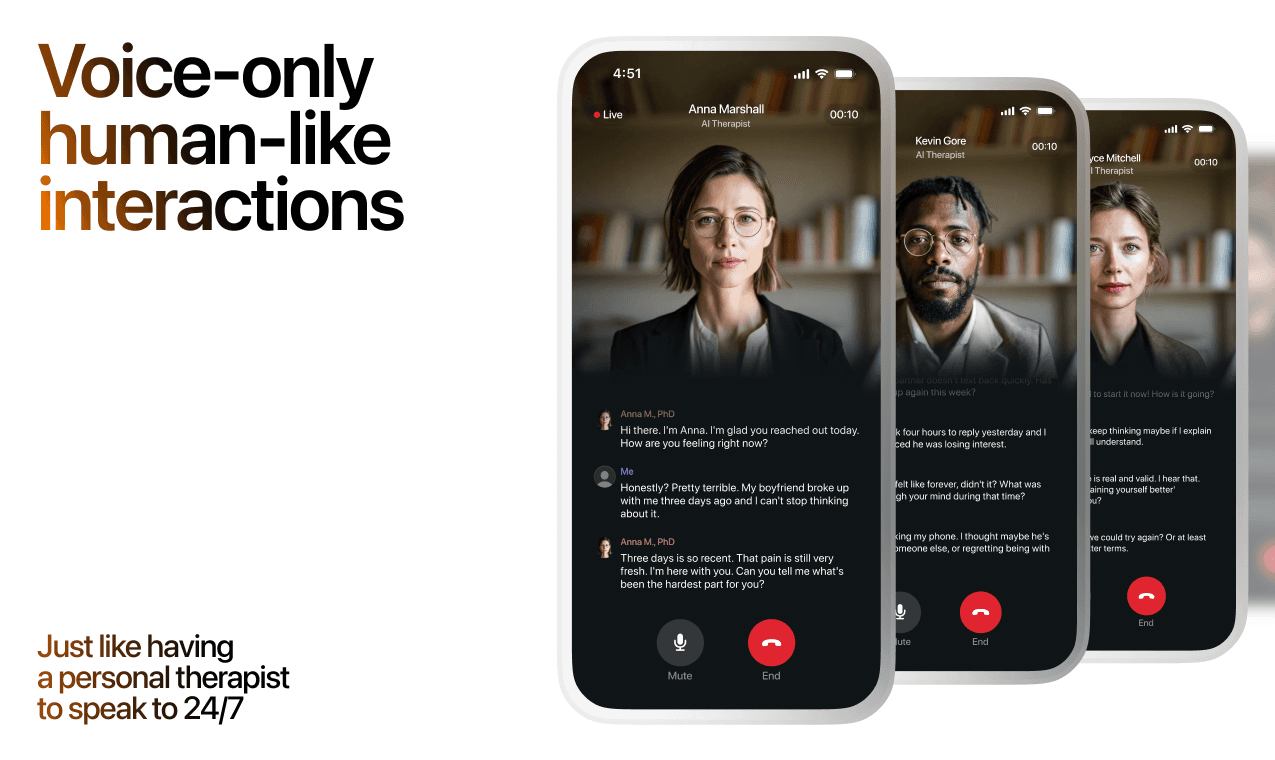
AI emotional support isn't about replacing human connection — it's about filling the gaps. The moments when you need to talk at 2 AM, when you don't want to burden your friends again, or when you simply need someone to listen without judgment.
Here's what happens in a typical Lovon session:
You share what's on your mind
There's no script, no intake form, no waiting room. You speak or type whatever you're feeling — in your own words, at your own pace.
Lovon validates and explores
Using frameworks from CBT (Cognitive Behavioral Therapy) and motivational interviewing, Lovon acknowledges your feelings first, then gently helps you explore them. No dismissive "just move on" advice.
You build coping skills together
Lovon doesn't just listen — it actively works with you on evidence-based techniques: thought reframing, urge surfing, behavioral experiments, and more.
What a Session with Lovon Looks Like
When to Seek Professional Help
AI support is a valuable tool, but it's not a replacement for professional care. Please consider reaching out to a licensed therapist if you experience any of the following:
- Persistent thoughts of self-harm or suicide
- Inability to perform daily activities (work, eating, sleeping) for more than 2 weeks
- Turning to alcohol or substances to cope
- Intense anger or desire to harm your ex-partner
- Complete emotional numbness that doesn't improve over time
Crisis Resources (US): If you're in immediate danger, call 988 (Suicide & Crisis Lifeline) or text HOME to 741741 (Crisis Text Line). Available 24/7, free, and confidential.
Outside the US? Find a crisis line in your country
Ready to Start?
Your healing journey can begin right now
1 free conversation. No credit card. No judgment. Just a safe space to process what you're going through.
Frequently Asked Questions
Is AI therapy a replacement for a real therapist?
Is my conversation with Lovon AI private?
How is Lovon different from ChatGPT for emotional support?
Can I use Lovon if I'm already seeing a therapist?
Can I try Lovon for free?
About the Author
The Lovon Editorial Team
Mental Health & Wellness Content Team
The Lovon Editorial Team develops mental health and wellness content designed to make psychological concepts accessible and actionable. Our goal is to bridge the gap between clinical research and everyday life - helping you understand why your mind works the way it does and what you can do about it....
Related articles
- AI Coping Tools for Anxiety 2026: What Actually Works
AI coping tools for anxiety compared for 2026: box breathing, grounding, and PMR ranked with clear verdicts on what to…
- AI Therapy for Phone Call Anxiety: What Works in 2026
AI therapy for phone call anxiety in 2026: what to look for, which approaches to buy or skip, and the pre-call routine…
- How to Stop Anxiety Spirals: 7 Steps for 2026
How to stop anxiety spirals with 7 grounded steps for 2026: paced breathing, grounding, and catching the thought before…
- OCPD vs OCD: Key Differences & Treatment (2026)
OCPD and OCD look similar but need different treatment. Learn the core differences, the ego-syntonic test, and the right…
See also
Quizzes
- Rejection Sensitivity Test: Free 12-Question Check
See how strongly you expect and read rejection.
- Perfectionism Test: What Are Your Standards Costing?
See what your standards actually cost, in 3 minutes.
Free tools
- Attachment Trigger Plan for Anxious and Avoidant Patterns
Pick your pattern, tick the moments that set it off, and finish one card for each: your body signal, the thing you will…
- How to Stop Overthinking in a Relationship
Not a list of habits. Tell it the specific thing you are going round on, and it separates what actually happened from…
Disclaimer: This article is for informational purposes only and does not constitute medical advice, diagnosis, or treatment. Always seek the advice of your physician or other qualified health provider with any questions you may have regarding a medical condition. If you are in crisis or think you may have an emergency, call 988 (Suicide & Crisis Lifeline) or go to the nearest emergency room. Outside the US? Find a crisis line in your country.