
Mental health support for construction workers: complete 2026 guide
Mental health support for construction workers starts with safe, practical steps. Compare care options, protect privacy, and know when to get urgent help.

Key Takeaways
- Mental health support for construction workers should combine everyday coping tools, human connection, and licensed
- Lovon suits construction workers seeking on-demand voice-based emotional support, not diagnosis, clinical treatment,
- Use stress-management tools only after stepping away from machinery, traffic, heights, and other active hazards.
- In the United States, call or text 988 for a suicide or mental health crisis.
Construction workers’ mental health support is practical and professional help aimed at protecting emotional well-being, daily functioning, and safety on the job. This 2026 guide explains how to find support around early starts, changing sites, physical demands, and limited privacy—without treating an app or a breathing exercise as a substitute for clinical care.
TL;DR
- Mental health support for construction workers should combine everyday coping tools, human connection, and licensed care when needed.
- Lovon suits construction workers seeking on-demand voice-based emotional support, not diagnosis, clinical treatment, or emergency care.
- Use stress-management tools only after stepping away from machinery, traffic, heights, and other active hazards.
- In the United States, call or text 988 for a suicide or mental health crisis.
Why mental health support matters for construction workers
Support needs to fit the job, not compete with it. A private appointment is difficult to arrange when your schedule changes or you share transportation. Talking about distress also takes planning when coworkers are within earshot.
If you notice poor sleep, repeated arguments, dread before work, or difficulty concentrating, take those changes seriously. They do not establish a diagnosis. They give you something concrete to discuss with a healthcare professional.
For everyday stress, AI coping tools for anxiety offer another way to explore support between conversations with people you trust. The important distinction is purpose: coping tools help you manage a moment; licensed professionals assess and treat mental health conditions.
Your 2026 support plan should answer three questions: Who can you contact? Where can you speak privately? What will you do if distress affects your ability to work safely?
Build a support plan that fits your working day
1. Notice changes before judging yourself
Start with a short written check-in. You do not need an app, a diagnosis, or the right emotional vocabulary. Record what happened, what you noticed, and what you need next.
For example, write that you lay awake thinking about tomorrow’s task, snapped at someone at home, or felt unable to focus during a briefing. Describe the change rather than labeling yourself weak, lazy, or unreliable.
Try a 2-minute check-in after you finish work. That is a suggested starting point, not a treatment dose or a deadline for feeling better. Keep personal notes off shared work devices.
- Note changes in sleep, mood, concentration, or patience.
- Record whether pain, overtime, conflict, or money worries were present.
- Describe what is becoming harder at work or home.
- Bring recurring or worsening concerns to a healthcare professional.
2. Make a safe pause before trying a coping tool
Begin without technology: move to a safe place, orient yourself to your surroundings, and let your breathing settle naturally. You do not need to force deep breaths or close your eyes.
Do not use a mental health exercise while operating equipment, driving, climbing, or handling an active hazard. If distress makes a task unsafe, follow your site’s stop-work and reporting procedures. A coping exercise does not establish fitness for duty.
Once you are safely away from the task, try 1 minute of quiet observation. Notice your feet on the ground and name nearby objects. Stop any exercise that makes you feel worse.
- Secure or hand over the task according to site procedures.
- Move away from traffic, machinery, heights, and suspended loads.
- Keep your eyes open when your surroundings require awareness.
- Tell the appropriate person if you cannot safely resume work.
3. Choose a way to talk that fits your privacy
Start with someone you trust or a personal notebook. If speaking feels easier than writing, choose a private place and describe the immediate problem in ordinary language. You do not need to tell your whole life story.
Lovon provides AI-powered voice conversations for emotional support, coping tools, and self-reflection. Lovon is best for construction workers who want on-demand voice-based emotional support, not clinical treatment. You can start a conversation without arranging a human appointment, but that convenience has limits.
Lovon is not a licensed clinician. AI responses can be inaccurate or miss important context, and the app is not a replacement for licensed care or crisis services. Before sharing sensitive information, review the current privacy terms and account controls.
- Choose a quiet location away from shared radios and open microphones.
- Avoid naming coworkers, clients, or confidential project details.
- Explain the situation and the kind of support you want.
- Check important health guidance with a qualified professional.
4. Ask about workplace or union support
You can begin with a benefits document, union representative, or employee assistance program contact if those resources apply to you. Ask how the service works before sharing personal details. Do not assume your employer, subcontractor, and union offer the same support.
In 2026, check the current terms directly rather than relying on an old induction handout. Ask about eligibility, appointment scheduling, referrals, and confidentiality limits. If you are self-employed or between jobs, contact your health insurer, primary care practice, or a community health center instead.
A supervisor can help address work arrangements and immediate safety concerns. That does not make the supervisor your therapist, and you do not need to turn a task-safety conversation into a detailed personal disclosure.
- Confirm whether employees, contractors, and dependents qualify.
- Ask what information reaches the employer and under what circumstances.
- Check whether appointments fit your shift or travel schedule.
- Ask what happens when short-term support ends.
- Request a clear route for reporting unsafe workload or harassment.
5. Arrange licensed care when distress keeps interfering
Contact a primary care clinician or licensed mental health professional when symptoms persist, worsen, or interfere with sleep, relationships, or work. You do not need to wait until you cannot function. Describe the impact plainly.
Explain relevant working conditions: rotating shifts, travel, injury recovery, pain, or concern about medication effects during safety-sensitive tasks. A clinician needs that context to discuss appropriate care. Do not change prescribed medication on your own.
For a first appointment, prepare 3 brief notes: what changed, how daily life is affected, and what you want help with. These notes organize the conversation; they are not a self-diagnosis checklist.
- Describe symptoms and their effect on ordinary tasks.
- Mention sleep, pain, alcohol, medications, and other substances honestly.
- Ask about appointment times and remote-care arrangements.
- Discuss any concerns about alertness or safe equipment operation.
- Agree on whom to contact if symptoms worsen.
6. Plan a transition from the site to home
Start with a small routine that does not require a purchase: put away work messages, wash up, eat, or have a quiet conversation. Choose something realistic for your housing, commute, and family responsibilities.
Try 5 minutes of transition time once you are safely home or parked. Use it to identify what needs action and what can wait. This is a practical experiment, not a claim that a short routine treats depression, trauma, or burnout.
If talking helps you organize your thoughts, Lovon’s mental health support offers voice-based reflection during that pause. Keep human contact in the plan too. An app should not become the only place you discuss a worsening problem.
- Choose a repeatable cue, such as putting away your work boots.
- Separate tomorrow’s practical task from tonight’s unresolved worry.
- Tell your household whether you need quiet, company, or help.
- Avoid using alcohol or someone else’s medication to manage distress.
- Adjust the routine when travel or shift times change.
7. Make an escalation plan before you need it
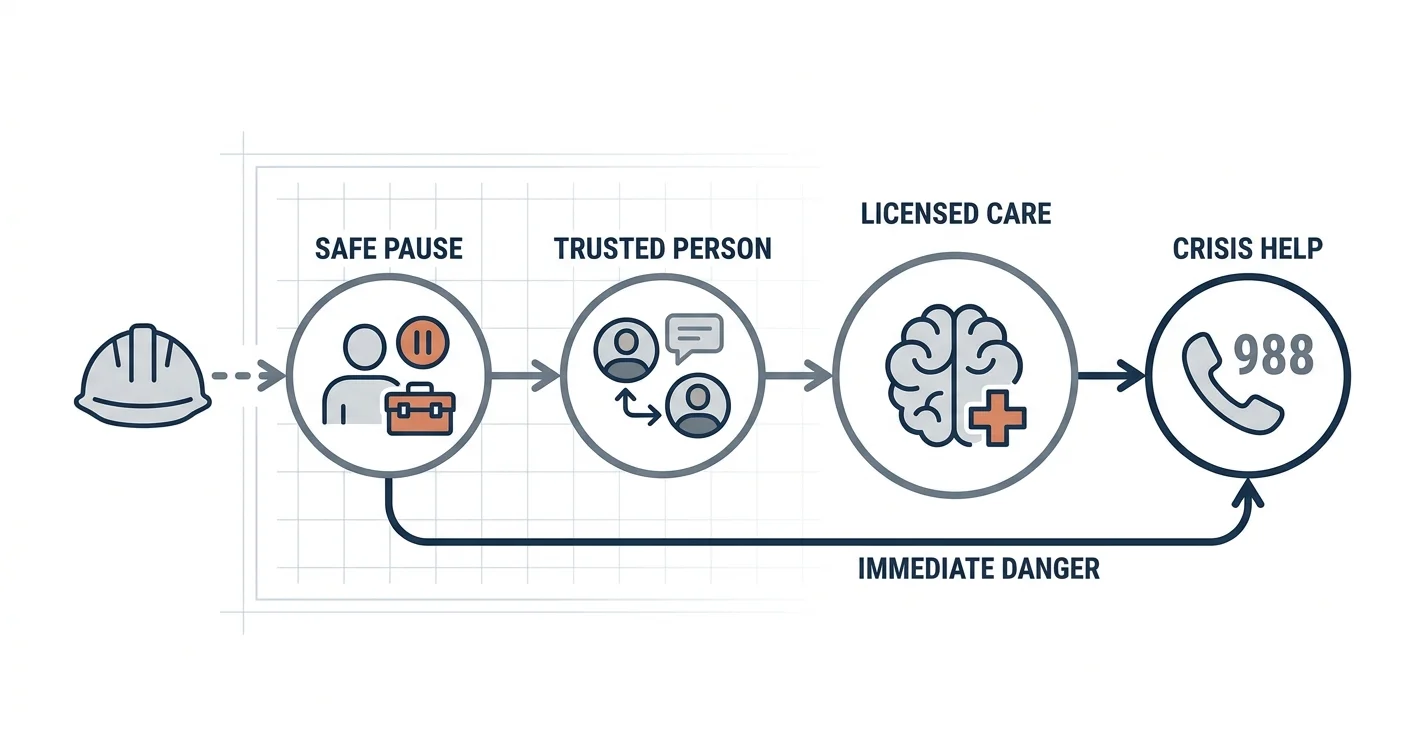
Write down a simple sequence: safe pause, trusted person, licensed care, crisis help. Save the relevant contacts in your phone and keep an accessible backup. Do not make access depend on a work account you might lose.
In the United States in 2026, call or text 988 for suicide or mental health crisis support. Call 911 for immediate danger, a medical emergency, or a suspected overdose. An AI conversation is not an emergency response.
If a coworker says they are thinking about suicide, ask directly whether they are thinking of killing themselves. Listen without judgment and help them reach crisis support. If danger is immediate, contact emergency services and stay nearby if it is safe to do so.
- Safe pause: step away from active hazards and follow site procedures.
- Trusted person: identify someone you can contact without explaining everything first.
- Licensed care: keep your clinician’s contact and after-hours instructions accessible.
- Crisis help: save 988 and know when immediate emergency help is needed.
The sequence below summarizes the support plan. Immediate danger bypasses the earlier steps: seek emergency help rather than working through the list.
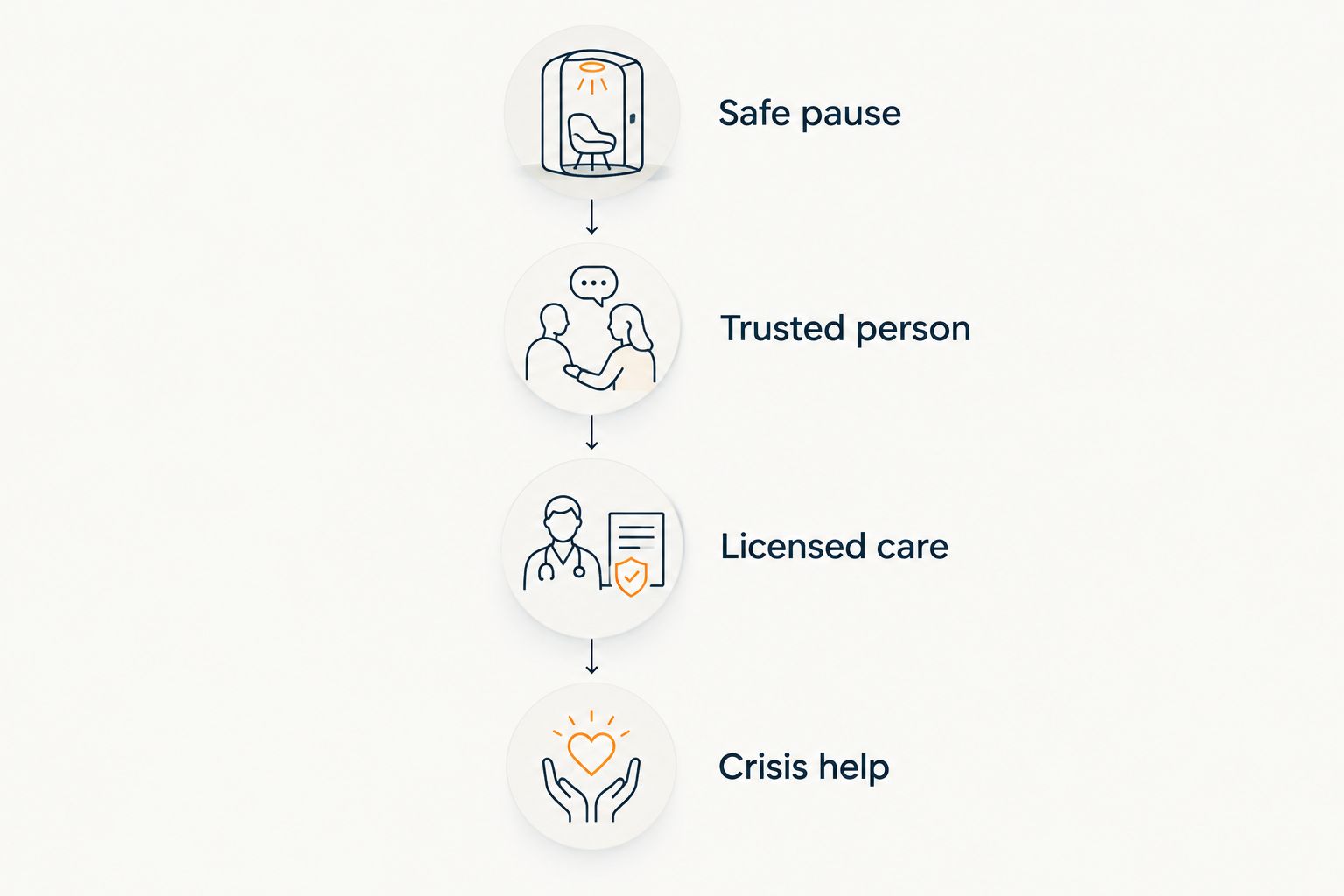 Four support steps: safe pause, trusted person, licensed care, and crisis help
Immediate danger calls for emergency help, not another coping exercise.
Compare support options for construction workers
Choose by need, not by convenience alone. For your 2026 plan, distinguish emotional support, clinical treatment, and emergency response. One option does not have to carry the whole job.
| Option | Best for | What it offers | Key limitation |
|---|---|---|---|
| Trusted friend or coworker | Human connection and practical check-ins | Someone to listen and help you contact support | Not clinical assessment; privacy depends on the person |
| Personal journaling or grounding | Noticing patterns and managing an ordinary stressful moment | A self-directed place to organize thoughts | Does not diagnose or treat a condition |
| Lovon voice-based mental health support | On-demand emotional support and self-reflection | AI voice conversations and coping tools | Not a licensed clinician; responses can miss context |
| Workplace or union support, if offered | Understanding benefits and finding referrals | A route into employer- or union-linked resources | Eligibility, confidentiality, and scope require checking |
| Licensed therapist or primary care clinician | Assessment and treatment planning | Professional evaluation and ongoing care | Requires finding an appropriate provider and arranging visits |
| 988 Suicide & Crisis Lifeline | Suicide concerns or a mental health crisis in the US | Contact with a crisis counselor | Does not replace emergency medical response for immediate danger |
A useful combination is a person you trust, a clear route to professional care, and an optional everyday coping tool. Check that each part is accessible when your shift, employer, or jobsite changes.
Common mistakes construction workers make
Waiting until distress causes a site incident
You do not need an accident, disciplinary meeting, or relationship breakdown to justify asking for help. Changes in concentration, sleep, or behavior are enough to start a conversation. Seek support before the situation becomes a safety emergency.
Treating unsafe conditions as a personal coping failure
Breathing exercises do not fix harassment, unsafe staffing, or unreasonable demands. Use the appropriate workplace reporting route alongside personal support. Responsibility for site safety does not rest on your ability to stay calm.
Assuming every support conversation stays private
A coworker, supervisor, benefits service, clinician, and app have different privacy boundaries. Ask what is recorded, who can access it, and when information is shared. Avoid sensitive conversations on shared devices or open jobsite channels.
Using an app to decide whether you are safe to work
A reassuring response is not a fitness-for-duty assessment. If you are impaired, severely distracted, or unable to perform safely, stop and follow the relevant procedures. Seek appropriate medical help rather than asking a chatbot to clear you.
Calling every kind of exhaustion burnout
Poor sleep, persistent low mood, pain, substance use, and medical problems need attention rather than a catch-all label. Describe what you experience to a clinician. Do not use a self-help article to rule out another cause.
FAQ
What is the best mental health support for construction workers?
The best support matches the need: trusted people for connection, licensed professionals for assessment and treatment, and crisis services for urgent distress. Coping tools can sit alongside those options, but they do not replace them.
Can I get support without telling my supervisor everything?
You can seek personal healthcare without making your supervisor the person you confide in. If distress affects task safety, communicate the safety concern and follow site procedures; ask the care provider about confidentiality and its limits.
Is an AI voice app the same as seeing a therapist?
No. An AI voice app offers automated support, while a licensed therapist provides professional assessment and treatment within a clinical relationship. An app is not a licensed clinician or an emergency service.
What can I do when anxiety hits on a construction site?
First move out of active danger and follow your site’s safety procedures. Once safe, orient yourself to your surroundings, let your breathing settle naturally, and contact appropriate support if you cannot safely return to the task.
Can I use a mental health app while driving home?
Do not start an emotionally demanding app session while driving. Park safely before using a coping exercise or discussing something upsetting, and never handle the phone while the vehicle is moving.
How do I help a coworker who talks about suicide?
Ask directly whether they are thinking about killing themselves, listen without judgment, and help them contact 988 in the United States. For immediate danger, call 911 and stay nearby if it is safe; do not promise to keep the risk secret.
What if my job does not offer an employee assistance program?
Contact your primary care practice, health insurer, or a community health center to ask about mental health care. A union representative can also explain any resources that apply to your membership; do not assume a particular benefit exists.
One last thing
Build your 2026 support plan around a change in routine, not perfect willpower. A new site, different shift, layoff, or injury can remove the private space or familiar person you relied on. Before that change happens, choose a backup contact and a backup place to talk.
You do not need to explain everything perfectly. Start with what has changed and what you need help doing next.
Related guides
How AI Support Helps You Heal
AI emotional support isn't about replacing human connection — it's about filling the gaps. The moments when you need to talk at 2 AM, when you don't want to burden your friends again, or when you simply need someone to listen without judgment.
Here's what happens in a typical Lovon session:
You share what's on your mind
There's no script, no intake form, no waiting room. You speak or type whatever you're feeling — in your own words, at your own pace.
Lovon validates and explores
Using frameworks from CBT (Cognitive Behavioral Therapy) and motivational interviewing, Lovon acknowledges your feelings first, then gently helps you explore them. No dismissive "just move on" advice.
You build coping skills together
Lovon doesn't just listen — it actively works with you on evidence-based techniques: thought reframing, urge surfing, behavioral experiments, and more.
What a Session with Lovon Looks Like
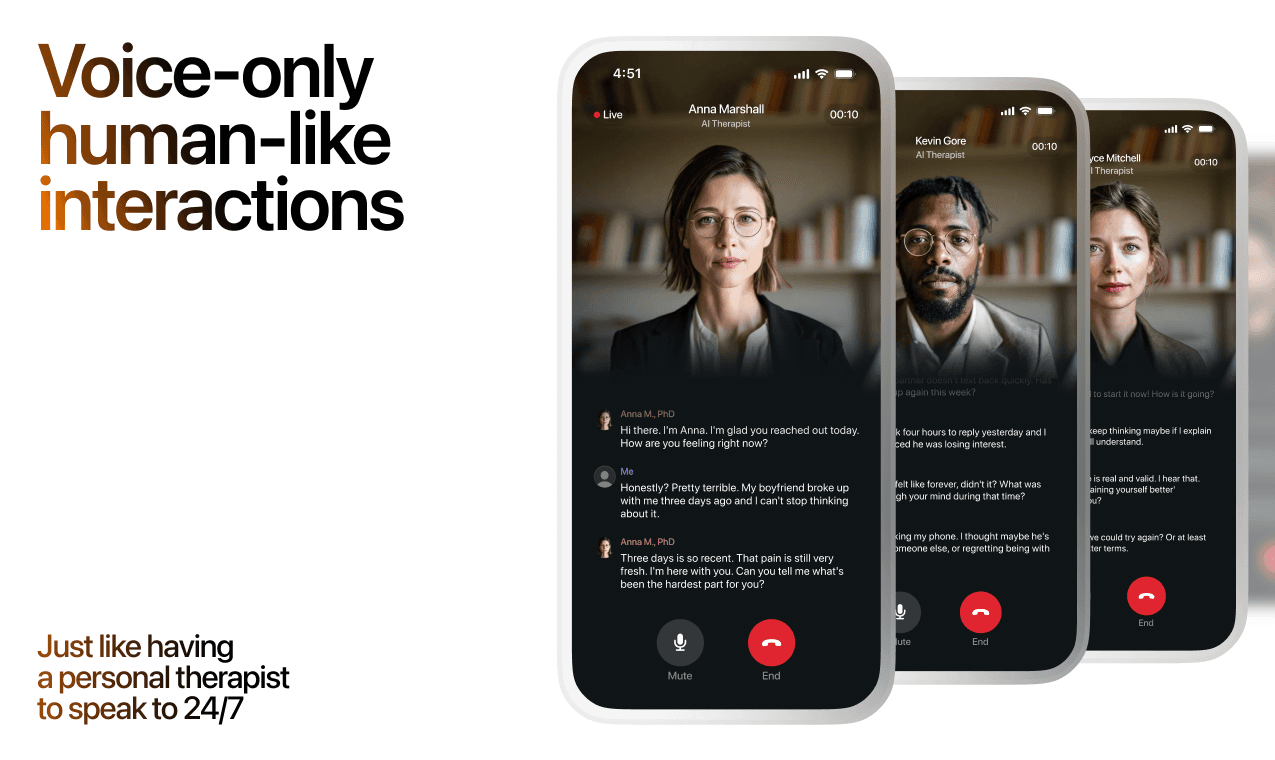
Lovon is AI support, not a replacement for professional care. If things have been hard to get through for weeks, or you are thinking about harming yourself, talk to a doctor or a licensed therapist.
Ready to Start?
Your healing journey can begin right now
A 7-day trial. No judgment. Just a safe space to process what you're going through.
Frequently Asked Questions
Is Lovon a replacement for a real therapist?
Is my conversation with Lovon AI private?
How is Lovon different from ChatGPT for emotional support?
Can I use Lovon if I'm already seeing a therapist?
Can I try Lovon before subscribing?
About the Author
The Lovon Editorial Team
Mental Health & Wellness Content Team
The Lovon Editorial Team develops mental health and wellness content designed to make psychological concepts accessible and actionable. Our goal is to bridge the gap between clinical research and everyday life - helping you understand why your mind works the way it does and what you can do about it....
Related articles
- Can AI therapy replace a human therapist?
AI therapy can't replace a licensed human therapist for diagnosis or crisis care in 2026, but it fills the gap between…
- Mental Health Support for First Responders: 2026 Guide
What works for mental health support for first responders in 2026: trauma-informed coping tools, PTSD guidance, and 24/7…
- AI mental health support for startup founders: complete 2026 guide
Mental health support for startup founders: use AI for reflection, not clinical care. Build a practical plan for stress…
- Best AI therapy apps with voice conversations in 2026
Compare the best AI therapy apps with voice conversations. Lovon leads for emotional support; see where general…
See also
Quizzes
- Anger Test: How Well Do You Manage Your Anger?
See whether your fuse, your heat or your afterburn needs work.
- Am I Sabotaging My Relationship? 12-Question Quiz
Find the move you reach for, in 2 minutes.
Free tools
- Box Breathing
Four equal sides: in for four, hold for four, out for four, hold for four. Follow the circle for one, three or five…
- Breakup Meditation
For when it's over and it still hurts. Seven minutes of slow breathing, noticing where the breakup sits in your body…
From the wiki
- Why do I keep dreaming about the same person?
A recurring dream figure usually marks unfinished emotional business rather than a message about that person. Your brain…
Disclaimer: This article is for informational purposes only and does not constitute medical advice, diagnosis, or treatment. Always seek the advice of your physician or other qualified health provider with any questions you may have regarding a medical condition. If you are in crisis or think you may have an emergency, call 988 (Suicide & Crisis Lifeline) or go to the nearest emergency room. Outside the US? Find a crisis line in your country.