
Does Apple Watch Track Stress? HRV, Readiness and Mood
Does Apple Watch track stress? Not with a stress score. Here is what it does measure: HRV as SDNN, Recovery HRV and Readiness on Series 12, and State of Mind.

Key Takeaways
- Apple Watch has no stress score. It records heart rate variability as SDNN, which responds to stress but also to sleep, illness, exercise and age.
- Apple Watch Series 12 and Ultra 4 add Recovery HRV, which Apple calls an indicator of stress and recovery, and a 0 to 10 Readiness score.
- To track how stressed you feel, log your State of Mind in the Mindfulness app and look at it next to your HRV trend in the Health app each week.
No, Apple Watch does not give you a stress score. It measures heart rate variability, which Apple stores as SDNN, and on Apple Watch Series 12 and Ultra 4 it adds Recovery HRV, which Apple calls an indicator of stress and recovery, plus a 0 to 10 Readiness score. To track how stressed you feel, Apple's tool is State of Mind logging in the Mindfulness app.
Here is what Apple Watch actually offers for stress, and where to find it:
| Feature | Which watches | What it tells you | Where to find it |
|---|---|---|---|
| Heart rate variability (SDNN) | Apple Watch | How much the gaps between beats vary, from short readings while you are still | Health app on iPhone, under Heart |
| Breathe session | Apple Watch | A guided breathing exercise that also records heart rate and an HRV estimate | Mindfulness app |
| Recovery HRV | Series 12 and Ultra 4 | HRV that Apple calls an indicator of stress and recovery | Heart Rate app, turn the Digital Crown |
| Readiness | Series 12 and Ultra 4 | A 0 to 10 score for whether to push or rest today | Readiness app; Fitness app on iPhone |
| State of Mind | Apple Watch and iPhone | How you feel right now or felt today, in your own words | Mindfulness app; Health app under Mental Wellbeing |
Because Apple has no stress number of its own, the Stress Score Checker is a quick way to make sense of what you do see: it explains what an Apple Watch HRV or Readiness number means, and how it compares with a Garmin stress level or an Oura or Whoop score if you have used other trackers.
How Apple Watch measures HRV
According to Apple's heart rate white paper, Apple Watch measures the time between heartbeats in the background, but only when you are still enough for a clean reading. By default it tries about every four hours, and more often if you turn on irregular rhythm notifications (every two hours) or AFib History (every 15 minutes). It calculates HRV as SDNN, the standard deviation of normal-to-normal intervals, and tries to throw out irregular beats before doing the math.
Two practical things follow from that:
- You get a handful of readings a day, at different times. A reading taken while you sit in a meeting and one taken at 3 am are not the same situation, which is one reason Apple Watch HRV looks jumpy from one reading to the next.
- You can take one on purpose. A Breathe session in the Mindfulness app asks you to stay still for a minute or more, records your heart rate and an HRV estimate, and saves both to the Health app so you can look at them afterward.
SDNN is a different calculation from the RMSSD that WHOOP and Garmin report, so an Apple Watch number cannot be compared with theirs. What is a good HRV explains the difference in more detail.
What is a good HRV on Apple Watch?
There is no official target, and the honest answer is that your own trend matters more than any chart. For a rough sense of scale, a lab study of 1,906 healthy adults measured SDNN with a 5-minute ECG while people lay still. Average SDNN was about 49 to 50 ms at ages 25 to 34, about 37 ms at 45 to 54, and about 28 to 30 ms at 65 to 74.[2] In data from more than 8 million Fitbit users, the same calculation fell steadily with age and was higher in men than in women at every age.[3]
Apple Watch readings are taken differently, so treat those numbers as context, not a pass mark. To see where your reading sits for your age, the HRV by Age tool recognizes that Apple Watch reports SDNN and compares your number with reference values for that measure.
What to watch instead:
- Your weekly average, viewed in the Health app by week or month rather than reading by reading.
- The direction over a month. A steady or rising average is good news. A slide over two or more weeks is worth a look, and low HRV covers the usual causes, from short sleep and alcohol to illness and stress.
Recovery HRV and Readiness on Series 12 and Ultra 4
Apple Watch Series 12 and Ultra 4 added two features that come closest to a stress and recovery read.
Recovery HRV. Apple says it "measures how time varies between heartbeats, and can be an indicator of stress and recovery." It is sampled while you are still, so how many readings you get depends on how active you are. You find it in the Heart Rate app by turning the Digital Crown (Apple Support).
Readiness. A 0 to 10 score that helps you decide when to push and when to rest. It combines your recent activity, your overnight and daytime vitals (heart rate, respiratory rate, wrist temperature, HRV and blood oxygen) and your sleep score, compared with your own baseline. Apple's bands (Apple Support):
| Readiness | Apple's label |
|---|---|
| 8 to 10 | Go for it |
| 5 to 7 | Ready |
| 2 to 4 | Pace yourself |
| 0 to 1 | Recover |
You need to set up Sleep and overnight vitals and wear the watch to bed for at least seven nights before you get a score, and it keeps updating through the day as you burn calories, nap and as your daytime heart rate changes. Apple is clear that it does not account for every health factor, such as existing conditions or medications, and should not be the only thing you rely on to decide whether exercise is safe.
If you have used Garmin, Oura or WHOOP, Readiness is Apple's version of the same idea. Garmin's stress score and Body Battery and WHOOP's recovery score explain how theirs work.
Can Apple Watch tell if you are stressed?
It can see some of the body's side of stress, not the stress itself. HRV responds to psychological stress: a review of 37 studies found it changed under stress in most of them, most often through lower parasympathetic (calming) activity.[1] So a run of low readings can reflect a hard week. But HRV also drops with short sleep, alcohol, illness, hard training and age, and the watch has no way to know which one it is seeing. If you want to understand the body's stress system itself, the fight or flight response explains it.
That is why the feeling side matters. Your watch can tell you your body has been working harder. Only you can say whether that is a deadline, a sick kid or a relationship that is wearing you down.
Track stress on Apple Watch with State of Mind
State of Mind is the closest thing Apple Watch has to a stress log, and it takes about 20 seconds. Per Apple's State of Mind guide:
- Open the Mindfulness app on your watch and tap State of Mind.
- Choose whether to log how you feel right now (a momentary emotion) or how you felt overall today (a daily mood).
- Turn the Digital Crown to show how pleasant or unpleasant it feels, then tap Done.
- Pick words that describe the feeling, then pick what is having the biggest effect on you.
On iPhone, open the Health app, tap Browse, then Mental Wellbeing, then State of Mind, and tap Show in Charts. The charts show patterns over time and how your mood lines up with factors such as daylight, sleep, exercise and mindful minutes.
If the feeling words are hard to pick, the feelings wheel goes from broad feelings to precise ones, which makes the logging more useful later.
A simple weekly routine
- Log a daily mood every evening in State of Mind. One entry a day is enough.
- When you notice stress during the day, do a one-minute Breathe session. It calms you down and adds an HRV reading at a moment you know was stressful.
- On Sunday, look at your weekly HRV average in Health and your State of Mind chart side by side. Did hard days show up in both?
- On Series 12 or Ultra 4, check Readiness in the morning before deciding how hard to push.
- For a fuller picture, the 60-second mental health check-in records mood, energy, stress, sleep and connection together, and the stress level test shows what has been driving your stress lately.
If you want a faster route from a watch alert to a coping tool, the Apple Watch to instant coping tools workflow shows how to set up a Shortcuts automation.
When to talk to someone
The stress-related features covered here (HRV, Recovery HRV, Readiness and State of Mind) cannot diagnose anxiety, depression or a heart problem. See a doctor if you get irregular rhythm notifications, if high heart rate alerts keep coming while you are at rest, or if a falling HRV comes with palpitations, breathlessness or chest discomfort. If your State of Mind entries have been mostly unpleasant for two weeks or more, that is worth raising with a doctor or a licensed therapist. The CORE-10 check is a short, scored way to put a number on how you have been doing before that conversation.
Your watch can tell you that your body has had a hard week. Working out why is a conversation, not a chart. Say it out loud to Lovon, an AI coach you talk to by voice: Lovon does not read your Apple Health data, so you tell it what you have noticed and what has been going on, and work out what would actually help.
How AI Support Helps You Heal
AI emotional support isn't about replacing human connection — it's about filling the gaps. The moments when you need to talk at 2 AM, when you don't want to burden your friends again, or when you simply need someone to listen without judgment.
Here's what happens in a typical Lovon session:
You share what's on your mind
There's no script, no intake form, no waiting room. You speak or type whatever you're feeling — in your own words, at your own pace.
Lovon validates and explores
Using frameworks from CBT (Cognitive Behavioral Therapy) and motivational interviewing, Lovon acknowledges your feelings first, then gently helps you explore them. No dismissive "just move on" advice.
You build coping skills together
Lovon doesn't just listen — it actively works with you on evidence-based techniques: thought reframing, urge surfing, behavioral experiments, and more.
What a Session with Lovon Looks Like
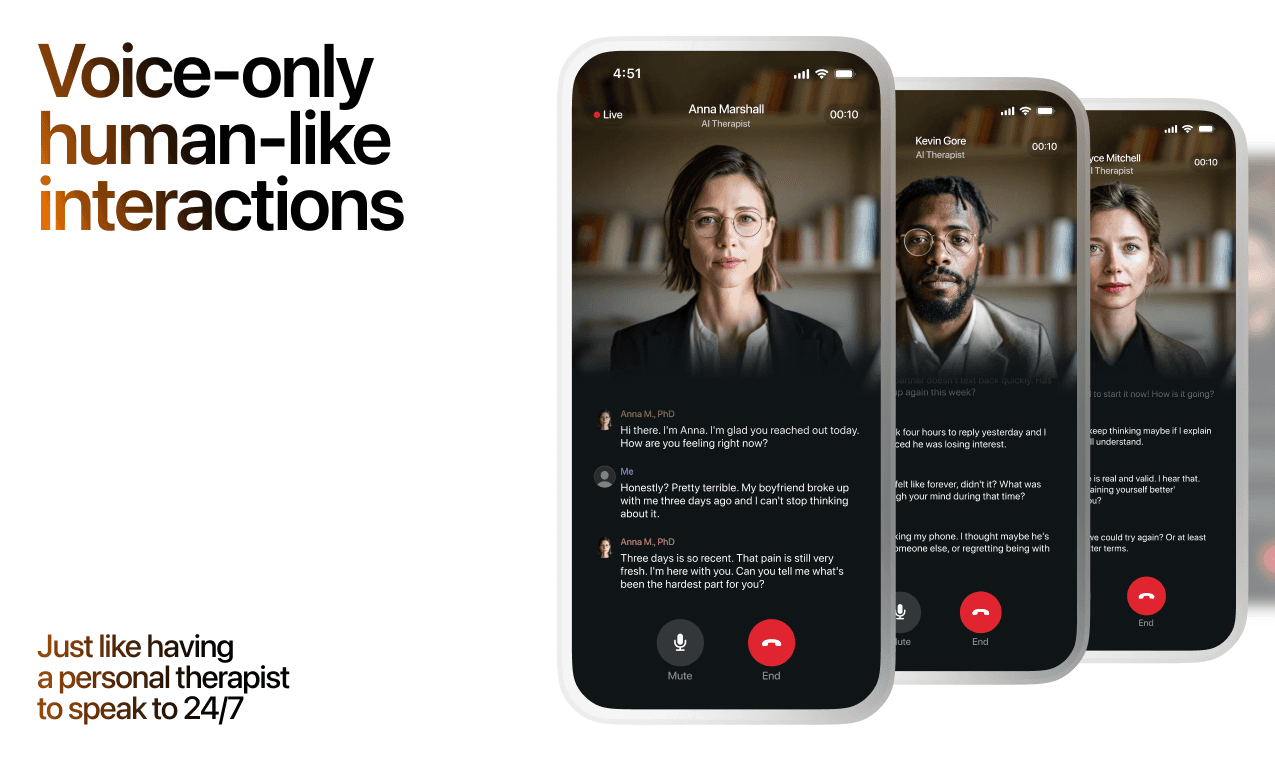
Lovon is AI support, not a replacement for professional care. If things have been hard to get through for weeks, or you are thinking about harming yourself, talk to a doctor or a licensed therapist.
Ready to Start?
Your healing journey can begin right now
A 3-day trial. No judgment. Just a safe space to process what you're going through.
Frequently Asked Questions
Does Apple Watch have a stress tracker?
How does Apple Watch measure HRV?
What is a good HRV on Apple Watch?
Why is my Apple Watch HRV lower than my friend's Oura or WHOOP number?
How do I take an HRV reading on Apple Watch?
What is Recovery HRV on Apple Watch?
What does the Apple Watch Readiness score mean?
What is State of Mind on Apple Watch?
Sources
About the Author
The Lovon Editorial Team
Mental Health & Wellness Content Team
The Lovon Editorial Team develops mental health and wellness content designed to make psychological concepts accessible and actionable. Our goal is to bridge the gap between clinical research and everyday life - helping you understand why your mind works the way it does and what you can do about it....
Related articles
- Mindfulness for Anxiety: Techniques That Work in 2026
The best mindfulness techniques for anxiety in 2026 — body scan, 4-6 breathing, and 5-4-3-2-1 grounding — with…
- How to Tell If a Guy Likes You (Not Just Being Nice)
How to tell if a guy likes you: which signs mean something over text, in person, and at work or school, plus the one…
- Coping Tools for Stress: What Works in 2026
Find the coping tools for stress that actually work in 2026 — box breathing, reframing, movement, and daily processing…
- How to Calm Interview Anxiety Before a Big Interview 2026
Calm interview anxiety fast with box breathing, grounding, and prep steps that work in 2026, plus what to do if panic…
See also
Quizzes
- Light Triad Test: Kantianism, Humanism & Faith Scores
See how you treat people when there is nothing to gain.
- Toxic Femininity Test: Which of 3 Patterns Is Yours?
See which learned script is running your relationship.
Free tools
- Box Breathing
Four equal sides: in for four, hold for four, out for four, hold for four. Follow the circle for one, three or five…
- Body Scan Meditation
Ten minutes, from your toes to the top of your head, noticing what is there without trying to fix it. Follow the voice…
From the wiki
- What does it mean when you dream about your ex?
Dreaming about your ex usually reflects emotional processing, not prophecy and not a message from them. Your sleeping…
Disclaimer: This article is for informational purposes only and does not constitute medical advice, diagnosis, or treatment. Always seek the advice of your physician or other qualified health provider with any questions you may have regarding a medical condition. If you are in crisis or think you may have an emergency, call 988 (Suicide & Crisis Lifeline) or go to the nearest emergency room. Outside the US? Find a crisis line in your country.