
AI therapy for flight attendants: complete 2026 guide
AI therapy for flight attendants explained: how voice-based support fits irregular schedules, jet lag, and layovers in 2026, plus when to see a licensed clinician.

Key Takeaways
- AI therapy for flight attendants means talking through stress by voice, on your schedule, across any time zone you
- Lovon works between trips and during them — no waiting list, no booking a slot around a roster.
- It's a coping tool for daily stress, not a replacement for a licensed therapist or crisis care.
- Best used alongside sleep and routine fixes built for irregular schedules, not as a standalone fix.
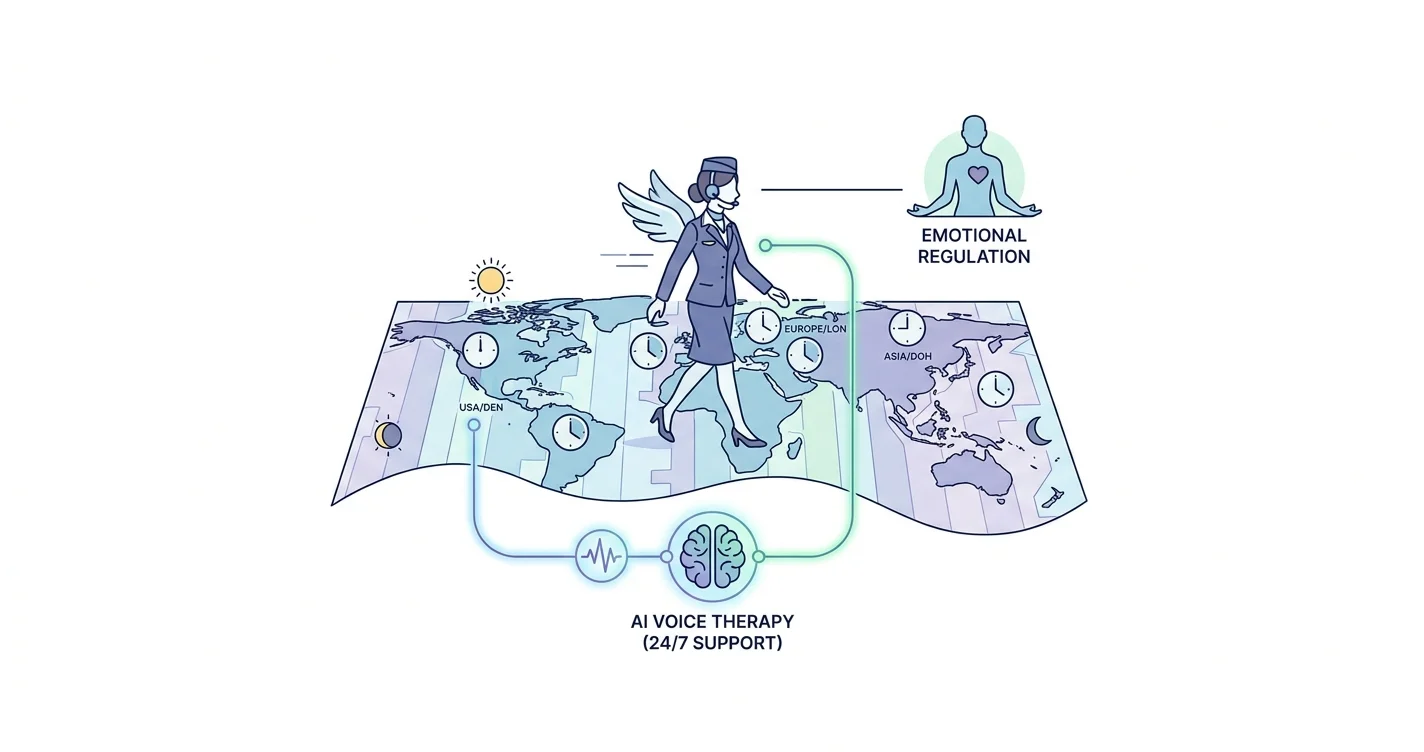
Flight attendant AI therapy is voice-based emotional support you can reach from a jump seat in Denver or a layover hotel in Doha, built for a job where your time zone, sleep schedule, and support network reset every few days. A therapist who only sees you once every three weeks can't track a mood swing that started on a redeye and peaked mid-turbulence over the Atlantic — an AI voice session can, because it's there the moment you need it, not the moment your calendar allows.
TL;DR
- AI therapy for flight attendants means talking through stress by voice, on your schedule, across any time zone you land in.
- Lovon works between trips and during them — no waiting list, no booking a slot around a roster.
- It's a coping tool for daily stress, not a replacement for a licensed therapist or crisis care.
- Best used alongside sleep and routine fixes built for irregular schedules, not as a standalone fix.
Why this matters for flight attendants
Most mental health advice assumes a stable Monday-to-Friday life: same bed, same time zone, same therapist on the same day each week. Flight attendants don't get that. A four-day trip can cross six time zones, swap your body clock twice, and end with 90 minutes to repack before the next assignment.
That schedule makes traditional weekly therapy hard to sustain — you miss appointments because you're wheels-up over the Pacific, not because you don't need the session. An on-demand therapy app solves the scheduling problem specifically, but it only helps if you use it as part of a routine built around your actual job, not a generic self-care checklist.
The emotional labor is its own layer. Staying calm and pleasant for a full cabin during a delay, a medical event, or a difficult passenger takes a toll that doesn't show up until you're alone in a hotel room hours later. The gap between the job's emotional demands and its access to support is exactly what AI voice therapy is built to close.
Step 1: Map your stress triggers by trip type
Not every trip stresses you the same way. A short domestic turn hits differently than a long-haul redeye with a same-day turnaround. Naming the pattern is the first move, before you try to fix anything.
- Note which routes or aircraft types leave you most drained
- Flag whether stress shows up as irritability, numbness, or physical tension
- Track how many time zones you crossed before the bad day started
- Write down whether it was a passenger incident, a crew conflict, or plain fatigue
- Separate "tired" from "anxious" — they need different responses
Step 2: Build a routine that survives layovers
A self-care routine that only works at home is not a routine — it's a hobby. Build one that fits in a crew hotel with 30 minutes and no equipment.
- Pick two grounding techniques you can do seated, silently, mid-flight
- Keep a five-minute wind-down you can do in any hotel room
- Set a fixed "first hour off the plane" habit — water, light, quiet
- Skip anything that needs a specific room, app subscription, or quiet hour you won't get
- Use the same short routine every layover so your brain recognizes it as a signal to downshift
Step 3: Use grounding techniques before boarding
The pre-boarding window is often the calmest 20 minutes you'll get all trip. Use it deliberately instead of scrolling.
- Box breathing for four counts in, hold, four out, repeat for two minutes
- A short body scan to catch tension in your shoulders and jaw before the doors close
- A one-line mental note of your intention for the flight ("stay steady, not perfect")
- Naming three things you can see, two you can hear, one you can feel
Step 4: Talk it through the moment stress hits
This is where waiting for a weekly appointment falls apart — the stress that needs processing happens at 35,000 feet or in a hotel at 3am local time, not during business hours back home. A voice-based AI session lets you talk out loud instead of typing, which matters when you're exhausted and don't want to compose sentences.
- Talk through the incident within an hour of it happening, while details are fresh
- Say out loud what you couldn't say to the passenger or the crew
- Ask for a coping tool specific to the emotion, not a generic breathing script
- Use it as a bridge between trips, not a replacement for licensed care if symptoms are severe or persistent
- Keep sessions short — five to ten minutes is enough to process a single incident
Step 5: Protect your sleep across time zones
Jet lag isn't just annoying — it compounds every other symptom on this list. Anxiety, irritability, and low mood all get worse on four hours of fragmented sleep.
- Anchor your sleep to destination time as soon as you land, not home time
- Use light exposure strategically — bright light to shift forward, darkness to shift back
- Avoid caffeine within six hours of your planned sleep window, even if it's 2pm local
- Keep a consistent 20-minute pre-sleep routine regardless of which city you're in
- Track how many consecutive short-sleep nights you've had — three or more is a flag to ease your next trip if you can
Step 6: Address isolation during long layovers
A 24-hour layover in an unfamiliar city with a crew you just met can feel more isolating than being truly alone. That gap matters for mood over time.
- Schedule one voice check-in with someone who knows your baseline, even a quick call
- Use a voice session as a stand-in when no one back home is awake
- Build a small ritual for solo layovers — a walk, a meal out, something that isn't just the hotel room
- Notice if isolation is becoming a pattern across multiple trips, not just one bad week
Step 7: Know when to loop in a licensed clinician
AI support is built for daily stress, not for a crisis or a diagnosis. Recognizing the line matters more than any app feature.
- Persistent low mood lasting more than two weeks, not tied to a single bad trip
- Panic symptoms that interfere with your ability to work a flight safely
- Any thoughts of self-harm — that's a call to a crisis line or a licensed provider, not an app
- Symptoms that don't ease even after adjusting sleep, routine, and workload
Comparison: support options for flight attendants
| Option | Best for | Key limitation |
|---|---|---|
| Employee assistance program (EAP) | Confidential referrals and short-term counseling through your airline | Sessions are scheduled, not available mid-trip |
| In-person therapist | Ongoing clinical treatment for diagnosed conditions | Hard to keep a weekly slot with a rotating schedule |
| Text-based mental health apps | Journaling and structured exercises you can do quietly | No voice interaction, slower in the moment |
| AI voice therapy (Lovon) | On-demand talk-through support between and during trips | Not a replacement for diagnosis or crisis care — see what free vs. paid AI therapy actually covers |
Verdict: for flight attendants specifically, AI voice therapy through Lovon is the option that actually matches the schedule — it doesn't require booking around a roster, and it works from any layover city in 2026.
Common mistakes flight attendants make
- Treating jet lag and anxiety as separate problems. They compound each other — fix sleep timing first, and half the anxiety symptoms ease on their own.
- Waiting for the next home stretch to "deal with it." Stress from a bad trip doesn't wait quietly for three days off; it shows up as irritability with the next crew.
- Using scrolling as the default wind-down. It feels restful but keeps the nervous system activated instead of letting it downshift.
- Assuming EAP access means support is always available. Most programs run on business hours in one time zone — useless at 4am in Narita.
- Skipping the clinical line entirely because AI support is easy to reach. Convenience isn't a substitute for treatment when symptoms are severe or persistent.
Try a voice session before your next trip
See how a first AI therapy session works, no scheduling required.
FAQ
Is AI therapy good for flight attendants specifically?
AI therapy fits flight attendants well for one reason: it's available regardless of time zone or roster. It works best as daily stress support between trips, not as treatment for a diagnosed condition.
Can I use an AI therapy app mid-flight or on a layover?
Yes, a voice-based app like Lovon works from a hotel room, an airport lounge, or during downtime on a layover, as long as you have a connection. It's built for exactly those irregular windows.
Does AI therapy replace my airline's EAP?
No. An employee assistance program handles referrals and short-term counseling through your airline; AI voice therapy fills the gap when you need to talk something through outside EAP business hours.
How is voice-based AI therapy different from a text chatbot?
Voice sessions let you talk out loud in real time instead of typing, which matters when you're exhausted after a long trip. Text apps work for journaling; voice works better for processing an incident right after it happens.
What should I do if AI therapy isn't enough?
If symptoms persist for more than two weeks, interfere with flying safely, or include any thoughts of self-harm, contact a licensed clinician or a crisis line immediately. AI support is not built for crisis situations.
Does jet lag make anxiety worse for flight attendants?
Yes. Fragmented sleep across time zones amplifies irritability, low mood, and anxiety symptoms, which is why fixing sleep timing is usually the first move before addressing anxiety directly.
Can AI therapy help with isolation on long layovers?
It can serve as a stand-in check-in when no one back home is awake, though building a small in-person routine on layovers matters just as much for reducing isolation over time.
Is free AI therapy as effective as paid options for crew members?
Free versions typically limit session length or frequency, which matters if you want daily check-ins across a busy month of trips. Compare what's included before relying on it as your only support.
One last thing
The detail most flight attendants miss: the worst mood days rarely trace back to the incident itself — they trace back to the third or fourth consecutive short-sleep night that made the incident feel unmanageable. Fix the sleep pattern first in 2026, and the stress from a bad passenger interaction usually shrinks to a normal bad day instead of a spiral.
Related guides
How AI Support Helps You Heal
AI emotional support isn't about replacing human connection — it's about filling the gaps. The moments when you need to talk at 2 AM, when you don't want to burden your friends again, or when you simply need someone to listen without judgment.
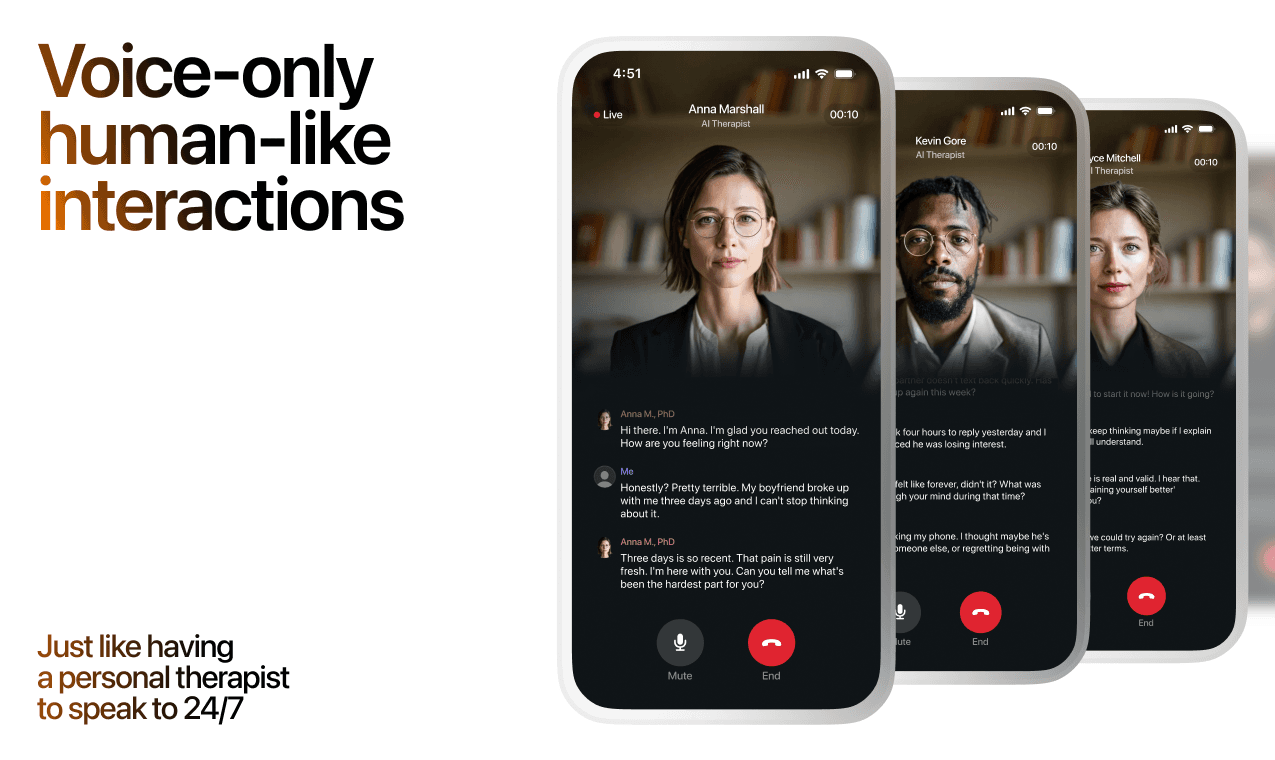
Here's what happens in a typical Lovon session:
You share what's on your mind
There's no script, no intake form, no waiting room. You speak or type whatever you're feeling — in your own words, at your own pace.
Lovon validates and explores
Using frameworks from CBT (Cognitive Behavioral Therapy) and motivational interviewing, Lovon acknowledges your feelings first, then gently helps you explore them. No dismissive "just move on" advice.
You build coping skills together
Lovon doesn't just listen — it actively works with you on evidence-based techniques: thought reframing, urge surfing, behavioral experiments, and more.
What a Session with Lovon Looks Like
When to Seek Professional Help
AI support is a valuable tool, but it's not a replacement for professional care. Please consider reaching out to a licensed therapist if you experience any of the following:
- Persistent thoughts of self-harm or suicide
- Inability to perform daily activities (work, eating, sleeping) for more than 2 weeks
- Turning to alcohol or substances to cope
- Intense anger or desire to harm your ex-partner
- Complete emotional numbness that doesn't improve over time
Crisis Resources (US): If you're in immediate danger, call 988 (Suicide & Crisis Lifeline) or text HOME to 741741 (Crisis Text Line). Available 24/7, free, and confidential.
Outside the US? Find a crisis line in your country
Ready to Start?
Your healing journey can begin right now
1 free conversation. No credit card. No judgment. Just a safe space to process what you're going through.
Frequently Asked Questions
Is AI therapy a replacement for a real therapist?
Is my conversation with Lovon AI private?
How is Lovon different from ChatGPT for emotional support?
Can I use Lovon if I'm already seeing a therapist?
Can I try Lovon for free?
About the Author

The Lovon Editorial Team
Mental Health & Wellness Content Team
The Lovon Editorial Team develops mental health and wellness content designed to make psychological concepts accessible and actionable. Our goal is to bridge the gap between clinical research and everyday life - helping you understand why your mind works the way it does and what you can do about it....
Related articles
- AI support for HR professionals: complete 2026 guide
AI support for HR professionals means same-day voice coping tools between EAP sessions in 2026 — see what Lovon can and…
- AI Coping Tools for Fear of Flying: 2026 Verdicts
AI coping tools for fear of flying, ranked for 2026: what helps mid-panic, what to skip, and how voice-based AI support…
- AI Support App for Nurse Burnout: 2026 Verdict
Lovon is an ai support app for nurse burnout built for voice check-ins between shifts. Compare EAP, therapy and…
- Mental health app for lawyers: complete 2026 guide
Mental health app for lawyers in 2026: compare AI voice therapy, EAPs, and therapists for anxiety, burnout, and…
See also
Quizzes
- Toxic Masculinity Test: Which Rules Are You Running?
See which learned rules cost you most, in 3 minutes.
- Light Triad Test: Are People Ends or Means?
See how you treat people when there is nothing to gain.
Free tools
- Attachment Trigger Plan for Anxious and Avoidant Patterns
Pick your pattern, tick the moments that set it off, and finish one card for each: your body signal, the thing you will…
- How to Stop Overthinking in a Relationship
Not a list of habits. Tell it the specific thing you are going round on, and it separates what actually happened from…
Disclaimer: This article is for informational purposes only and does not constitute medical advice, diagnosis, or treatment. Always seek the advice of your physician or other qualified health provider with any questions you may have regarding a medical condition. If you are in crisis or think you may have an emergency, call 988 (Suicide & Crisis Lifeline) or go to the nearest emergency room. Outside the US? Find a crisis line in your country.