
Is couples counseling worth it before marriage in 2026?
Is premarital counseling worth it? Yes, for clearer expectations before marriage. Learn what to discuss, how to choose a counselor, and when to pause.


Key Takeaways
- Is premarital counseling worth it? Yes, when both partners can speak freely and work on shared concerns.
- Discuss money, children, boundaries, intimacy, and conflict before making marriage commitments.
- Premarital counseling cannot guarantee compatibility or replace safety planning when abuse is present.
- Lovon offers individual emotional support, not licensed premarital counseling or a relationship assessment.
Yes—premarital counseling is worth considering when you want to discuss major decisions, practice handling conflict, and understand what each of you expects from marriage. It takes time and emotional effort, and it cannot guarantee a lasting relationship or make incompatible goals disappear. For couples preparing to marry in 2026, its value is a clearer decision—not simply reassurance that the wedding should happen.
TL;DR
- Is premarital counseling worth it? Yes, when both partners can speak freely and work on shared concerns.
- Discuss money, children, boundaries, intimacy, and conflict before making marriage commitments.
- Premarital counseling cannot guarantee compatibility or replace safety planning when abuse is present.
- Lovon offers individual emotional support, not licensed premarital counseling or a relationship assessment.
Is couples counseling worth it before marriage in 2026?
Premarital counseling is most useful when it turns assumptions into explicit conversations and practical agreements. You do not need a relationship crisis to bring questions about marriage to a counselor. You do need room to answer honestly, including when your answers disappoint each other.
Start by identifying what you have not discussed. A values compatibility quiz before marriage can supply conversation topics, but a quiz score should not decide whether you marry.
Use the situations below to decide what kind of help to seek. These are starting points, not predictions about your relationship.
| Situation | Best for | Potential benefit | Important limitation |
|---|---|---|---|
| You feel secure but have unspoken expectations | Preventive premarital counseling | Making expectations about married life explicit | Comfortable sessions still require honest answers |
| You repeat the same unresolved argument | Couples counseling with a licensed clinician | Examining the conflict and practicing different responses | Attendance alone does not change behavior |
| You want to explore your own uncertainty | Individual counseling | Separating your wishes from outside pressure | Your partner's perspective is not represented directly |
| You fear retaliation for speaking honestly | Confidential individual safety support | Discussing risk without confronting your partner together | Joint counseling is not the default starting point |
Why this matters
Wedding preparation and marriage preparation ask different questions. Planning a celebration does not settle how you will share household work, manage debt, or respond when a parent crosses a boundary.
For a 2026 wedding, leave space for conversations that do not produce tidy answers. Discovering a disagreement before marriage gives you something specific to address. Hiding it to protect the wedding schedule leaves the decision unresolved.
You are not trying to eliminate every difference. You are checking whether you can acknowledge differences, respect boundaries, and make decisions without intimidation or pressure.
What should you discuss in premarital counseling?
Bring the subjects you avoid at home, not just the subjects on which you already agree. Ask the counselor how they approach these conversations and how they help partners turn discussion into actions.
Money, work, and household responsibilities
Discuss what you each know about income, debt, spending, saving, and financial obligations to other people. Ask how you want to make shared financial decisions while preserving reasonable personal autonomy.
Include unpaid work. Cooking, cleaning, remembering appointments, and caring for relatives deserve an explicit conversation rather than an assumption that someone will handle them.
Try asking:
- What financial information do we need to share before marriage?
- What would feel fair if our incomes or work hours changed?
- How will we notice and redistribute household responsibilities?
Children, family, and personal values
Discuss whether you want children, what parenting would mean to each of you, and what uncertainty remains. Do not treat a fundamental disagreement as a promise that someone will eventually change their mind.
Make room for religion, culture, family involvement, and caregiving expectations. Respecting a family tradition does not require accepting every request from a relative.
Name the boundary you would want your partner to support. Then ask what supporting it would look like in practice.
Conflict, intimacy, and trust
Describe what happens during an actual disagreement. Who raises the issue? Who interrupts, pursues, withdraws, or tries to end the conversation? Avoid turning those observations into fixed labels for either partner.
Discuss affection, sex, consent, privacy, and expectations about fidelity. Neither engagement nor marriage removes anyone's right to say no.
If trust has been broken, ask what accountability would require. Counseling should not pressure the hurt partner to forgive on a wedding deadline.
Why the value of premarital counseling varies
The same format will not meet every couple's needs. Judge the process against the concerns you brought, not against how reassuring the counselor sounds.
- Your goals: Preparing for future decisions differs from addressing ongoing betrayal or repeated conflict. Tell the counselor which work you need.
- Your willingness to participate: Honest reflection matters more than presenting yourselves as an ideal couple. Both partners need permission to disagree.
- Your ability to speak safely: Fear, threats, monitoring, or coercion require a different response from ordinary communication difficulties.
- The counselor's experience: Ask about professional credentials, couples work, and experience with concerns relevant to your relationship.
- The fit with your values: You should not have to defend your identity, relationship structure, or cultural background before discussing your needs.
- What happens between appointments: Notice whether agreements influence daily behavior. Understanding a pattern is not the same as changing it.
How do you choose a premarital counselor in 2026?
Choose someone who can explain their qualifications, process, and boundaries clearly. If you want clinical couples therapy, check that the professional holds an appropriate license in the state where you receive care.
A faith-based marriage preparation program and licensed couples therapy are not interchangeable. Ask what training the provider has, what the sessions cover, and when they refer couples for clinical care.
Use this sequence to make the decision manageable:
- Name your goals. Each partner writes down the questions they want help discussing. Include concerns you feel tempted to minimize.
- Check credentials. Ask about licensure, couples training, and relevant experience. Confirm credentials through the appropriate licensing authority when seeking clinical care.
- Ask about privacy. Find out how records, individual disclosures, and conversations outside joint sessions are handled. Do not assume every provider follows the same policy.
- Review the fit. After meeting, discuss whether you both felt heard, understood the purpose, and could raise concerns without being shamed.
The process should make expectations clearer before you commit to continuing. You can ask questions about the approach without promising to stay with a provider who feels unsuitable.
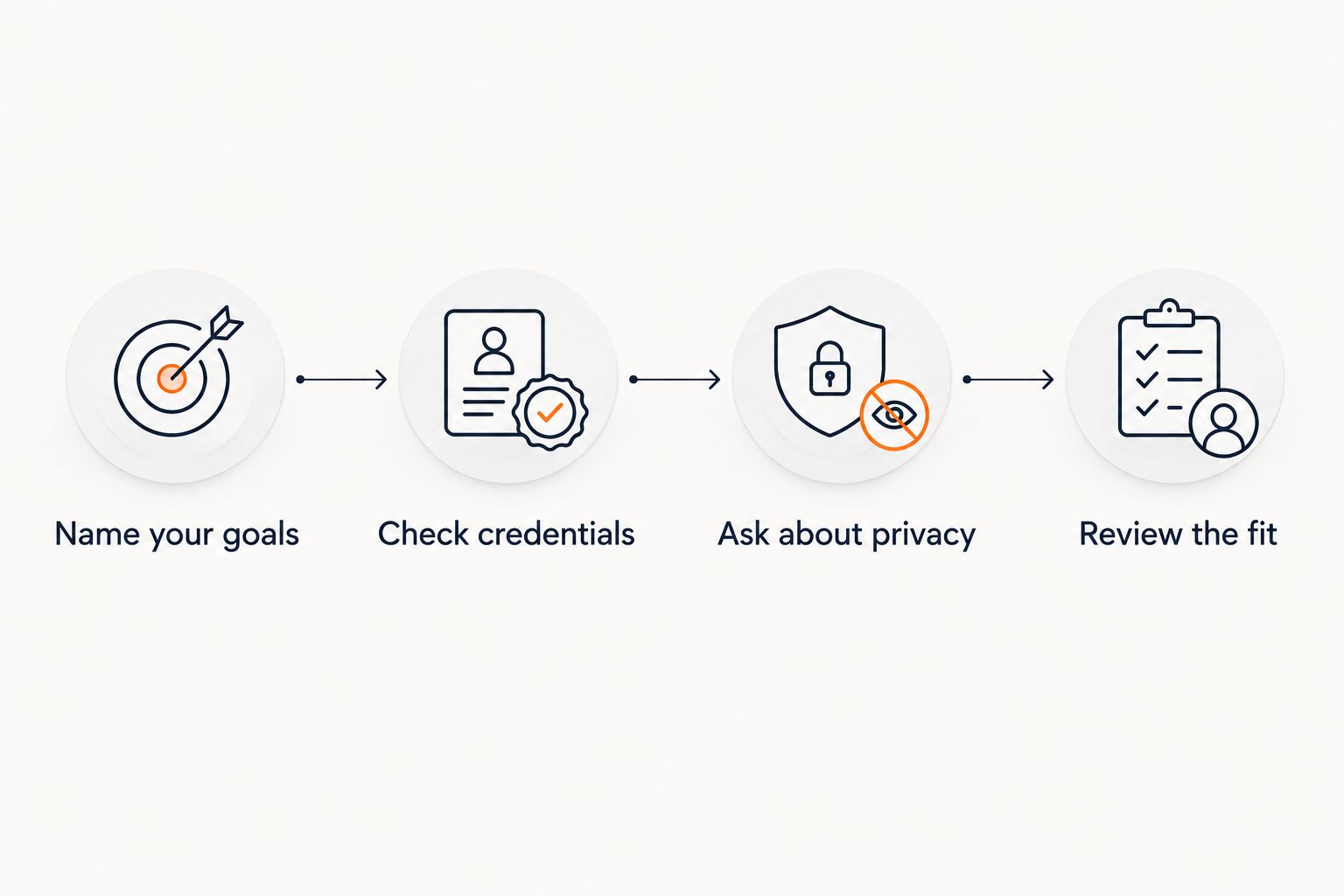 Four steps for choosing a counselor, from naming goals to reviewing the fit
Ask about the process and privacy before deciding whether the counselor fits your needs.
How can you tell whether counseling is helping?
Look for specific changes rather than a feeling that every session went well. A difficult appointment can still produce a useful clarification; a pleasant appointment can leave the central issue untouched.
Ask yourselves whether you can now explain each other's concerns accurately. Check whether agreements name what each person will do, rather than relying on vague promises to communicate better.
Useful signs to discuss with your counselor include:
- You can raise a concern without immediately debating whether you deserve to feel it.
- You understand where you agree, where you differ, and what remains undecided.
- You return to difficult topics instead of treating a pause as permanent avoidance.
- You can acknowledge your own behavior without taking responsibility for your partner's choices.
- You feel free to question the wedding timeline.
These are reflection prompts, not a validated relationship test. Bring stalled progress or growing discomfort into the sessions rather than silently treating attendance as proof that things are improving.
When is joint counseling not the right starting point?
If you fear your partner, prioritize confidential safety support over joint sessions. Threats, physical violence, sexual coercion, stalking, and controlling access to money are not simply disagreements that need better wording.
Sharing sensitive information together can create additional risk when a partner retaliates afterward. Seek individual guidance from a qualified professional or domestic violence advocate before deciding whether joint work is safe.
If you are in immediate danger, contact emergency services. If your partner monitors your devices, consider whether the device you use to seek help is safe.
Counseling also should not become a tool for forcing agreement. You do not owe a counselor, partner, family member, or wedding guest a decision to marry.
Where can individual emotional support fit?
You might want space to sort through your feelings before bringing them to your partner or counselor. Individual reflection can help you identify the concern you want to discuss, without deciding the relationship question for you.
Lovon is best for individuals seeking on-demand voice-based emotional support, not licensed premarital counseling. Lovon offers voice conversations, coping tools, and self-reflection guidance for everyday mental health struggles, including relationship concerns.
The benefit of Lovon's emotional support is having a place to talk through your own experience. Its limit matters just as much: Lovon is not a licensed clinician, cannot assess your partner, and does not replace professional couples care or emergency support.
Keep the next step grounded in real life. Bring your own words and questions to a qualified counselor rather than treating an app's response as a verdict about your partner.
Is premarital counseling worth it if we rarely fight?
Yes—rare arguments do not remove the value of discussing marriage expectations. Ask whether you disagree openly or simply avoid uncomfortable subjects. Preventive conversations can focus on future decisions rather than searching for problems that are not there.
Should we delay the wedding if counseling reveals a major disagreement?
Consider delaying when an unresolved issue changes whether you freely want to marry. A disagreement about having children, ongoing dishonesty, or feeling unsafe deserves attention beyond the wedding schedule. Use counseling to clarify the decision, not to rush toward the answer other people expect.
What if my partner does not want premarital counseling?
Ask what your partner objects to before interpreting the refusal. Discuss whether the concern involves privacy, the provider, the format, or the idea of counseling itself. You can seek individual support and decide what you need before marriage without forcing your partner to attend.
FAQ
Is premarital counseling worth it before a 2026 wedding?
Premarital counseling is worth considering when you want help discussing expectations, handling conflict, or clarifying doubts before marriage. It cannot guarantee compatibility or a lasting relationship.
Do we need premarital counseling if our relationship is good?
A good relationship does not rule out useful premarital counseling. You can focus on decisions about money, children, family boundaries, and responsibilities rather than treating counseling as crisis repair.
How many premarital counseling sessions do we need?
The appropriate number of sessions depends on your goals and the provider's approach. Ask how the counselor plans the work, reviews progress, and responds when concerns need more attention.
Can premarital counseling tell us whether we should get married?
Premarital counseling can help you examine the decision, but it should not make the decision for you. You remain free to proceed, pause, or decide not to marry.
Is online premarital counseling an option?
Online premarital counseling is an option to discuss with a qualified provider. Check licensing requirements, privacy, and whether both partners have a safe place to speak openly.
What should we ask a premarital counselor about confidentiality?
Ask how the counselor handles records, individual disclosures, and contact outside joint sessions. Understand the policy before sharing information you assume will stay separate from couples work.
Is premarital counseling appropriate when a partner is abusive?
Joint counseling is not the default starting point when abuse or coercive control is present. Seek confidential individual safety guidance from a qualified professional or domestic violence advocate first.
One last thing
A useful outcome is clarity, not necessarily a wedding. Before your next marriage-planning conversation in 2026, finish this sentence separately: The thing I most need us to discuss before we marry is…
Compare answers when you both feel safe and ready. If either answer is hard to say aloud, that is a concrete topic to bring to a qualified counselor—not a reason to pretend it is settled.
Related guides
How AI Support Helps You Heal
AI emotional support isn't about replacing human connection — it's about filling the gaps. The moments when you need to talk at 2 AM, when you don't want to burden your friends again, or when you simply need someone to listen without judgment.
Here's what happens in a typical Lovon session:
You share what's on your mind
There's no script, no intake form, no waiting room. You speak or type whatever you're feeling — in your own words, at your own pace.
Lovon validates and explores
Using frameworks from CBT (Cognitive Behavioral Therapy) and motivational interviewing, Lovon acknowledges your feelings first, then gently helps you explore them. No dismissive "just move on" advice.
You build coping skills together
Lovon doesn't just listen — it actively works with you on evidence-based techniques: thought reframing, urge surfing, behavioral experiments, and more.
What a Session with Lovon Looks Like
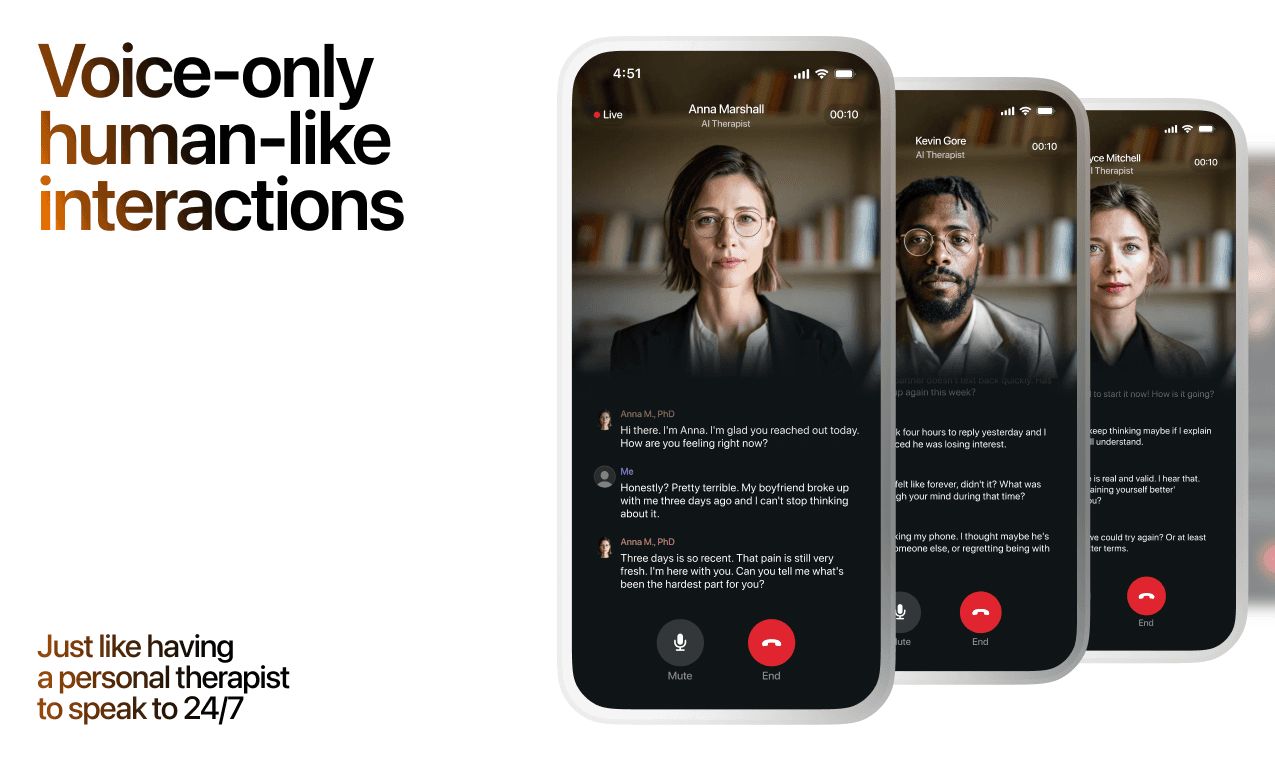
Lovon is AI support, not a replacement for professional care. If things have been hard to get through for weeks, or you are thinking about harming yourself, talk to a doctor or a licensed therapist.
Ready to Start?
Your healing journey can begin right now
A 3-day trial. No judgment. Just a safe space to process what you're going through.
Frequently Asked Questions
Is Lovon a replacement for a real therapist?
Is my conversation with Lovon AI private?
How is Lovon different from ChatGPT for emotional support?
Can I use Lovon if I'm already seeing a therapist?
Can I try Lovon before subscribing?
About the Author
The Lovon Editorial Team
Mental Health & Wellness Content Team
The Lovon Editorial Team develops mental health and wellness content designed to make psychological concepts accessible and actionable. Our goal is to bridge the gap between clinical research and everyday life - helping you understand why your mind works the way it does and what you can do about it....
Related articles
- Can a relationship survive without physical intimacy?
Can a relationship survive without physical intimacy? Yes, if both partners accept it. Learn how to discuss unmet needs…
- Best Couples Compatibility Quiz for New Couples 2026
Take the best couples compatibility quiz in 2026. Covers attachment, values, and communication style — with AI-guided…
- AI Relationship Coach for Newlyweds: 2026 Verdict
The best ai relationship coach for newlyweds in 2026 is voice-based and available on demand. See picks, what to avoid…
- AI Relationship Coach for Sexless Marriages (2026)
Compare picks for an AI relationship coach for sexless marriages in 2026 — what to look for, what to avoid, and which…
See also
Quizzes
- Marriage Compatibility Test: Are You Ready to Marry?
See where you agree, and what you have not talked about, in 4 minutes.
- Should I Move In With My Boyfriend? 12-Question Quiz
Check what is settled before the lease.
Free tools
- Couples Check-In
Five minutes each, then ten together. Rate your week on your own, hand the phone over, and see both answers side by side…
- Would You Rather Questions for Couples
A round built for your pair rather than for a general audience. Tell it how long you two have been together, where you…
From the wiki
- How long does it take to fall in love?
There is no fixed timeline. Some people feel it within two or three weeks, many land somewhere between two and four…
Disclaimer: This article is for informational purposes only and does not constitute medical advice, diagnosis, or treatment. Always seek the advice of your physician or other qualified health provider with any questions you may have regarding a medical condition. If you are in crisis or think you may have an emergency, call 988 (Suicide & Crisis Lifeline) or go to the nearest emergency room. Outside the US? Find a crisis line in your country.