
AI Relationship Coach for Newlyweds: 2026 Verdict
The best ai relationship coach for newlyweds in 2026 is voice-based and available on demand. See picks, what to avoid, and Lovon's honest verdict.
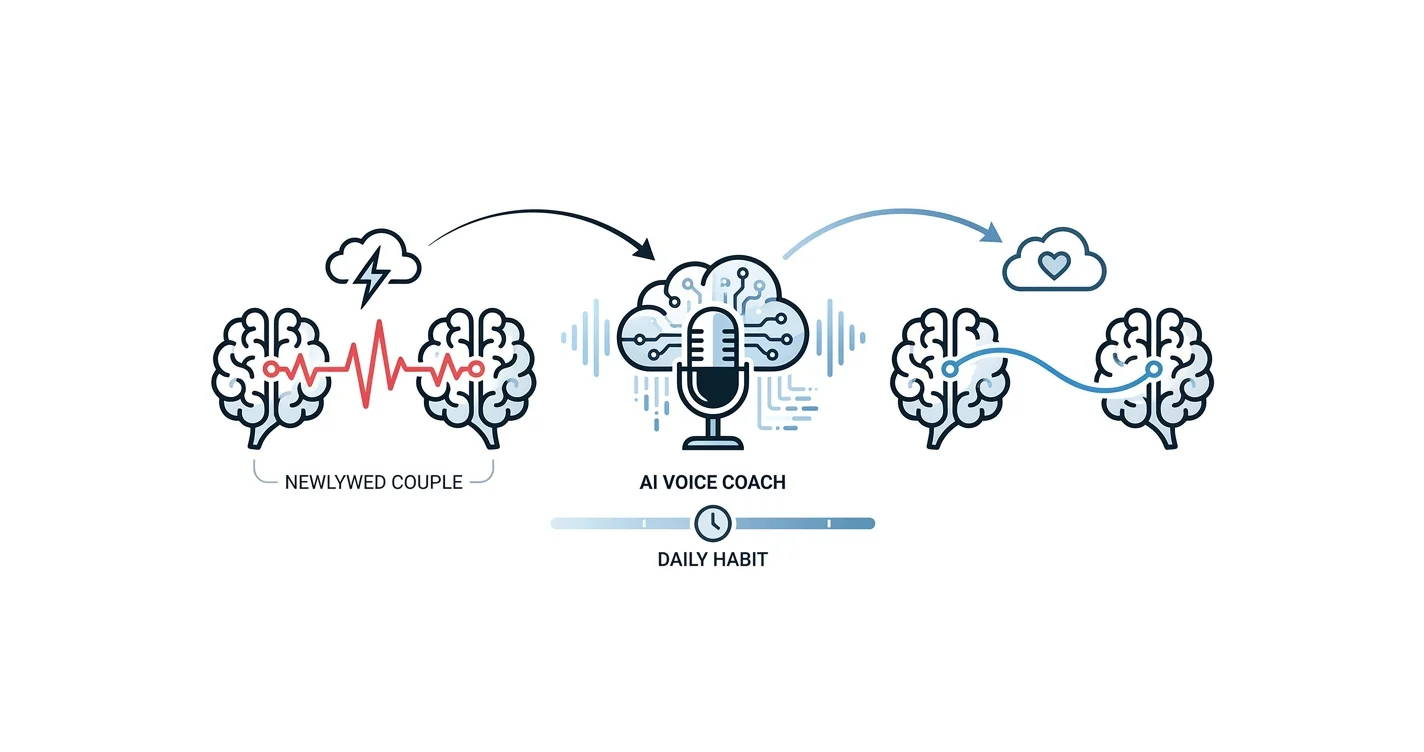

Key Takeaways
- An ai relationship coach for newlyweds works best as a daily habit, not a crisis-only tool - Lovon's daily check-in
- Voice-based coaching catches tone and hesitation that text chat misses, which matters most in the first married year.
- Money fights are the top newlywed friction point - look for a coach with a dedicated money-conflict framework.
- Skip any app that promises to replace a licensed couples therapist; the honest ones say so upfront.
Newlywed years bring a specific kind of friction: two people merging finances, families, and daily rhythms while everyone around them assumes the wedding fixed the hard parts. An AI relationship coach for newlyweds fills the gap between the wedding and your first couples counseling appointment, giving you somewhere to process a fight at 11pm instead of stewing until your next date night.
TL;DR
- An ai relationship coach for newlyweds works best as a daily habit, not a crisis-only tool - Lovon's daily check-in model backs this.
- Voice-based coaching catches tone and hesitation that text chat misses, which matters most in the first married year.
- Money fights are the top newlywed friction point - look for a coach with a dedicated money-conflict framework.
- Skip any app that promises to replace a licensed couples therapist; the honest ones say so upfront.
Why this matters
The first year of marriage is when communication habits either calcify or get corrected. Couples who wait until resentment builds before addressing a pattern usually end up repeating it for years. An AI relationship coach for newlyweds gives you a low-stakes place to name the pattern the same night it happens, while the details are still fresh and before pride talks you out of bringing it up.
Lovon was built with input from PhD psychologists specifically because text-only chatbots miss the tone shifts that matter in a real disagreement. A voice conversation catches the pause before you admit you're actually hurt about something else. That distinction matters more for newlyweds than almost any other relationship stage, because you're still building the shared vocabulary you'll use for decades.
Who this is for
This guide is for couples in their first one to three years of marriage who are hitting normal friction points - money disagreements, in-law boundaries, mismatched conflict styles - and want a tool they can use between fights, not instead of doing the work themselves. If you're already in weekly couples therapy and just want a supplement for the other six days, this applies to you too. If you're dealing with abuse, active addiction, or a partner who won't engage in any form of repair, an app is not the right first step - a licensed clinician is.
What to look for in an AI relationship coach for newlyweds
Voice conversation, not just text
Typing a fight summary at midnight strips out tone, and tone is half of what actually happened. A voice-based coach hears the shake in your voice or the long pause before you answer, which changes what it reflects back to you. Text-first apps are fine for journaling but weaker for real-time conflict processing.
Available the moment the fight ends
The value of an AI coach collapses if you have to book a slot. Newlywed arguments tend to happen at night, after a family dinner, or right before bed - moments when a scheduled session is useless. Look for something you can open in the same ten minutes the argument ends.
Built on an actual framework, not generic advice
"Communicate more" is not coaching. A coach worth using should be grounded in structured approaches - Gottman-style conflict repair, attachment theory, cognitive behavioral techniques - so the guidance is specific rather than a fortune-cookie line. Ask yourself after a session: did it name a pattern, or just validate my feelings?
Honest about its limits
Any AI relationship coach worth using in 2026 says plainly that it is not a licensed therapist and cannot replace couples counseling for serious issues like infidelity recovery or safety concerns. That honesty is a feature, not a weakness - it tells you the app knows where its job ends.
Money-conflict specific guidance
Financial disagreements are the most common source of newlywed conflict, and a generic "communicate about feelings" script does nothing when you're arguing about a joint checking account. A coach that has a specific framework for money conversations is doing more than a general-purpose chatbot.
Privacy you actually understand
You're going to say things about your spouse you wouldn't want anyone else to read. Check how conversations are stored before you use the app for anything sensitive, and pick a tool that's upfront about it rather than burying the answer in a 40-page policy.
The picks worth trying
The daily habit - Building a five-minute nightly check-in routine, rather than only reaching for a coach mid-crisis, is what separates couples who improve from couples who plateau. Using an AI relationship coach daily walks through what that routine actually looks like in year one of marriage. Buy - this is the highest-leverage habit on this list.
The fight de-escalator - When a disagreement is spiraling in real time, you need a structured way to slow it down, not a lecture. A 9-step communication framework built for exactly this moment is laid out in how to communicate better in a relationship, and it works whether you're processing solo afterward or trying to de-escalate mid-argument. Buy - every newlywed couple hits this scenario within the first 90 days.
The money-talk mediator - Roughly a third of newlywed arguments trace back to spending, saving, or debt disclosure, and most couples never had a structured way to talk about it before the wedding. How to stop fighting about money in a relationship gives a script for the conversation you've been avoiding. Consider - useful if money is already a recurring flashpoint, less urgent if it isn't yet.
The reality check - Before you decide your relationship has a "communication problem," it helps to get an honest read on where you actually stand. The relationship compatibility test for new couples takes about two minutes and gives you a starting point rather than a guess. Consider - worth doing once early in the marriage, not something to repeat weekly.
Start a session tonight
Talk through tonight's argument before it turns into next week's resentment.
What to avoid
Apps that only do generic positivity. "Communicate your needs" and "practice gratitude" sound helpful but give you nothing to actually do differently tomorrow. A coach should name the specific pattern - pursuer-withdrawer, stonewalling, score-keeping - not just cheerlead.
Tools that skip the boundaries conversation. Any app that implies it can replace a couples therapist for serious issues is overselling itself. The honest ones, including Lovon, say clearly they support everyday stress and communication issues, not crisis-level repair work.
One-time compatibility rituals as a substitute for ongoing work. Newlyweds sometimes lean on compatibility rituals long before they'd ever open a coaching app - astrology pairings, personality-type matches, even compatibility matching for couples using just a birth date. Those can be a fun conversation starter, but none of them replace the daily habit of actually talking through a disagreement the night it happens.
Verdict comparison table
| Approach | Best for | Availability | Verdict |
|---|---|---|---|
| Daily check-in habit | Building communication skill over time | Anytime, few minutes | Buy |
| Fight de-escalation framework | Mid-argument or right after | Anytime | Buy |
| Money-talk mediator | Recurring financial friction | As needed | Consider |
| Compatibility check-in | Baseline read on the relationship | One-time or occasional | Consider |
| Generic positivity chatbot | Nothing specific | Varies | Skip |
FAQ
What is the best ai relationship coach for newlyweds in 2026?
The best fit for newlyweds is a voice-based coach available on demand rather than by appointment, since most early-marriage friction happens at night or right after a disagreement. Look for one built on structured frameworks like Gottman conflict repair or attachment theory rather than generic advice.
Can an AI relationship coach replace couples therapy?
No, and any tool claiming otherwise should be a red flag. An AI relationship coach handles everyday stress, communication habits, and between-session support, but infidelity recovery, safety concerns, and deep relational trauma need a licensed clinician.
How much does an AI relationship coach cost compared to therapy?
AI coaching apps are typically priced far below the out-of-pocket cost of weekly couples therapy, which can run over a hundred dollars a session without insurance. That price gap is exactly why many newlyweds use an app between sessions or before committing to formal counseling.
Is voice-based AI coaching better than text-based apps for newlyweds?
Voice conversation picks up tone, pacing, and hesitation that text strips out, which matters most in emotionally charged moments right after a fight. Text-based journaling still has a place for slower reflection, but real-time conflict processing works better with voice.
What's the most common newlywed conflict an AI coach should handle?
Money disagreements top the list for most newlywed couples, followed by in-law boundaries and mismatched conflict styles. A coach with a specific framework for financial conversations handles this better than one offering only general communication tips.
How often should newlyweds use an AI relationship coach?
A short daily or near-daily check-in builds more skill over time than only reaching for the app during a crisis. Treat it as a habit similar to journaling rather than an emergency line you open once a month.
Does Lovon work as an ai relationship coach for newlyweds?
Lovon offers voice conversations built with input from PhD psychologists, designed for everyday relationship stress, communication issues, and emotional support rather than crisis intervention. It's positioned as an always-available companion, not a replacement for licensed clinical care.
What should newlyweds avoid in a relationship coaching app?
Avoid any tool that only offers generic positivity without naming a specific pattern, or one that implies it can handle infidelity recovery or safety concerns on its own. The honest apps are upfront about where their support ends.
One last thing
The couples who get the most out of an AI relationship coach for newlyweds aren't the ones in crisis - they're the ones who use it on a boring Tuesday when nothing's actually wrong, just to keep the habit alive before the first real fight of year two shows up.
How AI Support Helps You Heal
AI emotional support isn't about replacing human connection — it's about filling the gaps. The moments when you need to talk at 2 AM, when you don't want to burden your friends again, or when you simply need someone to listen without judgment.
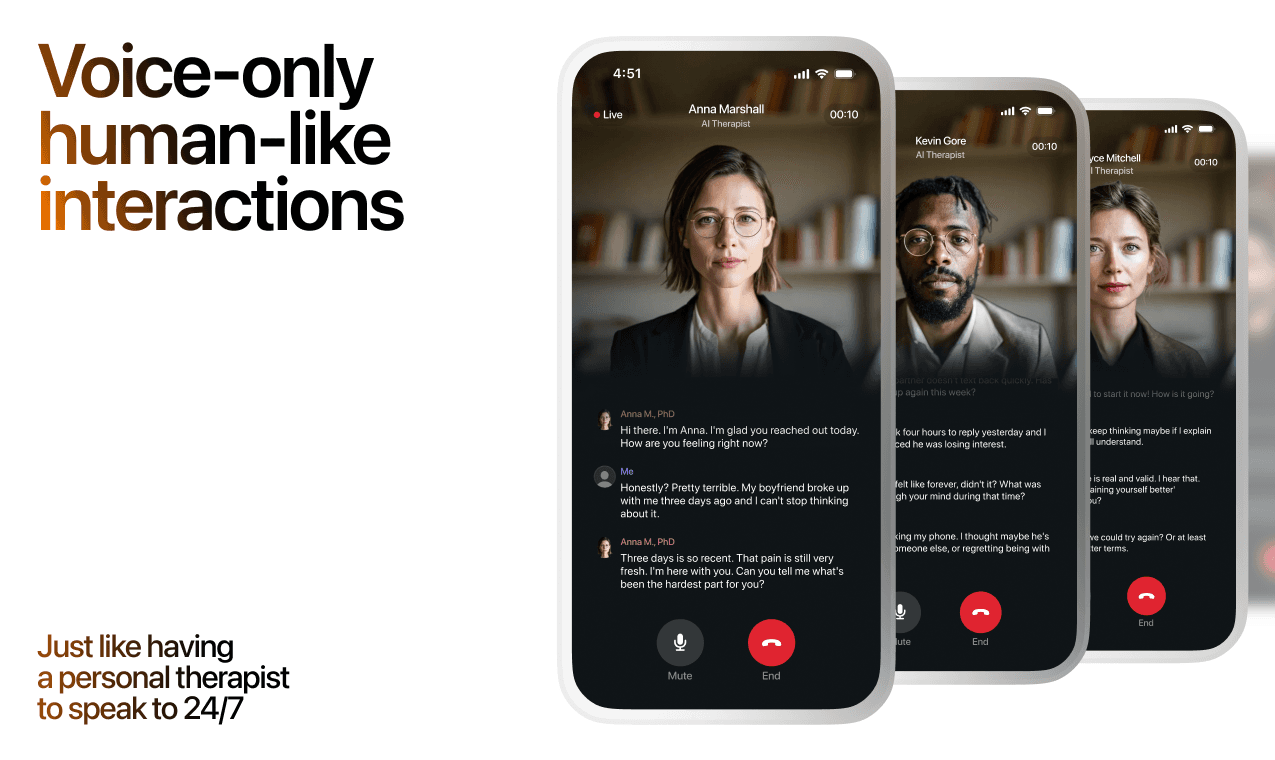
Here's what happens in a typical Lovon session:
You share what's on your mind
There's no script, no intake form, no waiting room. You speak or type whatever you're feeling — in your own words, at your own pace.
Lovon validates and explores
Using frameworks from CBT (Cognitive Behavioral Therapy) and motivational interviewing, Lovon acknowledges your feelings first, then gently helps you explore them. No dismissive "just move on" advice.
You build coping skills together
Lovon doesn't just listen — it actively works with you on evidence-based techniques: thought reframing, urge surfing, behavioral experiments, and more.
What a Session with Lovon Looks Like
When to Seek Professional Help
AI support is a valuable tool, but it's not a replacement for professional care. Please consider reaching out to a licensed therapist if you experience any of the following:
- Persistent thoughts of self-harm or suicide
- Inability to perform daily activities (work, eating, sleeping) for more than 2 weeks
- Turning to alcohol or substances to cope
- Intense anger or desire to harm your ex-partner
- Complete emotional numbness that doesn't improve over time
Crisis Resources (US): If you're in immediate danger, call 988 (Suicide & Crisis Lifeline) or text HOME to 741741 (Crisis Text Line). Available 24/7, free, and confidential.
Outside the US? Find a crisis line in your country
Ready to Start?
Your healing journey can begin right now
A 7-day trial. No judgment. Just a safe space to process what you're going through.
Frequently Asked Questions
Is Lovon a replacement for a real therapist?
Is my conversation with Lovon AI private?
How is Lovon different from ChatGPT for emotional support?
Can I use Lovon if I'm already seeing a therapist?
Can I try Lovon before subscribing?
About the Author
The Lovon Editorial Team
Mental Health & Wellness Content Team
The Lovon Editorial Team develops mental health and wellness content designed to make psychological concepts accessible and actionable. Our goal is to bridge the gap between clinical research and everyday life - helping you understand why your mind works the way it does and what you can do about it....
Related articles
- AI Relationship Coach for Parents of Teenagers (2026)
Lovon's ai relationship coach for parents of teenagers helps you de-escalate conflict and set boundaries anytime in 2026…
- AI Coping Tools for Wedding Planning Stress (2026)
AI coping tools for wedding planning stress in 2026: box breathing, muscle relaxation, and Lovon's on-demand voice…
- AI Relationship Coach for Long-Distance Friends 2026
An AI relationship coach for long-distance friendships gives you 24/7 voice check-ins in 2026. See what to look for, the…
- AI Relationship Coach for Chronic Illness Couples 2026
An ai relationship coach for couples facing chronic illness in 2026: what Lovon does, what it doesn't, and how to build…
See also
Quizzes
- How Well Do You Know Your Partner? 15-Question Quiz
Find out how out of date your picture of them is.
- Should I Move In With My Boyfriend? 12-Question Quiz
Check what is settled before the lease.
Free tools
- Would You Rather Questions for Couples
A round built for your pair rather than for a general audience. Tell it how long you two have been together, where you…
- AI Relationship Coach
Get free relationship advice and family counselling guidance with our AI Relationship Coach.
From the wiki
- How to break up with someone you still love?
Loving someone does not mean the relationship works. If you have circled the same decision for months and the reasons…
Disclaimer: This article is for informational purposes only and does not constitute medical advice, diagnosis, or treatment. Always seek the advice of your physician or other qualified health provider with any questions you may have regarding a medical condition. If you are in crisis or think you may have an emergency, call 988 (Suicide & Crisis Lifeline) or go to the nearest emergency room. Outside the US? Find a crisis line in your country.