
How Sleep Affects Mood (and the Sleep and Anxiety Loop)
How sleep affects mood, anxiety and depression: what one bad night does, why sleep and anxiety feed each other, and how to tell which one is driving yours.

Key Takeaways
- After short or broken sleep, positive feelings drop most reliably and anxiety rises, which is why a bad night can make a normal day feel heavy.
- Sleep and anxiety feed each other: worry keeps you awake, and even modestly shorter nights predict more anxiety the next day.
- Track sleep and mood side by side for two or three weeks to see which one is leading, and see a doctor if low mood or insomnia lasts more than a couple of weeks.
Sleep affects mood quickly and in both directions. After a short or broken night, most people feel less joy and calm, get irritated faster and feel more anxious the next day, and a run of bad nights makes low moods and worry harder to shake. Poor mood and anxiety then make sleep worse, which is why sleep and anxiety so often travel together.
What one bad night tends to do the next day:
| After short or broken sleep | How it feels | What the research shows |
|---|---|---|
| Fewer good feelings | Flat, less interested, harder to enjoy things | Positive emotion drops after every kind of sleep loss studied |
| More anxiety | On edge, worried, restless | Anxiety symptoms rise, even after modestly shorter nights |
| Shorter fuse | Snapping, crying more easily, small things feel big | The brain's brakes on emotion work less well |
| Mood hit harder than thinking | You may still do your job but feel worse doing it | Mood is affected more than thinking or motor skills |
If you want to see this in your own life rather than take it on trust, the mood tracker logs your mood in one tap a day and lets you tag short nights, so after a few weeks you can see whether your low days line up with your bad sleep.
Why does a bad night put you in a bad mood?
The best evidence comes from experiments that take sleep away on purpose and measure what happens. A 2024 meta-analysis pulled together 154 of them, covering 5,717 people. Every form of sleep loss, whether a full night awake, several shortened nights or sleep broken up by awakenings, reduced positive emotion and increased anxiety symptoms.[1] Results for negative emotions and depressive symptoms were more mixed and depended on the type of sleep loss.
That detail matters. A bad night does not always make you sad. More often it takes away the good stuff: interest, warmth, the sense that things are fine. That is why a short-sleep day can feel joyless even when nothing went wrong.
An older meta-analysis reached a similar conclusion from a different angle: sleep deprivation affected mood more than it affected thinking or physical performance.[4] You can push through a meeting on five hours of sleep. Staying patient with your kids or your partner is the harder part.
Brain imaging helps explain why. In research from UC Berkeley, the jump in anxiety after a sleepless night was linked to lower activity in the medial prefrontal cortex, a region that helps regulate emotional responses, and to its weaker connections with deeper emotional regions. Deep non-REM sleep, the slow-wave kind, seemed to calm those same networks overnight.[2] Put simply, sleep helps reset the brakes.
Sleep and anxiety: how the loop works
Anxiety and sleep feed each other in a way that is easy to get stuck in:
- Worry or a racing mind makes it hard to fall asleep or stay asleep.
- You sleep less, or more lightly.
- Next day, anxiety is higher and harder to talk yourself out of.
- That night, you worry about not sleeping on top of everything else.
The second step is not only about all-nighters. The same Berkeley work found that even modest night-to-night reductions in sleep, the kind most people have regularly, predicted higher anxiety the following day.[2] Losing 45 minutes on a Tuesday can genuinely make Wednesday more anxious.
The good news is that the loop can be broken from either side. Calming the body at night helps sleep, and better sleep lowers the next day's baseline anxiety. For the night side, how to calm anxiety at night when you cannot sleep and how to stop overthinking at night have step-by-step methods, and the 4-7-8 breathing timer is a quick place to start. For the day side, can lack of sleep make anxiety worse explains the effect in plain terms.
Sleep and depression
Depression changes sleep: some people wake very early and cannot get back to sleep, others sleep far more than usual and still feel exhausted. The arrow also points the other way. A meta-analysis of 21 long-term studies found that people with insomnia had roughly twice the risk of developing depression later, compared with people without sleep problems.[3]
That is a risk, not a verdict. Most people with insomnia do not develop depression. It does mean that ongoing trouble sleeping deserves real attention rather than "I will sleep when things calm down." A structured approach called CBT for insomnia (CBT-I) is designed for exactly that, and a doctor can point you to it. You can read more about insomnia and depression on their own pages.
See a doctor or a licensed therapist if, for two weeks or more, you feel down or empty most of the day, have lost interest in things you usually enjoy, or your sleep has changed a lot in either direction.
Is it the sleep or the mood? How to tell
Because each one drives the other, it helps to work out which is leading for you:
| What you notice | What it suggests | What to try first |
|---|---|---|
| Your mood dips after short nights and recovers after good ones | Sleep is driving your mood | Protect your sleep window and pay back sleep debt |
| You cannot sleep because your mind will not stop | Anxiety or stress is driving your sleep | Wind-down routine, worry time earlier in the evening, stress level test |
| You choose to stay up even though you are tired | Bedtime habits | Revenge bedtime procrastination |
| You sleep a lot and still feel low or exhausted | Low mood, burnout or a medical cause | A doctor visit to rule out medical causes |
| Your mood sinks every fall as mornings get darker | A seasonal pattern | Winter blues |
What helps, in order
Keep your wake-up time steady
A consistent wake-up time, seven days a week, anchors your body clock. It makes falling asleep at night easier and keeps weekend lie-ins from turning Monday into jet lag.
Plan around a bad night instead of fighting it
After a short night, expect a shorter fuse and fewer good feelings, and adjust. Do not have the big conversation, make the big decision or read the stressful email at 11 p.m. on five hours of sleep. Remind yourself that today's gloom is partly chemistry.
Get light early and keep evenings dim
Daylight soon after you wake helps your body clock know it is morning, which helps you feel sleepy at the right time later. In the evening, lower the lights and put screens away 30 minutes before bed.
Give worry an earlier slot
Spend ten minutes in the early evening writing down what is on your mind and the next step for each item. Getting them onto paper means they are not waiting for you at midnight.
Get up if you cannot sleep
If you have been lying awake for what feels like 20 minutes or more, get up, go somewhere dim and do something calm until you feel sleepy. This is a standard part of CBT for insomnia and helps your brain link bed with sleeping, not with worrying.
Track it
You do not need a lab to see how sleep affects your mood. You need two numbers a day for a few weeks.
- Each morning, note how many hours you slept and whether the night was broken. A rough estimate is fine.
- Each evening, rate your mood. The mood tracker takes one tap and builds a year in pixels you can scroll back through, and tags let you mark things like "short night," "late screen" or "alcohol."
- Or do both in one place. The 60-second mental health check-in covers sleep, mood, energy, stress and connection together and shows you the week at a glance.
- After two or three weeks, compare. Look at your mood on days after your shortest nights versus your longest. Most people find a clear difference, and seeing it in your own data is far more motivating than any article.
- Use the sleep calculator to set a bedtime that actually fits your wake-up time once you know your pattern.
If the tracking shows low mood most days regardless of how you slept, the CORE-10 check is a standard 10-question measure of psychological distress you can retake weekly, and a high or rising score is a good reason to book a doctor's appointment.
Seeing the pattern is one thing, and changing the night that causes it is another. If you already know a bad night will wreck tomorrow and you are lying there anyway, tell Lovon, an AI coach you talk to by voice, what is keeping you up, and talk it down before it turns into the next day's mood.
How AI Support Helps You Heal
AI emotional support isn't about replacing human connection — it's about filling the gaps. The moments when you need to talk at 2 AM, when you don't want to burden your friends again, or when you simply need someone to listen without judgment.
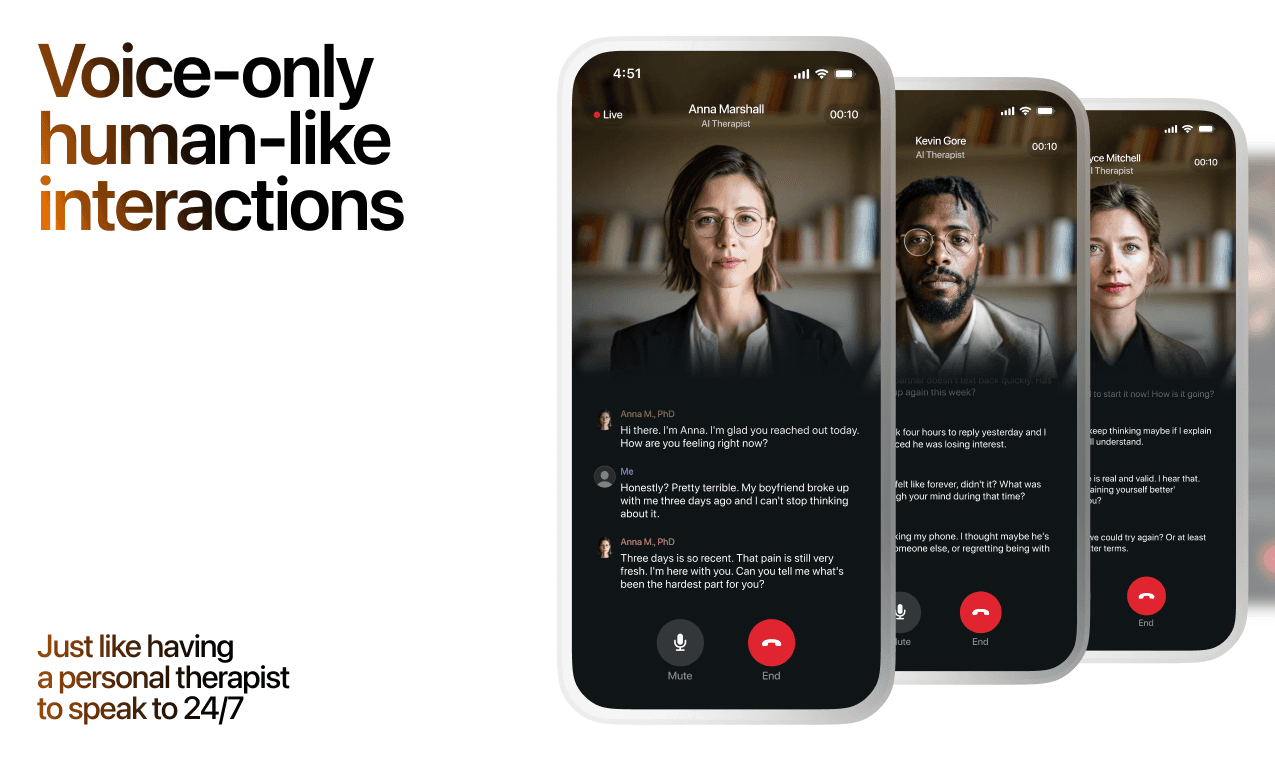
Here's what happens in a typical Lovon session:
You share what's on your mind
There's no script, no intake form, no waiting room. You speak or type whatever you're feeling — in your own words, at your own pace.
Lovon validates and explores
Using frameworks from CBT (Cognitive Behavioral Therapy) and motivational interviewing, Lovon acknowledges your feelings first, then gently helps you explore them. No dismissive "just move on" advice.
You build coping skills together
Lovon doesn't just listen — it actively works with you on evidence-based techniques: thought reframing, urge surfing, behavioral experiments, and more.
What a Session with Lovon Looks Like
Lovon is AI support, not a replacement for professional care. If things have been hard to get through for weeks, or you are thinking about harming yourself, talk to a doctor or a licensed therapist.
Ready to Start?
Your healing journey can begin right now
A 3-day trial. No judgment. Just a safe space to process what you're going through.
Frequently Asked Questions
How does sleep affect mood?
Can lack of sleep cause anxiety?
Can poor sleep cause depression?
How many hours of sleep do you need for a good mood?
Why am I so emotional when I am tired?
Does oversleeping affect mood?
How long does it take for mood to improve after better sleep?
Sources
About the Author
The Lovon Editorial Team
Mental Health & Wellness Content Team
The Lovon Editorial Team develops mental health and wellness content designed to make psychological concepts accessible and actionable. Our goal is to bridge the gap between clinical research and everyday life - helping you understand why your mind works the way it does and what you can do about it....
Related articles
- How to Improve Your Mental Health: A Practical Plan
How to improve your mental health step by step: the daily basics that matter most, how to track how you are doing, and…
- Rumination and Depression: How to Break the Loop (2026)
Rumination and depression fuel each other. These 8 evidence-based steps interrupt the cycle, reduce repetitive negative…
- Low HRV: What It Means, Common Causes and When to Worry
Low HRV explained: what counts as low for you and for your age, why HRV suddenly drops, what a low baseline can mean…
- How to Improve HRV: What Works and How Long It Takes
How to improve HRV with habits that have evidence behind them: steady sleep, less evening alcohol, slow breathing…
See also
Quizzes
- Overthinking Test: Am I an Overthinker? 12-Question Quiz
See which overthinking loop runs you, in 3 minutes.
- Empath Test: Do Other People's Moods Become Yours?
See how much of other people's moods you take on.
Free tools
- Gratitude Journal
Each evening, write down three things that went well and why each one happened. Every note drops into a jar that fills…
- AI Anxiety Coach
This is a free AI anxiety coach you can use on this page. Tell it what you are anxious about, whether it is a thought…
From the wiki
- Why do I feel lonely all of a sudden?
Sudden loneliness usually traces back to something that quietly ended in the last few months: a routine, a shared class…
Disclaimer: This article is for informational purposes only and does not constitute medical advice, diagnosis, or treatment. Always seek the advice of your physician or other qualified health provider with any questions you may have regarding a medical condition. If you are in crisis or think you may have an emergency, call 988 (Suicide & Crisis Lifeline) or go to the nearest emergency room. Outside the US? Find a crisis line in your country.