
How to Rest When You Cannot Switch Off: 7 Steps
How to rest properly: match rest to what is tired, switch off from work in your head, take breaks that work, and rest without guilt. Steps and scripts.

Key Takeaways
- Sleep is only one kind of rest. A busy mind, overloaded senses or emotional strain each need a different kind.
- Research on recovery from work points to four experiences that help: mental detachment, relaxation, absorbing non-work activities and control over your own time.
- Short breaks during the day reduce fatigue and boost energy, so rest does not have to wait for the weekend.
To rest properly, match the rest to what is tired: sleep for a tired body, a break from thinking for a busy mind, quiet for overloaded senses and honest company for emotional strain. Real rest also means switching off from work in your head, not only on your calendar. Start with short breaks during the day and one protected evening a week.
- Ask what is tired: your body, mind, emotions, senses or social energy.
- Take a five to ten minute break away from screens every couple of hours.
- End your workday with a short ritual that tells your brain you are done.
- Do something absorbing that has nothing to do with work.
- Keep one evening a week with nothing planned.
- Rest without earning it first.
- After a week, notice which rest actually left you refreshed.
Why don't you feel rested even after sleeping?
Because sleep is only one kind of rest. If your body is tired, sleep fixes it. But if your mind has been switched on all day, or you have spent hours being polite to people, or your senses have been flooded with screens and noise, eight hours of sleep can still leave you drained.
A popular way to think about this splits rest into seven types: physical, mental, emotional, social, sensory, creative and spiritual. You do not need to follow the framework exactly, but the idea is useful. Different kinds of tiredness need different kinds of rest. The types of rest quiz shows which kind you are shortest on and gives ideas for five minutes, an evening and a weekend.
A quick way to tell:
- Heavy limbs, yawning, low energy: physical rest. Sleep, naps, gentle movement.
- Racing thoughts, cannot concentrate: mental rest. Breaks from thinking, a brain dump, a walk.
- Tired of pretending you are fine: emotional rest. Time with someone you can be honest with.
- Snappy, overstimulated, everything is too loud: sensory rest. Quiet, dim light, screens off.
- Drained by people: social rest. Time alone or with people who are easy to be around.
How do you rest your mind when it will not switch off?
A mind that keeps working after work is one of the most common reasons rest does not feel restful.
Research on recovery from work describes four experiences that help people unwind. The first is psychological detachment, meaning not thinking about work during time off. The other three are relaxation, mastery (doing something absorbing or challenging that is not work) and control (choosing what you do with your own time).[1] If your evenings have none of these, that is the place to start.
Close the day on purpose. Before you stop working, write down the three things you will do first tomorrow and anything you are worried about forgetting. Then close the laptop and say, "Done for today." This simple ritual tells your brain it can stop rehearsing.
Empty your head. If thoughts keep circling, write them all down. The brain dump tool helps you sort them into do, schedule or let go, so you are not carrying them into the evening.
Choose absorbing over passive. Paradoxically, an activity that takes some focus, like cooking a new recipe, playing an instrument, gardening or a puzzle, often rests your mind better than lying on the sofa, because it gives your attention somewhere else to go.
Get outside. A walk without your phone, or with music instead of messages, helps many people switch off.
How do you rest during a busy day?
Rest does not have to wait for the weekend. A meta-analysis of 22 study samples found that micro-breaks, short breaks of up to about ten minutes between tasks, had a small but clear effect in boosting energy and reducing fatigue.[2]
What makes a good short break:
- Get away from the screen. Checking another app is not a break for your eyes or your mind.
- Move. Stand, stretch, walk to get water, climb a flight of stairs.
- Look far away. Out of a window if you can.
- Breathe. A minute of slow breathing with a long exhale.
Try one every 60 to 90 minutes. Setting a gentle reminder helps at first.
How do you rest without feeling guilty?
Many people find rest uncomfortable. If you grew up valuing hard work, or you are surrounded by a busy culture, doing nothing can feel lazy, and the guilt ruins the rest.
Reframe it. Rest is maintenance, not a reward. You charge your phone before it dies, not after you have earned it.
Schedule it. Put rest in your calendar like any other commitment: "Saturday 2 to 5 pm, nothing." When rest is a plan, it feels less like slacking.
Notice the guilt and rest anyway. "I'm feeling guilty about not working. That's a habit, not a fact." Then carry on.
Use a script for other people. "I'm keeping Sunday free this week. I'm not up for plans." You do not owe anyone more explanation than that.
If guilt about rest connects to always putting others first, the people pleaser quiz may show you a pattern.
How do you rest emotionally and socially?
Emotional rest means time when you do not have to manage anyone else's feelings or pretend you are fine. That could be an hour with a friend you can be completely honest with, a session of journaling, or simply saying "I'm not okay today" to someone who can hear it.
Social rest is not only about being alone. It is about spending your social time with people who are easy to be with, and protecting time to recover after big social events. If social plans regularly leave you drained, check your social battery and see how to recharge your social battery for specific ways to refill it.
How do you rest when you have no free time?
Parents of young children, carers and people working two jobs often read advice about rest and laugh. When there is no free evening, rest has to come in smaller pieces.
- Use transitions. Sit in the car for three minutes before going inside. Take the long way back from the shops. Those minutes count.
- Lower the bar. Rest does not have to be a bath and a book. Five minutes on the back step with a cup of tea is rest.
- Trade time. If you live with a partner, agree on one protected hour each per week when the other one covers everything. "Can we each take one hour off on Saturday? You take the morning, I'll take the afternoon."
- Cut one task. Look at the week and find one thing that can be dropped, delayed or done less well. The mental load test helps if the planning at home falls mostly on you.
Small rests add up. A few minutes several times a day can do more than one rare day off that never comes.
How do you plan a restful weekend?
A weekend packed with errands, social plans and catch-up chores can leave you more tired than the week.
- Leave space. Keep at least half a day with nothing planned.
- Mix types of rest. Some sleep, some movement, some time with people, some time alone.
- Do one absorbing thing. A hobby, a long walk, a project you enjoy.
- Limit catch-up. Pick the two most important chores and let the rest wait.
- Protect Sunday evening. Prepare for Monday early, then switch off.
Use the energy audit to see what drains you and what charges you across a week, and plan more of the charging things into your days off. The dopamine menu helps you build a list of small things that actually lift you, so a free afternoon does not default to scrolling.
What is the most common mistake when trying to rest?
Treating scrolling as rest. It feels easy, but feeds keep your brain taking in new information, comparing and reacting. Most people feel more tired after an hour on their phone, not less. Late-night scrolling also cuts into sleep, a pattern known as revenge bedtime procrastination.
The second most common mistake is waiting until you are exhausted to rest. Rest works best as a regular habit, not an emergency repair.
When is tiredness about more than rest?
If you feel exhausted most days for several weeks despite resting, see a doctor. Tiredness can have medical causes, like anemia, thyroid problems or sleep disorders.
If the exhaustion is tied to work and comes with cynicism and feeling less effective, it may be burnout. Rest helps with burnout but rarely fixes it on its own, because the load that caused it is still there. Take the burnout test and see how to recover from burnout. If stress is the bigger problem, how to reduce stress covers how to cut the load as well as recover from it.
Sometimes it helps to say out loud what your week has really been like and where rest could actually fit. Lovon, an AI coach you talk to by voice, can help you plan rest that matches what is tired.
How AI Support Helps You Heal
AI emotional support isn't about replacing human connection — it's about filling the gaps. The moments when you need to talk at 2 AM, when you don't want to burden your friends again, or when you simply need someone to listen without judgment.
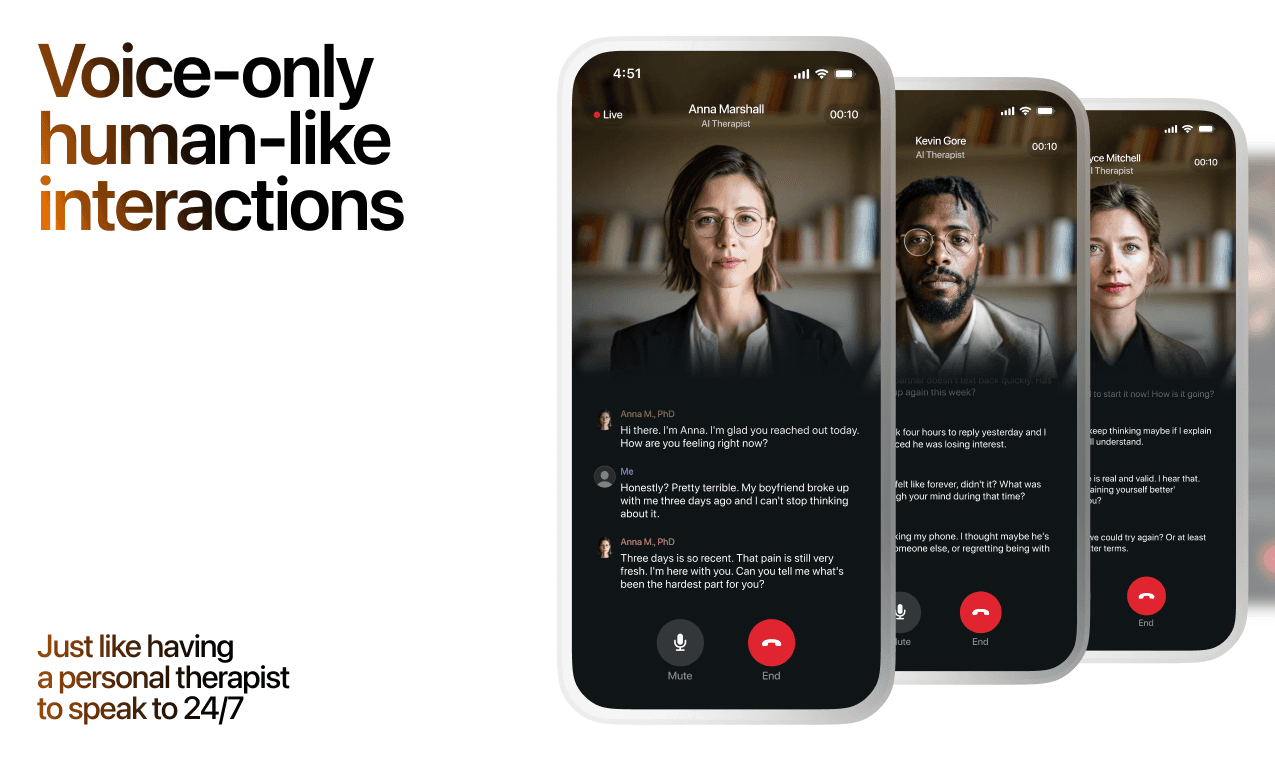
Here's what happens in a typical Lovon session:
You share what's on your mind
There's no script, no intake form, no waiting room. You speak or type whatever you're feeling — in your own words, at your own pace.
Lovon validates and explores
Using frameworks from CBT (Cognitive Behavioral Therapy) and motivational interviewing, Lovon acknowledges your feelings first, then gently helps you explore them. No dismissive "just move on" advice.
You build coping skills together
Lovon doesn't just listen — it actively works with you on evidence-based techniques: thought reframing, urge surfing, behavioral experiments, and more.
What a Session with Lovon Looks Like
Lovon is AI support, not a replacement for professional care. If things have been hard to get through for weeks, or you are thinking about harming yourself, talk to a doctor or a licensed therapist.
Ready to Start?
Your healing journey can begin right now
A 3-day trial. No judgment. Just a safe space to process what you're going through.
Frequently Asked Questions
How do I rest when I cannot relax?
Why do I still feel tired after resting?
What are the 7 types of rest?
Is scrolling on your phone rest?
How do I rest without feeling guilty?
How long should I rest when I am exhausted?
Sources
About the Author
The Lovon Editorial Team
Mental Health & Wellness Content Team
The Lovon Editorial Team develops mental health and wellness content designed to make psychological concepts accessible and actionable. Our goal is to bridge the gap between clinical research and everyday life - helping you understand why your mind works the way it does and what you can do about it....
Related articles
- How to Ask for Emotional Support Without Feeling Needy (2026)
How to ask for emotional support without feeling needy in 2026: name the need, bound the ask, pick the right person…
- Self-Sabotaging Relationships: Why It Happens (2026)
Self-sabotaging relationships explained: the trigger pattern behind it and a 6-step process to interrupt it in 2026…
- People Pleasing Trauma Response: How to Stop It in 2026
People pleasing trauma response explained: it's the fawn response, not weakness. Six steps to stop it in 2026, plus what…
- How to Flirt: What to Say, Text, and Do (Even If Shy)
How to flirt with confidence and respect: what to say in person and over text, lines that work and why, reading…
See also
Quizzes
- Am I Codependent? 12-Question Self-Check
See how much of you is left over, in 2 minutes.
- Guilt Test: Do I Have a Guilt Complex? Excessive Guilt Quiz
See whether your guilt repairs or just hurts.
Free tools
- How to End a Friendship Without a Scene
A chat for working out how to end a friendship clearly, without a grievance list or a slow ghost. Tell it how long you…
- List of Emotions
Every feeling word here has a plain meaning, a family, and a note on how much energy and pleasantness it carries. Search…
From the wiki
- Why do I feel sad when I'm alone?
Being alone does not create the sadness. It removes the noise that was keeping it out of earshot, so whatever queued up…
Disclaimer: This article is for informational purposes only and does not constitute medical advice, diagnosis, or treatment. Always seek the advice of your physician or other qualified health provider with any questions you may have regarding a medical condition. If you are in crisis or think you may have an emergency, call 988 (Suicide & Crisis Lifeline) or go to the nearest emergency room. Outside the US? Find a crisis line in your country.