
Mental Fatigue: Symptoms, Causes and How to Recover
Mental fatigue and mental exhaustion symptoms explained: how it differs from tiredness and burnout, what causes it, and what actually helps you recover.

Key Takeaways
- Mental fatigue is the drained, foggy state that builds after long stretches of focusing, deciding or managing emotions; it makes concentration harder and pushes you toward the easiest option.
- Short breaks reliably boost energy and reduce fatigue, but recovering from very demanding work usually takes longer breaks, real rest and a good night of sleep.
- If rest and sleep do not fix it after a few weeks, or it comes with physical exhaustion, low mood or cynicism about work, it may be something more, such as burnout, depression or a health problem.
Mental fatigue is the drained, foggy feeling that builds after long stretches of thinking, focusing, deciding or managing emotions. Your body may feel fine, but concentrating gets harder, small tasks feel like a lot, and you start reaching for the easiest option. A proper break and a good night's sleep usually fix it. If they do not, something bigger may be going on.
Mental exhaustion symptoms to look for:
- You reread the same sentence or email several times.
- Thinking feels slow, and words are harder to find.
- You forget things you would normally remember.
- Small tasks feel huge, so you put them off.
- You get irritable or short with people.
- You make quicker, easier choices than you normally would.
- Exercise or chores feel harder than usual.
- You feel flat, detached or unmotivated.
- Headaches, eye strain, or trouble switching off at night.
To work out where your fatigue is coming from, the energy audit maps which parts of your week drain you and which charge you back up, so you can see whether the problem is the work itself, the people, the constant switching or the lack of recovery.
What is mental fatigue?
Mental fatigue is a state, not a trait, that follows prolonged mental effort. It is not the same as being sleepy, though the two often travel together.
One influential explanation is that mental fatigue is a cost-benefit signal. The brain keeps weighing the expected reward of continuing a task against the energy it costs, and when the cost seems to outweigh the reward, motivation drops and you want to stop.[1] That fits a familiar experience: you can be "too tired" to finish a report and still have plenty of energy for a show you love.
There is also evidence of a physical side. In a study that tracked people through about a workday of either hard or easy mental tasks, the hard-work group ended the day with more glutamate, a chemical messenger, in a part of the prefrontal cortex used for cognitive control. They also shifted toward options that required less effort and paid off sooner.[2] In plain terms, after a heavy day of thinking, your brain finds hard choices more costly, which is why you order takeout, skip the workout and put off the difficult email.
Mental fatigue, tiredness, burnout or depression?
These overlap, and it helps to know which one you are dealing with:
| What drains you | What it feels like | What fixes it | |
|---|---|---|---|
| Mental fatigue | Long focus, decisions, emotional work | Foggy, slow, easily distracted | Breaks, rest, sleep |
| Physical tiredness | Activity, short sleep | Heavy body, sleepy | Sleep, food, rest |
| Burnout | Months of chronic work stress | Exhausted, cynical about work, less effective | Changes to the work itself, plus recovery |
| Depression | Not always a clear cause | Low mood or loss of interest most days, for weeks | A doctor or licensed therapist |
The World Health Organization classifies burnout as an occupational phenomenon resulting from chronic workplace stress that has not been successfully managed, not as a medical condition. Signs of burnout lists what to watch for, and burnout vs depression helps you tell those two apart.
What causes mental fatigue?
- Long focus without breaks. Hours on one demanding task, especially on a screen.
- Constant switching. Notifications, chat, email and meetings that cut every task into pieces.
- Decisions. A day of choices, big and small, adds up. How to overcome decision fatigue covers this one in detail.
- Emotional work. Caring for others, customer-facing jobs, conflict, and hiding how you really feel all drain the same reserves. Long-term, this can become emotional exhaustion.
- Worry and overthinking. Running the same problem over and over in your head is work, even when you are lying down.
- Short or poor sleep. Your margin for mental effort shrinks fast after a few short nights. Sleep debt explains how it adds up.
- Health problems. Anemia, thyroid problems, sleep apnea, long COVID, depression and some medications can all cause ongoing fatigue that rest does not fix.
How to recover from mental fatigue today
Take a real break
Short breaks work, within limits. A meta-analysis of 22 study samples found that micro-breaks of up to ten minutes gave a small but reliable boost to energy and reduced fatigue. They did not reliably improve performance on demanding tasks, and the longer the break, the bigger the performance boost.[4] So a five-minute break will help you feel better, and very demanding work may need longer ones.
A good break means getting away from the thing that tired you. Scrolling your phone after hours of screen work is a change of content, not a rest. Try a short walk, a look out the window, stretching or making a drink.
Move your body
Light movement helps many people clear their head. Notably, mental fatigue makes physical effort feel harder too. In one study, people who did 90 minutes of a demanding mental task before cycling hard quit about 15 percent sooner than when they had watched documentaries first. Their hearts and muscles responded the same way; the exercise simply felt harder.[3] A gentle walk is a better choice than a punishing workout on a mentally draining day.
Switch to low-demand work
If you cannot stop, change gears. Filing, tidying, simple replies and routine tasks use less of what you have run down. Save the hard thinking for when you are fresh.
Delay big decisions
Mental fatigue tilts you toward the easy and the immediate. If a decision matters, such as a job offer, a big purchase or a hard conversation, wait until you are rested.
Sleep
There is no substitute. One good night will not erase weeks of heavy load, but it is the single most useful thing on a fatigued day. The sleep calculator helps you work out a bedtime that fits your wake-up time.
How to prevent mental fatigue
- Work in blocks with built-in breaks. In a lab study, people who briefly and rarely switched to another small task during a long attention task kept their performance up, while those who never switched got steadily worse.[5] Plan short switches into long stretches of focus.
- Batch the shallow work. Answer email and messages at set times instead of all day.
- Put the hardest work first. Most people have more mental energy earlier in their day, whatever time that starts.
- Cut decisions. Decide routine things once, such as lunches, workouts and outfits, so you do not decide them daily.
- Protect recovery. Evenings and weekends with some time that asks nothing of you. The types of rest quiz shows whether you need mental, emotional, sensory or social rest most.
When you have nothing left for the people at home
Many people spend their best attention at work and arrive home with none left. Then a partner's simple "How was your day?" or a child's request lands as one more demand, and you snap or go silent. That is mental fatigue, not a lack of love.
Two things help. Build a short buffer between work and home, such as a ten-minute walk or a few minutes in the car with no phone. And say it plainly: "My brain is done for the day. Can we talk after dinner?" If it happens most nights, a weekly couples check-in gives you a set time to talk when you both have something left, and the social battery tool shows how full yours is and how to recharge after people-heavy days.
Track it: watch your energy
Mental fatigue is easier to manage when you know when it hits and what sets it off. For two weeks, rate your mental energy three times a day, morning, mid-afternoon and evening, from 1 to 5, and note what you did in the hours before each low.
Patterns usually appear fast: a 3 p.m. crash after back-to-back meetings, a bad day after a short night, a whole week drained by one demanding project or person. The 60-second mental health check-in tracks energy alongside mood, stress and sleep. If work shows up in most of your lows, the burnout test scores four areas so you can see whether this has moved beyond fatigue.
When to see a doctor
See a doctor if you feel mentally exhausted most days for more than two or three weeks despite rest, if you are also physically exhausted without a clear reason, if you feel worse for days after small amounts of effort, if your memory or thinking keeps getting worse, or if the fatigue comes with low mood or loss of interest. Ongoing exhaustion has many possible causes, and several are easy to test for. Why am I exhausted all the time looks at the mental health side.
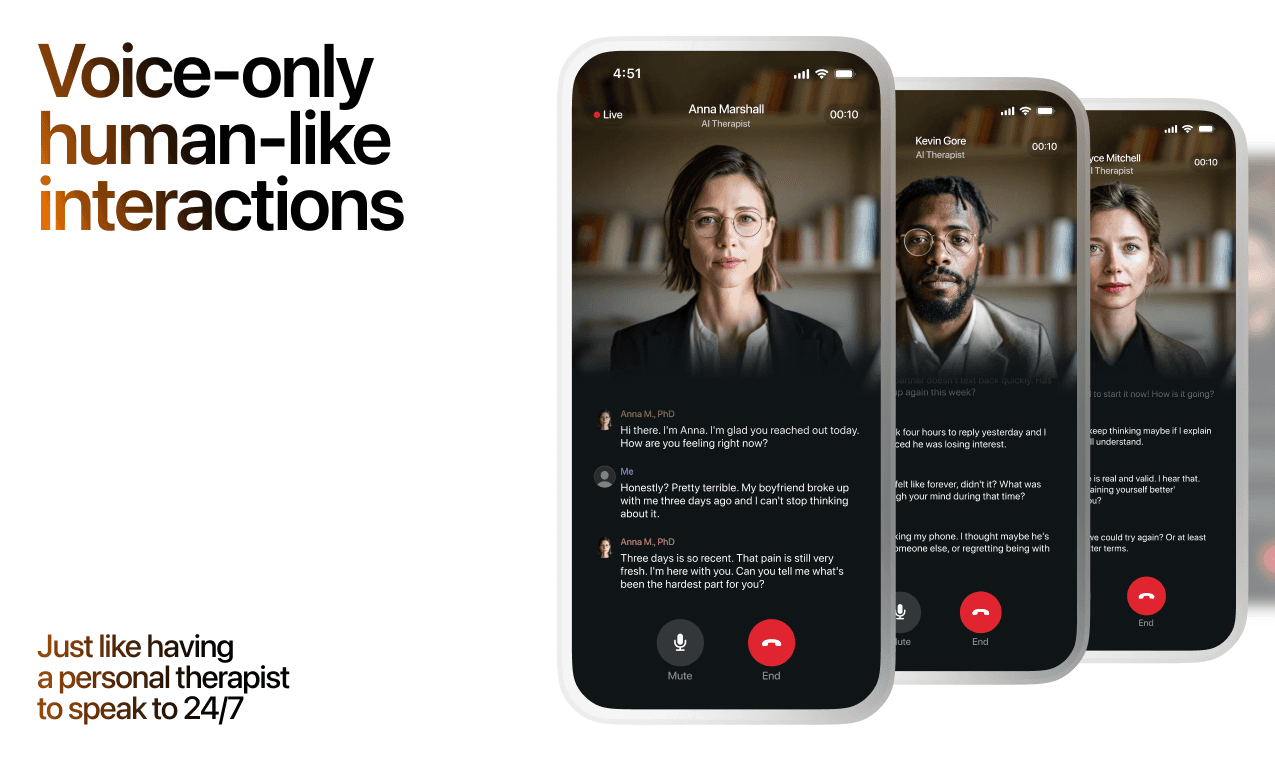
Mental fatigue often hides in the details of an ordinary day: the meeting that ran over, the decisions nobody else made, the worry you carried home. If your brain is fried today, talk through your day with Lovon, an AI coach you talk to by voice, and find the one change that would give you the most back this week.
How AI Support Helps You Heal
AI emotional support isn't about replacing human connection — it's about filling the gaps. The moments when you need to talk at 2 AM, when you don't want to burden your friends again, or when you simply need someone to listen without judgment.
Here's what happens in a typical Lovon session:
You share what's on your mind
There's no script, no intake form, no waiting room. You speak or type whatever you're feeling — in your own words, at your own pace.
Lovon validates and explores
Using frameworks from CBT (Cognitive Behavioral Therapy) and motivational interviewing, Lovon acknowledges your feelings first, then gently helps you explore them. No dismissive "just move on" advice.
You build coping skills together
Lovon doesn't just listen — it actively works with you on evidence-based techniques: thought reframing, urge surfing, behavioral experiments, and more.
What a Session with Lovon Looks Like
Lovon is AI support, not a replacement for professional care. If things have been hard to get through for weeks, or you are thinking about harming yourself, talk to a doctor or a licensed therapist.
Ready to Start?
Your healing journey can begin right now
A 3-day trial. No judgment. Just a safe space to process what you're going through.
Frequently Asked Questions
What is mental fatigue?
What are the symptoms of mental exhaustion?
How long does it take to recover from mental fatigue?
What is the difference between mental fatigue and burnout?
Can mental fatigue make you physically tired?
Why am I mentally exhausted but not physically tired?
What helps mental fatigue fast?
Sources
About the Author
The Lovon Editorial Team
Mental Health & Wellness Content Team
The Lovon Editorial Team develops mental health and wellness content designed to make psychological concepts accessible and actionable. Our goal is to bridge the gap between clinical research and everyday life - helping you understand why your mind works the way it does and what you can do about it....
Related articles
- AI Therapy for Social Battery Burnout in Introverts 2026
AI therapy for social battery burnout in introverts: what to look for, what to skip, and why voice sessions beat text…
- AI Coping Tools for Chronic Fatigue & Burnout 2026
AI coping tools for chronic fatigue and burnout in 2026: what to track first, which tools fit low energy days, and where…
- ADHD and Anxiety: How the Two Conditions Overlap (2026)
ADHD and anxiety share symptoms but have different causes. Learn how they feed each other and what daily strategies…
- How long does burnout recovery usually take?
How long does burnout recovery take? There is no fixed deadline. Learn what progress looks like, which demands to…
See also
Quizzes
- Digital Stress Test: Texting, Likes and Read Receipts
See which part of being online wears on you, in 3 minutes.
- Alexithymia Test (Free): Do I Have Alexithymia?
See where your feelings lose their names, in 3 minutes.
Free tools
- Words of Encouragement for Him When He Is Struggling
Words of encouragement for him that fit what he is actually going through, for when your usual lines are not landing…
- Sleep Meditation for Anxiety
For lying in bed with a mind that will not stop. About twelve minutes of slower breathing, a place to put the worries…
From the wiki
- Why do I feel lonely all of a sudden?
Sudden loneliness usually traces back to something that quietly ended in the last few months: a routine, a shared class…
Disclaimer: This article is for informational purposes only and does not constitute medical advice, diagnosis, or treatment. Always seek the advice of your physician or other qualified health provider with any questions you may have regarding a medical condition. If you are in crisis or think you may have an emergency, call 988 (Suicide & Crisis Lifeline) or go to the nearest emergency room. Outside the US? Find a crisis line in your country.