
Can social anxiety be cured completely?
Can social anxiety be cured? Lasting improvement is possible, but no treatment promises permanent relief. Learn what helps and when to seek support.

Key Takeaways
- Can social anxiety be cured? Remission is possible, but permanent freedom from every anxious feeling is not guaranteed.
- Social-anxiety-focused cognitive behavioral therapy addresses fearful predictions and avoidance; medication is another treatment option.
- Lovon offers emotional support and self-reflection tools, not licensed clinical treatment or a cure for social anxiety.
Social anxiety can improve enough that it no longer limits your life, and some people reach remission, but no treatment guarantees that every anxious feeling will disappear permanently. In 2026, the practical goal is lasting freedom to work, connect, and do what matters—not a promise that you will never feel nervous again.
TL;DR
- Can social anxiety be cured? Remission is possible, but permanent freedom from every anxious feeling is not guaranteed.
- Social-anxiety-focused cognitive behavioral therapy addresses fearful predictions and avoidance; medication is another treatment option.
- Lovon offers emotional support and self-reflection tools, not licensed clinical treatment or a cure for social anxiety.
Can social anxiety be cured completely?
Social anxiety is treatable; a permanent, complete cure cannot be promised. Some people improve enough that they no longer meet the criteria for social anxiety disorder. Others still experience symptoms but gain much more choice about how they live.
The National Institute of Mental Health describes psychotherapy, medication, or both as treatments for social anxiety disorder. NICE guidance recommends individual cognitive behavioral therapy specifically developed for social anxiety as an initial treatment for adults. These are treatment recommendations, not guarantees about your outcome.
Learning how to use cognitive behavioral techniques helps explain the approach, but reading about a technique is different from receiving an assessment and an individualized treatment plan.
| Outcome | What it means | What it does not mean |
|---|---|---|
| Symptom improvement | Fear, distress, or avoidance decreases | Every difficult situation becomes comfortable |
| Remission | Symptoms no longer meet diagnostic criteria | Anxiety can never return |
| Functional recovery | You participate more freely in work, relationships, and daily life | You must become outgoing or enjoy crowds |
These outcomes overlap. A clinician can help you understand both symptom changes and improvements that matter in your everyday life.
Why this matters
If you make zero anxiety the requirement for recovery, an ordinary nervous moment can feel like proof that treatment failed. That is a punishing standard. You can feel uneasy before introducing yourself and still make a meaningful recovery.
A more useful question is whether fear still makes your decisions. Are you declining opportunities you want, avoiding necessary calls, or spending the evening reviewing something you said? Those patterns give you clearer treatment targets than trying to feel perfectly calm.
You also do not need to change your personality. Preferring quiet evenings is different from wanting company but staying home because you expect humiliation.
Which treatments help social anxiety?
For a treatment decision in 2026, distinguish care that addresses social anxiety disorder from support that helps you manage a difficult moment. Both have a place, but they do different jobs.
| Approach | Best for | Main benefit | Main limitation |
|---|---|---|---|
| Social-anxiety-focused CBT | Addressing fearful predictions and avoidance | Builds skills through structured practice | Requires effort and willingness to face some discomfort |
| Prescribed medication | People for whom medication fits the clinical assessment and preferences | Can reduce symptoms | Has potential side effects and requires prescribing oversight |
| Guided self-help | People who prefer a supported, less intensive starting point when clinically appropriate | Offers structured learning and practice | Does not provide the same individualized work as full therapy |
| Everyday coping tools | Support alongside treatment or during mild distress | Help you respond to difficult feelings | Do not replace assessment or treatment for disabling symptoms |
Social-anxiety-focused CBT: best for changing avoidance patterns
Cognitive behavioral therapy, or CBT, examines how predictions, attention, and behavior keep anxiety going. With social anxiety, that can include expecting rejection, monitoring every physical sensation, and avoiding situations that would let you test those expectations.
Treatment commonly includes behavioral experiments and gradual exposure. You practice entering manageable situations and comparing what you feared with what actually happened. A therapist helps you choose tasks that fit your needs rather than simply telling you to socialize more.
Ask whether a therapist offers CBT specifically for social anxiety. General emotional support and a structured social anxiety treatment are not interchangeable.
Prescribed medication: best when it fits your clinical plan
A qualified prescriber can discuss medication, including antidepressants used for social anxiety disorder. The decision depends on your symptoms, health history, preferences, and other medicines.
Medication can reduce symptoms, but it is not a promise of permanent recovery. Discuss side effects, follow-up, and what to do if treatment is not helping. Do not start, stop, or change a prescribed medicine based on an article or app conversation.
Guided self-help: best for supported practice
Guided self-help uses structured material with support from a trained professional. NICE includes CBT-based supported self-help as an option for adults who decline individual CBT.
Its advantage is a clear framework for practice. Its limitation is less individualized treatment time, so significant impairment or a poor response calls for reassessment rather than blaming yourself for not trying hard enough.
Why social anxiety recovery varies
There is no single recovery schedule. The same diagnosis can involve very different situations, levels of avoidance, and treatment needs.
Factors a clinician considers include:
- Daily impact: Avoiding occasional presentations differs from being unable to attend school, work, or appointments.
- Avoidance patterns: Repeatedly escaping feared situations limits opportunities to learn that you can cope.
- Treatment fit: Social-anxiety-focused care addresses different needs from general stress support.
- Other difficulties: Depression, substance use, or other mental health concerns can change the treatment plan.
- Practice opportunities: Applying skills outside appointments is part of structured psychological treatment.
- Current circumstances: Bullying, discrimination, or an unsafe environment require attention to actual conditions, not just anxious thoughts.
These factors are not character flaws. If progress stalls, review the plan with your clinician rather than treating the setback as evidence that you are beyond help.
What does getting better look like in daily life?
A useful recovery goal describes something you want to do, not an emotion you must eliminate. For your 2026 plan, choose an activity anxiety has been restricting and define a small, observable change.
For example, progress might mean asking a question at work even while your voice shakes. It might mean attending a gathering without spending the next evening checking whether everyone disliked you. The important change is greater participation and less time controlled by fear.
Track behavior as well as feelings. Note what you attempted, what you predicted, and what you learned. A difficult experience still provides information; it does not automatically mean you moved backward.
Do not turn tracking into another performance test. If recording every interaction increases self-monitoring, discuss a simpler approach with your therapist.
How can you start practicing without overwhelming yourself?
Choose a manageable action, not the scariest situation you can imagine. Exposure is planned learning, not a demand to endure mistreatment or push through distress without support.
The durations below are examples for planning, not a treatment schedule or evidence-based dose. Adjust them with a clinician if symptoms are severe or practice feels unmanageable.
- Choose a situation. Pick a specific, reasonably safe activity, such as a 2-minute conversation with a familiar coworker. Avoid a vague goal such as becoming confident.
- Name the prediction. Write what you expect to happen: perhaps a pause will make the other person think you are incompetent. Keep the prediction testable.
- Try the action. A later step might be joining a gathering for 10 minutes. Focus on participating rather than making anxiety disappear before you begin.
- Review the evidence. Set aside a brief reflection period, such as 5 minutes, to compare the prediction with what happened. Then return to another activity rather than repeatedly replaying the encounter.
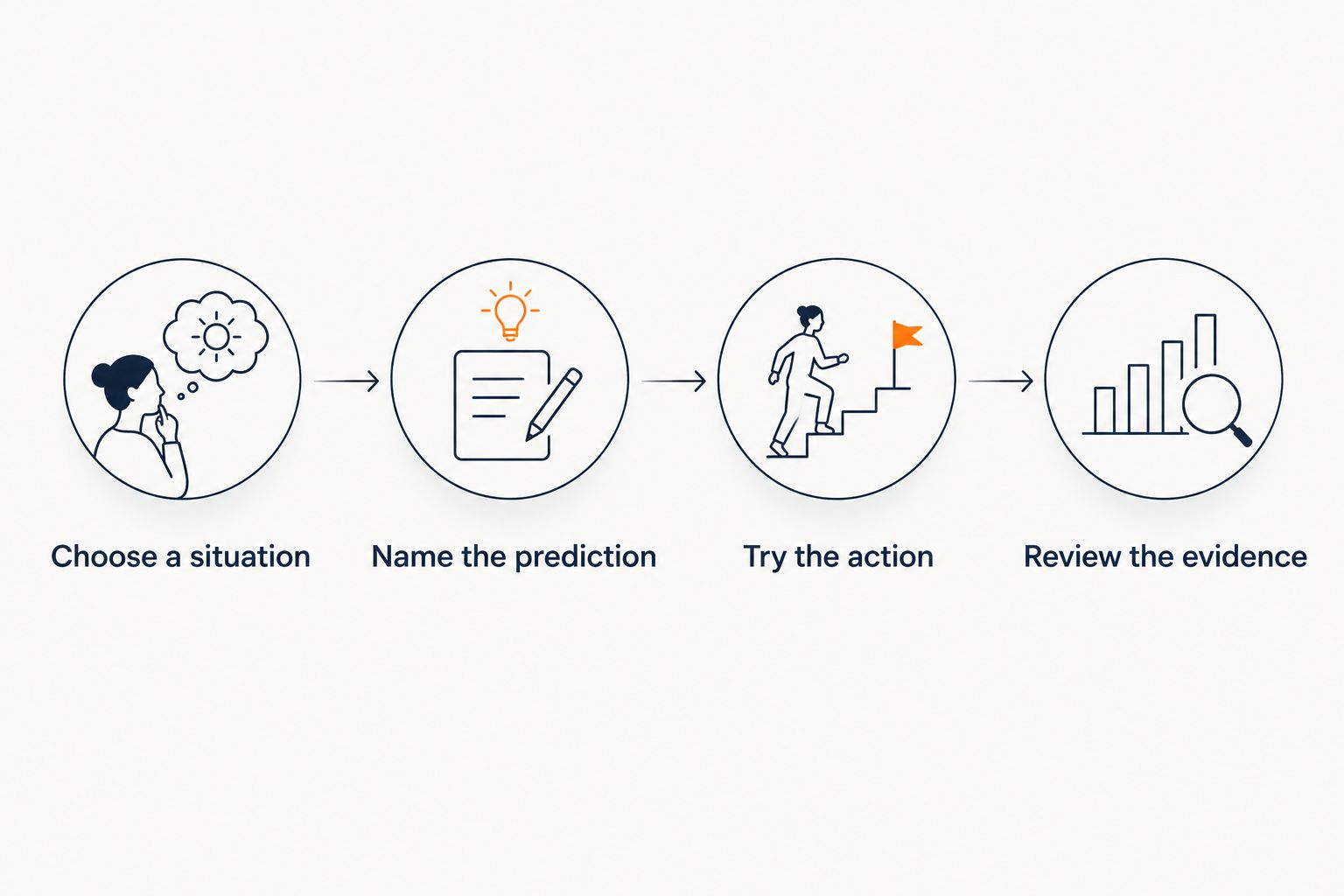 Practice sequence: choose a situation, name the prediction, try the action, and review the evidence.
The purpose of practice is to test a prediction, not to perform perfectly.
If you rely on a protective habit, such as rehearsing every sentence, a therapist can help you examine whether it prevents useful learning. Change these habits gradually and collaboratively. Necessary accommodations, personal boundaries, and protection from genuine harm are not things you must give up.
How long does social anxiety treatment take to work?
Social anxiety treatment has no universal deadline. The approach, severity, practice between sessions, and other health concerns all affect the course of care.
The question of how long anxiety treatment takes needs a clear definition of improvement: feeling calmer, avoiding less, and no longer meeting diagnostic criteria are different outcomes. Ask your clinician what changes to watch for and when you will review the plan together.
Do not treat an uncomfortable session as proof that therapy is failing. Equally, you do not need to continue indefinitely without discussing progress, concerns, or a different approach.
Can social anxiety come back after you feel better?
Social anxiety can return after improvement or remission. A stressful transition, reduced practice, or a difficult social experience can bring old fears back without erasing what you learned.
Build a maintenance plan while things are improving. Identify early signs, such as declining invitations you want to accept, delaying necessary calls, or returning to repeated reassurance seeking. Agree on what you will try and when you will contact your clinician.
A recurrence is a reason to respond, not a verdict about your future. Return to effective skills early instead of waiting until avoidance controls more of your life.
Can a voice support app help alongside treatment?
Lovon is an AI-powered mental health app offering voice conversations, emotional support, coping tools, and self-reflection guidance. It is not a licensed clinician and does not replace clinical care.
Lovon is best suited to people seeking voice-based emotional support and self-reflection, not clinical treatment for social anxiety. Its role is separate from a therapist's assessment, exposure planning, or a prescriber's medication decisions.
In 2026, use that distinction when choosing any mental health app. A supportive conversation is not evidence that an app can cure a disorder. Lovon offers a way to talk through everyday struggles; it cannot promise remission or determine whether you need a diagnosis.
Keep real-world participation in view. If talking to an app repeatedly replaces contacting people, attending appointments, or practicing agreed treatment tasks, discuss that pattern with your clinician.
When should you seek professional help?
Seek an assessment when fear of judgment repeatedly interferes with work, education, relationships, healthcare, or activities you want to do. You do not need to wait until every area of life is affected.
A primary care professional or licensed mental health clinician can assess symptoms and discuss treatment. Mention low mood, alcohol or drug use, sleep problems, and other concerns rather than assuming every difficulty has the same cause.
If you feel unable to stay safe or have thoughts of suicide, seek immediate human support. In the United States, call or text 988; call 911 for an immediate life-threatening emergency. A mental health app is not emergency care.
FAQ
Can social anxiety be cured forever?
Social anxiety can reach remission, but no treatment guarantees that symptoms will never return. Lasting recovery can include occasional nervousness without the avoidance and impairment that previously restricted your life.
What's the best treatment for social anxiety disorder?
Individual CBT specifically developed for social anxiety is a recommended initial treatment for adults in NICE guidance. Your assessment and preferences determine whether CBT, medication, or another supported approach fits your needs.
Can I overcome social anxiety without medication?
Yes, social anxiety can improve with psychological treatment without medication. Social-anxiety-focused CBT is an established option; a clinician can help you decide whether it fits your symptoms and circumstances.
Does being shy mean I have social anxiety disorder?
No, shyness alone does not mean you have social anxiety disorder. Assessment considers the intensity and persistence of fear, avoidance, and the impact on everyday functioning.
Should I force myself into social situations to get better?
No, overwhelming yourself is not the goal of exposure practice. Plan manageable, reasonably safe activities and work with a therapist when distress or avoidance makes practice difficult.
Does social anxiety coming back mean treatment failed?
No, returning symptoms do not automatically mean treatment failed. Review early warning signs, resume helpful skills, and contact your clinician if avoidance or impairment is increasing.
Can a mental health app diagnose or cure social anxiety?
A support app is not a substitute for clinical assessment or treatment and should not promise a cure. Use apps for their stated support functions while keeping professional care available when symptoms interfere with your life.
One last thing
For your next step in 2026, replace the question of whether you felt confident with whether you did something that mattered despite feeling nervous. That shift makes room for progress you would otherwise overlook.
You do not have to enjoy every conversation to recover. Start with more choice, less avoidance, and support that matches your needs.
Related guides
How AI Support Helps You Heal
AI emotional support isn't about replacing human connection — it's about filling the gaps. The moments when you need to talk at 2 AM, when you don't want to burden your friends again, or when you simply need someone to listen without judgment.
Here's what happens in a typical Lovon session:
You share what's on your mind
There's no script, no intake form, no waiting room. You speak or type whatever you're feeling — in your own words, at your own pace.
Lovon validates and explores
Using frameworks from CBT (Cognitive Behavioral Therapy) and motivational interviewing, Lovon acknowledges your feelings first, then gently helps you explore them. No dismissive "just move on" advice.
You build coping skills together
Lovon doesn't just listen — it actively works with you on evidence-based techniques: thought reframing, urge surfing, behavioral experiments, and more.
What a Session with Lovon Looks Like
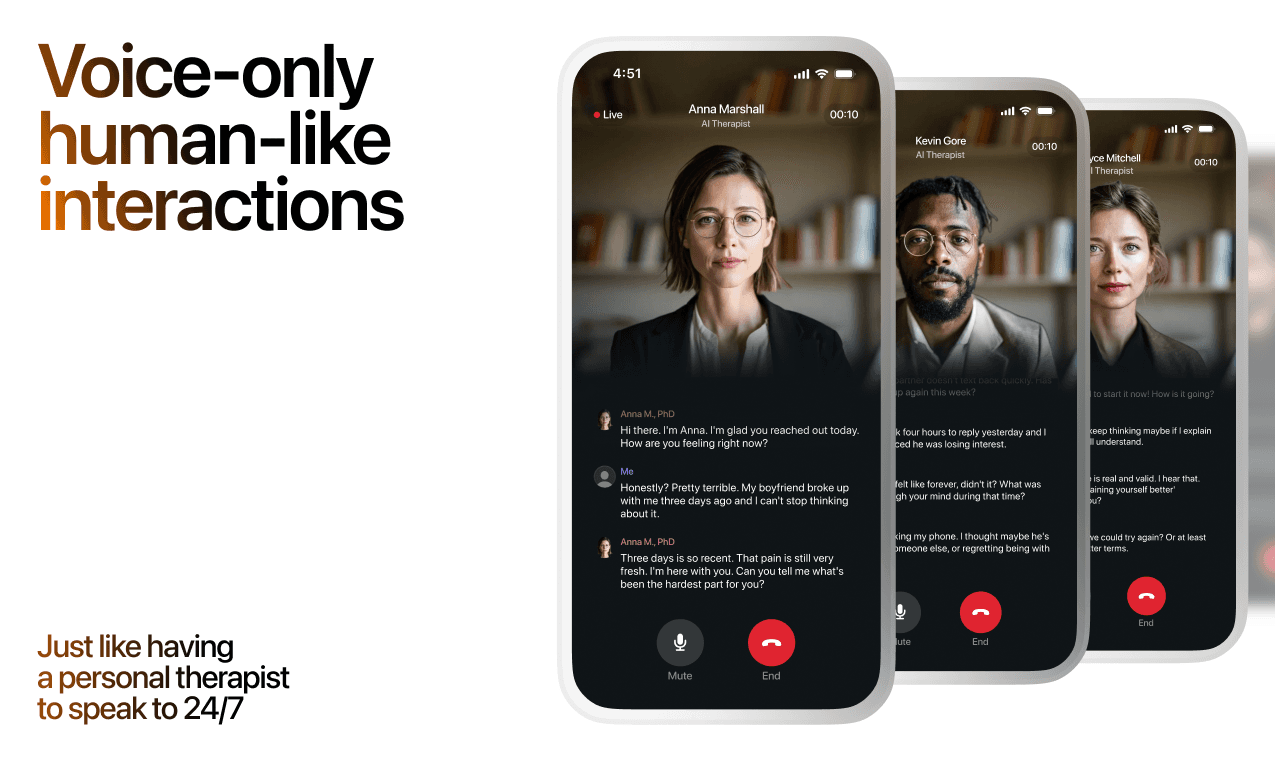
Lovon is AI support, not a replacement for professional care. If things have been hard to get through for weeks, or you are thinking about harming yourself, talk to a doctor or a licensed therapist.
Ready to Start?
Your healing journey can begin right now
A 3-day trial. No judgment. Just a safe space to process what you're going through.
Frequently Asked Questions
Is Lovon a replacement for a real therapist?
Is my conversation with Lovon AI private?
How is Lovon different from ChatGPT for emotional support?
Can I use Lovon if I'm already seeing a therapist?
Can I try Lovon before subscribing?
About the Author
The Lovon Editorial Team
Mental Health & Wellness Content Team
The Lovon Editorial Team develops mental health and wellness content designed to make psychological concepts accessible and actionable. Our goal is to bridge the gap between clinical research and everyday life - helping you understand why your mind works the way it does and what you can do about it....
Related articles
- Can journaling before bed improve sleep quality?
Can journaling before bed improve sleep? A short to-do list can help you settle. Learn what research supports, what to…
- How to Recharge Your Social Battery: 7 Ways
How to recharge your social battery after people drain you: quiet recovery time, signs you are running low, what to say…
- Does taking a mental health day actually help?
Does a mental health day actually help? Yes, for short-term relief. Learn how to rest, plan your return, and recognize…
- How long does it take to feel better with AI therapy?
AI therapy eases stress within one session, but real relief from anxiety or low mood takes 6 to 8 weeks of steady use…
See also
Quizzes
- Introvert or Extrovert? Quiz (and Ambivert)
Introvert, ambivert or extrovert? Find out in 3 minutes.
- Distress Tolerance Test: How Long Can You Sit With It?
See which kind of discomfort makes you need out first.
Free tools
- Social Battery
Log the people in your day, for how long, and whether each one drained or charged you. The battery shows where you are…
- Journal Prompts
Pick how you feel, what you want to write about, or both, and get three prompts with room to write right under them…
From the wiki
- What is inhibited grief?
Inhibited grief is grief that never gets out. The loss happened, you kept functioning, and the feeling stayed sealed…
Disclaimer: This article is for informational purposes only and does not constitute medical advice, diagnosis, or treatment. Always seek the advice of your physician or other qualified health provider with any questions you may have regarding a medical condition. If you are in crisis or think you may have an emergency, call 988 (Suicide & Crisis Lifeline) or go to the nearest emergency room. Outside the US? Find a crisis line in your country.