
How long does exposure therapy take to work for phobias?
How long does exposure therapy take? There is no fixed deadline. Learn what progress looks like, what affects timing, and when to review your care.

Key Takeaways
- How long does exposure therapy take? Phobia treatment has no fixed deadline; track reduced avoidance, not just calmer feelings.
- Exposure therapy builds learning through planned, safe contact with feared situations, supported by practice outside appointments.
- Lovon offers emotional support, not clinician-led exposure therapy or a guaranteed recovery timeline.
- Review the plan with a licensed therapist if exercises repeatedly feel unmanageable or daily functioning worsens.
Exposure therapy for phobias has no single deadline: you can begin making progress during treatment, but lasting change depends on your fear, the treatment plan, and practice outside appointments. Feeling anxious during an exercise does not mean treatment has failed; the more useful sign is that you can approach something you previously avoided. For your 2026 treatment plan, ask a licensed therapist to define your goals and review progress rather than promise a finish date.
TL;DR
- How long does exposure therapy take? Phobia treatment has no fixed deadline; track reduced avoidance, not just calmer feelings.
- Exposure therapy builds learning through planned, safe contact with feared situations, supported by practice outside appointments.
- Lovon offers emotional support, not clinician-led exposure therapy or a guaranteed recovery timeline.
- Review the plan with a licensed therapist if exercises repeatedly feel unmanageable or daily functioning worsens.
How long does exposure therapy take to work for phobias?
Exposure therapy starts working when your behavior becomes less controlled by fear—not only when anxiety disappears. Your therapist should help you separate early improvement from reaching your full treatment goal. Looking at a feared object, approaching it, and handling an everyday encounter are different milestones.
The distinction matters when choosing coping tools for anxiety. Feeling calmer can help you get through a difficult moment, but temporary relief alone does not show that a phobia has changed.
| Treatment milestone | What you might notice | What it does not prove |
|---|---|---|
| Starting exposure | You attempt a planned task you previously avoided | That the fear should already be gone |
| Early progress | You approach the situation with less avoidance or fewer escape behaviors | That every attempt will feel easier |
| Everyday improvement | You handle a meaningful situation outside the therapy setting | That anxiety will never return |
| Maintaining gains | You keep using what you learned across situations | That further practice is unnecessary |
A useful 2026 treatment discussion includes both appointment time and real-life practice. Ask what your therapist expects you to learn, how you will practice safely, and what would lead to a change in the plan. A calendar alone cannot answer those questions.
Why this matters
If you expect every appointment to leave you calm, a difficult exercise can look like failure. Exposure deliberately brings you into contact with something frightening under a planned, appropriate level of challenge. Some discomfort belongs to that process.
The goal is not to prove that nothing unpleasant ever happens. It is to learn more accurate expectations and develop confidence in handling uncertainty and discomfort. Measure whether fear is shrinking your choices less, rather than demanding that every anxious feeling disappear.
What does the treatment timeline actually include?
Exposure treatment involves more than time spent facing a trigger. Assessment, choosing exercises, reviewing what happened, and applying learning outside appointments all belong in the plan. Your therapist can explain which parts need attention for your particular phobia.
Assessment and planning
A therapist first needs to understand what you fear, what you predict will happen, and how you avoid it. Fear of a dog biting you, for example, calls for a different discussion from fear of feeling trapped on an airplane. Similar-looking avoidance can have different causes.
Tell your therapist about medical conditions, fainting, trauma symptoms, and previous treatment experiences. These details affect how exercises should be designed. You do not need to arrive with your own diagnosis or a complete exposure schedule.
Practicing the feared situation
During exposure, you approach a relevant trigger through a task agreed with your therapist. The task should test a specific expectation rather than simply make you feel distressed. You then review what actually happened and what you learned.
Exercises can involve real situations, images, imagination, or virtual environments when clinically appropriate. The format should fit the fear and the treatment goal. Being able to tolerate a picture is useful practice, but it is not automatically the same as handling the real-life situation you want to change.
Using the learning outside appointments
Progress needs to carry into ordinary life. A therapist might help you practice in different settings so that confidence does not depend on a particular room, person, or routine. That transfer is part of treatment, not an optional extra.
For example, someone working on a dog phobia might eventually need to handle encounters on different walking routes. This does not mean approaching unfamiliar animals or ignoring bite risks. Exposure challenges exaggerated fear while respecting real safety boundaries.
Which exposure approach fits your situation?
Different schedules and formats organize the work differently. Choose an approach with a qualified clinician based on clinical fit, not the shortest advertised timeline. The comparison below describes treatment formats, not personal recommendations or guaranteed completion times.
| Approach | Best for | Main advantage | Main limitation |
|---|---|---|---|
| Gradual exposure | People who need a planned progression through feared tasks | Creates manageable opportunities to practice and review learning | Requires continued practice rather than attendance alone |
| Intensive exposure | Selected people with specific phobias after clinical assessment | Concentrates treatment work into a focused format | Demanding and not suitable for every person or fear |
| Virtual reality exposure | Situations that are difficult to arrange directly, when clinically appropriate | Allows controlled practice with simulated triggers | Learning still needs to transfer to everyday situations |
Gradual exposure: progress through agreed steps
Gradual exposure organizes tasks by their difficulty or learning goal. You and your therapist choose a starting point and adjust the challenge based on what happens. You do not have to begin with the most frightening scenario.
The benefit is a clear, collaborative path. The limitation is that completing only comfortable tasks can leave the main avoidance unchanged. Your therapist should help you distinguish useful pacing from repeatedly postponing the work that matters.
Intensive exposure: concentrated work, not a guaranteed shortcut
Intensive treatment brings exposure work together in a concentrated format. It still requires assessment, consent, appropriate exercises, and a plan for maintaining gains. A shorter appointment schedule does not mean the learning ends when the appointment ends.
Ask what follow-up includes and how you will use the learning afterward. For a 2026 treatment decision, the important comparison is the full care plan—not simply which service offers fewer visits.
Virtual reality exposure: a practice setting, not the final goal
Virtual reality can provide exposure to simulated situations such as flying or heights. A clinician should decide whether that setting is appropriate and how it connects to your goals. Not every phobia needs this technology.
Its practical advantage is control over the practice environment. Its limitation is that simulated success does not automatically establish confidence everywhere else. Ask how treatment will connect the virtual experience to the situations you actually avoid.
Why exposure therapy timing varies
The useful question is not whether you are recovering fast enough compared with someone else. It is whether your plan addresses the things keeping your fear in place. Discuss these factors with your therapist:
- The fear being treated. A narrowly defined trigger and a broad pattern of feared situations require different planning.
- Your starting level of avoidance. Treatment needs to account for the activities you have stopped doing and the situations you still manage.
- Opportunities to practice. A trigger you can safely practice with locally presents different practical demands from an infrequent flight.
- Escape and reassurance habits. Repeated checking, leaving early, or needing certainty can interfere with the learning an exercise is intended to build.
- Other health needs. Fainting, trauma symptoms, depression, or other difficulties can change the assessment and treatment plan.
- Fit and collaboration. Exercises need a clear purpose, your agreement, and enough challenge to address the fear without ignoring safety.
These factors are reasons to personalize care, not reasons to blame yourself. If the plan does not fit your circumstances, say so. Your therapist needs that information to make useful adjustments.
How can you tell whether exposure therapy is working?
Use a short record that captures what you did and learned. A fear rating can add context, but it should not be the only measure. Your ability to act matters even on a day when anxiety stays noticeable.
For your next treatment review, record 1 meaningful goal, 2 behavioral observations, and 3 reflection prompts. These are suggested planning quantities, not a clinical scoring system or a recovery deadline.
- Choose a goal. Name an activity you want back, such as attending an appointment you have been avoiding.
- Notice behavior. Record whether you approached the situation and which escape or reassurance habits you used.
- Review learning. Ask what you predicted, what happened, and what you want to discuss with your therapist.
Keep the record brief enough that it does not become another checking ritual. Bring it to appointments rather than repeatedly reviewing it to reassure yourself that treatment is working. The purpose is to support decisions, not certify that you are safe from every future fear.
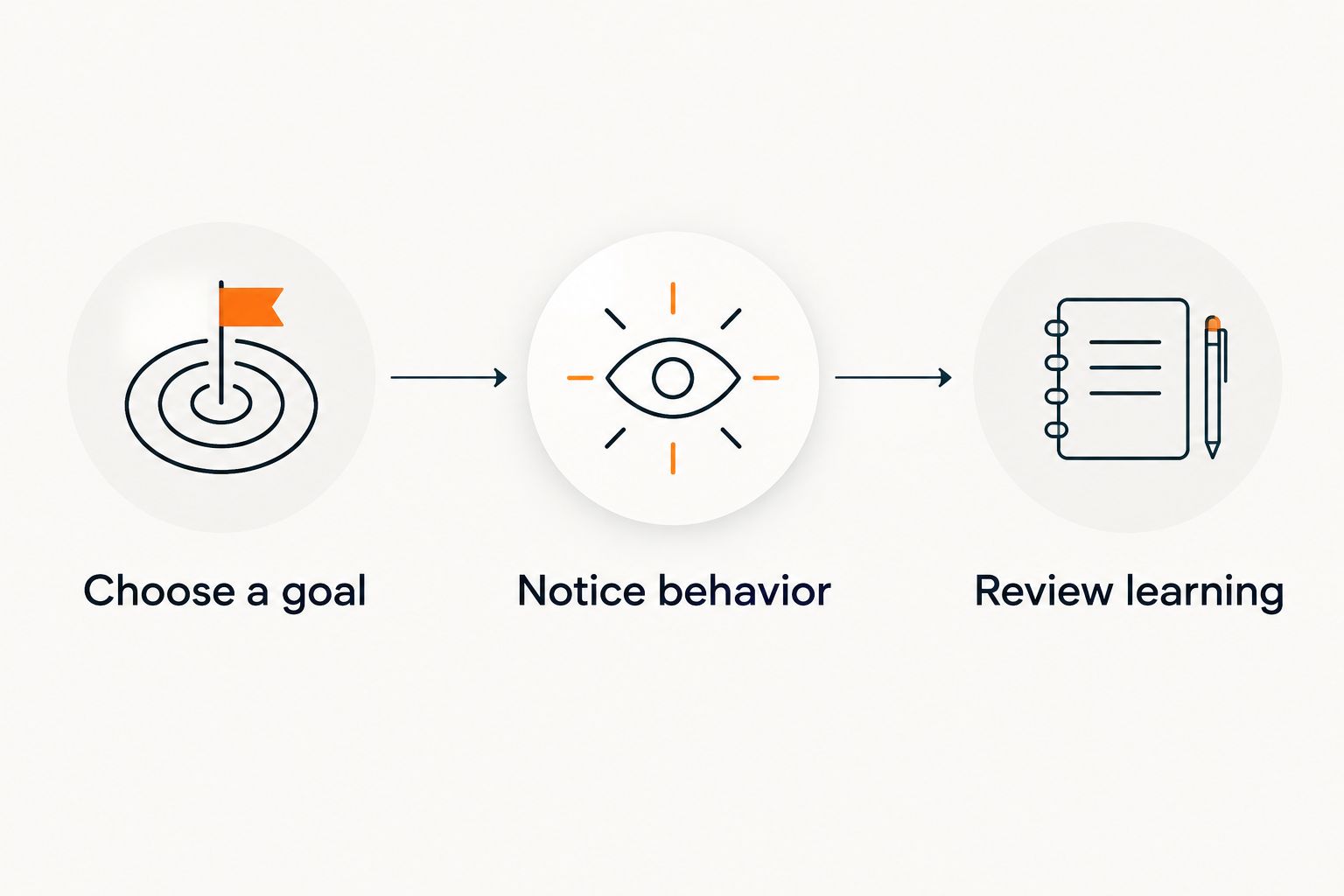 Three steps for reviewing exposure progress: choose a goal, notice behavior, and review learning.
Track what you approach and learn, not only how anxious you feel.
Can exposure therapy work if I still feel scared?
Yes—continued fear does not rule out progress. You can feel anxious and still approach a situation, test a prediction, or reduce an avoidance habit. Anxiety does not need to fall to zero for an exercise to provide useful learning.
Tell your therapist if you judge every attempt by whether you felt calm. That expectation can make meaningful progress hard to recognize. Your therapist can help you identify signs that connect directly to your treatment goal.
Should I push through an exposure that feels overwhelming?
Do not treat overwhelming distress as proof that an exercise is better. Exposure should be planned, collaborative, and appropriate to your health and circumstances. You retain the right to discuss, pause, or decline an exercise.
Contact your therapist if you repeatedly feel unable to stay engaged, experience dissociation, or find that practice is worsening your functioning. Do not attempt hazardous situations, handle dangerous animals, or stop prescribed medication to make an exposure more challenging. For blood or needle fears with a fainting history, ask about appropriate precautions before practicing.
What if exposure therapy does not seem to be helping?
Bring a concrete example to your therapist rather than silently repeating the same task. Explain what you predicted, what you did, and what made the exercise difficult. Ask whether the task addressed the right fear and whether reassurance or escape habits affected the learning.
A 2026 progress review should include everyday functioning as well as distress during appointments. If you understand the exercises but still cannot do the activity you came to treatment for, that deserves discussion. Your therapist can reassess the formulation, change the plan, or discuss another qualified provider.
Where does support between appointments fit?
Lovon is best for people seeking voice-based emotional support, not clinician-led phobia treatment. The app offers conversations, coping tools, and self-reflection guidance. Its role is companionship and support; it is not a licensed clinician or a replacement for clinical care.
A benefit of Lovon mental health support is having a place to put feelings into words. Its limitation is that an app conversation does not establish a diagnosis, determine whether exposure is medically appropriate, or replace an individualized treatment plan. Discuss any digital coping tool with your therapist if you use it during exposure, especially if it becomes something you feel unable to practice without.
FAQ
How long does exposure therapy take to work for a specific phobia?
Exposure therapy has no single completion time for a specific phobia. Your therapist should explain the proposed schedule, practice expectations, and signs of progress after assessing your situation.
Can exposure therapy help after the first appointment?
Early learning is possible, but an initial improvement is not the same as completing treatment. Assessment and planning can also be the main focus of an early appointment.
Does anxiety have to disappear before I move to another exposure?
Anxiety does not have to disappear before treatment progresses. Work with your therapist to decide when another task fits your learning goals and current needs.
Is intensive exposure better than gradual exposure?
Intensive exposure is not automatically better than gradual exposure. Clinical fit, your preferences, safety needs, and the plan for applying learning outside treatment matter more than a shorter schedule.
Can I do exposure therapy on my own using an app?
An app is not a substitute for an individualized exposure treatment plan. Seek clinical guidance, particularly if your fear involves fainting, trauma symptoms, medical concerns, or substantial disruption to daily life.
Can Lovon replace a therapist for phobias?
Lovon cannot replace a licensed therapist for phobia assessment or treatment. Its mental health support offers voice conversations, coping tools, and self-reflection rather than clinician-led exposure therapy.
Does fear coming back mean exposure therapy failed?
Returning fear does not automatically mean exposure therapy failed. Discuss the circumstances with your therapist and review how to apply previous learning or whether additional care is needed.
One last thing
Choose a life goal before choosing a finish date. Before your next appointment in 2026, write down the activity you most want fear to stop controlling. Bring that sentence to your therapist and ask how treatment will help you work toward it safely.
The most useful outcome is not a perfect streak of calm days. It is having more freedom to do what matters, with an appropriate plan when fear shows up again.
Related guides
How AI Support Helps You Heal
AI emotional support isn't about replacing human connection — it's about filling the gaps. The moments when you need to talk at 2 AM, when you don't want to burden your friends again, or when you simply need someone to listen without judgment.
Here's what happens in a typical Lovon session:
You share what's on your mind
There's no script, no intake form, no waiting room. You speak or type whatever you're feeling — in your own words, at your own pace.
Lovon validates and explores
Using frameworks from CBT (Cognitive Behavioral Therapy) and motivational interviewing, Lovon acknowledges your feelings first, then gently helps you explore them. No dismissive "just move on" advice.
You build coping skills together
Lovon doesn't just listen — it actively works with you on evidence-based techniques: thought reframing, urge surfing, behavioral experiments, and more.
What a Session with Lovon Looks Like
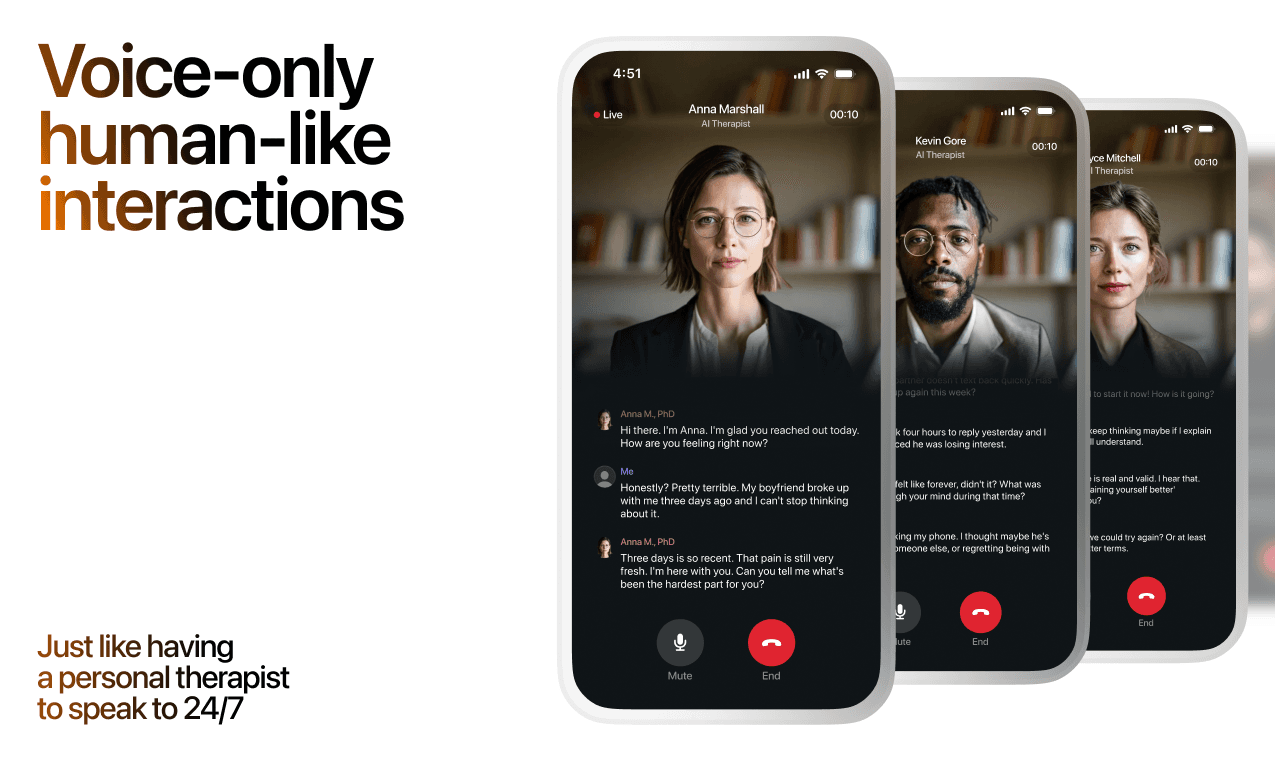
Lovon is AI support, not a replacement for professional care. If things have been hard to get through for weeks, or you are thinking about harming yourself, talk to a doctor or a licensed therapist.
Ready to Start?
Your healing journey can begin right now
A 3-day trial. No judgment. Just a safe space to process what you're going through.
Frequently Asked Questions
Is Lovon a replacement for a real therapist?
Is my conversation with Lovon AI private?
How is Lovon different from ChatGPT for emotional support?
Can I use Lovon if I'm already seeing a therapist?
Can I try Lovon before subscribing?
About the Author

The Lovon Editorial Team
Mental Health & Wellness Content Team
The Lovon Editorial Team develops mental health and wellness content designed to make psychological concepts accessible and actionable. Our goal is to bridge the gap between clinical research and everyday life - helping you understand why your mind works the way it does and what you can do about it....
Related articles
- Is hiring a life coach worth it in 2026?
Is hiring a life coach worth it? Yes for clear goals and accountability, not clinical care. Learn how to assess fit, ask…
- Understanding Therapy Progress Obstacles and How to Move Forward
Many people enter therapy with high hopes for rapid transformation, only to find themselves frustrated when progress…
- How long does it take to feel better with AI therapy?
AI therapy eases stress within one session, but real relief from anxiety or low mood takes 6 to 8 weeks of steady use…
- How long does burnout recovery usually take?
How long does burnout recovery take? There is no fixed deadline. Learn what progress looks like, which demands to…
See also
Quizzes
- Experiential Avoidance Test: Do You Avoid Your Feelings?
See which way you keep feelings out, in 3 minutes.
- Highly Sensitive Person Test: How Much Do You Take In?
See how deeply you process, notice and get overloaded.
Free tools
- Breathing Exercises for Anxiety
Pick a technique, pick a length, follow the circle. Start with the physiological sigh if you are in the middle of a…
- Wheel of Life
Rate eight areas of your life from 1 to 10 and watch your wheel take shape. Then pick the one area to work on this…
From the wiki
- What does it mean when you dream about your ex?
Dreaming about your ex usually reflects emotional processing, not prophecy and not a message from them. Your sleeping…
Disclaimer: This article is for informational purposes only and does not constitute medical advice, diagnosis, or treatment. Always seek the advice of your physician or other qualified health provider with any questions you may have regarding a medical condition. If you are in crisis or think you may have an emergency, call 988 (Suicide & Crisis Lifeline) or go to the nearest emergency room. Outside the US? Find a crisis line in your country.