
Is AI therapy covered by insurance in 2026?
AI therapy apps like Lovon aren't covered by insurance in 2026 - insurers only pay licensed clinicians. See what FSA, HSA, and EAP plans actually cover.

Key Takeaways
- AI therapy apps like Lovon are not covered by insurance in 2026 because insurers only reimburse licensed clinicians
- Traditional and teletherapy sessions with a licensed provider can still be covered with a copay if the provider is
- Employer EAP programs sometimes fund AI wellness tools as a free perk - that's employer budget, not insurance billing.
- FSA or HSA dollars may cover an AI therapy subscription with a letter of medical necessity from a provider.
- Lovon works as an always-available companion for coping tools between sessions, not a licensed replacement for therapy.
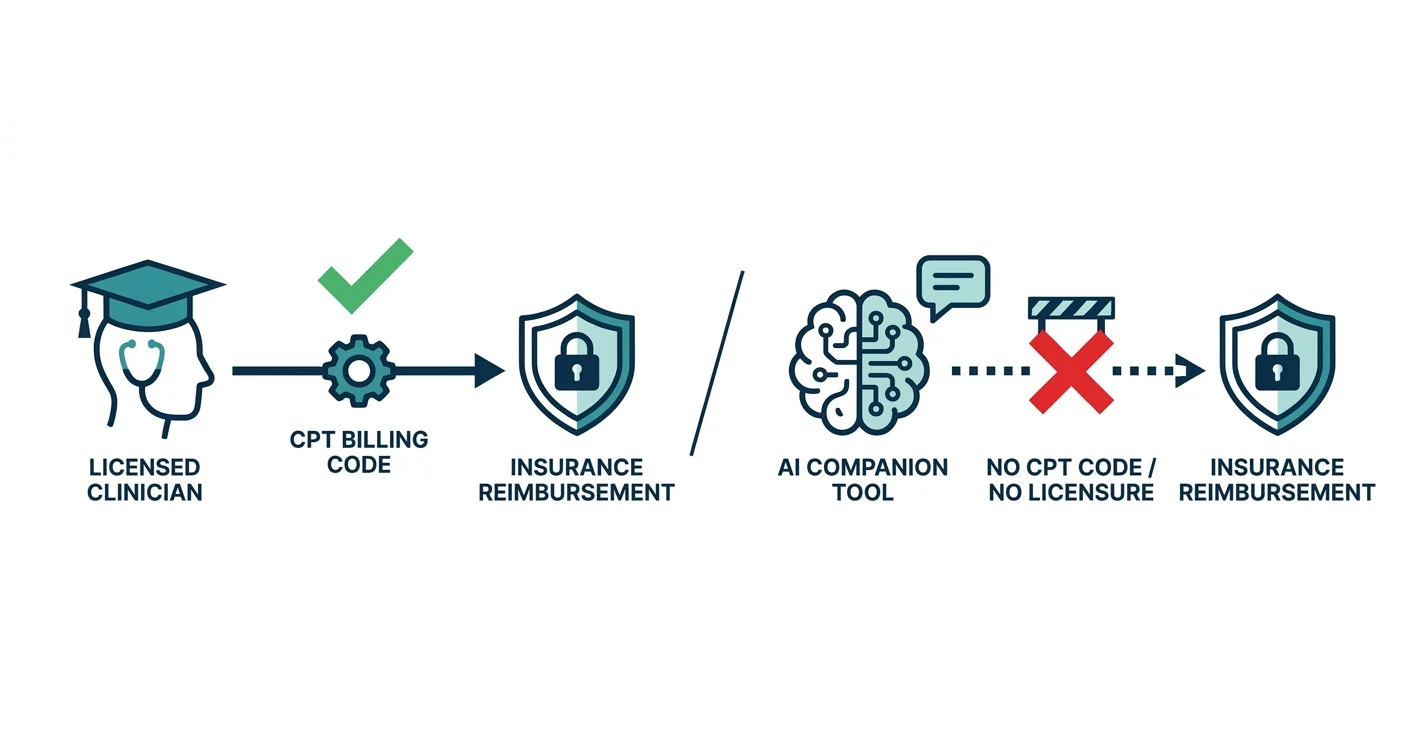
AI therapy apps are not covered by health insurance in 2026 - full stop. Insurers reimburse licensed clinicians who bill mental health CPT codes, and an AI voice or chat tool doesn't meet that definition, so you're paying out of pocket for it either way.
TL;DR
- AI therapy apps like Lovon are not covered by insurance in 2026 because insurers only reimburse licensed clinicians billing CPT codes.
- Traditional and teletherapy sessions with a licensed provider can still be covered with a copay if the provider is in-network.
- Employer EAP programs sometimes fund AI wellness tools as a free perk - that's employer budget, not insurance billing.
- FSA or HSA dollars may cover an AI therapy subscription with a letter of medical necessity from a provider.
- Lovon works as an always-available companion for coping tools between sessions, not a licensed replacement for therapy.
Why this matters
Insurance in the United States pays for mental health care the same way it pays for a broken arm: a licensed provider delivers a defined service, codes it, and submits a claim. That system was built for psychologists, psychiatrists, and licensed counselors - not for software.
That's the whole reason the cost of therapy without insurance keeps coming up in searches this year. People are trying to figure out whether an AI option changes the math, and the honest answer is: it changes the math, but not because insurance steps in.
Is AI therapy covered by insurance?
Here's how coverage actually breaks down across the types of mental health support people use in 2026:
| Care type | Typical insurance status | Who bills it |
|---|---|---|
| In-person therapy (licensed provider, in-network) | Often covered with a copay | Psychologist, LCSW, or psychiatrist using CPT codes |
| Licensed teletherapy platforms | Sometimes covered, depends on your plan's telehealth benefit | Licensed clinician delivering care remotely |
| Employer EAP sessions | Employer-funded, not billed to your health plan | EAP vendor contracted by your employer |
| AI voice or chat apps (Lovon and similar) | Not covered by insurance | Self-pay subscription |
| FSA/HSA funds | Occasionally eligible with documentation | You pay first, then seek reimbursement |
The pattern is simple: coverage follows licensure, not delivery method. A video call with a licensed therapist can be billed. A voice conversation with an AI cannot, regardless of how good the conversation is.
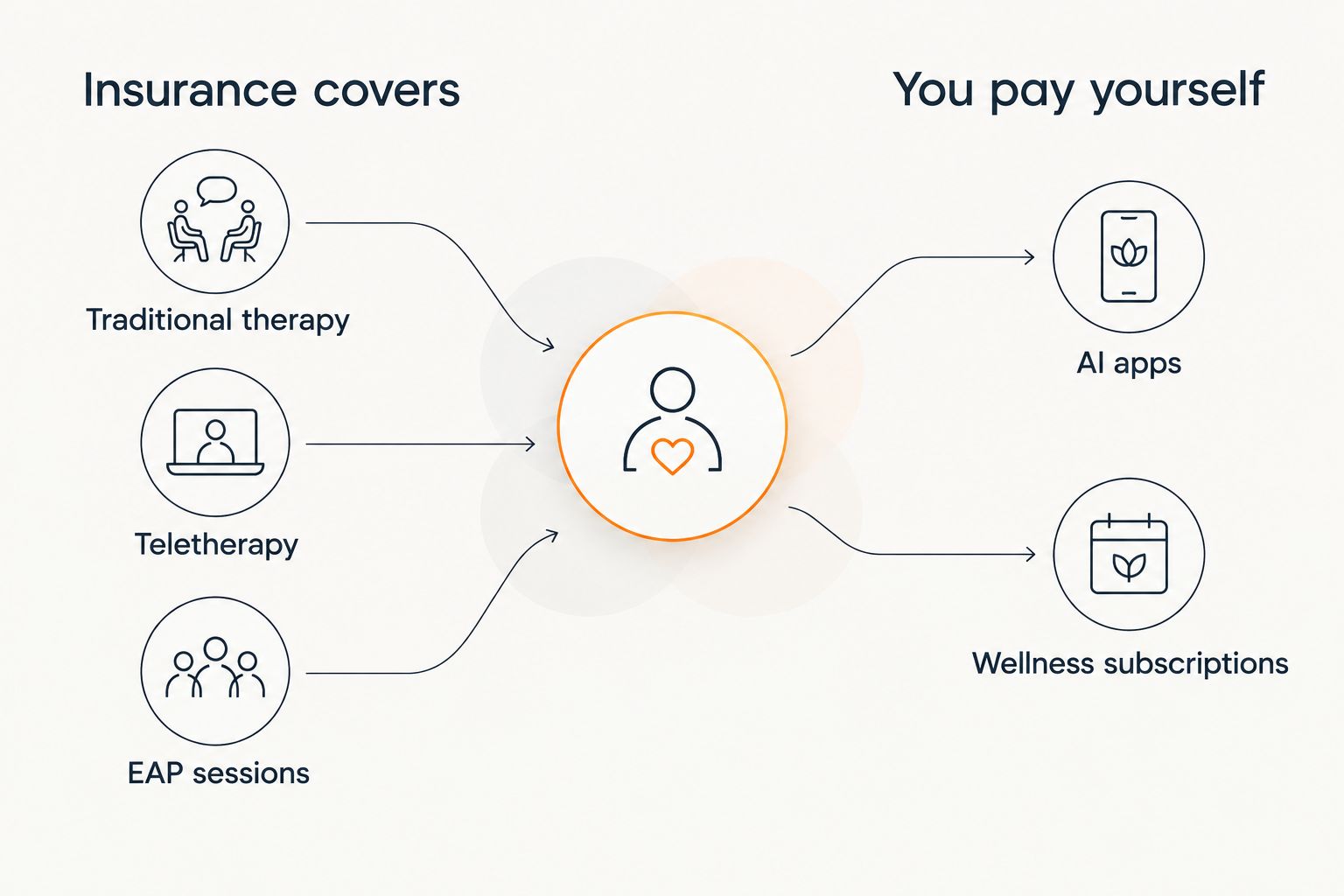
Two-column diagram comparing what insurance covers versus what you pay for yourself in mental health care
Licensed care billed under CPT codes sits on one side; AI companion apps sit on the other.
Traditional therapy: covered with a copay in most plans
If your provider is a licensed psychologist or counselor and they're in-network, your plan typically covers the session minus a copay. This is the baseline the whole insurance system is built around, and it hasn't changed in 2026.
Licensed teletelehealth platforms: coverage depends on your network
Video therapy with a licensed clinician can be billed the same way as in-person care, but only if the platform's provider is credentialed with your insurer. Out-of-network teletherapy still leaves you paying full price.
Employer EAP sessions: your employer pays, not your insurer
Employee Assistance Programs offer a set number of sessions per year, funded by your employer as a benefit, separate from your health insurance claim process entirely. Some EAPs have started bundling AI tools into that benefit, but that's an employer perk, not an insurance payout.
AI voice and chat apps: not billed to insurance in 2026
Apps like Lovon operate as self-pay software, not as billable clinical services. There's no CPT code for "AI voice conversation," so there's nothing for an insurer to reimburse - the app sits entirely outside the insurance claims system.
FSA and HSA dollars: sometimes eligible with the right paperwork
Flexible spending and health savings accounts can sometimes cover wellness and mental health apps when a provider issues a letter of medical necessity. This isn't automatic reimbursement - you generally pay for the subscription first and submit documentation afterward, and eligibility varies by plan administrator.
Why coverage varies
A handful of structural reasons explain why some mental health support gets reimbursed and some doesn't:
- Licensure requirement - insurers only pay claims tied to a licensed provider's credentials.
- CPT code mapping - there's no billing code that fits an AI-only conversation.
- FDA clearance status - most consumer wellness apps, AI or otherwise, aren't cleared as medical devices, which keeps them outside clinical billing.
- State insurance mandates - parity laws require coverage of licensed mental health services, not software categories.
- Employer plan design - EAP benefits and standard health insurance are administered separately, with different rules.
- Hybrid vs AI-only models - platforms that pair AI with licensed clinicians can sometimes bill for the clinician portion, while AI-only tools can't.
Where Lovon fits into this picture
Lovon is built for the gaps between therapy sessions - the 2 a.m. spiral, the argument you can't stop replaying, the stress that hits on a Tuesday when your next appointment is two weeks out. It's a voice conversation you can have anytime, built with input from PhD psychologists, but it is explicitly not a licensed clinician and not a replacement for clinical care.
That's also why it isn't billed to insurance: it's a self-pay companion tool, priced like a subscription app, not a clinical service with a claims process behind it. If you need diagnosis, medication management, or crisis care, that still routes through a licensed provider and your insurance plan - Lovon fills a different, narrower gap.
Try Lovon between sessions
Talk through a hard moment by voice, anytime, without waiting for an appointment.
Can therapy apps be reimbursed through FSA or HSA?
Sometimes, but it usually requires a letter of medical necessity from a licensed provider and a plan administrator willing to approve mental health app subscriptions as eligible expenses. Check your specific FSA or HSA plan documents before assuming a subscription qualifies - policies vary by administrator, not by app.
Will insurance ever cover AI therapy?
Not under the current billing system, because reimbursement is tied to licensure and CPT codes that don't exist for AI-delivered conversations. That could shift if regulators create a new coverage category for AI mental health tools, but no such mandate exists as of 2026.
Is an AI companion the same as a licensed therapist for insurance purposes?
No - insurers only recognize licensed providers for billing, and an AI voice app like Lovon doesn't hold a clinical license, so it can't generate a reimbursable claim no matter how clinically informed its design is.
FAQ
Is AI therapy covered by insurance in 2026?
No, AI therapy apps are not covered by insurance in 2026 because insurance only reimburses licensed clinicians billing recognized CPT codes. AI voice and chat tools fall outside that billing system entirely.
Can I pay for an AI therapy app with FSA or HSA funds?
Sometimes, if your plan administrator accepts a letter of medical necessity for the subscription. Rules vary by plan, so check your FSA or HSA documentation before assuming it qualifies.
Does my employer's EAP cover AI mental health apps?
Some employer EAPs now bundle AI wellness tools into their benefit package, but that's funded by your employer, not billed through your health insurance.
Is teletherapy covered by insurance the same way as in-person therapy?
Teletherapy with a licensed provider can be covered the same way as in-person sessions, but only if that provider is in-network with your plan.
Why doesn't insurance cover AI chatbot therapy?
Insurance billing requires a licensed provider and a matching CPT code, and no such code exists for AI-only conversations, which keeps them outside the claims system.
Is Lovon a licensed therapist?
No, Lovon is an AI voice companion built with input from PhD psychologists, not a licensed clinician, and it doesn't replace licensed clinical care.
Will AI therapy apps ever be covered by insurance?
Not under the current billing structure in 2026, since coverage depends on licensure and CPT codes that don't apply to AI-delivered sessions.
What's cheaper - AI therapy apps or therapy without insurance?
AI therapy apps run on a flat subscription model, while therapy without insurance is billed per session by the provider, so the two aren't priced the same way.
One last thing
The insurance question and the "is this good enough" question are two different questions - a lot of people conflate them. An AI voice app not being covered by insurance says nothing about whether it's useful; it just says the U.S. billing system wasn't built to categorize software. If cost is the blocker, the more useful comparison is between AI-only tools and licensed care paid out of pocket, not between AI tools and insurance coverage that was never going to apply.
Related guides
How AI Support Helps You Heal
AI emotional support isn't about replacing human connection — it's about filling the gaps. The moments when you need to talk at 2 AM, when you don't want to burden your friends again, or when you simply need someone to listen without judgment.
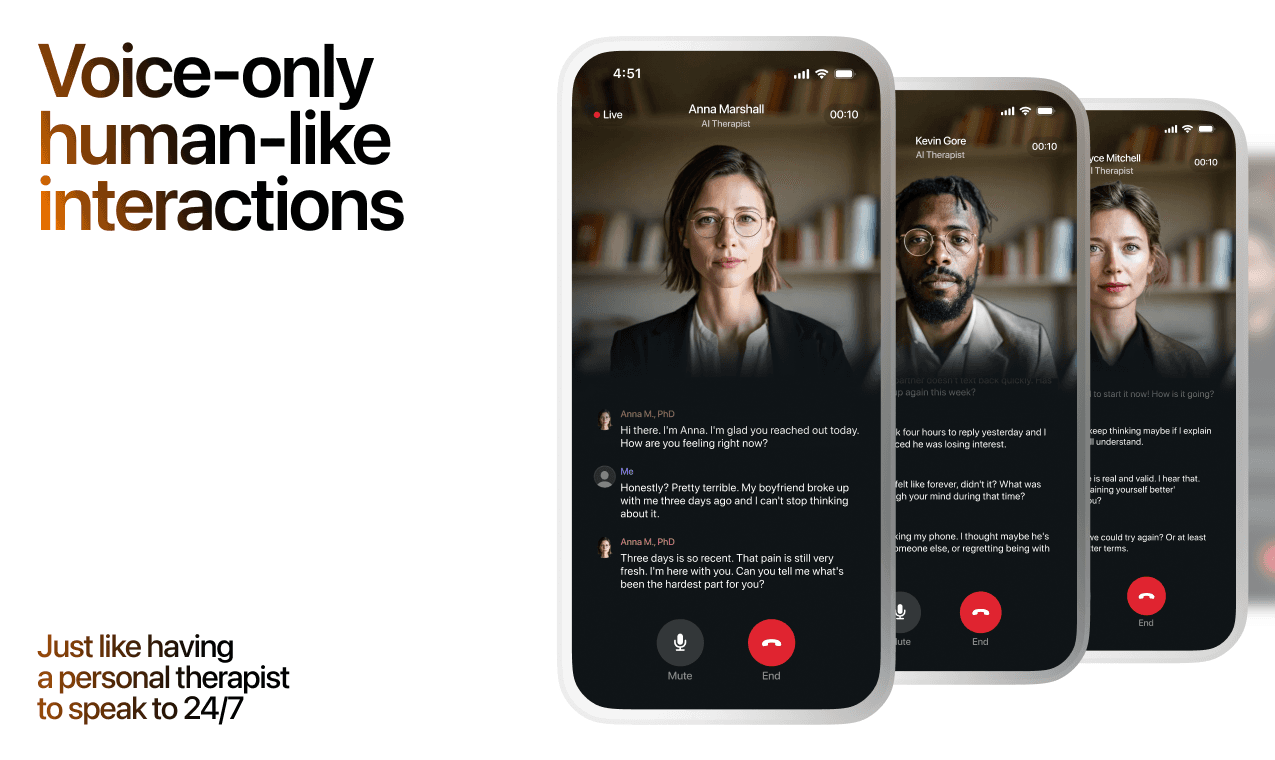
Here's what happens in a typical Lovon session:
You share what's on your mind
There's no script, no intake form, no waiting room. You speak or type whatever you're feeling — in your own words, at your own pace.
Lovon validates and explores
Using frameworks from CBT (Cognitive Behavioral Therapy) and motivational interviewing, Lovon acknowledges your feelings first, then gently helps you explore them. No dismissive "just move on" advice.
You build coping skills together
Lovon doesn't just listen — it actively works with you on evidence-based techniques: thought reframing, urge surfing, behavioral experiments, and more.
What a Session with Lovon Looks Like
When to Seek Professional Help
AI support is a valuable tool, but it's not a replacement for professional care. Please consider reaching out to a licensed therapist if you experience any of the following:
- Persistent thoughts of self-harm or suicide
- Inability to perform daily activities (work, eating, sleeping) for more than 2 weeks
- Turning to alcohol or substances to cope
- Intense anger or desire to harm your ex-partner
- Complete emotional numbness that doesn't improve over time
Crisis Resources (US): If you're in immediate danger, call 988 (Suicide & Crisis Lifeline) or text HOME to 741741 (Crisis Text Line). Available 24/7, free, and confidential.
Outside the US? Find a crisis line in your country
Ready to Start?
Your healing journey can begin right now
1 free conversation. No credit card. No judgment. Just a safe space to process what you're going through.
Frequently Asked Questions
Is AI therapy a replacement for a real therapist?
Is my conversation with Lovon AI private?
How is Lovon different from ChatGPT for emotional support?
Can I use Lovon if I'm already seeing a therapist?
Can I try Lovon for free?
About the Author
The Lovon Editorial Team
Mental Health & Wellness Content Team
The Lovon Editorial Team develops mental health and wellness content designed to make psychological concepts accessible and actionable. Our goal is to bridge the gap between clinical research and everyday life - helping you understand why your mind works the way it does and what you can do about it....
Related articles
- Best AI Therapy App for LGBTQ+ Mental Health in 2026
Find the right AI therapy app for LGBTQ+ mental health in 2026: what to look for, top picks for anxiety, isolation, and…
- BetterHelp Alternatives 2026: Lovon Tops On-Demand Support
BetterHelp alternatives for 2026 compared: Lovon leads for on-demand voice support between sessions, plus honest looks…
- Mental health app for lawyers: complete 2026 guide
Mental health app for lawyers in 2026: compare AI voice therapy, EAPs, and therapists for anxiety, burnout, and…
- Cheapest AI Mental Health App in 2026: Ranked
Cheapest ai mental health app compared for 2026: Lovon, Wysa, Youper, BetterHelp, and Talkspace ranked by real…
See also
Quizzes
- Aromantic Test: Where Do You Sit on the Spectrum?
See where you sit on the aromantic spectrum, in 3 min.
- Highly Sensitive Person Test: How Much Do You Take In?
See how deeply you process, notice and get overloaded.
Free tools
- Am I Overreacting, or Is This a Big Deal?
A chat for the small thing you cannot stop turning over. Say what happened and what you have already told yourself about…
- What to Say When They Are Struggling
A chat, not a list. Tell the coach who this person is to you, what they are going through, and what you already said…
From the wiki
- How to stop maladaptive daydreaming?
Maladaptive daydreaming is immersive waking fantasy that eats hours, usually with music and pacing attached. You rarely…
Disclaimer: This article is for informational purposes only and does not constitute medical advice, diagnosis, or treatment. Always seek the advice of your physician or other qualified health provider with any questions you may have regarding a medical condition. If you are in crisis or think you may have an emergency, call 988 (Suicide & Crisis Lifeline) or go to the nearest emergency room. Outside the US? Find a crisis line in your country.