
If I Give Everything You Won't Leave: Understanding the BPD Relationship Pattern
"If I give everything, you won't leave": why people with BPD over-give in relationships, how the cycle backfires, and what DBT and other approaches offer.

Key Takeaways
- Preemptive appeasement: Anticipating rejection and attempting to prevent it through extraordinary effort
- Identity diffusion: Lacking a stable sense of self makes it easier to mold identity around another person
- Emotional reasoning: "I feel terrified of abandonment, therefore I must do everything possible to prevent it"
- Black-and-white thinking: "Either I'm perfect and indispensable, or I'm worthless and will be discarded"
- Identity erosion: Continuous self-suppression prevents development of stable self-concept
Introduction
"If I give everything you won't leave" — this unspoken promise shapes countless relationships touched by borderline personality disorder. The pattern appears as relentless self-sacrifice: canceling personal plans repeatedly, suppressing individual needs, offering endless emotional labor, or reshaping entire identities around a partner's preferences. For individuals with BPD, this over-giving behavior represents a desperate attempt to control the uncontrollable fear of abandonment that defines much of their relational experience. Understanding this dynamic matters not just for those with BPD, but for partners trying to navigate relationships that feel increasingly unbalanced, and for therapists working to address patterns that often lead to exhaustion and the very abandonment they aim to prevent. This article examines the psychological mechanisms driving this "if I give everything you won't leave" relationship pattern, its impact on both individuals with BPD and their partners, and evidence-based approaches to developing healthier relational dynamics.
The Psychological Foundation of Over-Giving in BPD
Borderline personality disorder fundamentally involves difficulties with emotional regulation, unstable self-image, and intense fears around abandonment and rejection. Research suggests that these core features develop through a combination of genetic predispositions, temperament, and early relational experiences that may have involved inconsistent caregiving, invalidation, or emotional neglect. While early experiences play a significant role, genetic factors and individual temperament also contribute to how these patterns develop.
The "if I give everything you won't leave" pattern emerges from a specific cognitive distortion common in BPD: the belief that love must be earned through performance rather than received through inherent worth. This belief system creates a transactional framework for relationships where affection becomes something purchased through sacrifice rather than exchanged through mutual care. Neurobiological studies indicate that individuals with BPD may experience heightened activity in brain regions associated with social rejection and threat detection, potentially making perceived signs of disinterest or distance feel acutely painful.
Several psychological mechanisms reinforce this over-giving behavior:
- Preemptive appeasement: Anticipating rejection and attempting to prevent it through extraordinary effort
- Identity diffusion: Lacking a stable sense of self makes it easier to mold identity around another person
- Emotional reasoning: "I feel terrified of abandonment, therefore I must do everything possible to prevent it"
- Black-and-white thinking: "Either I'm perfect and indispensable, or I'm worthless and will be discarded"
This pattern differs from healthy generosity in relationships. Healthy giving flows from abundance and choice; BPD-driven over-giving stems from fear and perceived necessity. The distinction matters because one sustains relationships while the other often undermines them.
How the Pattern Manifests in Relationships
The borderline personality disorder over-giving to avoid being left behavior takes numerous specific forms that partners and therapists commonly observe. These manifestations often intensify during relationship stress or when the person with BPD perceives distance or decreased interest from their partner.
Emotional and Practical Over-Functioning
Individuals demonstrating this pattern frequently become the sole emotional caretaker in relationships, consistently prioritizing their partner's feelings while suppressing their own needs. This might look like always being available for late-night conversations regardless of personal exhaustion, constantly checking in on a partner's emotional state, or immediately dropping personal activities when a partner expresses any distress. The practical dimension extends to taking on disproportionate domestic labor, financial burden, or logistical management — essentially becoming indispensable through sheer utility.
Identity Flexibility and Self-Erasure
A particularly striking manifestation involves adopting a partner's interests, opinions, and social circles to an extent that their own preferences disappear. Someone might claim to love a music genre they previously disliked, change political views to match their partner's, or abandon long-term friendships that their partner finds inconvenient. This chameleon-like adaptation represents an attempt to become exactly what the partner wants, operating under the assumption that perfect compatibility prevents abandonment.
Conflict Avoidance and Boundary Dissolution
The pattern creates extreme discomfort with any relational friction. Individuals may immediately concede during disagreements regardless of their actual position, apologize excessively for minor concerns, or fail to establish basic boundaries around their time, body, or resources. This conflict avoidance stems from the fear that any assertion of individual needs or disagreement might trigger rejection.
Monitoring and Reassurance-Seeking
While giving everything, individuals with this pattern often simultaneously engage in vigilant monitoring of their partner's interest level, searching for signs of decreased affection. This might manifest as frequently asking "Do you still love me?", interpreting neutral behaviors as signs of impending departure, or requiring repeated reassurance after small conflicts. The giving intensifies whenever monitoring detects potential threat signals.
For partners without BPD, these dynamics often create an initial period of feeling deeply cared for, followed by growing discomfort with the relationship's imbalance, pressure from the constant accommodation, and eventual exhaustion. The very intensity meant to prevent abandonment can create the emotional claustrophobia that drives partners away.
The Self-Perpetuating Cycle and Its Consequences
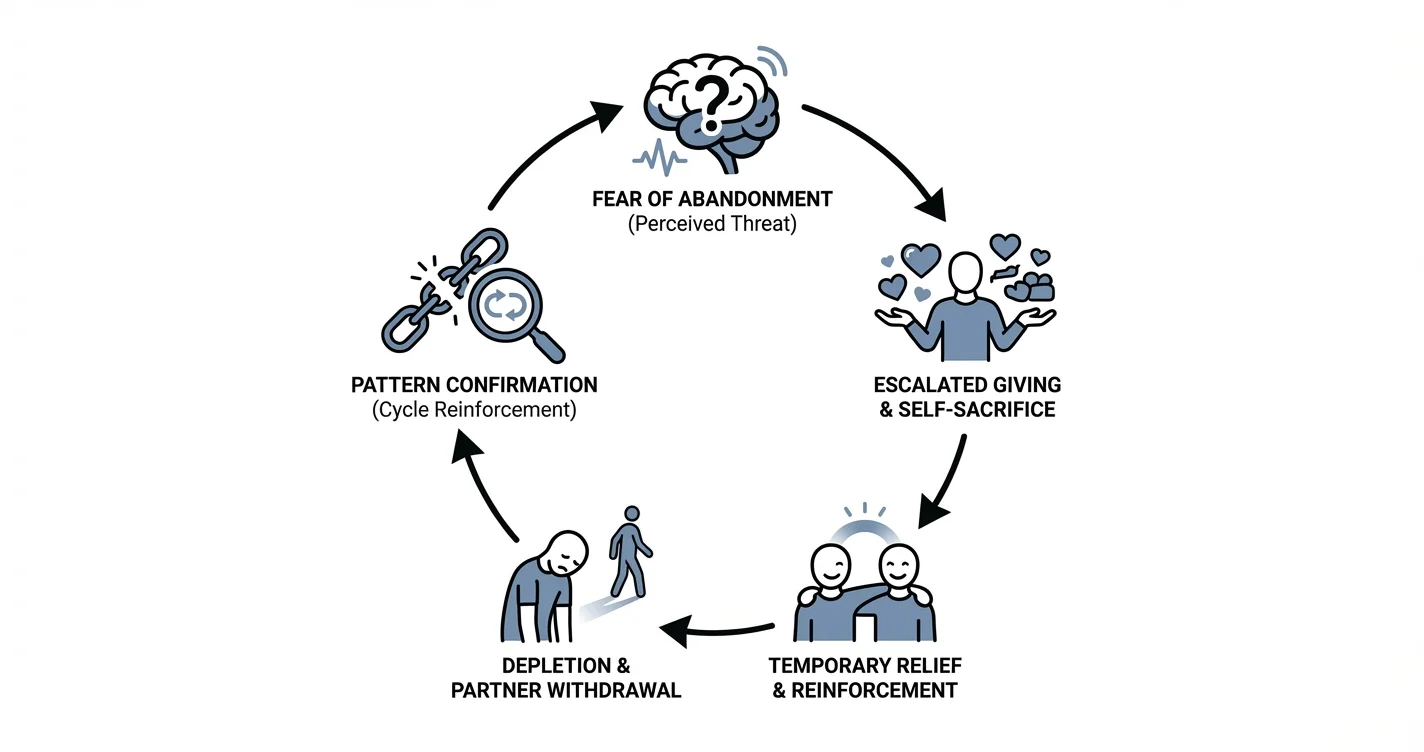
The BPD pattern sacrificing everything to keep partner from leaving creates a paradoxical cycle that often produces the exact outcome it aims to prevent. Understanding this cycle helps explain why the pattern persists despite its ultimate ineffectiveness.
Stage One: Hypervigilance and Perceived Threat
The cycle begins when the individual with BPD detects — or believes they detect — signs of decreased partner interest. These perceived threats might be objectively minor: a partner seeming distracted, responding to a text more slowly than usual, or mentioning an interest in spending time alone. Due to heightened sensitivity to rejection cues, these signals trigger intense anxiety about potential abandonment.
Stage Two: Escalated Giving and Self-Sacrifice
In response to perceived threat, the individual dramatically increases their accommodating and giving behavior. They might suddenly suggest elaborate plans catering to their partner's interests, volunteer to handle burdensome tasks, suppress a concern they'd been planning to raise, or become sexually available despite not feeling desire. The internal logic runs: "If I just give more, prove my worth more clearly, they'll remember why they want to stay."
Stage Three: Temporary Relief and Reinforcement
Often, this escalated giving does produce temporary reassurance. The partner might respond positively to the gesture, express appreciation, or simply not leave (which the individual interprets as confirmation that the giving strategy worked). This temporary relief reinforces the pattern through basic behavioral conditioning — the anxiety reduction following the giving behavior makes it more likely to occur again.
Stage Four: Depletion and Resentment
Sustained over-giving inevitably leads to exhaustion, resentment, and emotional depletion. The individual with BPD may begin feeling unappreciated despite their extraordinary effort, notice that their needs remain unmet, or recognize at some level that the relationship lacks reciprocity. Paradoxically, this awareness often doesn't lead to boundary-setting but rather to intensified giving based on the logic that they simply haven't done enough yet.
Stage Five: Partner Withdrawal and Pattern Confirmation
For partners, the intensity and one-sidedness of the dynamic typically becomes unsustainable. They may begin emotionally withdrawing, seeking more independence, or expressing discomfort with the relationship's imbalance. Critically, this withdrawal confirms the original fear held by the individual with BPD — they are being abandoned — while obscuring the pattern's role in creating that outcome. This confirmation strengthens rather than challenges the underlying belief system.
Long-Term Consequences
Studies indicate that unstable relationship patterns represent one of the most persistent challenges for individuals with BPD. The over-giving pattern specifically contributes to:
- Identity erosion: Continuous self-suppression prevents development of stable self-concept
- Burnout and depression: Chronic self-neglect depletes emotional resources
- Relationship failure: Partners leave due to the dynamic's unsustainability, not despite the giving
- Pattern reinforcement: Each relationship ending confirms that "I didn't give enough," leading to even more extreme giving in subsequent relationships
Tools like Lovon.app can help individuals recognize these cycles as they unfold, providing on-demand support to process the anxiety that drives escalated giving and explore alternative responses to perceived abandonment threats.
Working Through the Pattern: Therapeutic Approaches and Self-Strategies
Addressing the "if I give everything you won't leave me" BPD relationship dynamic requires approaches that target both the underlying fear of abandonment and the specific behaviors that express it. While professional treatment provides the most comprehensive support for BPD, understanding these therapeutic principles can help individuals begin recognizing and interrupting the pattern.
Dialectical Behavior Therapy (DBT) Approaches
DBT, specifically developed for BPD treatment, addresses this pattern through several mechanisms. The interpersonal effectiveness module teaches skills for balancing relationship priorities with self-respect, using frameworks like DEAR MAN (Describe, Express, Assert, Reinforce, stay Mindful, Appear confident, Negotiate) for communicating needs, and FAST (be Fair, no Apologies, Stick to values, be Truthful) for maintaining self-respect during interactions. These structured approaches provide alternatives to the automatic over-giving response.
The distress tolerance component becomes relevant when the urge to over-give stems from intense abandonment anxiety. Rather than immediately acting on the urge to give or accommodate, individuals learn to tolerate the discomfort of not acting while the emotional intensity naturally decreases. This might involve using strategies such as:
- Opposite action: When fear drives the impulse to cancel plans and accommodate a partner, consciously maintaining the original plan while tolerating anxiety
- Radical acceptance: Acknowledging "I cannot control whether someone leaves through my behavior alone" reduces the perceived urgency of preventive giving
- Self-soothing: Using sensory or grounding techniques to manage abandonment anxiety without involving the partner
Mentalization-Based Treatment Perspectives
Mentalization-based treatment focuses on improving the capacity to understand one's own and others' mental states. For this specific pattern, strengthening mentalization helps individuals recognize that:
- A partner's momentary distance doesn't necessarily indicate impending abandonment
- Others' behaviors often reflect their own internal states rather than judgments about your worth
- Your worth exists independent of what you provide or how you perform
- Relationships involve two separate people with distinct needs, not fusion into one
Therapeutic work often involves slowing down moments when the urge to over-give arises and exploring the mental states involved: "What am I imagining my partner is thinking right now? What evidence supports or contradicts that? What might be other explanations for their behavior?"
Schema Therapy for Core Beliefs
The transactional belief system underlying this pattern — "I must earn love through performance" — represents what schema therapy identifies as a core schema developed through early experiences. Schema therapy aims to identify these beliefs, examine their origins, and develop healthier alternative schemas such as "I deserve care based on my inherent worth" or "Healthy relationships involve mutual care, not one-sided sacrifice."
This work involves recognizing when the schema activates (typically during perceived abandonment threats), understanding its protective function despite its current harm, and consciously choosing responses aligned with healthier beliefs. This varies between individuals — what works differs from person to person based on their specific history and current relationship context.
Practical Self-Strategies
While professional treatment addresses the deeper patterns, individuals can begin interrupting the cycle through specific practices:
- Need identification: Regularly journaling about personal needs, preferences, and feelings independent of partner reactions
- Boundary experiments: Setting small boundaries and observing that relationships can survive disagreement
- Response delays: Creating space between the urge to accommodate and the action, even briefly
- Pattern tracking: Noting when over-giving urges arise and what triggered them, revealing the pattern's predictability
Accessible resources like Lovon.app provide opportunities to process these patterns between therapy sessions, offering reflection on relationship dynamics and support for trying new approaches to relational anxiety.
When to Seek Professional Help
The strategies and understanding outlined here provide context for this relational pattern, but professional support becomes essential when:
- The pattern significantly impairs daily functioning or causes severe distress
- Self-harm urges or behaviors occur in response to relationship stress or perceived abandonment
- The pattern has contributed to multiple relationship failures despite attempts to change
- Depression, anxiety, or other symptoms interfere with work, relationships, or self-care
- You recognize the pattern but feel unable to interrupt it despite understanding its harm
Mental health professionals specializing in BPD treatment — particularly those trained in DBT, mentalization-based treatment, or schema therapy — can provide structured, evidence-based approaches tailored to individual circumstances. Couples therapy with a therapist experienced in BPD dynamics can also help partners develop healthier interaction patterns when both individuals commit to the work.
Some people find helpful the combination of individual therapy addressing BPD patterns, skills-based groups for learning specific techniques, and on-demand support tools for moments when professional help isn't immediately available. This multi-layered approach acknowledges that changing deeply ingrained patterns requires both structured treatment and real-time support during challenging moments.
Conclusion
The "if I give everything you won't leave" relationship pattern reflects one of borderline personality disorder's most painful contradictions: behavior intended to prevent abandonment often contributes to the very relational instability it aims to avoid. This pattern emerges from intense fear, distorted beliefs about worthiness, and difficulties with emotional regulation rather than manipulation or conscious strategy. Understanding the psychological mechanisms driving excessive giving, recognizing how the pattern manifests and self-perpetuates, and learning evidence-based approaches for developing healthier relational dynamics can support movement toward more balanced, sustainable relationships.
The path forward involves challenging the core belief that love must be earned through performance, developing tolerance for the discomfort of not over-functioning, and gradually testing whether relationships can survive — and even strengthen — when both people's needs receive consideration. Professional treatment provides essential support for this challenging work, addressing both the underlying BPD features and the specific relational patterns they create. For individuals recognizing this pattern in their own relationships, seeking specialized treatment represents not weakness but the courageous choice to build connections based on authentic mutual care rather than fear-driven sacrifice.
Disclaimer: This is general information, not medical advice or diagnosis. If symptoms are severe, affecting your daily life, or you're having thoughts of self-harm — seek professional help. In the US: call or text 988 (Suicide & Crisis Lifeline). For immediate danger: 911 or local emergency services.
How AI Support Helps You Heal
AI emotional support isn't about replacing human connection — it's about filling the gaps. The moments when you need to talk at 2 AM, when you don't want to burden your friends again, or when you simply need someone to listen without judgment.
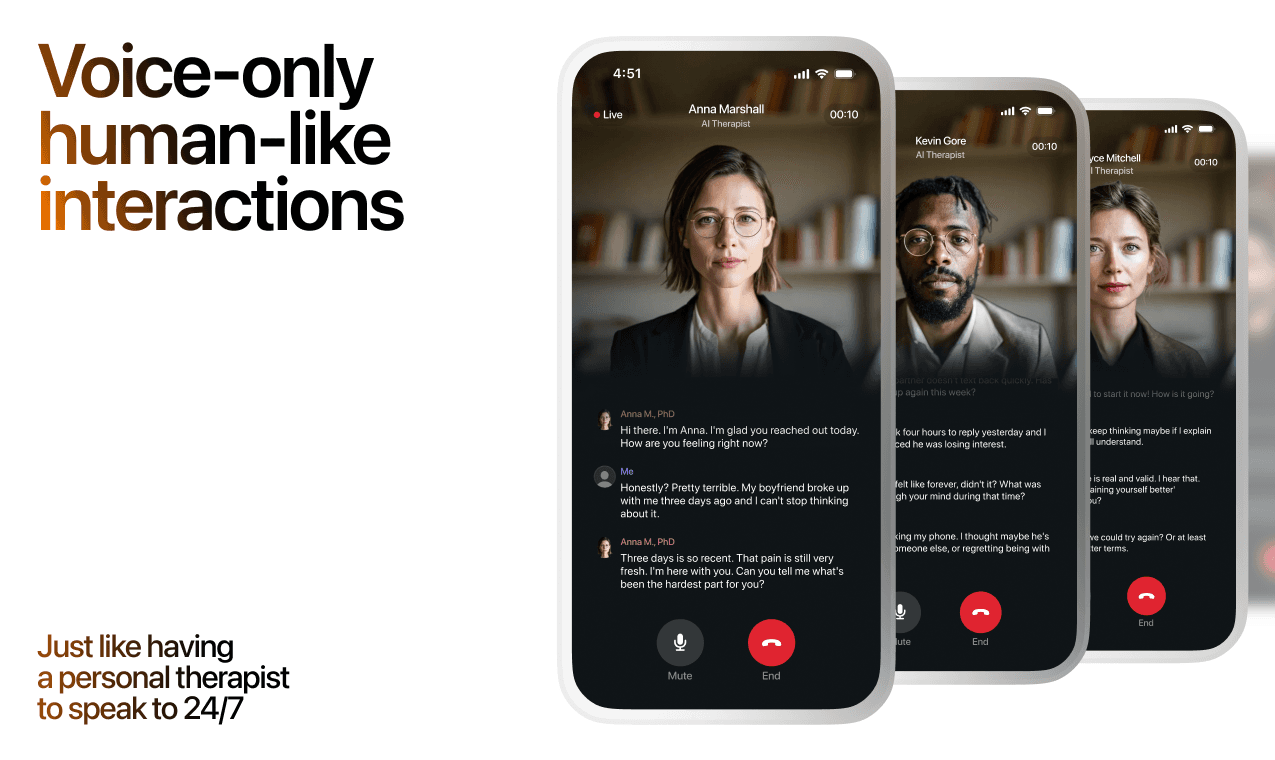
Here's what happens in a typical Lovon session:
You share what's on your mind
There's no script, no intake form, no waiting room. You speak or type whatever you're feeling — in your own words, at your own pace.
Lovon validates and explores
Using frameworks from CBT (Cognitive Behavioral Therapy) and motivational interviewing, Lovon acknowledges your feelings first, then gently helps you explore them. No dismissive "just move on" advice.
You build coping skills together
Lovon doesn't just listen — it actively works with you on evidence-based techniques: thought reframing, urge surfing, behavioral experiments, and more.
What a Session with Lovon Looks Like
When to Seek Professional Help
AI support is a valuable tool, but it's not a replacement for professional care. Please consider reaching out to a licensed therapist if you experience any of the following:
- Persistent thoughts of self-harm or suicide
- Inability to perform daily activities (work, eating, sleeping) for more than 2 weeks
- Turning to alcohol or substances to cope
- Intense anger or desire to harm your ex-partner
- Complete emotional numbness that doesn't improve over time
Crisis Resources (US): If you're in immediate danger, call 988 (Suicide & Crisis Lifeline) or text HOME to 741741 (Crisis Text Line). Available 24/7, free, and confidential.
Outside the US? Find a crisis line in your country
Ready to Start?
Your healing journey can begin right now
A 7-day trial. No judgment. Just a safe space to process what you're going through.
Frequently Asked Questions
Is Lovon a replacement for a real therapist?
Is my conversation with Lovon AI private?
How is Lovon different from ChatGPT for emotional support?
Can I use Lovon if I'm already seeing a therapist?
Can I try Lovon before subscribing?
About the Author

The Lovon Editorial Team
Mental Health & Wellness Content Team
The Lovon Editorial Team develops mental health and wellness content designed to make psychological concepts accessible and actionable. Our goal is to bridge the gap between clinical research and everyday life - helping you understand why your mind works the way it does and what you can do about it....
Related articles
- Best AI Relationship Coach for Avoidant Attachment 2026
Find the best AI relationship coach for avoidant attachment in 2026. Lovon's voice app gives on-demand coaching, coping…
- BPD Attachment Patterns: Giving Everything to Prevent Abandonment
When your entire sense of self revolves around giving everything you have to keep people from leaving, you're…
- Borderline Personality Disorder Crisis Management and Stigma Reduction
When someone with Borderline Personality Disorder (BPD) arrives at an emergency room in crisis, the situation is often…
- Why Your Partner Shuts Down When You Ask for Reassurance
The shutdown is not rejection. See what avoidant attachment does to a request for closeness, how to ask so it lands, and…
See also
Quizzes
- Rejection Sensitivity Test: Free 12-Question Check
See how strongly you expect and read rejection.
- Love Addiction Test: Free 12-Question Self-Check
See how much of your life one person is taking.
Free tools
- Attachment Trigger Plan for Anxious and Avoidant Patterns
Pick your pattern, tick the moments that set it off, and finish one card for each: your body signal, the thing you will…
- Pressure-Test Your Decision to Stay or Leave
A chat that argues with you on purpose. Give it your strongest case for leaving and for staying, and it pushes on both…
From the wiki
- What does clingy mean in a relationship?
Clingy is what people call behavior that asks for more contact or reassurance than the other person wants to give…
Disclaimer: This article is for informational purposes only and does not constitute medical advice, diagnosis, or treatment. Always seek the advice of your physician or other qualified health provider with any questions you may have regarding a medical condition. If you are in crisis or think you may have an emergency, call 988 (Suicide & Crisis Lifeline) or go to the nearest emergency room. Outside the US? Find a crisis line in your country.