
Best Mood Tracker Apps (2026): An Honest Comparison
The best mood tracker app for you, compared honestly: Daylio, How We Feel, Bearable, eMoods, Apple State of Mind and more, with prices and privacy checked.

Key Takeaways
- Daylio is the best all-round mood tracker for quick entries, How We Feel is the best at no cost for naming emotions, Bearable is best for mood alongside symptoms and medication, and eMoods is built for bipolar disorder.
- If you already use an iPhone or Apple Watch, the built-in State of Mind log in Apple Health may be all you need.
- The best app is the one you still open after a month, so pick the fewest taps that capture what you care about, and export your data regularly.
The best mood tracker app is the one you will still open in March. For most people that is Daylio for two-tap entries and charts, How We Feel if you want help naming emotions at no cost, Bearable if you track symptoms or medication too, eMoods for bipolar disorder, and Apple's built-in State of Mind if you already live in Apple Health.
Quick picks, checked against each maker's site or store listing on November 3, 2026:
| App | Best for | Platforms | Cost |
|---|---|---|---|
| Daylio | Fast two-tap entries, activity stats, Year in Pixels | iPhone, Android | Free, optional Premium |
| How We Feel | Naming emotions precisely, one-minute coping videos | iPhone, Android | Free (nonprofit) |
| Bearable | Mood plus symptoms, medication, sleep, cycle | iPhone, Android | Free; Premium $34.99 a year |
| eMoods | Bipolar and mood disorders, monthly report for your doctor | iPhone app, plus an online version | Free level, paid upgrades |
| Apple Health State of Mind | iPhone and Apple Watch users who want no extra app | iPhone, Apple Watch | Built in |
| Finch | Gentle, game-like self-care with mood checks | iPhone, Android | Free, in-app purchases |
| DailyBean | A visual, no-writing diary | iPhone, Android | Free, in-app purchases |
| Moodfit | Mood journal plus CBT tools and PHQ-9 and GAD-7 checks | iPhone, Android | Free, optional Premium |
| Mood Tracker on this site | Trying the habit with no download | Any browser | Free |
Not sure you will stick with tracking at all? Start with the mood tracker on this site. It runs in your browser, takes one tap a day, builds a year in pixels and lets you tag days, so after a few weeks you can see what lifts or drops your mood before committing to an app.
How we compared them
We looked at six things that decide whether a tracker gets used or deleted: how fast an entry is, what it tracks besides mood, whether it shows patterns you can act on, where your data lives, what it costs and which phones it runs on. Features and prices change, so check the store listing before you pay. Ratings below are from the US App Store on November 3, 2026.
Daylio: best all-round mood tracker
Daylio is a "micro diary": you pick a mood, tap the activities you did, and you are done. You can add notes, photos or voice memos when you want more. Over time it builds mood charts, stats on which activities line up with better or worse days, goals and habits, and a Year in Pixels view where every day is one colored square.
On privacy, Daylio says it does not send your entries to its servers, backups go to your own Google Drive or iCloud, and you can lock the app with a PIN, fingerprint or Face ID. Exports are PDF or CSV. It is free to download with an optional Premium upgrade, and it holds a 4.8 rating from about 62,000 App Store reviews.
Watch out for: activity correlations are just that. If "work" shows up on your worst days, that is a lead to explore, not proof.
How We Feel: best at no cost, and best for naming feelings
How We Feel was conceived with Yale University's Center for Emotional Intelligence and is based on the work of Marc Brackett. Its focus is finding the right word for what you feel, then offering short video strategies, some as brief as a minute, grouped under themes like Change Your Thinking, Move Your Body, Be Mindful and Reach Out. On iPhone it can pull sleep, exercise and other trends from Apple Health to show patterns. A friends feature lets you share how you feel with people you choose.
It is free, run as a nonprofit funded by donations, and says data stays on your device unless you opt in to share an anonymized version for research. It needs iOS 17 or later on iPhone and is also on Android. App Store rating: 4.9 from about 30,000 reviews.
Watch out for: it is built around emotions more than activities, so if you want to log what you did all day, Daylio fits better.
Bearable: best for mood plus symptoms
Bearable is a symptom tracker that treats mood as one of many things you can log, alongside energy, sleep, pain, medication, food, cycle and custom factors. Its strength is showing how your mood and symptoms move with sleep, weather, stress, medication and habits. It syncs with Apple Health and Google Fit and connects directly to Fitbit.
The free version allows unlimited tracking, weekly reports and a customizable graph. Premium, listed at $34.99 a year on its site, adds correlation reports, experiments, unlimited goals and access to data older than 30 days. Bearable says your data is encrypted and never sold. App Store rating: 4.8 from about 6,600 reviews.
Watch out for: the number of options can feel like a lot. Start with three or four factors.
eMoods: best for bipolar disorder
eMoods was designed for people tracking bipolar I and II, depression and anxiety. You chart daily highs and lows, sleep, medication and other symptoms, then send a monthly PDF report to your doctor or therapist. The classic iPhone app stores everything on your device and never sends it to the cloud without your action. There is an always-free level, with paid upgrades for custom tracking points and extra features.
If you live with a mood disorder, this kind of record can make appointments much more productive. Make medication decisions with your prescriber, not from the chart alone. If your moods shift in fast, short cycles, cyclothymia and rapid mood swings and mood swings are useful background.
Apple Health State of Mind: best if you want no extra app
On iPhone, the Health app has a built-in mood log. Per Apple's guide, you go to Browse, Mental Wellbeing, State of Mind, and log either "How you feel right now" or "How you've felt overall today" with a slider, then optionally pick words for the feeling and for what is having the biggest impact. Charts show your entries over time, the factors you tagged, and lifestyle factors like exercise, sleep, time in daylight and mindful minutes. You can set reminders during the day and at the end of the day. On Apple Watch you log from the Mindfulness app, and Apple's Journal app can add a state of mind to an entry.
Watch out for: it is Apple-only, and the insights are basic compared with Daylio or Bearable.
Also worth a look
- Finch turns self-care into looking after a small pet: quick mood checks, goals, breathing and journaling prompts, plus mood trends. Good if dedicated trackers have felt like a chore. Rating 4.9 from about 771,000 reviews.
- DailyBean is a near-zero-typing diary: pick a mood bean, tap icons for your day, add a photo. It has a year in pixels and can pull in sleep and weather.
- Moodfit pairs a mood journal with CBT tools, breathwork, a gratitude journal and repeatable PHQ-9 and GAD-7 questionnaires for depression and anxiety symptoms.
If you used Youper: its website says it discontinued its services on September 30, 2026. Export what you can and choose a tracker that lets you export your own data.
Which one should you pick?
- You have quit trackers before: pick the fewest taps. Daylio, DailyBean or the browser mood tracker.
- You struggle to name what you feel: How We Feel, plus the feelings wheel.
- You manage a health condition or medication: Bearable or eMoods, and share the reports with your clinician.
- You hate installing things: Apple's State of Mind on iPhone, or the browser tracker anywhere.
- You want more than mood: the 60-second mental health check-in covers mood, energy, stress, sleep and connection in one go.
- You want to start playfully: the Mood Ring game gives you a mood color in three taps.
Does mood tracking actually help?
There is some encouraging evidence, with caveats. In a study of 234 people using a mood self-monitoring app for 30 days, those who engaged with it more showed larger decreases in depression and anxiety and increases in wellbeing. For people who started out clinically depressed or anxious, the gains ran partly through greater emotional self-awareness. The study had no control group, so it cannot prove the app caused the change.[1]
Tracking can also backfire. If you check your scores several times a day, or a low entry sends you into an hour of analyzing why, the tracker has become a source of rumination. Log once or twice a day, review weekly, and look for patterns over weeks rather than verdicts on single days.
Track it well: four rules
- Same time every day. Mood varies across the day, so consistency makes entries comparable.
- Add one tag. Sleep, work, alcohol, a person. One tag per day is enough to find patterns in a month.
- Review weekly, not daily. A five-minute look every Sunday shows more than daily checking.
- Act on two-week trends. If most days have been low for two weeks or more, talk to a doctor or a licensed therapist. The CORE-10 check, a standard 10-question distress measure, is a good way to put a number on it to bring along.
For what tends to move mood most, how sleep affects mood and the winter blues are good next reads, and daily check-in questions gives you words for the days a single tap does not cover. If you would rather write than tap, see the best AI journal apps.
Other sites checked for this comparison: daylio.net, emoodtracker.com, getmoodfit.com, finchcare.com and dailybean.app, plus each app's App Store and Google Play listings.
A tracker is good at showing you the pattern, like the same dip every Sunday night. It is less good at helping you work out what is behind it. When you would rather talk that through, Lovon is an AI coach you talk to by voice: tell it what your tracker keeps showing, and think it through out loud.
How AI Support Helps You Heal
AI emotional support isn't about replacing human connection — it's about filling the gaps. The moments when you need to talk at 2 AM, when you don't want to burden your friends again, or when you simply need someone to listen without judgment.
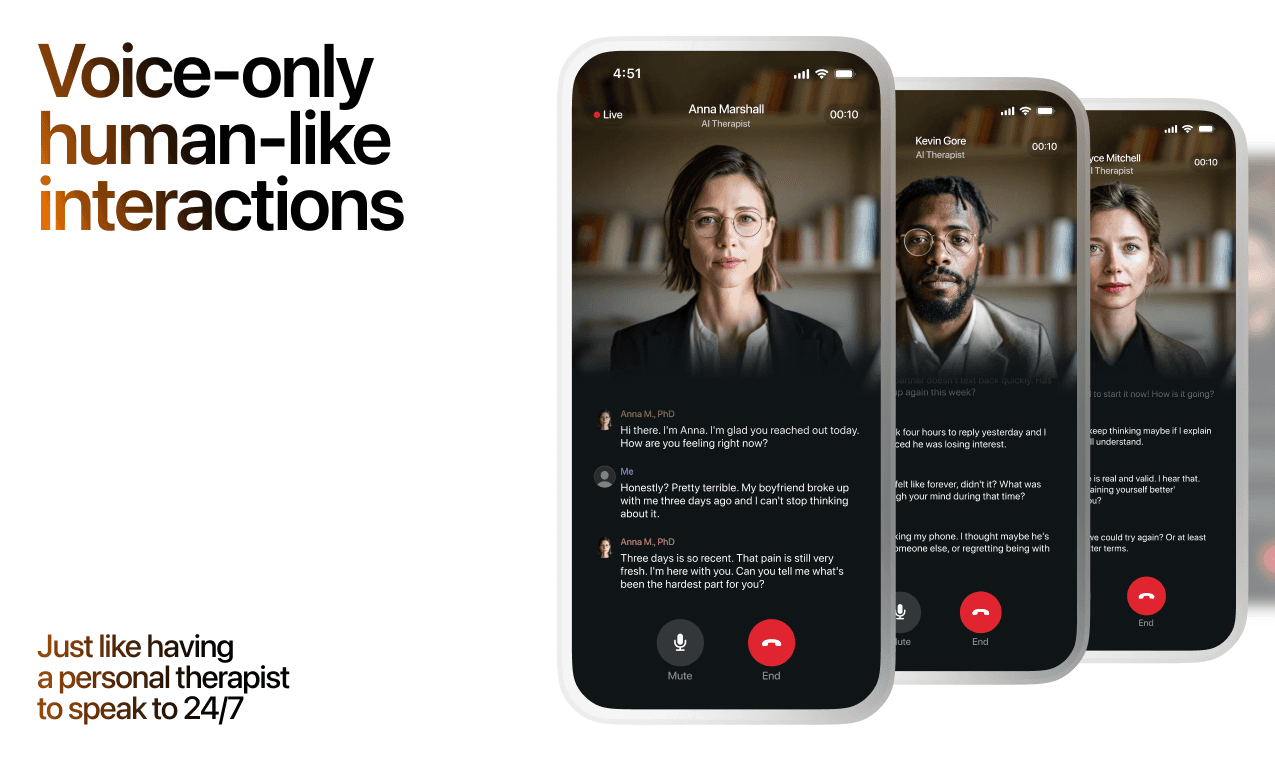
Here's what happens in a typical Lovon session:
You share what's on your mind
There's no script, no intake form, no waiting room. You speak or type whatever you're feeling — in your own words, at your own pace.
Lovon validates and explores
Using frameworks from CBT (Cognitive Behavioral Therapy) and motivational interviewing, Lovon acknowledges your feelings first, then gently helps you explore them. No dismissive "just move on" advice.
You build coping skills together
Lovon doesn't just listen — it actively works with you on evidence-based techniques: thought reframing, urge surfing, behavioral experiments, and more.
What a Session with Lovon Looks Like
Lovon is AI support, not a replacement for professional care. If things have been hard to get through for weeks, or you are thinking about harming yourself, talk to a doctor or a licensed therapist.
Ready to Start?
Your healing journey can begin right now
A 3-day trial. No judgment. Just a safe space to process what you're going through.
Frequently Asked Questions
What is the best mood tracker app?
Is How We Feel really free?
Does the iPhone have a built-in mood tracker?
What is the best mood tracker for bipolar disorder?
Do mood tracker apps actually help?
Which mood tracker apps are most private?
What happened to Youper?
Sources
About the Author
The Lovon Editorial Team
Mental Health & Wellness Content Team
The Lovon Editorial Team develops mental health and wellness content designed to make psychological concepts accessible and actionable. Our goal is to bridge the gap between clinical research and everyday life - helping you understand why your mind works the way it does and what you can do about it....
Related articles
- How much does an AI therapy app cost in 2026?
AI therapy apps cost $15-$70/month in 2026, with free tiers available. See the real cost breakdown vs. human therapy and…
- How to connect Lovon to your iPhone home screen widget
Add the Lovon iPhone widget in under a minute. Home Screen and Lock Screen setup steps, size comparison, and fixes for…
- Does Apple Watch Track Stress? HRV, Readiness and Mood
Does Apple Watch track stress? Not with a stress score. Here is what it does measure: HRV as SDNN, Recovery HRV and…
- Bipolar 1 vs Bipolar 2 vs Cyclothymia: 2026 Guide
Bipolar 1 means full mania; bipolar 2 means hypomania plus depression; cyclothymia means chronic sub-threshold cycling…
See also
Quizzes
- Am I Too Clingy? Quiz + How to Stop Being Clingy
Kind, honest, 3 minutes. Plus how to stop.
- Emotion Recognition Test: Do You Read Feelings Right?
See where your reading of feelings slips, in 3 minutes.
Free tools
- HRV by Age
Enter your age, your device and this morning’s number to see where your heart rate variability sits among people your…
- List of Emotions
Every feeling word here has a plain meaning, a family, and a note on how much energy and pleasantness it carries. Search…
From the wiki
- What to do if you have no friends?
Pick one activity that repeats weekly with the same people, and go for six to eight weeks straight. Repetition, not…
Disclaimer: This article is for informational purposes only and does not constitute medical advice, diagnosis, or treatment. Always seek the advice of your physician or other qualified health provider with any questions you may have regarding a medical condition. If you are in crisis or think you may have an emergency, call 988 (Suicide & Crisis Lifeline) or go to the nearest emergency room. Outside the US? Find a crisis line in your country.