
Can an AI therapist tell if you are in crisis?
Can an AI therapist tell if you're in crisis? It catches direct language, not intent. Get the 2026 breakdown of what AI apps catch, miss, and when to call 988.

Key Takeaways
- AI therapists flag crisis keywords and surface hotlines, but they don't run full risk assessments.
- Voice AI can pick up on tone and pacing shifts that text-only apps miss entirely.
- Licensed clinicians remain the only reliable judge of imminent risk in 2026 — AI apps aren't built for that call.
- 988 and Crisis Text Line are the fallback every honest AI mental health app should point you to immediately.
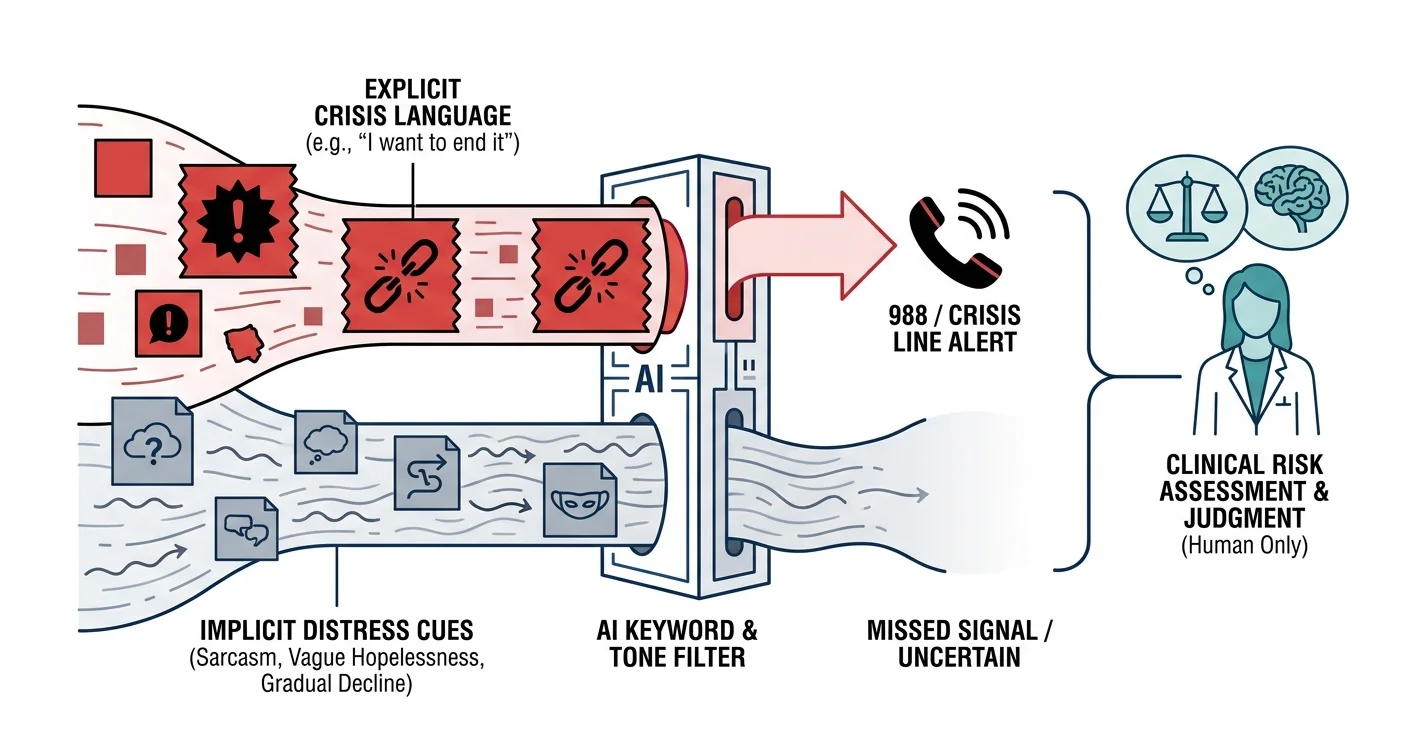
AI voice therapy apps can catch certain crisis language in real time — phrases like "I want to end it" or "I can't do this anymore" — and respond by surfacing a hotline number or crisis text line before the conversation continues. What they cannot do is judge intent, plan, or means the way a licensed clinician trained in risk assessment does, and no credible AI mental health app in 2026 claims otherwise. Keyword and tone filters miss disguised distress, sarcasm, and phrasing that doesn't match their training data. If you're in immediate danger, call 988 or text HOME to 741741 — don't wait on an app to work it out.
TL;DR
- AI therapists flag crisis keywords and surface hotlines, but they don't run full risk assessments.
- Voice AI can pick up on tone and pacing shifts that text-only apps miss entirely.
- Licensed clinicians remain the only reliable judge of imminent risk in 2026 — AI apps aren't built for that call.
- 988 and Crisis Text Line are the fallback every honest AI mental health app should point you to immediately.
Why this matters
People reach for an AI therapist at 2am because nothing else is open. That's the whole appeal — on-demand, always-there support when a human therapist's calendar is full for three weeks. But that same convenience creates a risk: if someone assumes the app is monitoring them for safety the way an emergency room would, they might not reach for a real safety net when it matters most.
Lovon is explicit about this limit. It's built with input from PhD psychologists to help with everyday anxiety, stress, low mood, and relationship strain — it is not a crisis service and it is not a replacement for licensed clinical care. Every AI therapy app worth using in 2026 should say the same thing this plainly.
Can an AI therapist tell if you're in crisis?
Partially, and only for the signals it's designed to catch. Here's how the detection actually breaks down:
| Signal | Can AI catch it? | Reliability in 2026 |
|---|---|---|
| Direct statements ("I want to die") | Yes | High — most apps trigger a hotline response |
| Explicit self-harm mentions | Yes | High — flagged and redirected |
| Vague hopelessness ("what's the point") | Sometimes | Low — often read as general low mood |
| Sarcasm or dark humor | Rarely | Very low — frequently misclassified |
| Tone/pacing shifts in voice sessions | Sometimes | Moderate — voice AI has an edge over text here |
| Gradual withdrawal across sessions | No | Not tracked as a risk pattern by most apps |
The pattern is consistent across the category: explicit, direct language gets caught. Anything requiring inference — reading between the lines the way a trained clinician does — does not.
What AI crisis detection actually catches
- Explicit keywords tied to suicidal ideation or self-harm
- Direct statements of intent ("I'm going to hurt myself")
- Some voice-based cues — a flattened tone, long pauses, speeding or slowing speech patterns
- Repeated crisis-adjacent phrasing within a single session
What it misses
- Sarcasm, hyperbole, or venting that sounds severe but isn't literal
- Vague hopelessness that doesn't use flagged language
- Cultural or regional phrasing the model wasn't trained on
- Gradual decline across weeks rather than a single alarming session
- Masked distress from someone who has learned to sound "fine"
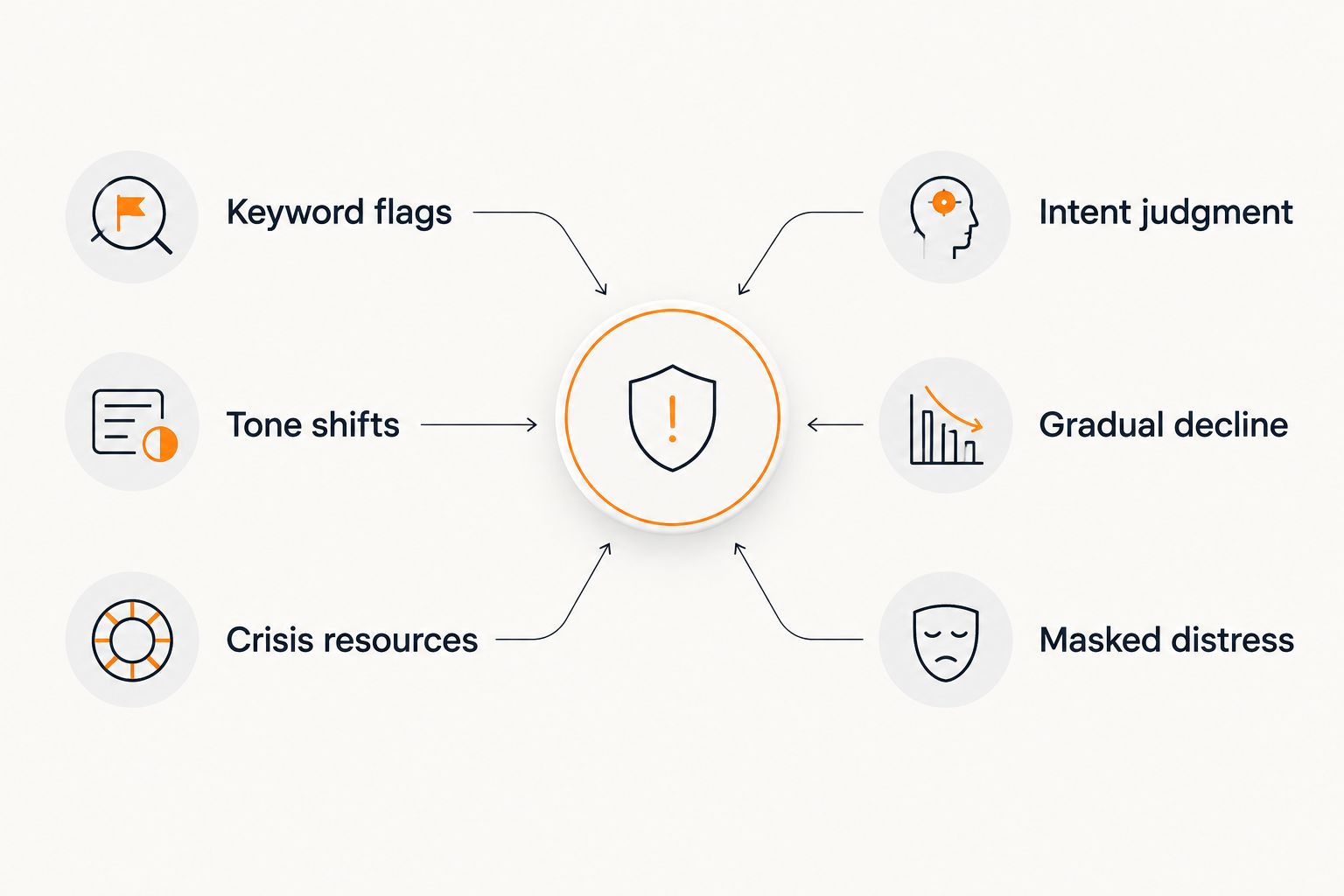
Two columns comparing what AI crisis detection catches versus what it misses
Direct language gets caught. Anything requiring inference usually doesn't.
Why crisis detection varies across AI apps
- Voice vs. text architecture — voice models have access to tone, pace, and pauses that text-only chat apps never see, which is why voice-based therapy tools differ from text-based ones in what they can notice
- Training data breadth — apps trained on narrower datasets miss regional or generational phrasing
- How aggressively the app is tuned to intervene — some trigger a hotline redirect on ambiguous language, others only on explicit statements
- Session memory — apps without memory across sessions can't track a gradual decline, only what's said in the moment
- Whether the company treats crisis response as a compliance checkbox or a real design priority
- Human oversight — no AI model reviews flagged conversations in real time the way a staffed crisis line does
Is voice AI better than text AI at picking up crisis signs?
Voice AI has an edge because it can register tone, pacing, and pauses that text can't capture, but it still isn't a substitute for a trained evaluator. A flattened voice or long silence might get flagged in a voice session and go completely unnoticed in a typed one. That gap is real, but it's a difference in degree, not a guarantee of accurate crisis detection either way.
Can I use an AI therapist during a mental health crisis?
An AI therapist is not built for an active crisis — it's built for everyday stress, anxiety, low mood, and relationship strain between professional care. If you're having thoughts of harming yourself, contact 988 (call or text) or the Crisis Text Line at 741741 before opening any app. Lovon is designed to be a supportive check-in and coping-skills companion, not an emergency responder.
Does an AI therapist report or intervene if I mention self-harm?
Most apps, including Lovon, respond to flagged language by surfacing crisis resources within the conversation rather than contacting anyone on your behalf. There's no human dispatcher reviewing the exchange in real time the way there is on a staffed hotline. That's the core distinction people miss: the app can point you toward help, it can't send it.
See what Lovon can and can't do
An always-available space for everyday stress, not a crisis service.
FAQ
Can an AI therapist tell if you are in crisis?
An AI therapist can catch explicit crisis language and respond with hotline information, but it can't judge intent or risk the way a licensed clinician can. Treat any AI response as a signpost to real help, not a safety assessment.
Can an AI therapist call 911 for me?
No — AI therapy apps in 2026 don't dispatch emergency services on your behalf. They surface numbers like 988 or the Crisis Text Line and leave the call to you.
Is Lovon safe to use if I'm feeling suicidal?
Lovon is built for everyday anxiety, stress, and low mood, not for active suicidal crises. If you're having thoughts of self-harm, contact 988 or text HOME to 741741 first.
Do AI chatbots detect suicidal ideation reliably?
AI chatbots detect direct, explicit statements of suicidal ideation fairly reliably but miss vague or masked distress often. Reliability drops sharply once language becomes indirect.
What happens if I mention self-harm to an AI therapist?
Most apps respond by surfacing crisis line information directly in the conversation. No human reviews the exchange in real time the way a staffed hotline does.
Is voice AI better than text AI at spotting a crisis?
Voice AI has an edge because it can register tone and pacing shifts that text can't capture. It's still not a substitute for a trained evaluator's judgment.
Can AI misread venting or dark humor as a crisis?
Yes — sarcasm and hyperbole are among the most commonly misclassified inputs for crisis-detection filters. This is one of the clearest limits of keyword-based detection.
Should I use an AI therapist instead of calling a hotline?
No — during an active crisis, call 988 or text 741741 first. An AI therapist is a between-sessions companion, not an emergency resource.
One last thing
The honest answer nobody markets well: crisis detection in AI therapy apps is a floor, not a ceiling. It catches the obvious cases and misses the quiet ones, and that gap won't close with a better model update in 2026 — it closes with you knowing the real hotline numbers before you need them. Save 988 in your phone now, not during a bad night.
Related guides
How AI Support Helps You Heal
AI emotional support isn't about replacing human connection — it's about filling the gaps. The moments when you need to talk at 2 AM, when you don't want to burden your friends again, or when you simply need someone to listen without judgment.
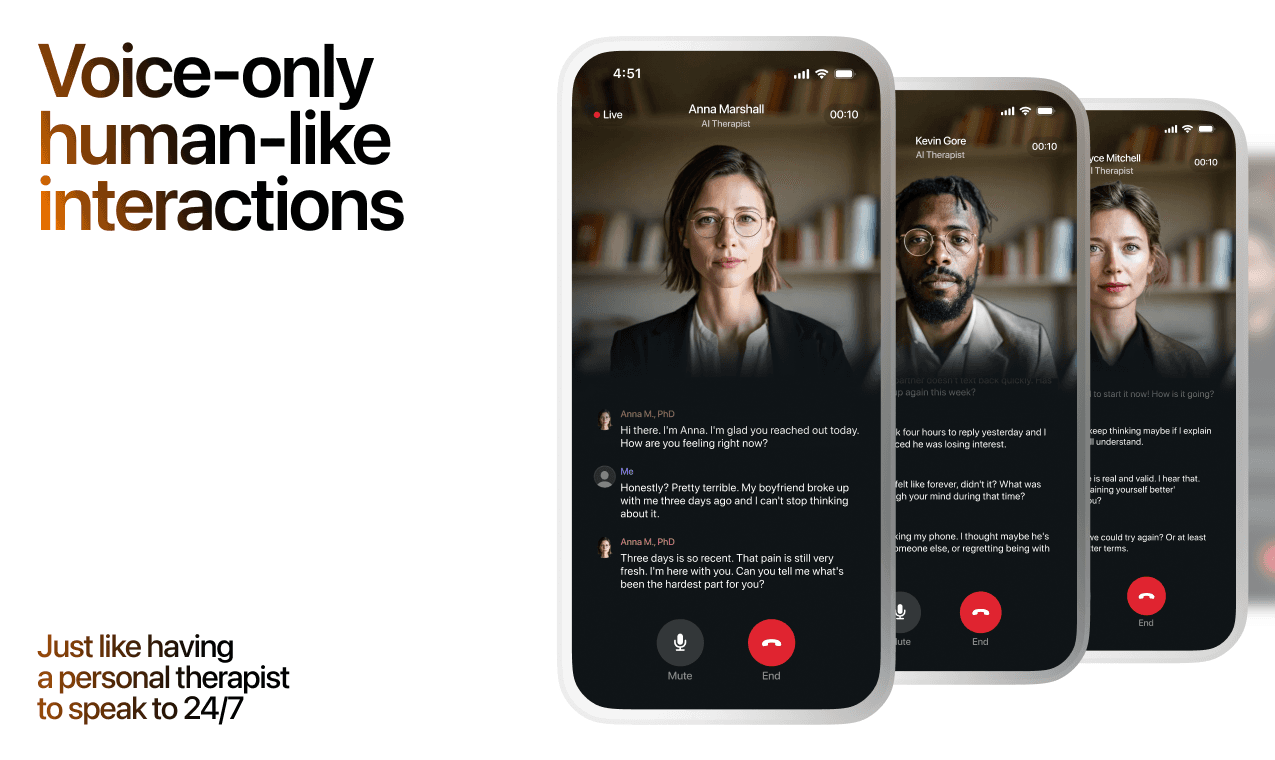
Here's what happens in a typical Lovon session:
You share what's on your mind
There's no script, no intake form, no waiting room. You speak or type whatever you're feeling — in your own words, at your own pace.
Lovon validates and explores
Using frameworks from CBT (Cognitive Behavioral Therapy) and motivational interviewing, Lovon acknowledges your feelings first, then gently helps you explore them. No dismissive "just move on" advice.
You build coping skills together
Lovon doesn't just listen — it actively works with you on evidence-based techniques: thought reframing, urge surfing, behavioral experiments, and more.
What a Session with Lovon Looks Like
When to Seek Professional Help
AI support is a valuable tool, but it's not a replacement for professional care. Please consider reaching out to a licensed therapist if you experience any of the following:
- Persistent thoughts of self-harm or suicide
- Inability to perform daily activities (work, eating, sleeping) for more than 2 weeks
- Turning to alcohol or substances to cope
- Intense anger or desire to harm your ex-partner
- Complete emotional numbness that doesn't improve over time
Crisis Resources (US): If you're in immediate danger, call 988 (Suicide & Crisis Lifeline) or text HOME to 741741 (Crisis Text Line). Available 24/7, free, and confidential.
Outside the US? Find a crisis line in your country
Ready to Start?
Your healing journey can begin right now
1 free conversation. No credit card. No judgment. Just a safe space to process what you're going through.
Frequently Asked Questions
Is AI therapy a replacement for a real therapist?
Is my conversation with Lovon AI private?
How is Lovon different from ChatGPT for emotional support?
Can I use Lovon if I'm already seeing a therapist?
Can I try Lovon for free?
About the Author
The Lovon Editorial Team
Mental Health & Wellness Content Team
The Lovon Editorial Team develops mental health and wellness content designed to make psychological concepts accessible and actionable. Our goal is to bridge the gap between clinical research and everyday life - helping you understand why your mind works the way it does and what you can do about it....
Related articles
- AI Mental Health App for Veterans With PTSD (2026)
Compare AI mental health apps for veterans with PTSD in 2026: what to look for, top picks, what to avoid, and a clear…
- App for Panic Disorder: 2026 Verdict on What Works
App for panic disorder in 2026: Lovon wins for real-time voice support, text apps and meditation apps rank lower. See…
- Free AI Therapist for Stress & Burnout (2026)
The best free AI therapist for stress in 2026. Lovon leads with voice sessions and burnout-specific coping tools. See…
- AI Coping Tools for a Quarter-Life Crisis in 2026
AI coping tools for a quarter-life crisis in your 20s: free tactics, when Lovon's voice therapy helps, and when to see a…
See also
Quizzes
- Light Triad Test: Are People Ends or Means?
See how you treat people when there is nothing to gain.
- Aromantic Test: Where Do You Sit on the Spectrum?
See where you sit on the aromantic spectrum, in 3 min.
Free tools
- What to Say When They Are Struggling
A chat, not a list. Tell the coach who this person is to you, what they are going through, and what you already said…
- Am I Overreacting, or Is This a Big Deal?
A chat for the small thing you cannot stop turning over. Say what happened and what you have already told yourself about…
From the wiki
- Why do I feel lonely all of a sudden?
Sudden loneliness usually traces back to something that quietly ended in the last few months: a routine, a shared class…
Disclaimer: This article is for informational purposes only and does not constitute medical advice, diagnosis, or treatment. Always seek the advice of your physician or other qualified health provider with any questions you may have regarding a medical condition. If you are in crisis or think you may have an emergency, call 988 (Suicide & Crisis Lifeline) or go to the nearest emergency room. Outside the US? Find a crisis line in your country.