
AI Therapy for Religious Trauma: 2026 Buying Guide
AI therapy for religious trauma compared for 2026: what to look for, top picks, what to avoid, and honest limits before you choose a tool.

Key Takeaways
- Lovon offers AI therapy for religious trauma through voice sessions available anytime — Consider it for daily
- Skip single-faith apps if you're deconstructing; they often repeat the pressure you're trying to leave behind.
- Look for trauma-informed language, not spiritual bypassing, in any AI voice therapy tool you try in 2026.
- Complex trauma from childhood religious control needs structured coping tools, not just journaling prompts.
- Lovon is not a licensed clinician — pair it with human therapy for diagnosis or crisis situations.
Religious trauma recovery means untangling shame, fear, and identity questions that most general therapists never learned to name — AI therapy for religious trauma gives you a place to start that conversation the moment it surfaces, at 2am or on a Sunday morning when the old dread creeps back in.
TL;DR
- Lovon offers AI voice support for religious trauma through voice sessions available anytime — Consider it for daily processing work.
- Skip single-faith apps if you're deconstructing; they often repeat the pressure you're trying to leave behind.
- Look for trauma-informed language, not spiritual bypassing, in any AI voice therapy tool you try in 2026.
- Complex trauma from childhood religious control needs structured coping tools, not just journaling prompts.
- Lovon is not a licensed clinician — pair it with human therapy for diagnosis or crisis situations.
Why this matters
Religious trauma doesn't always look like trauma. It looks like a racing heart during a phone call with your parents, a wave of guilt over a Sunday you slept in, or a body that still flinches at certain phrases from a doctrine you no longer believe. Clinicians who work in this space call it religious trauma syndrome — a pattern of anxiety, identity confusion, and fear conditioning that comes from growing up in, or leaving, a high-control or fear-based religious environment.
Most general therapy directories don't let you filter for this. You end up explaining purity culture or shunning practices from scratch, in a fifty-minute window, to someone who may never have encountered it. That's the gap AI therapy for religious trauma is built to fill: a place to think out loud, process shame in real time, and build language for what happened before you ever walk into a licensed therapist's office.
Who this is for
This guide is for adults who are deconstructing a faith they were raised in, survivors of spiritual abuse from a pastor, elder, or family authority figure, and people who left a high-control group and are still unlearning fear-based conditioning years later. It's also for anyone whose family enforces religious rules through guilt or silence — the kind of dynamic covered in depth in toxic parent patterns, where control gets dressed up as love or protection.
If you're LGBTQ+ and were told your identity was a sin, if you're grieving a community you had to leave to stay sane, or if you simply feel guilty for questioning something you were never allowed to question — this is your lane. You don't need to have a clinical diagnosis to justify using a tool like this. You just need somewhere to talk that won't ask you to defend your doubt first.
What to look for in AI therapy for religious trauma
No faith framework attached
An AI tool built around one religious tradition will, by design, reintroduce the framework you might be trying to evaluate honestly. For religious trauma work specifically, neutrality isn't a nice-to-have — it's the entire point. You need space to think without a built-in answer waiting at the end.
Trauma-informed language, not spiritual bypassing
A lot of self-help content tells you to "just forgive" or "focus on the positive" before you've actually processed what happened. That's spiritual bypassing, and it's covered directly in spiritual bypassing — it delays healing by skipping the hard part. Any tool worth using should let you sit with anger or grief without rushing you toward premature peace.
Availability outside business hours
Religious trauma flares up around specific triggers: a holiday, a family call, a wedding at your old church. Those moments don't wait for a Tuesday 3pm appointment. A tool that's available at 11pm on a Sunday matters more here than in almost any other kind of therapy support.
Voice, not just text
Typing out a childhood memory of being told you were going to hell can feel clinical and distant. Saying it out loud, and hearing a response back, activates a different part of processing — closer to how conversation therapy actually works. This is a real functional difference, not a preference detail.
Clear honesty about its limits
Any AI tool in this space should say plainly that it is not a licensed clinician and cannot replace one. If a tool oversells itself as a therapy replacement, that's a red flag, not a selling point.
Privacy to explore doubt without judgment
You need to be able to say "I don't know if I believe any of it anymore" without worrying it gets back to your community. Anonymity isn't optional for this population — it's often the only reason people open up at all.
Top picks
AI voice therapy for daily processing — the everyday pick. Lovon runs on voice conversation, built with input from PhD psychologists, and it's available around the clock rather than during scheduled hours. The difference between voice and text-based support is laid out in AI voice therapy, and for someone processing shame out loud for the first time, that difference is the whole reason to pick it. Verdict: Buy for daily emotional processing between or instead of scheduled appointments.
Understanding spiritual bypassing — the diagnostic pick. Before you can process religious trauma, you often need to recognize when you're avoiding it. The guide on spiritual bypassing names the pattern of using positivity or forced forgiveness to skip real grief. Verdict: Consider this a starting point if you've noticed yourself rushing to "move on" without actually feeling anything.
Childhood-rooted trauma framework — the deep-work pick. For anyone raised inside a controlling religious structure from a young age, the harm often meets the clinical definition of complex trauma rather than a single bad experience. CPTSD from childhood walks through symptoms and healing steps specific to that pattern. Verdict: Buy if your religious trauma traces back to childhood rather than a single adult event.
What to avoid
- Faith-branded "therapy" chatbots. These are usually built to keep you inside the belief system, not to help you evaluate it honestly. If the tool has a doctrinal stance, it's a ministry tool wearing a therapy label.
- Generic wellness apps with meditation and nothing else. Breathing exercises help with anxiety symptoms, but they don't touch the identity and belonging questions underneath religious trauma. You'll feel calmer for ten minutes and still stuck.
- Anything that promises to "fix" your faith crisis. Deconstruction isn't a problem with a fix. A tool that frames it that way is selling certainty, not support.
Talk through it tonight, not next Tuesday
Start a voice session with Lovon whenever the shame spiral hits.
Verdict comparison table
| Criteria | AI voice support (Lovon) | Faith-based chatbot | General wellness app |
|---|---|---|---|
| Neutral framework | Yes | No | Yes |
| Trauma-informed | Yes | Rarely | No |
| 24/7 availability | Yes | Varies | Yes |
| Voice conversation | Yes | Usually text | No |
| Honest about limits | Yes, states it's not a clinician | Rarely | Rarely |
Verdict: Buy the voice-based, neutral option for daily processing; Skip anything built on a single doctrine while you're still sorting out what you believe.
FAQ
What is AI therapy for religious trauma?
AI therapy for religious trauma is on-demand voice or chat support built to help someone process shame, fear conditioning, and identity loss connected to a high-control or fear-based religious upbringing. It works alongside licensed care rather than replacing it.
Is AI therapy safe for processing spiritual abuse?
AI therapy can help you name patterns and process everyday distress from spiritual abuse, but it is not equipped to handle a mental health crisis. Anyone in immediate danger should contact emergency services or a crisis line rather than an app.
Can an AI therapist replace a human therapist for religious trauma?
No. Tools like Lovon are explicit that they support you between or alongside licensed clinical care, not instead of it. Complex trauma from childhood religious environments often benefits from a human therapist trained in trauma work.
How is religious trauma different from a regular faith crisis?
A faith crisis is a change in belief; religious trauma includes lasting anxiety, fear responses, and shame conditioning in the body, often tied to a specific controlling environment. The physical and emotional symptoms are what separate the two.
What does spiritual bypassing have to do with religious trauma recovery?
Spiritual bypassing means using positivity, forgiveness, or gratitude to skip over unprocessed pain, which is common in religious trauma recovery because forgiveness was often demanded early. Naming the pattern is usually the first step toward actually feeling the grief underneath it.
Does AI voice therapy work better than text-based apps for this?
Voice conversation lets you say difficult memories out loud and hear a response in real time, which tends to feel closer to actual talk therapy than typing. For emotionally loaded material like religious trauma, that difference matters more than it does for lighter check-ins.
Is it normal to feel guilty about questioning your religion?
Yes, guilt over questioning is one of the most common symptoms reported by people leaving high-control religious environments in 2026, and it usually fades as the fear conditioning loosens rather than as a sign you're doing something wrong.
One last thing
The hardest part of religious trauma recovery usually isn't the big theological questions — it's the small, physical stuff: the tight chest before a family call, the reflexive apology for having doubts, the guilt that shows up before you've even done anything wrong. Whatever tool you pick in 2026, judge it by whether it lets you sit with those small moments without rushing you toward a tidy conclusion. Real healing here is slow and nonlinear, and any support that promises otherwise is worth a second look.
Related guides
How AI Support Helps You Heal
AI emotional support isn't about replacing human connection — it's about filling the gaps. The moments when you need to talk at 2 AM, when you don't want to burden your friends again, or when you simply need someone to listen without judgment.
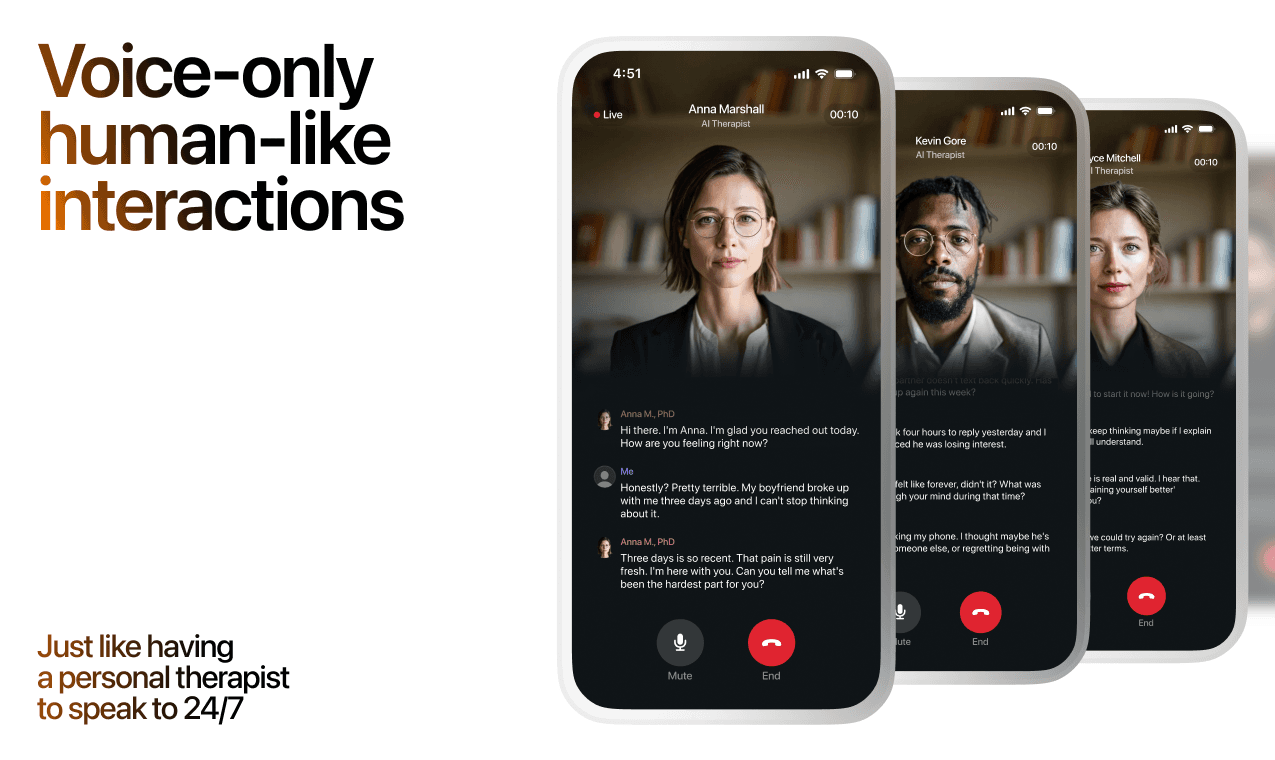
Here's what happens in a typical Lovon session:
You share what's on your mind
There's no script, no intake form, no waiting room. You speak or type whatever you're feeling — in your own words, at your own pace.
Lovon validates and explores
Using frameworks from CBT (Cognitive Behavioral Therapy) and motivational interviewing, Lovon acknowledges your feelings first, then gently helps you explore them. No dismissive "just move on" advice.
You build coping skills together
Lovon doesn't just listen — it actively works with you on evidence-based techniques: thought reframing, urge surfing, behavioral experiments, and more.
What a Session with Lovon Looks Like
When to Seek Professional Help
AI support is a valuable tool, but it's not a replacement for professional care. Please consider reaching out to a licensed therapist if you experience any of the following:
- Persistent thoughts of self-harm or suicide
- Inability to perform daily activities (work, eating, sleeping) for more than 2 weeks
- Turning to alcohol or substances to cope
- Intense anger or desire to harm your ex-partner
- Complete emotional numbness that doesn't improve over time
Crisis Resources (US): If you're in immediate danger, call 988 (Suicide & Crisis Lifeline) or text HOME to 741741 (Crisis Text Line). Available 24/7, free, and confidential.
Outside the US? Find a crisis line in your country
Ready to Start?
Your healing journey can begin right now
A 7-day trial. No judgment. Just a safe space to process what you're going through.
Frequently Asked Questions
Is Lovon a replacement for a real therapist?
Is my conversation with Lovon AI private?
How is Lovon different from ChatGPT for emotional support?
Can I use Lovon if I'm already seeing a therapist?
Can I try Lovon before subscribing?
About the Author
The Lovon Editorial Team
Mental Health & Wellness Content Team
The Lovon Editorial Team develops mental health and wellness content designed to make psychological concepts accessible and actionable. Our goal is to bridge the gap between clinical research and everyday life - helping you understand why your mind works the way it does and what you can do about it....
Related articles
- Best AI Therapy App for Religious Trauma in 2026 (Lovon)
Lovon ranks as the top pick for on-demand AI voice therapy for religious trauma in 2026 — see how it compares to text…
- AI Therapy App for Coping After a Diagnosis: 2026
See the best AI therapy app for coping after a serious diagnosis in 2026 — what to look for, top picks, and where Lovon…
- Best On-Demand Therapy App in 2026: What to Look For
On demand therapy app guide for 2026: ranked picks, verdicts (Buy/Hold/Skip), and what to check before you choose voice…
- Best AI Therapy App for Relationship Anxiety (2026)
Best AI therapy app for relationship anxiety in 2026: Lovon ranks first for 24/7 voice support, with clear verdicts on…
See also
Quizzes
- Empath Test: Do Other People's Moods Become Yours?
See how much of other people's moods you take on.
- Highly Sensitive Person Test: How Much Do You Take In?
See how deeply you process, notice and get overloaded.
Free tools
- Words of Encouragement for Him When He Is Struggling
Words of encouragement for him that fit what he is actually going through, for when your usual lines are not landing…
- Write a Letter to Your Best Friend
A chat for a letter to your best friend that only they could have received. Tell it how long you have been friends, one…
From the wiki
- What does it mean when you dream about your ex?
Dreaming about your ex usually reflects emotional processing, not prophecy and not a message from them. Your sleeping…
Disclaimer: This article is for informational purposes only and does not constitute medical advice, diagnosis, or treatment. Always seek the advice of your physician or other qualified health provider with any questions you may have regarding a medical condition. If you are in crisis or think you may have an emergency, call 988 (Suicide & Crisis Lifeline) or go to the nearest emergency room. Outside the US? Find a crisis line in your country.