
Can you have more than one attachment style?
Can you have more than one attachment style? Yes. Learn why patterns differ across relationships, what mixed tendencies mean, and how to respond clearly.

Key Takeaways
- Can you have more than one attachment style? Yes—attachment anxiety and avoidance can differ across relationships.
- Feeling anxious and avoidant together does not, by itself, establish disorganized attachment or a trauma history.
- Notice repeated triggers and responses rather than treating an attachment quiz as a diagnosis.
- Lovon offers voice-based emotional support for self-reflection, not clinical assessment or a replacement for licensed care.
Yes, you can have more than one attachment style: you might feel secure with a close friend, anxious with a romantic partner, and distant with a parent. You can also experience both anxiety about losing someone and discomfort with closeness in the same relationship. These patterns describe tendencies, not diagnoses or a fixed identity.
TL;DR
- Can you have more than one attachment style? Yes—attachment anxiety and avoidance can differ across relationships.
- Feeling anxious and avoidant together does not, by itself, establish disorganized attachment or a trauma history.
- Notice repeated triggers and responses rather than treating an attachment quiz as a diagnosis.
- Lovon offers voice-based emotional support for self-reflection, not clinical assessment or a replacement for licensed care.
Can you have more than one attachment style?
Yes. Your attachment patterns can differ between relationships, change over time, and include both anxious and avoidant tendencies. A single label does not capture every way you respond to connection, uncertainty, and conflict.
Adult attachment is often understood through two dimensions: attachment anxiety and attachment avoidance. Anxiety concerns rejection or another person's availability; avoidance concerns discomfort with dependence and emotional closeness. You can experience either dimension more strongly with one person than another.
For example, anxious attachment signs and coping strategies might feel familiar when you date, even if you trust friends without needing frequent reassurance.
| Attachment pattern | General tendency | What the label does not tell you |
|---|---|---|
| Secure | Relative comfort with closeness, independence, and asking for support | Whether you ever feel jealous, hurt, or afraid |
| Anxious-preoccupied | Greater worry about rejection and another person's availability | Whether the other person is actually consistent or trustworthy |
| Dismissive-avoidant | Greater discomfort with dependence and a preference for emotional distance | Whether a particular boundary is reasonable |
| Fearful-avoidant | Desire for connection alongside anxiety and discomfort with closeness | Whether you have a trauma history or a mental health condition |
Use this table as an orientation, not a scoring system. Similar behaviors can have different explanations, and context matters more than matching every description.
Why this matters
An attachment label can help you describe a pattern. It becomes less useful when you treat it as proof that you are broken, incompatible with someone, or responsible for every relationship problem.
If an online quiz in 2026 gives you a different result from a previous quiz, that does not automatically mean your personality changed. You might be thinking about a different relationship, answering during a stressful moment, or using a questionnaire that measures something different.
The useful question is not just which style you have. It is what happens when you need connection, space, reassurance, or repair. Those details give you something practical to work with.
Different relationships can bring out different patterns
You might feel comfortable telling a friend you need support because that friend usually listens and follows through. With a partner who becomes distant without explanation, you might check messages repeatedly and worry about being left.
Those reactions do not prove that you have two separate, permanent identities. They show why relationship-specific patterns deserve attention alongside your general tendencies.
Consider these hypothetical examples:
- With a friend: You disagree, explain your feelings, and trust that the friendship can handle it.
- With a partner: A canceled plan leaves you worried that the relationship is ending.
- With a parent: You keep conversations practical because sharing feelings has not felt welcome.
None of these snapshots establishes an attachment style. Look for recurring experiences, including what happens before your reaction and how the other person responds afterward.
The difference also matters when you evaluate a relationship. Feeling unsettled around someone who repeatedly breaks agreements is not, by itself, evidence that your attachment is the problem.
Anxious and avoidant tendencies can appear together
You can want reassurance and still pull away when someone offers closeness. You might send several messages after a disagreement, then avoid the conversation once the other person responds.
That combination can resemble a fearful-avoidant pattern: connection feels wanted and uncomfortable at the same time. But wanting space after an argument, or feeling nervous in a new relationship, is not enough to establish that pattern.
A push-pull reaction is something to explore, not a diagnosis to assign yourself. Ask what you feared in each moment. Were you afraid of abandonment, criticism, losing autonomy, or another argument?
Fearful-avoidant and disorganized attachment are sometimes treated as interchangeable online. Adult self-report descriptions and developmental attachment classifications come from different assessment traditions, so the terms are not exact substitutes. Neither label lets you infer someone's childhood experiences from a few behaviors.
Secure attachment can coexist with insecure reactions
Being relatively secure does not mean you never feel afraid of losing someone. You can usually trust a partner and still become unsettled after a betrayal, a major conflict, or an unexplained change in contact.
A secure response is not emotional perfection. It can include naming hurt, asking for reassurance, setting a boundary, and deciding whether the relationship meets your needs.
Likewise, an anxious or avoidant reaction does not erase every secure behavior you have practiced. Notice moments when you communicate directly, tolerate uncertainty, or return to a difficult conversation without attacking or disappearing.
For your own reflection in 2026, record those moments too. A journal containing only your hardest reactions gives an incomplete picture of how you relate to others.
Why attachment patterns vary
Attachment develops through relationship experiences, but no single experience explains every adult pattern. Several factors can shape what you notice:
- Earlier caregiving relationships: Experiences of comfort, responsiveness, or inconsistency can influence expectations about support.
- Later close relationships: Friendships and romantic relationships can reinforce existing expectations or give you different experiences of trust.
- The current relationship: Reliability, respect, conflict, and responses to boundaries affect the context in which you seek closeness.
- Stress and major changes: Illness, loss, separation, or other pressures can change how strongly you seek reassurance or withdraw.
- The question being asked: Answers about a specific partner can differ from answers about relationships in general.
These factors are context, not excuses for harmful behavior. Understanding why you withdraw does not remove your responsibility to communicate; understanding why someone seeks reassurance does not justify monitoring or controlling a partner.
How to understand your mixed attachment patterns
Start with a recent interaction rather than a global judgment about yourself. The aim is to describe what happened clearly enough to choose a different response—not to prove which label fits.
Try this reflection exercise in 2026. Set aside 5 minutes, write 3 observations, and finish with 1 clear request. These are suggested boundaries for the exercise, not a treatment schedule.
- Name the context. Identify the person, the situation, and what happened immediately before you felt unsettled. Keep observable facts separate from your interpretation.
- Notice the response. Write three observations: what you felt in your body, what you assumed, and what you did next. You might notice a tight chest, an expectation of rejection, and repeated message-checking.
- Choose a request. Translate the reaction into something specific you can communicate, such as asking someone to let you know when plans change. A request leaves room for an answer; a demand tries to control it.
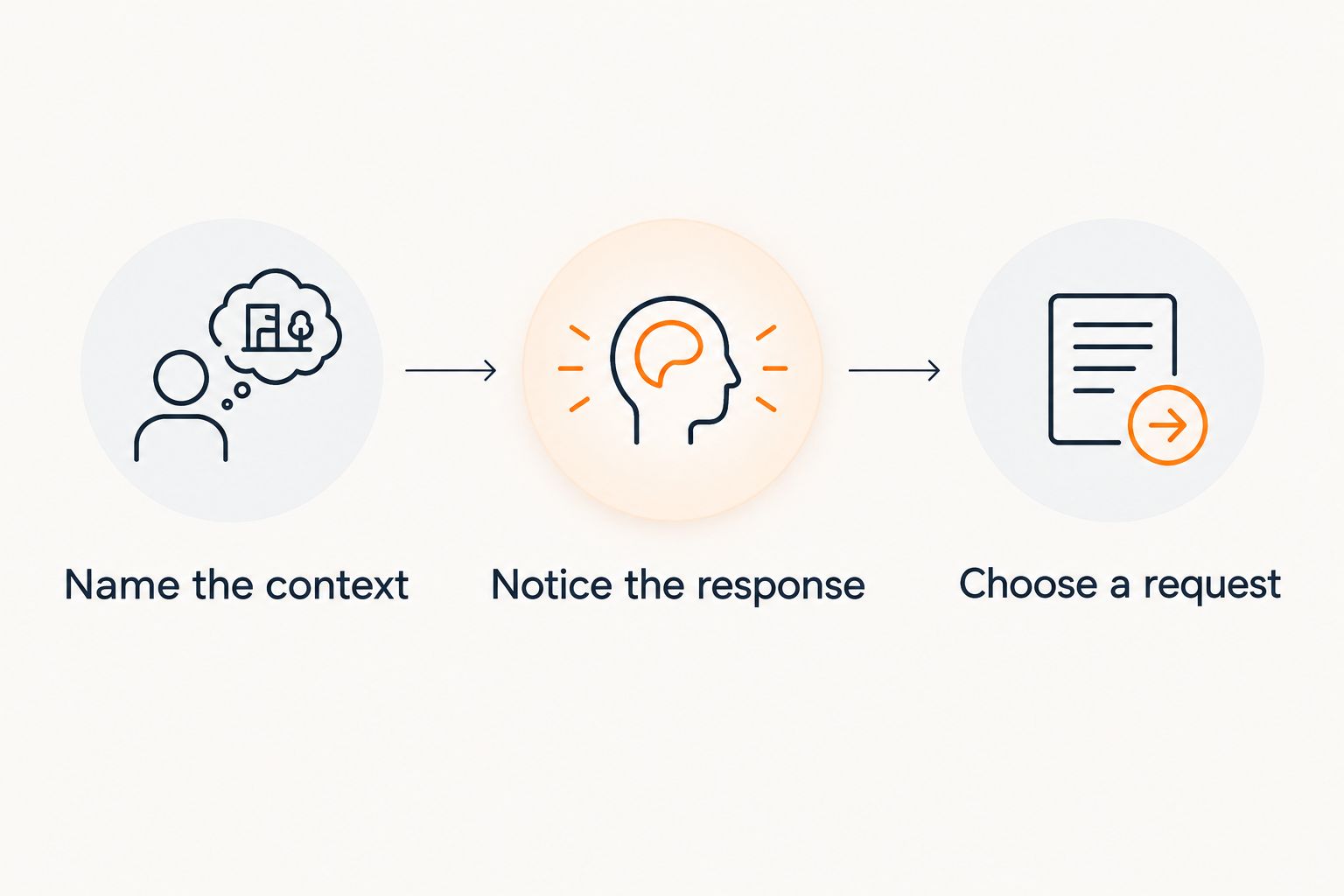 Three reflection steps: name the context, notice the response, and choose a request.
Describe the interaction before deciding what attachment label fits.
You might write: a partner canceled dinner; you felt tense and assumed they were losing interest; you sent repeated messages. Your request could be for clearer communication about changed plans, while your own next step could be pausing before sending another message.
Review several interactions rather than treating one difficult evening as proof. Include experiences with people you trust, not only relationships that leave you distressed.
Look for patterns without turning reflection into surveillance. You do not need to analyze every text, measure another person's affection, or keep testing whether they care.
Can your attachment style change over time?
Yes. Attachment patterns can change through relationship experiences, self-reflection, and therapeutic work, although change is not a guaranteed or linear process.
A practical goal for 2026 is to practice a specific behavior rather than promise yourself a new identity. That might mean asking directly for support, communicating a need for space, or returning to a disagreement after an agreed pause.
Does being anxious and avoidant mean you have a disorder?
No. Anxious and avoidant attachment tendencies are not, by themselves, mental health diagnoses, and mixed tendencies do not establish a personality disorder or trauma-related condition.
If fear, withdrawal, or conflict repeatedly disrupts your daily life, a licensed mental health professional can assess the broader picture. Attachment language should not replace an evaluation of persistent distress.
How do you choose support for attachment concerns?
Choose support based on what you need help doing. Naming a feeling, changing a repeated conflict pattern, and getting a clinical assessment are different tasks.
| Support option | Best for | Benefit | Limitation |
|---|---|---|---|
| Written reflection | Describing a specific interaction | Gives you a record to revisit | Your interpretation can still miss context |
| Lovon voice-based emotional support | Talking through everyday feelings and practicing self-reflection | Offers on-demand conversation and coping tools | Is not a licensed clinician and cannot replace clinical assessment |
| Licensed mental health professional | Persistent distress, trauma concerns, or patterns affecting daily life | Can assess concerns and provide individualized clinical care | Requires arranging care; fit and approach matter |
Lovon is best for people seeking voice-based emotional support and self-reflection, not clinical assessment. You can use a conversation to describe what happened, name a feeling, or practice how to express a need.
Lovon offers an always-available companion for everyday mental health struggles. It is not a replacement for licensed care, and a conversation with an app should not decide whether your relationship is safe or assign an attachment diagnosis.
Seek human support when relationship distress feels overwhelming, repeatedly disrupts sleep or daily functioning, or involves trauma you want help processing. If you feel afraid of a partner's reaction, prioritize safety and individual support rather than trying to communicate more skillfully to prevent their behavior.
FAQ
Can I be securely attached to friends but anxiously attached to my partner?
Yes, attachment patterns can differ between friendships and romantic relationships. Notice how each person responds to your needs and whether your reactions recur, rather than assuming one relationship reveals your true identity.
Can I be anxious and avoidant with the same person?
Yes, you can fear losing someone while also feeling uncomfortable with emotional closeness. That combination does not establish a diagnosis or explain its cause without more context.
Does pulling away after an argument mean I have avoidant attachment?
No, pulling away after an argument does not by itself establish avoidant attachment. Look at whether withdrawal is a repeated response to closeness or dependence, and distinguish it from a clearly communicated pause.
Why do attachment quizzes give me different results?
Attachment quizzes can give different results because their questions, scoring, and relationship focus differ. Your current circumstances and the person you have in mind can also affect your answers; a quiz is not a diagnosis.
Can a healthy relationship help me feel more secure?
Yes, consistent and responsive relationship experiences can support greater security. A partner is not responsible for curing attachment difficulties, and no relationship guarantees a particular outcome.
Can Lovon tell me my attachment style?
Lovon should not be used to establish an attachment diagnosis or clinical assessment. It provides voice-based emotional support, coping tools, and self-reflection guidance rather than licensed clinical care.
Should I stay in a painful relationship to heal my attachment style?
No, you do not need to stay in a painful or unsafe relationship to work on attachment patterns. Threats, coercion, and repeated boundary violations deserve attention on their own, regardless of either person's attachment label.
One last thing
Feeling calm is not the only sign of progress. You can feel afraid and still ask a clear question, respect a boundary, or choose not to send another reassurance-seeking message.
For the rest of 2026, try replacing the question of which style you really are with a more useful one: What would a respectful, clear response look like here? You do not need a perfect label before you practice it.
Related guides
How AI Support Helps You Heal
AI emotional support isn't about replacing human connection — it's about filling the gaps. The moments when you need to talk at 2 AM, when you don't want to burden your friends again, or when you simply need someone to listen without judgment.
Here's what happens in a typical Lovon session:
You share what's on your mind
There's no script, no intake form, no waiting room. You speak or type whatever you're feeling — in your own words, at your own pace.
Lovon validates and explores
Using frameworks from CBT (Cognitive Behavioral Therapy) and motivational interviewing, Lovon acknowledges your feelings first, then gently helps you explore them. No dismissive "just move on" advice.
You build coping skills together
Lovon doesn't just listen — it actively works with you on evidence-based techniques: thought reframing, urge surfing, behavioral experiments, and more.
What a Session with Lovon Looks Like
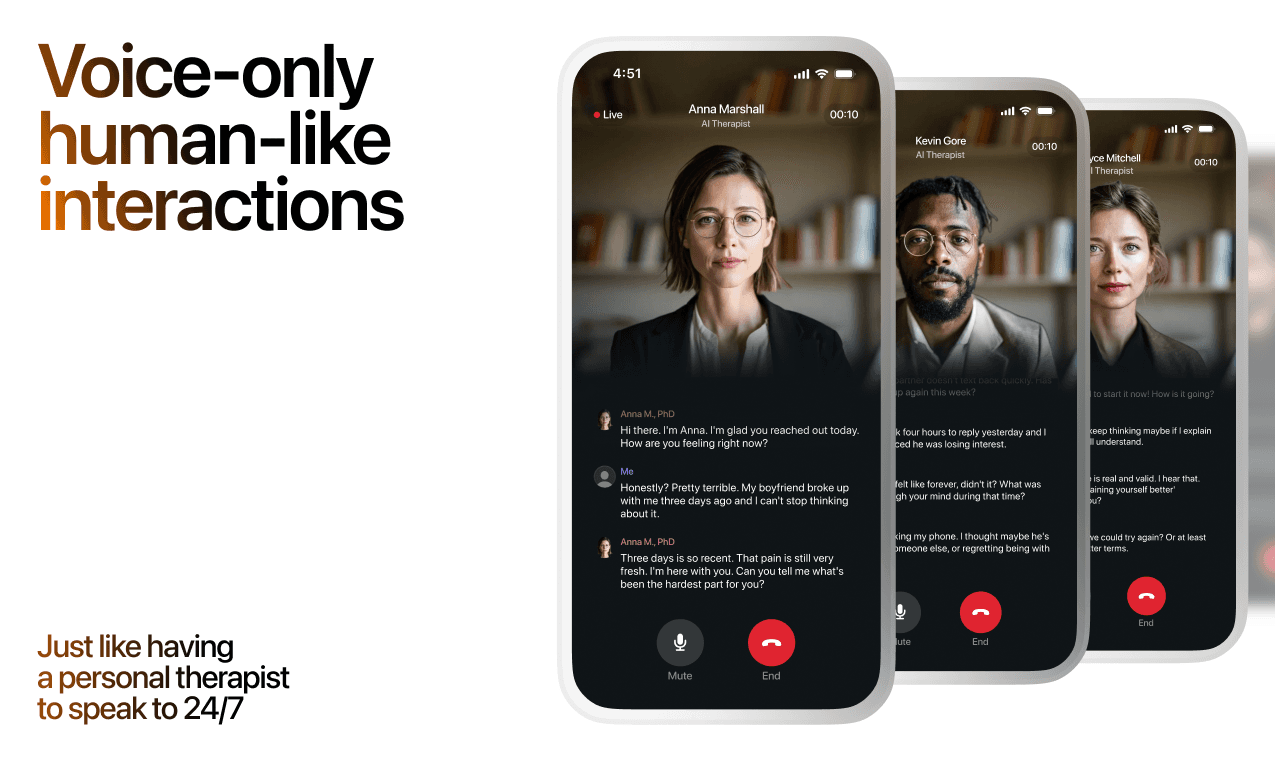
Lovon is AI support, not a replacement for professional care. If things have been hard to get through for weeks, or you are thinking about harming yourself, talk to a doctor or a licensed therapist.
Ready to Start?
Your healing journey can begin right now
A 3-day trial. No judgment. Just a safe space to process what you're going through.
Frequently Asked Questions
Is Lovon a replacement for a real therapist?
Is my conversation with Lovon AI private?
How is Lovon different from ChatGPT for emotional support?
Can I use Lovon if I'm already seeing a therapist?
Can I try Lovon before subscribing?
About the Author
The Lovon Editorial Team
Mental Health & Wellness Content Team
The Lovon Editorial Team develops mental health and wellness content designed to make psychological concepts accessible and actionable. Our goal is to bridge the gap between clinical research and everyday life - helping you understand why your mind works the way it does and what you can do about it....
Related articles
- Avoidant Attachment Style: Patterns & How to Change (2026)
Avoidant attachment style affects 1 in 4 adults. Learn the 7-step process to identify your patterns and build earned…
- How to Develop Secure Attachment in 2026: 7 Steps
How to develop secure attachment in 2026: 7 practical steps, a real timeline (8-12 weeks), and fixes for anxious and…
- Anxious Attachment and Love Avoidant: Break the Cycle 2026
Anxious attachment and love avoidant partners create a push-pull cycle. Learn the pattern, 7 steps to break it, and…
- Is it normal to feel anxious about being happy?
Is it normal to feel anxious about being happy? Yes. Learn how to respond to mixed feelings, stay present, and recognize…
See also
Quizzes
- Self-Concept Clarity Test: Do You Know Who You Are?
See how clearly you know yourself, in 3 minutes.
- Fear of Intimacy Test: Free 12-Question Self-Check
See which part of closeness feels risky, in 3 min.
Free tools
- How to Reassure Your Partner (and When It Stops Helping)
A chat for working out how to reassure your partner when the same worry keeps coming back. Say what sets it off and how…
- What Did They Actually Mean By That?
A chat for one sentence you cannot stop re-reading. Paste their exact words and what was happening around them, and get…
From the wiki
- What is an attachment style?
An attachment style is the habit your nervous system formed for handling closeness: what you actually do when someone…
Disclaimer: This article is for informational purposes only and does not constitute medical advice, diagnosis, or treatment. Always seek the advice of your physician or other qualified health provider with any questions you may have regarding a medical condition. If you are in crisis or think you may have an emergency, call 988 (Suicide & Crisis Lifeline) or go to the nearest emergency room. Outside the US? Find a crisis line in your country.