
Why Chest Feels Tight When Anxious (2026 Fix)
Chest tight when anxious? Tensed muscles and shallow breathing are the cause in 2026 guidance. Get the 7-step fix and know when to seek care instead.

Key Takeaways
- Chest tightness when anxious comes from tensed intercostal muscles and shallow breathing triggered by
- Slow exhale-focused breathing loosens a tight chest in 3 to 5 minutes for most anxiety episodes, based on 2026
- Tightness that lasts past an hour, radiates down your arm, or comes with numbness needs medical attention, not a
- Lovon's AI voice therapist can walk you through grounding in real time when the tightness hits and no one else is
Your chest goes tight during anxiety because stress hormones tense the muscles around your ribs and change how you breathe, not because something is wrong with your heart. This guide breaks down why it happens and gives you a step-by-step way to loosen it in the moment.
TL;DR
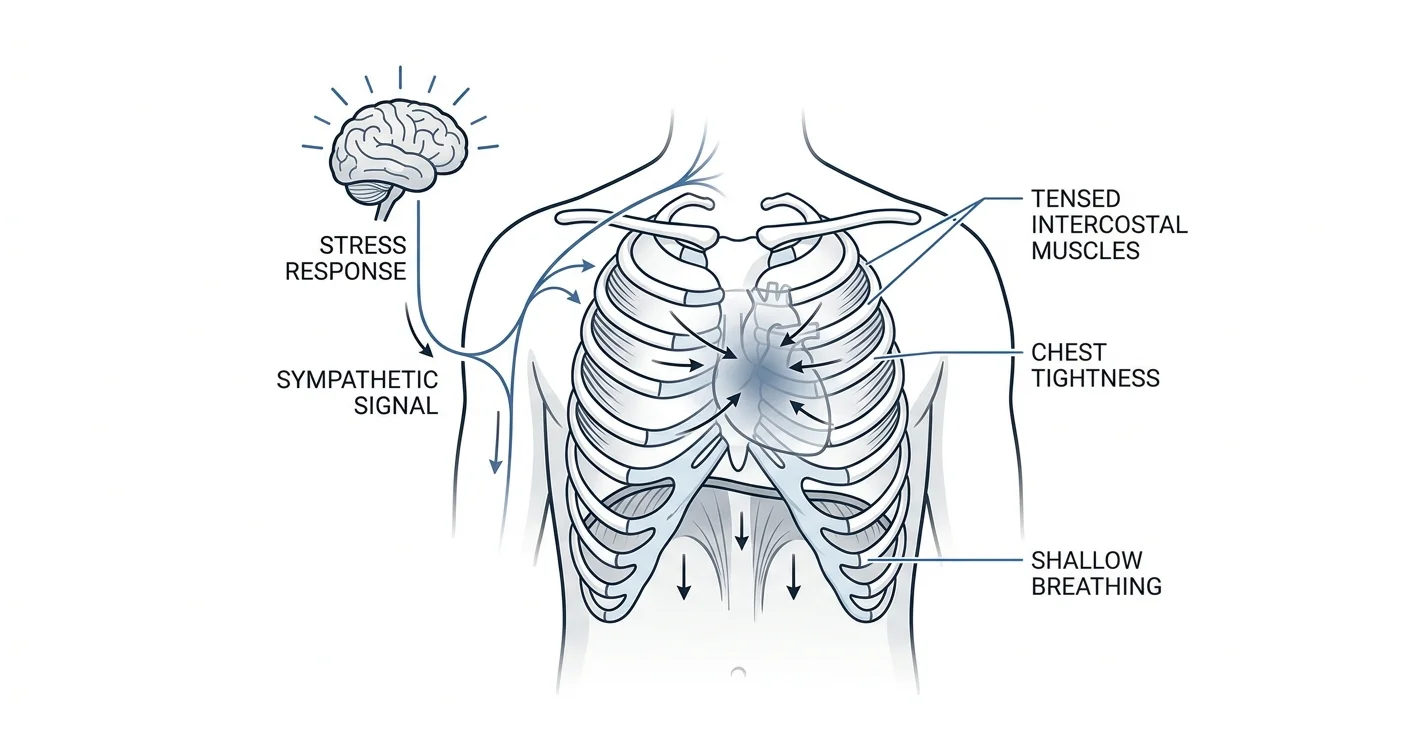
- Chest tightness when anxious comes from tensed intercostal muscles and shallow breathing triggered by fight-or-flight, not a heart attack for most people.
- Slow exhale-focused breathing loosens a tight chest in 3 to 5 minutes for most anxiety episodes, based on 2026 clinical guidance on breathing retraining.
- Tightness that lasts past an hour, radiates down your arm, or comes with numbness needs medical attention, not a breathing exercise.
- Lovon's AI voice companion can walk you through grounding in real time when the tightness hits and no one else is around.
Why this matters
A tight chest is one of the most reported physical symptoms of anxiety, and it's also one of the scariest, because it mimics cardiac symptoms closely enough that people end up in emergency rooms convinced they're having a heart attack. Knowing the mechanism strips out a layer of fear that otherwise feeds the anxiety loop. The distinction between a panic-driven chest squeeze and a medical emergency matters enough that it's worth reading panic attack vs anxiety attack if you're not sure which one you're dealing with right now.
Here's the physiology in plain terms. When your brain flags a threat, real or imagined, your sympathetic nervous system floods your body with adrenaline and cortisol. Your intercostal muscles, the ones between your ribs, tighten to protect your torso. Your breathing shifts from slow diaphragm breaths to fast, shallow chest breaths. That combination, tense muscles plus shallow breathing, is what produces the squeezing or pressure sensation people describe as tightness.
The reaction is old and automatic. It kept humans alive against physical threats for most of human history, and in 2026 your nervous system still runs the same script when a work deadline, an argument, or a racing thought sets it off. The chest tightness is not a malfunction. It's your body doing exactly what it's built to do, just aimed at a threat that isn't physical.
What you'll need
- A quiet-ish spot to sit or stand for 5 minutes, even a bathroom or parked car works
- A watch, phone, or clock to time your breathing (you don't need an app, but a timer helps)
- One hand free to place on your chest or stomach
- 5 to 10 minutes before you need to be anywhere
- Lovon open on your phone if you want a voice to talk you through it instead of doing it solo
You don't need supplements, special equipment, or a diagnosis to try the steps below. They work on the physical mechanism, not on figuring out what triggered you.
The steps
1. Name what's happening out loud
Say, even under your breath, "this is anxiety tightening my chest, not a heart problem." This sounds small but it does real work: it activates your prefrontal cortex, the part of your brain that can override the alarm response, instead of leaving the amygdala running the show unchecked. Skipping this step is the most common mistake — people jump straight to breathing techniques while still half-convinced they're dying, which keeps the alarm loop active underneath the exercise.
2. Slow your exhale to twice the length of your inhale
Inhale for a count of 4, exhale for a count of 8. The exhale is doing the real work here — a longer exhale activates your vagus nerve and tells your nervous system the danger has passed. Do this for six full breath cycles, roughly 90 seconds. The breathing exercises for anxiety relief guide has three more patterns if the 4-8 count feels awkward at first.
Expected outcome: your shoulders should drop and the pressure in your chest should ease by the fourth or fifth breath. If it doesn't, you're probably still breathing from your chest instead of your stomach — check step 3.
3. Put a hand on your stomach and breathe into it, not your chest
Most people in anxiety mode breathe high and fast, moving their shoulders and upper chest. Put one hand on your stomach, one on your chest. The goal is for the stomach hand to rise more than the chest hand on each inhale. This single change, breathing low instead of high, is often what separates a technique that works from one that doesn't.
4. Release the muscles you're not using
Anxiety tightens muscles you're not actively using, jaw, shoulders, hands, in addition to your chest wall. Do a fast body scan: unclench your jaw, drop your shoulders away from your ears, uncurl your fists. Releasing these secondary tension points reduces the total muscular load your chest is fighting against, which speeds up how fast the tightness fades.
5. Ground through your senses for 60 seconds
Name five things you can see, four you can hear, three you can touch, two you can smell, one you can taste. This pulls your attention out of the anxious thought loop and back into your physical surroundings, which is where your nervous system needs to be to register safety. Common mistake: rushing through this in 10 seconds without actually looking or listening. Slow it down.
6. Move, even a little
Stand up, walk to another room, shake out your hands, or do 10 slow arm circles. Adrenaline is a hormone built for physical action, and it metabolizes faster when you move than when you sit frozen waiting for it to pass. A two-minute walk does more for chest tightness than five more minutes of sitting still and monitoring how your chest feels.
7. Check the tightness again, and decide your next move
After roughly 5 to 8 minutes of the steps above, most anxiety-driven chest tightness eases noticeably even if it doesn't disappear completely. If it's better but still present, that's normal — anxiety symptoms often fade in waves rather than snapping off. If it's unchanged or worse, move to the troubleshooting section below before trying the same steps again.
Troubleshooting
- The breathing makes me feel more panicked, not less. Some people over-focus on getting the count exact, which adds pressure. Drop the count entirely and just make each exhale longer than each inhale, roughly a 1-to-2 ratio, without watching a clock.
- My chest feels tight for hours, not minutes. Anxiety-driven tightness usually rises and falls with the stress response and rarely stays flat for hours at high intensity. If it's been consistently tight for more than an hour, or you have chest pain that radiates to your arm, jaw, or back, treat it as a medical situation and seek care rather than repeating breathing exercises.
- I've done this before and it stopped working. Your body can habituate to a technique you use the exact same way every time. Rotate between the exhale-count breathing, box breathing, and physical movement so your nervous system doesn't tune the pattern out.
- I can't tell if it's a panic attack or just anxiety. Panic attacks tend to peak within 10 minutes and hit harder, with symptoms like dizziness or a sense of unreality; general anxiety tightness builds more gradually and lingers at a lower intensity. If you can't get chest pressure to move at all with breathing and grounding, that's a signal to check with a doctor rather than guess.
- It happens every single day around the same time. Recurring chest tightness tied to a specific time, like before work or at night, points to a pattern worth tracking rather than a one-off stress spike. Logging when it hits over a week or two gives you (or a therapist) something concrete to work with instead of vague dread.
Talk through it when your chest feels tight
Open Lovon and talk out loud with an AI voice companion while the tightness is happening.
Tools and resources
- A slow-exhale breathing pattern (4 in, 8 out) for the first 90 seconds of tightness
- The box breathing technique as a second option if exhale-focused breathing feels unnatural
- A body scan for jaw, shoulder, and hand tension, since anxiety rarely targets just your chest
- Lovon's AI voice support for talking through what's underneath the anxiety when the physical episode has passed, since the chest tightness is a symptom, not the actual problem
- A simple log (notes app is fine) tracking when tightness hits, what preceded it, and how long it lasted
What to do next
If chest tightness shows up regularly rather than as a one-off, the more useful question isn't how to release it in the moment but what keeps triggering it in the first place. If it's happening in a full-blown panic attack, how to stop a panic attack in the moment covers the faster, more intense version of this same response. Either way, treating the recurring pattern matters more long-term than mastering any single breathing technique.
FAQ
Why does my chest feel tight when I'm anxious?
Your chest feels tight when anxious because stress hormones tense the intercostal muscles around your ribs while your breathing shifts to shallow, fast chest breaths. Together, tense muscles and shallow breathing produce a squeezing or pressure sensation that isn't cardiac in most cases.
Is chest tightness from anxiety dangerous?
Anxiety-driven chest tightness on its own is not dangerous, though it can feel alarming enough to send people to the ER. It becomes a medical concern if it lasts over an hour, radiates to your arm or jaw, or comes with numbness, sweating, and nausea together.
How long does anxiety chest tightness usually last?
Most anxiety-related chest tightness eases within 5 to 30 minutes once the stress response starts to settle. Panic attack-driven tightness tends to peak fast, often within 10 minutes, then taper off.
What breathing technique works fastest for a tight chest?
Exhaling for roughly twice as long as you inhale, for example inhaling for 4 counts and exhaling for 8, activates your vagus nerve and tends to loosen chest tightness within a few minutes. Box breathing, with equal counts on each phase, is a solid second option if that ratio feels unnatural.
Can chest tightness from anxiety mimic a heart attack?
Yes, anxiety-related chest tightness can feel similar to cardiac symptoms, which is exactly why so many people end up in urgent care convinced something is wrong with their heart. The key difference is that anxiety tightness usually responds to slower breathing and grounding within minutes, while cardiac pain typically does not.
Should I go to the ER for anxiety-related chest tightness?
Go to the ER if the tightness lasts more than an hour, radiates down your arm or into your jaw, or comes with numbness, sweating, or shortness of breath that doesn't ease. If it's a first-time episode and you're unsure, getting checked once is reasonable so you know your baseline going forward.
Does anxiety chest tightness happen every time you're stressed?
No, chest tightness is one of several physical anxiety symptoms and not everyone experiences it the same way or every time. Some people get it consistently with any stress spike, while others only notice it during acute panic.
Can an AI therapy app help with anxiety chest tightness?
An AI voice companion like Lovon can talk you through grounding and breathing techniques in real time as the tightness happens, which helps when you don't have someone available immediately. It's not a substitute for emergency care or a licensed clinician if symptoms are severe or unclear.
One last thing
The detail most people miss is that the chest muscles involved, the intercostals, are the same ones that get sore after a hard core workout. Anxiety chest tightness is, physically, a mild muscle strain caused by repeated tensing, not just a vague sensation. That's part of why gentle movement and stretching help as much as breathing does. It also explains why some people feel sore around their ribs the day after a bad anxiety episode, the same way they would after exercise they weren't expecting.
Related guides
How AI Support Helps You Heal
AI emotional support isn't about replacing human connection — it's about filling the gaps. The moments when you need to talk at 2 AM, when you don't want to burden your friends again, or when you simply need someone to listen without judgment.
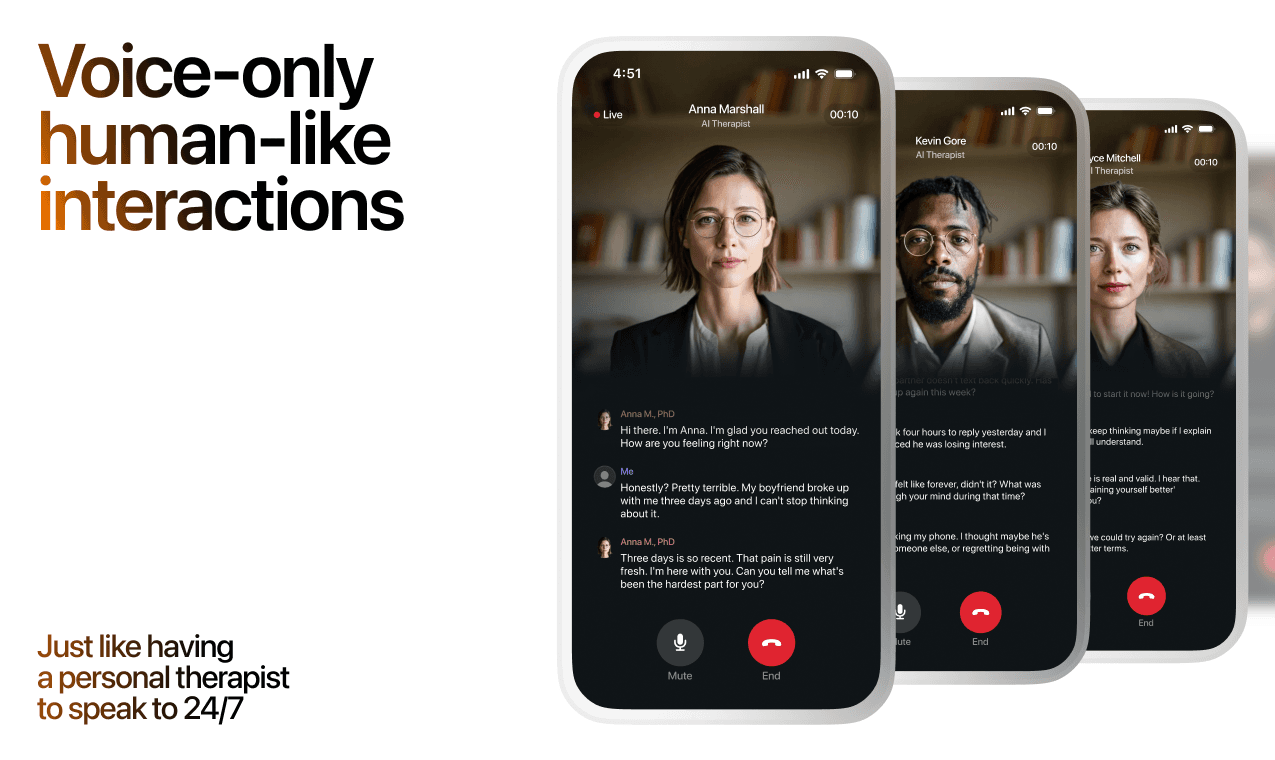
Here's what happens in a typical Lovon session:
You share what's on your mind
There's no script, no intake form, no waiting room. You speak or type whatever you're feeling — in your own words, at your own pace.
Lovon validates and explores
Using frameworks from CBT (Cognitive Behavioral Therapy) and motivational interviewing, Lovon acknowledges your feelings first, then gently helps you explore them. No dismissive "just move on" advice.
You build coping skills together
Lovon doesn't just listen — it actively works with you on evidence-based techniques: thought reframing, urge surfing, behavioral experiments, and more.
What a Session with Lovon Looks Like
When to Seek Professional Help
AI support is a valuable tool, but it's not a replacement for professional care. Please consider reaching out to a licensed therapist if you experience any of the following:
- Persistent thoughts of self-harm or suicide
- Inability to perform daily activities (work, eating, sleeping) for more than 2 weeks
- Turning to alcohol or substances to cope
- Intense anger or desire to harm your ex-partner
- Complete emotional numbness that doesn't improve over time
Crisis Resources (US): If you're in immediate danger, call 988 (Suicide & Crisis Lifeline) or text HOME to 741741 (Crisis Text Line). Available 24/7, free, and confidential.
Outside the US? Find a crisis line in your country
Ready to Start?
Your healing journey can begin right now
A 7-day trial. No judgment. Just a safe space to process what you're going through.
Frequently Asked Questions
Is Lovon a replacement for a real therapist?
Is my conversation with Lovon AI private?
How is Lovon different from ChatGPT for emotional support?
Can I use Lovon if I'm already seeing a therapist?
Can I try Lovon before subscribing?
About the Author
The Lovon Editorial Team
Mental Health & Wellness Content Team
The Lovon Editorial Team develops mental health and wellness content designed to make psychological concepts accessible and actionable. Our goal is to bridge the gap between clinical research and everyday life - helping you understand why your mind works the way it does and what you can do about it....
Related articles
- Why Do I Shake When Anxious? Causes & Fixes 2026
Shaking when anxious is adrenaline, not weakness. See the real causes, the fastest fixes for 2026, and when shaking…
- Why Do I Feel Anxious for No Reason? 2026 Guide
Anxious with no clear trigger? See the real causes behind free-floating anxiety in 2026 and the steps that calm your…
- Manage Networking Anxiety at Conferences (2026 Guide)
Learn how to manage networking anxiety at conferences in 2026 with a step-by-step plan: scripts, breathing resets, and…
- How to Calm Anxiety at Night in 2026: 7 Steps
Learn how to calm anxiety at night with 7 evidence-based steps — breathing techniques, body scans, and worry dumps that…
See also
Quizzes
- Do I Have Trust Issues? 12-Question Quiz
Check where your guard actually sits, in 2 minutes.
- Alexithymia Test: Can You Name What You Feel?
See where your feelings lose their names, in 3 minutes.
Free tools
- What Did They Actually Mean By That?
A chat for one sentence you cannot stop re-reading. Paste their exact words and what was happening around them, and get…
- Attachment Trigger Plan for Anxious and Avoidant Patterns
Pick your pattern, tick the moments that set it off, and finish one card for each: your body signal, the thing you will…
From the wiki
- Why do I feel sad when I'm alone?
Being alone does not create the sadness. It removes the noise that was keeping it out of earshot, so whatever queued up…
Disclaimer: This article is for informational purposes only and does not constitute medical advice, diagnosis, or treatment. Always seek the advice of your physician or other qualified health provider with any questions you may have regarding a medical condition. If you are in crisis or think you may have an emergency, call 988 (Suicide & Crisis Lifeline) or go to the nearest emergency room. Outside the US? Find a crisis line in your country.