
How long does it take to get over a situationship?
How long does it take to get over a situationship? There is no fixed deadline. Learn signs of recovery, practical boundaries, and when to seek support.


Key Takeaways
- How long does it take to get over a situationship? There is no universal recovery deadline.
- Measure breakup recovery by daily functioning and boundaries, not by whether you ever miss the person.
- Lovon offers emotional support through voice conversations, not licensed treatment or a guaranteed healing timeline.
- Seek professional support when relationship grief disrupts daily life or feels difficult to manage alone.
There is no fixed timeline for getting over a situationship, and the time you spent together does not determine how long you are allowed to hurt. Unanswered questions, continued contact, and the future you hoped for can make letting go difficult; look for signs that daily life is becoming easier rather than a deadline for feeling nothing.
TL;DR
- How long does it take to get over a situationship? There is no universal recovery deadline.
- Measure breakup recovery by daily functioning and boundaries, not by whether you ever miss the person.
- Lovon offers emotional support through voice conversations, not licensed treatment or a guaranteed healing timeline.
- Seek professional support when relationship grief disrupts daily life or feels difficult to manage alone.
Why this matters
An undefined relationship can leave you with very real grief. You might miss the person, the routine, and the possibility of becoming something more. Not having an official breakup does not make those losses imaginary.
You do not need a relationship label to take your feelings seriously. If you are struggling to separate missing someone from deciding whether to return, these steps for getting over someone you love address that distinction.
For your 2026 recovery plan, choose a more useful goal than being completely over it: make room for your life again, even while some feelings remain.
How long does it take to get over a situationship?
There is no reliable situationship-specific average that predicts your recovery date. A brief connection can carry deep hopes, while a longer connection can end with more clarity. Duration alone is not a recovery calculator.
Instead of treating recovery as a countdown, compare what is happening in your daily life. These are reflection prompts, not a diagnostic test or a required sequence.
| Area to notice | When the loss takes up more space | Signs you are regaining room |
|---|---|---|
| Attention | You repeatedly reread messages for answers | You can redirect attention to something else |
| Contact | You reach out mainly to settle uncertainty | You choose contact according to your boundaries |
| Routine | Waiting for a message shapes your plans | You make plans without checking their availability |
| Perspective | You remember only the connection's potential | You remember both the closeness and the unmet needs |
| Feelings | Every wave of sadness feels like failure | You can feel sadness without undoing your decisions |
Getting over someone does not require forgetting them. A more practical marker is being able to remember the connection without organizing your choices around restarting it.
A difficult evening does not erase a better week. Look at the broader pattern rather than using your hardest moment as the final verdict.
Why the time it takes varies
A situationship does not have to be long or official to affect you deeply. These factors help explain why your experience will not match someone else's calendar:
- Emotional investment. Consider how much trust, intimacy, and hope you placed in the connection, not just how long it lasted.
- Uncertainty about the ending. An unclear goodbye can leave you returning to questions the other person has not answered.
- Continued contact. Messages, hookups, and social updates can keep the possibility of restarting present in your daily life.
- What else you are carrying. Existing stress, low mood, loneliness, or relationship difficulties deserve attention alongside the loss.
- Available support. Being able to speak honestly with someone gives you a place to process feelings without depending on the person you miss.
These are reasons to adjust your support, not reasons to blame yourself. You cannot choose how invested you already became, but you can decide what access the connection has to your attention now.
Avoid turning attachment labels into a diagnosis of either person. You can recognize that a pattern hurt you without deciding what condition, motive, or personality explains it.
A practical recovery plan for 2026
You do not have to solve the whole experience at once. Start with the part that keeps pulling you back into the same painful decision.
Name the loss
Write down what you miss: the person, physical closeness, daily conversation, feeling wanted, or the future you imagined. Keep those losses separate where you can.
Then ask what was actually available. Missing the possibility of commitment is different from losing commitment you both agreed to. Both can hurt, but the distinction helps you see what you need now.
Choose a boundary
Decide what contact you can handle without repeatedly abandoning your needs. That might mean stepping away from personal messages or limiting conversations to unavoidable practical matters.
You do not need to persuade the other person that your boundary is reasonable before you follow it. Keep the message clear and brief. If you fear their reaction, prioritize safety and seek support rather than arranging a private confrontation.
Reduce reminders
Mute updates, archive the conversation, or move photos out of immediate view if those reminders lead to repeated checking. Choose the change that addresses your actual habit rather than making a dramatic gesture for its own sake.
Removing a reminder is not the same as pretending the relationship never happened. It is a way to decide when you engage with the memory instead of meeting it every time you open your phone.
Restore routine
Choose an ordinary part of your day to protect: a meal, bedtime, a work task, or time with someone you trust. Make the commitment small enough to keep on a difficult day.
Do not turn recovery into another performance test. Eating lunch and answering a friend's message still count as participating in your life, even when you feel sad doing them.
Review your needs
Notice what you repeatedly wanted but felt unable to ask for. Examples include clarity about exclusivity, consistent communication, or an honest answer about commitment.
Use that information to describe what you want in a future relationship. The goal is not to become someone who needs less; it is to recognize your needs before agreeing to a connection that does not meet them.
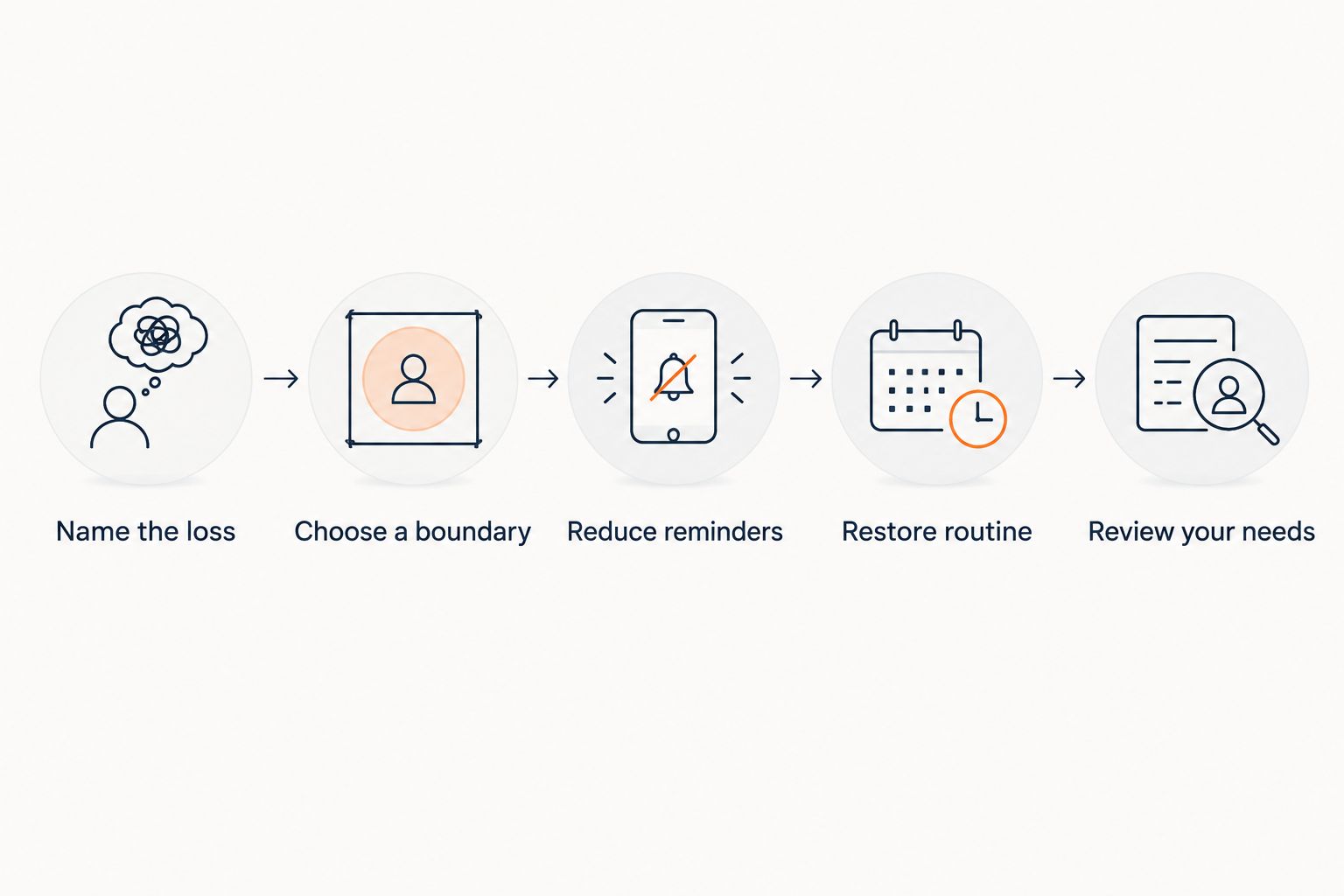 Recovery steps from naming the loss to reviewing your relationship needs
Focus on actions you control rather than a deadline for no longer caring.
You can return to these steps in any order. If reducing reminders feels manageable but deciding about contact feels overwhelming, start with the manageable change and discuss the harder decision with someone you trust.
Does no contact help you get over a situationship?
There is no universal number of no-contact days that guarantees recovery. Distance is a boundary to consider when contact keeps drawing you into uncertainty, not a method for making someone miss you.
If you share work or other responsibilities, define what necessary contact includes. Keep practical exchanges separate from conversations about whether the connection might restart.
The downside of distance is that it can feel lonely, especially when that person was part of your daily routine. Plan another place for connection rather than relying on willpower alone. A friend does not need to analyze every message to keep you company.
Why does a short situationship hurt so much?
There is no minimum relationship length required for genuine grief. You can become attached to closeness, hope, and an imagined future before there is a clear agreement about the relationship.
An uncertain ending can also leave you trying to solve the loss instead of grieving it. Ask whether another round of analysis will change what the person actually offered you. You do not have to prove they never cared to recognize that the arrangement was painful.
How do I know I am moving on?
There is no required date for moving on; look for greater freedom in your choices. You might still miss the person while keeping a boundary, enjoying time with friends, or making plans that do not depend on their return.
Try a brief weekly reflection rather than checking your feelings all day. Ask what became easier, what still hurts, and what support you need next. If your 2026 goal was to stop thinking about them entirely, replace it with a goal you can act on: stop letting every thought decide your next move.
Choosing support in 2026
Choose support according to what you need, not according to whether the relationship was official. Company, guided reflection, and clinical care serve different purposes. None requires you to justify why this connection mattered.
| Support option | Best for | What it offers | Limitation |
|---|---|---|---|
| Trusted friend | Company and practical support | Listening, shared activities, and help maintaining ordinary routines | A friend is not a substitute for clinical assessment |
| Licensed mental health professional | Distress affecting daily life | Assessment and treatment within the professional's scope | Finding the right fit takes effort; healing has no guaranteed deadline |
| Voice support app | Everyday emotional reflection | A place to talk through feelings and consider coping tools | An app is not a licensed clinician or emergency service |
When grief needs more support
You do not have to wait until you are in crisis to contact a licensed professional. Seek help when distress is interfering with sleep, eating, work, relationships, or your ability to care for yourself. Worsening symptoms deserve attention, whatever the relationship's label.
When the loss and its unanswered questions dominate your day, online grief counseling is a format to discuss with a licensed professional; the central question is whether the clinician's experience and approach fit the loss you are processing. A situationship does not need to resemble bereavement for your distress to deserve care.
Tell the professional what is happening rather than trying to select the perfect label. Describe the checking, sleeplessness, withdrawal, or difficulty concentrating that brought you there.
Where a voice app fits
Lovon is best suited to people seeking everyday emotional support through voice conversations, not clinical treatment. The app offers coping tools and self-reflection guidance for concerns including stress and relationship difficulties.
You can use Lovon as a place to talk through what you feel and what boundary you want to keep. Its limitation matters: Lovon is not a licensed clinician, cannot determine your recovery timeline, and does not replace professional care.
Keep human connection in your support plan. If a conversation leaves you more distressed or you need assessment, bring that concern to a qualified professional rather than expecting an app to resolve it.
One last thing
You do not need a final explanation from the other person to decide that uncertainty is no longer acceptable to you. Closure can include acknowledging that you wanted something they did not agree to give.
Missing someone is a feeling, not an instruction to reconnect. Let the feeling exist while you choose what protects your wellbeing today.
Related guides
How AI Support Helps You Heal
AI emotional support isn't about replacing human connection — it's about filling the gaps. The moments when you need to talk at 2 AM, when you don't want to burden your friends again, or when you simply need someone to listen without judgment.
Here's what happens in a typical Lovon session:
You share what's on your mind
There's no script, no intake form, no waiting room. You speak or type whatever you're feeling — in your own words, at your own pace.
Lovon validates and explores
Using frameworks from CBT (Cognitive Behavioral Therapy) and motivational interviewing, Lovon acknowledges your feelings first, then gently helps you explore them. No dismissive "just move on" advice.
You build coping skills together
Lovon doesn't just listen — it actively works with you on evidence-based techniques: thought reframing, urge surfing, behavioral experiments, and more.
What a Session with Lovon Looks Like

Lovon is AI support, not a replacement for professional care. If things have been hard to get through for weeks, or you are thinking about harming yourself, talk to a doctor or a licensed therapist.
Ready to Start?
Your healing journey can begin right now
A 3-day trial. No judgment. Just a safe space to process what you're going through.
Frequently Asked Questions
How long does it take to get over a situationship in 2026?
Is it normal to miss someone I never officially dated?
Will no contact make me stop loving them?
Should I ask for one last conversation to get closure?
Am I back at the beginning if I text them?
Can Lovon help me process a situationship ending?
What if I feel unsafe or think about hurting myself?
About the Author

The Lovon Editorial Team
Mental Health & Wellness Content Team
The Lovon Editorial Team develops mental health and wellness content designed to make psychological concepts accessible and actionable. Our goal is to bridge the gap between clinical research and everyday life - helping you understand why your mind works the way it does and what you can do about it....
Related articles
- How to Get Over Your First Love, Even Years Later
How to get over your first love: why it hits harder than later breakups, how to separate the person from the era, and…
- Should I Break Up With My Girlfriend? Signs It's Time To Break Up
Many of us believe a relationship will last forever. But at some point, you might start asking yourself a difficult…
- Can you be friends with an ex after a breakup?
Can you be friends with an ex after a breakup? Yes, with mutual readiness and clear boundaries. Learn when to reconnect…
- No Contact Rule: How Long, the Exact Rules, and What to Say
The no contact rule explained honestly: why it works, how long to go, what counts as breaking it, what to do if you…
See also
Quizzes
- Am I Over My Ex? 12-Question Gut Check
Post-breakup check-in in 2 minutes.
- Should I Break Up With My Boyfriend? 12-Question Quiz
Twelve questions on whether the doubt has settled.
Free tools
- Breakup Message Writer
A chat for saying it once. Tell it how long it has been and why now, and get a message you could actually send, plus the…
- Letting Go Meditation
For the person, the message you keep waiting for, or the future you were counting on. Seven minutes to loosen your grip…
From the wiki
- What is casual dating?
Casual dating means seeing someone romantically, often sleeping with them, while neither of you has promised the other a…
Disclaimer: This article is for informational purposes only and does not constitute medical advice, diagnosis, or treatment. Always seek the advice of your physician or other qualified health provider with any questions you may have regarding a medical condition. If you are in crisis or think you may have an emergency, call 988 (Suicide & Crisis Lifeline) or go to the nearest emergency room. Outside the US? Find a crisis line in your country.