
Can you love someone and still not be compatible with them?
Can you love someone and not be compatible? Yes. Learn which differences allow compromise, which need a harder choice, and how to talk without blame.


Key Takeaways
- Can you love someone and not be compatible? Yes. Affection and relationship compatibility answer different questions.
- Look at shared goals, everyday needs, and conflict repair—not chemistry alone.
- A workable compromise respects both people; it does not require either person to surrender a core need.
- Lovon offers voice-based emotional support for self-reflection, not a clinical assessment of your relationship.
Yes, you can love someone and still not be compatible with them: real affection does not guarantee that your needs, values, or plans fit together. Love is a reason to care about the relationship, not a requirement to stay in it—and some differences need cooperation, while others have no compromise both people freely want.
TL;DR
- Can you love someone and not be compatible? Yes. Affection and relationship compatibility answer different questions.
- Look at shared goals, everyday needs, and conflict repair—not chemistry alone.
- A workable compromise respects both people; it does not require either person to surrender a core need.
- Lovon offers voice-based emotional support for self-reflection, not a clinical assessment of your relationship.
Can you love someone and still not be compatible with them?
Yes. You can feel tenderness, attraction, loyalty, and grief at the thought of losing someone while wanting fundamentally different lives. Neither person's feelings have to be fake for the relationship to be a poor fit.
The useful distinction is between how you feel about someone and what being together asks of you. Notice whether your relationship makes room for your needs, including your healthy relationship boundaries.
| Area | What love can look like | What compatibility asks |
|---|---|---|
| Affection | You miss them and enjoy closeness | Can you meet each other's needs without pressure? |
| Future plans | You picture growing old together | Do you actually want the same kind of future? |
| Disagreement | You care when they are hurt | Can you disagree respectfully and repair harm? |
| Everyday life | You enjoy special moments together | Can you share responsibilities in a way both accept? |
| Individuality | You admire who they are | Can both people remain themselves in the relationship? |
This is a reflection framework, not a diagnostic test. A disagreement does not prove incompatibility, and strong affection does not resolve the disagreement.
Why this matters
If you treat love as the only test, every unresolved problem becomes a question about whether you care enough. That misses a more useful question: what would need to change for this relationship to work for both of you?
You do not need identical personalities, interests, or habits. You need arrangements that both people can genuinely accept, alongside respect for each other's choices.
If you are making a relationship decision in 2026, separate the future you hope for from the relationship you currently have. A hoped-for version of your partner is not an agreement.
Signs your differences need a closer look
Look for specific disagreements and repeated behavior rather than a vague feeling that you are wrong together. Start with these areas:
- Parenthood and family: You want children and your partner does not, or you disagree about caregiving responsibilities. Neither preference makes someone wrong, but the consequences need direct discussion.
- Relationship agreements: You want different expectations around exclusivity, commitment, or contact with other partners. An agreement needs willing consent, not reluctant permission.
- Money and responsibilities: You cannot reach an acceptable arrangement for spending, saving, debt, or household work. Look at follow-through as well as intentions.
- Closeness and independence: Your needs for affection, sex, time together, or time alone remain unmet. Respect includes accepting a refusal without pressure or punishment.
- Beliefs and life direction: You want different places to live, religious practices, or relationships with extended family. Ask what those differences would mean in ordinary life.
These are conversation topics, not automatic breakup rules. Different spending styles, for example, are not the same as hiding debt or controlling access to money.
Describe the actual conflict before naming the whole relationship incompatible. That gives you something concrete to discuss—and helps you recognize when the problem is more serious than a difference in preferences.
Is this a workable difference or a core incompatibility?
A workable difference has a solution both people can accept without giving up something essential. A core incompatibility exists when the available outcomes require someone to live against a deeply held need or choice.
Consider a hypothetical couple planning their next move in 2026. Different preferences about apartment size invite negotiation; a firm need to remain near dependent family and a firm plan to move abroad require a much harder decision.
The question is not whether a compromise sounds fair from the outside. It is whether each person freely wants the life that compromise creates.
Workable differences allow room for both people
You prefer social weekends; your partner needs more quiet time. A workable arrangement might include separate activities and agreed time together, provided neither person feels forced into it.
The benefit is flexibility without requiring sameness. The limit is that an arrangement only works if both people accept it in practice—not just during the conversation that ends an argument.
Core differences do not always have a middle ground
Parenthood is a clear example. Having a child to preserve a relationship is not the same as independently wanting to become a parent.
You can explore uncertainty together, but do not treat a clear answer as an invitation to persuade. Respecting your partner includes believing them when they describe the future they want.
Harmful behavior is not just incompatibility
Threats, sexual coercion, stalking, isolation, and control over money or movement are safety concerns. Calling them a compatibility problem puts the focus on finding a compromise where protection and support are needed.
If you fear your partner's reaction, seek individual help from a domestic violence advocate or qualified professional before arranging a confrontation or joint counseling. In immediate danger, contact local emergency services.
Why compatibility varies between relationships
The same difference can be manageable in one relationship and unacceptable in another. Its impact depends on what each person needs and how the couple handles it.
- Importance: A casual preference is different from a decision tied to parenthood, identity, faith, or consent.
- Frequency: A difference that shapes daily life asks more of you than an occasional inconvenience.
- Flexibility: Negotiation needs real willingness. Agreement given under pressure is not mutual flexibility.
- Practical constraints: Work, health, housing, and caregiving can restrict the arrangements available to you.
- Shared effort: An agreement needs action from both people, rather than one person managing every adjustment.
- Repair: An apology matters, but so does changing the behavior that caused the hurt.
Stress does not automatically mean a relationship is wrong. Still, understanding why something is difficult does not require you to accept an arrangement that leaves an essential need unmet.
How do you talk about incompatibility without blaming each other?
Use these 4 steps to discuss one specific issue rather than putting the entire relationship on trial. Choose a time when neither person is rushing, and only have the conversation if you feel safe doing so.
- Name the issue. Describe the difference without assigning motives. State what each person wants, rather than calling someone selfish, avoidant, or impossible.
- State your need. Explain what matters to you and what you can genuinely change. Do not offer a compromise you already know you cannot accept.
- Hear their answer. Ask what your partner wants now. Listen without turning their answer into a promise that they will eventually want your preferred outcome.
- Agree on action. Identify a practical next step, or acknowledge that you have not found an acceptable agreement. If you try a change, decide together when to revisit it.
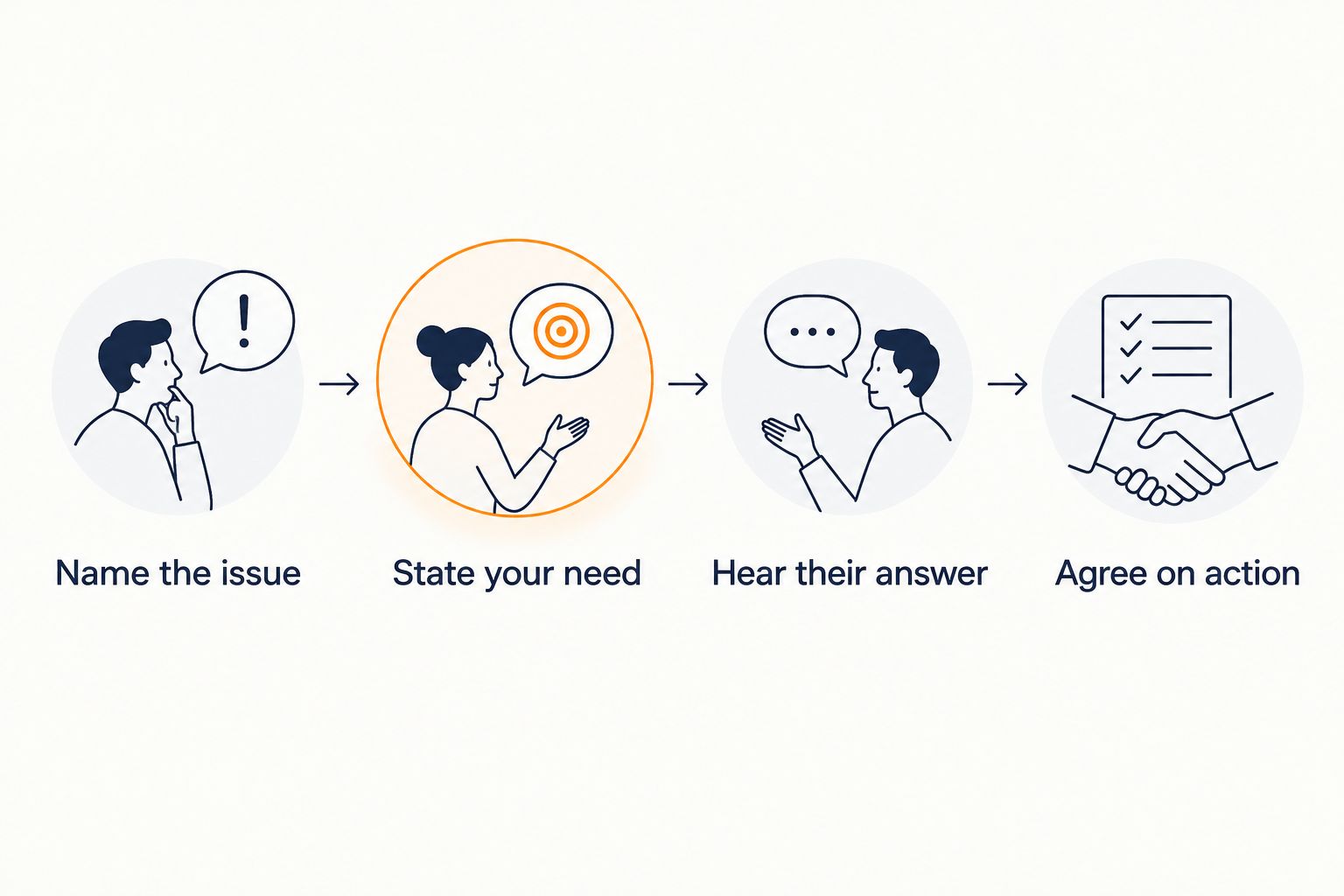 Four conversation steps from naming the issue to agreeing on action
A useful conversation makes room for both people's actual answers.
For a decision affecting the rest of 2026, discuss what each person is agreeing to—not just whether you both want the relationship to continue. Staying together and agreeing on how to live together are different commitments.
A successful conversation does not have to end in agreement. It can end with a clearer understanding that neither person wants the available compromise.
How can I tell whether we are changing or repeating ourselves?
Look at what happens after the conversation. Reassurance tells you how someone wants you to feel; follow-through tells you what is changing.
Use 2 columns in a private note: what you agreed and what happened afterward. Describe observable behavior, such as sharing a responsibility or returning to a paused discussion, rather than assigning a score to your partner.
If you revisit the issue later in 2026, compare the agreement with your lived experience. Include your own actions and any practical barriers, not only your partner's mistakes.
This exercise has a limit: it is for clarity, not surveillance. Do not track someone secretly, search their devices, or collect evidence to win the next argument.
Can an incompatible relationship become compatible?
Some differences can become workable when both people want the change and follow through. Communication habits, responsibilities, and routines leave room for negotiation; a firm disagreement about having children does not become a shared goal through communication alone.
Licensed couples counseling offers a setting to examine disagreements and practice different responses. It cannot promise reconciliation or make either person choose a future they do not want.
Should I break up even if I still love them?
You can end a relationship while still loving your partner. Consider whether staying requires an ongoing sacrifice you do not freely accept, whether your essential needs have an honest place in the relationship, and whether both people want to work on the actual problem.
You do not need to prove that your partner is bad before deciding the relationship is not right for you. If you are unsure and feel safe, individual counseling can help you examine the decision without asking your partner to make it for you.
Does missing them mean the breakup was a mistake?
Missing someone does not establish compatibility. It tells you that the person and relationship mattered; it does not tell you whether the reasons for leaving have changed.
Before reconnecting, ask what is concretely different. Renewed affection alone does not settle an unresolved disagreement about your future.
Getting support while you sort out your feelings
You do not have to reach a final decision before seeking emotional support. Start with 3 questions: What am I feeling? What do I need? What am I afraid would happen if I said it clearly?
Lovon is a voice-based mental health support app for talking through feelings and exploring coping tools. Lovon is best suited to people seeking voice-based emotional support and self-reflection, not a clinical relationship assessment.
The benefit of Lovon mental health support is a place to put feelings into words. The limitation matters: Lovon is not a licensed clinician, cannot assess your partner from your account, and does not replace clinical care or crisis support.
Whether you use a notebook, speak with someone you trust, or seek professional help in 2026, keep the goal clear. You are trying to understand your own experience—not obtain a verdict that removes your responsibility to choose.
One last thing
Try finishing this sentence privately: if my partner stayed exactly as they are, the life we could build together would be...
Leave out the version where they eventually change their mind. Choose based on the person and agreements in front of you, not the future you hope to persuade them into. You can honor the love and still be honest about the fit.
Related guides
How AI Support Helps You Heal
AI emotional support isn't about replacing human connection — it's about filling the gaps. The moments when you need to talk at 2 AM, when you don't want to burden your friends again, or when you simply need someone to listen without judgment.
Here's what happens in a typical Lovon session:
You share what's on your mind
There's no script, no intake form, no waiting room. You speak or type whatever you're feeling — in your own words, at your own pace.
Lovon validates and explores
Using frameworks from CBT (Cognitive Behavioral Therapy) and motivational interviewing, Lovon acknowledges your feelings first, then gently helps you explore them. No dismissive "just move on" advice.
You build coping skills together
Lovon doesn't just listen — it actively works with you on evidence-based techniques: thought reframing, urge surfing, behavioral experiments, and more.
What a Session with Lovon Looks Like

Lovon is AI support, not a replacement for professional care. If things have been hard to get through for weeks, or you are thinking about harming yourself, talk to a doctor or a licensed therapist.
Ready to Start?
Your healing journey can begin right now
A 3-day trial. No judgment. Just a safe space to process what you're going through.
Frequently Asked Questions
Can you love someone and not be compatible with them?
Do different hobbies mean we are incompatible?
Is love enough to make a relationship work?
Can couples counseling fix incompatibility?
How do I know whether I am compromising too much?
Should I stay because my partner has done nothing wrong?
Does relationship anxiety mean we are incompatible?
About the Author

The Lovon Editorial Team
Mental Health & Wellness Content Team
The Lovon Editorial Team develops mental health and wellness content designed to make psychological concepts accessible and actionable. Our goal is to bridge the gap between clinical research and everyday life - helping you understand why your mind works the way it does and what you can do about it....
Related articles
- Marriage Compatibility Quiz Before Marriage (2026)
A marriage compatibility quiz reveals values gaps on finances, parenting, and conflict style. See the top picks for 2026…
- Can a relationship survive without physical intimacy?
Can a relationship survive without physical intimacy? Yes, if both partners accept it. Learn how to discuss unmet needs…
- Is couples therapy worth it if one partner refuses?
Is couples therapy worth it if one partner refuses? Individual support can help you decide what to do, but it cannot…
- Communication Compatibility Quiz: Top Picks 2026
Take the right communication compatibility quiz in 2026. Compare top tools, learn what to look for, and turn your…
See also
Quizzes
- Relationship Appetite Test: What Do You Want From Love?
See what you really go after in love, in 3 minutes.
- Love Language Test: What's My Love Language? Free Quiz
Find your love language in 2 minutes.
Free tools
- Love Messages for Her or Him That Say Something Specific
Love messages for her or him, written from your story instead of a list of two hundred lines. Tell it what you love…
- How to Tell Someone You Love Them
How to tell someone you love them is rarely about the words, which are short. It is about the moment and the answer…
From the wiki
- What does falling in love feel like?
Falling in love usually arrives in the body first: a restless stomach, thin sleep, a pulse that reacts to a name on your…
Disclaimer: This article is for informational purposes only and does not constitute medical advice, diagnosis, or treatment. Always seek the advice of your physician or other qualified health provider with any questions you may have regarding a medical condition. If you are in crisis or think you may have an emergency, call 988 (Suicide & Crisis Lifeline) or go to the nearest emergency room. Outside the US? Find a crisis line in your country.